
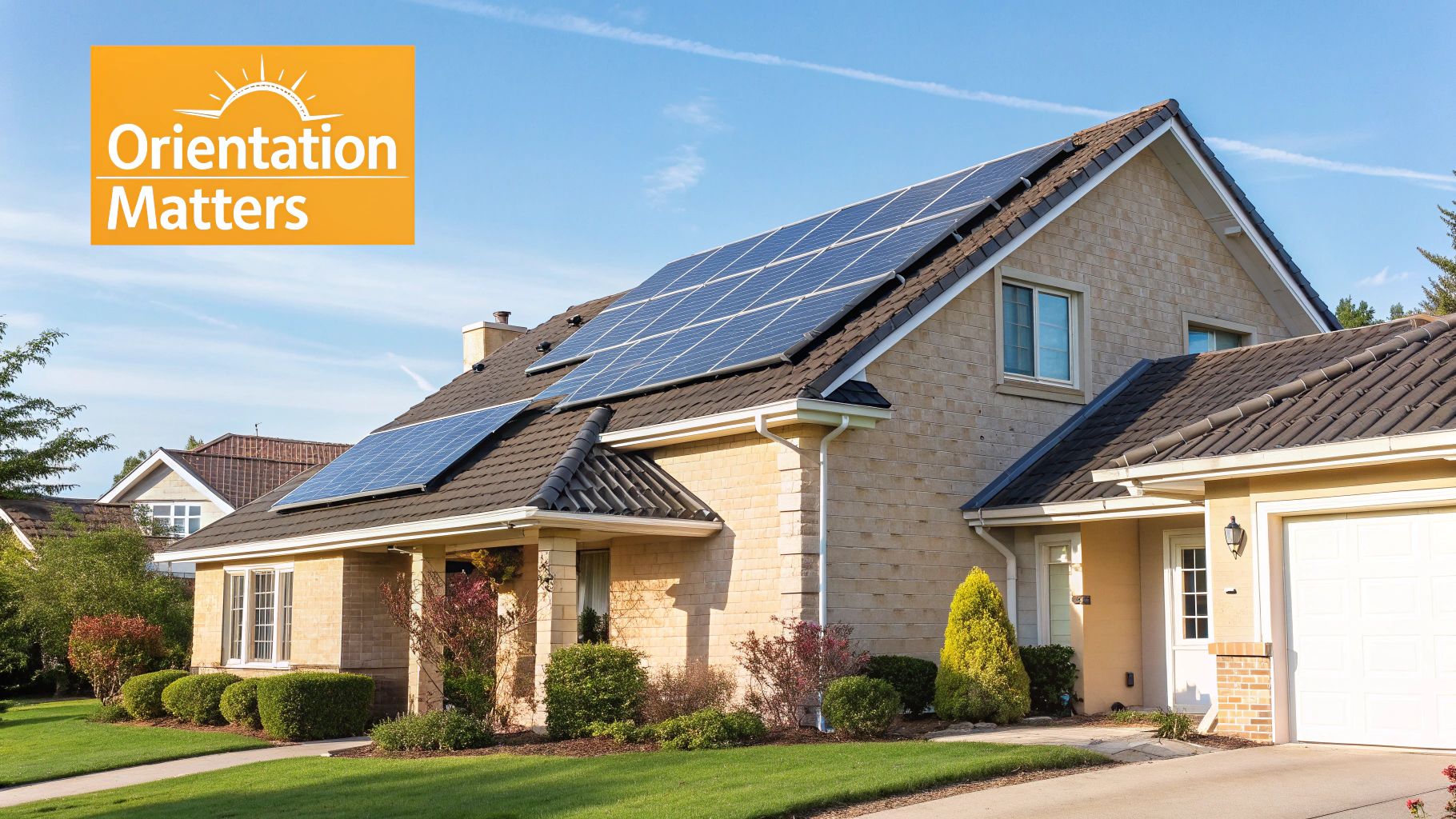
If you're a homeowner or business owner in New York trying to figure out the best direction for solar panels, the answer is clear-cut: aim them south.
Think of your solar panels like a sunflower. They need to face the sun for as long as possible to soak up the most energy and generate clean power. In the Northern Hemisphere, that sweet spot is a true south orientation, which guarantees your panels get maximum exposure as the sun moves across the sky. This simple principle is the key to maximizing your system's output, achieving energy independence, and seeing bigger savings on your utility bills.
Unlocking Peak Performance With the Right Panel Direction
Getting the most out of your solar investment all comes down to smart design, and the direction of your panels is the foundation of a high-performance system. For any property in New York, whether it's a home on Long Island or a commercial building in Albany, a southern-facing roof is the gold standard.
It’s the most direct path to energy independence and significant cost savings.
Placing your panels to face south aligns them to receive the most direct, intense, and prolonged sunlight throughout the day. This one decision can dramatically boost your system’s output and, ultimately, your return on investment.
Why We Aim for True South, Not Magnetic South
When we talk about "south," it's important for New Yorkers to know there's a slight difference between what a compass says (magnetic south) and the planet's actual rotational axis (true south). Professional installers don't just rely on a handheld compass; we use specialized tools to pinpoint true south.
This precision ensures every panel is perfectly positioned to capture the maximum amount of sunlight. It’s a critical step in the detailed site assessments we conduct for customers in all our New York service areas.
How Much Does Direction Really Affect Your Savings?
So, what happens if your roof doesn't face perfectly south? You’re still in great shape. While a true south orientation delivers 100% of a system's potential power, you might be surprised by how well other directions perform.
Even east or west-facing panels can be a fantastic investment. They often generate only about 10-20% less power than a perfectly south-facing array and can be a strategic choice for homeowners who use more electricity in the morning or late afternoon. A slight deviation from south might only result in a tiny drop-off in production, while still delivering huge environmental benefits.
To give you a clearer picture, here's a quick breakdown of what to expect in New York.
How Panel Direction Impacts Energy Output in New York
The table below summarizes how a panel's direction affects its potential energy generation for a typical NY installation.
| Panel Facing Direction | Estimated Energy Output | Best Use Case |
|---|---|---|
| True South | ~100% | Ideal for maximizing overall annual energy production and savings. |
| Southwest/Southeast | ~92-95% | An excellent alternative with only a very small loss in output. |
| East/West | ~80-90% | Great for matching energy generation with peak morning or afternoon usage. |
Even if your roof isn't perfectly positioned, don't worry. Our team at NYS Essential Power specializes in designing high-performance systems that are tailored to your property's unique layout. We analyze every angle to make sure you get the biggest cost savings and the most energy independence possible.
Why a South-Facing System Is the Gold Standard
If you've ever spent a day at Jones Beach, you already understand the basic principle of solar panel orientation. You instinctively turn your chair to face the sun to get the most warmth. Solar panels are no different—they need to face the sun for as long as possible to do their job.
Here in the Northern Hemisphere, the sun travels along a predictable path every day. It rises in the east, arcs high across the southern sky, and sets in the west. That arc is the key. By facing your panels south, you're pointing them right at the sun's main stage.
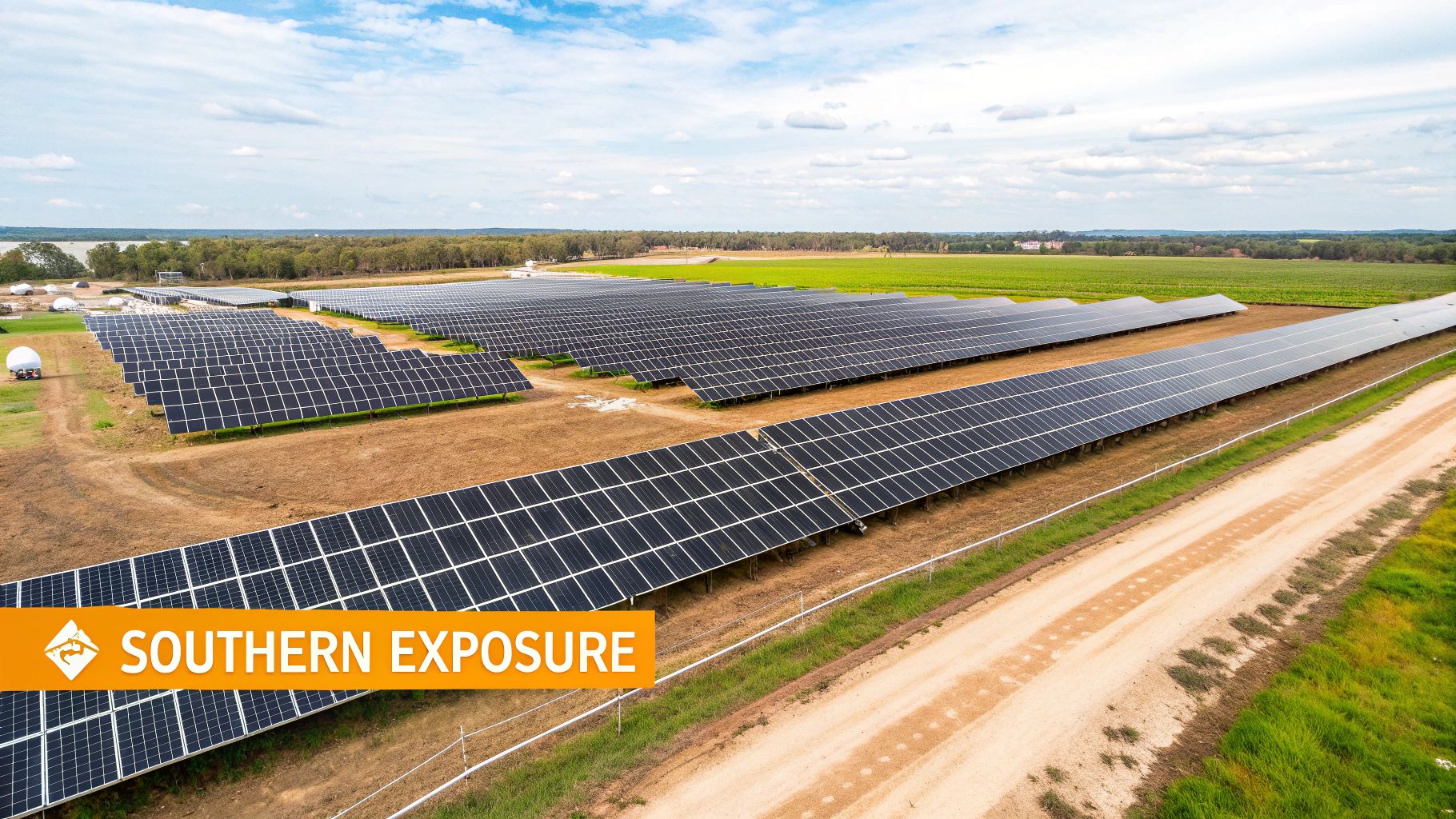
This southern orientation ensures your panels soak up the most intense sunlight during the peak hours of the day, typically between 9 AM and 3 PM. Think of it like using a magnifying glass—the more directly you aim it at the sun, the more powerful the beam. This is when your system will be generating the most electricity, offsetting your utility costs and reducing your carbon footprint.
The Sun's Path Across New York Skies
The sun doesn't take the same path every day; it shifts with the seasons. This is where a southern orientation really proves its worth, giving you consistent performance whether you’re in Buffalo or the Hudson Valley.
- Summer Solstice: On those long New York summer days, the sun sits high in the sky. South-facing panels are perfectly positioned to catch that direct, overhead light, generating a huge amount of power to keep your AC running guilt-free.
- Winter Solstice: In the dead of winter, the sun hangs much lower in the southern sky. A system facing south can still catch those low-angle rays head-on, while panels facing other directions would let the light glance off. It’s a huge advantage for maximizing your production when the days are short.
By facing true south, your solar array is strategically positioned to perform optimally through every season New York throws at it. It’s the single most important factor in maximizing your long-term energy savings and achieving energy independence.
This fundamental rule of solar geometry is why every professional site assessment starts by finding the best southern exposure. It’s step one for unlocking a property's full solar potential and a core design principle for everything from a small residential rooftop to large-scale commercial solar installations.
Why Direct Sunlight Matters Most
It’s easy to think that any daylight will do, but it’s really about the quality of the sunlight, not just the quantity. Your panels generate the most power when sunlight hits them at a direct, 90-degree angle.
Panels facing east or west get a blast of direct sun for a few hours in the morning or afternoon, but for the rest of the day, the light hits them at a weak, shallow angle.
A south-facing panel, on the other hand, maintains a much more direct angle to the sun for a longer stretch of the day. This consistent, high-quality exposure translates directly into more kilowatt-hours on your production meter. More production means lower utility bills and a faster return on your investment. It’s a core concept in understanding how solar panels work to generate clean power for your home or business.
At the end of the day, the goal is simple: capture as much free energy from the sun as you can. Pointing your panels south is the most reliable and effective way to make that happen, setting you up for decades of clean power and financial savings.
How Panel Tilt Unlocks Maximum Solar Power
While pointing your panels in the right direction gets you in the ballpark, it's the tilt—the angle of the panels themselves—that really dials in your system for peak performance. Think of it like this: if facing south is aiming a satellite dish at the sky, setting the tilt is like fine-tuning the angle to lock onto the strongest signal.
The objective is to get sunlight to hit your panels as close to a perpendicular, 90-degree angle as possible. Because the sun sits high in the sky during a New York summer and low on the horizon in winter, the ideal tilt has to strike a perfect balance. It’s a small detail that makes a huge difference in your energy output and cost savings.
Matching Tilt to Your New York Latitude
A fantastic rule of thumb for the best year-round tilt is simply to match your property's latitude. Across New York, this sweet spot is generally between 40 and 45 degrees. A home in Yonkers (at 40.9° N) might be set up slightly differently than a business up in Rochester (43.2° N).
Setting your panels to this angle is the ultimate "set it and forget it" solution for most rooftop systems. It creates a solid, year-round average that captures plenty of that high summer sun without giving up too much production when the winter sun is low. Before any installation, it's vital to know your roof's existing slope, and using a roof pitch calculator is a quick way to figure that out.
This infographic shows just how much the sun's position changes and why adjusting for it matters.
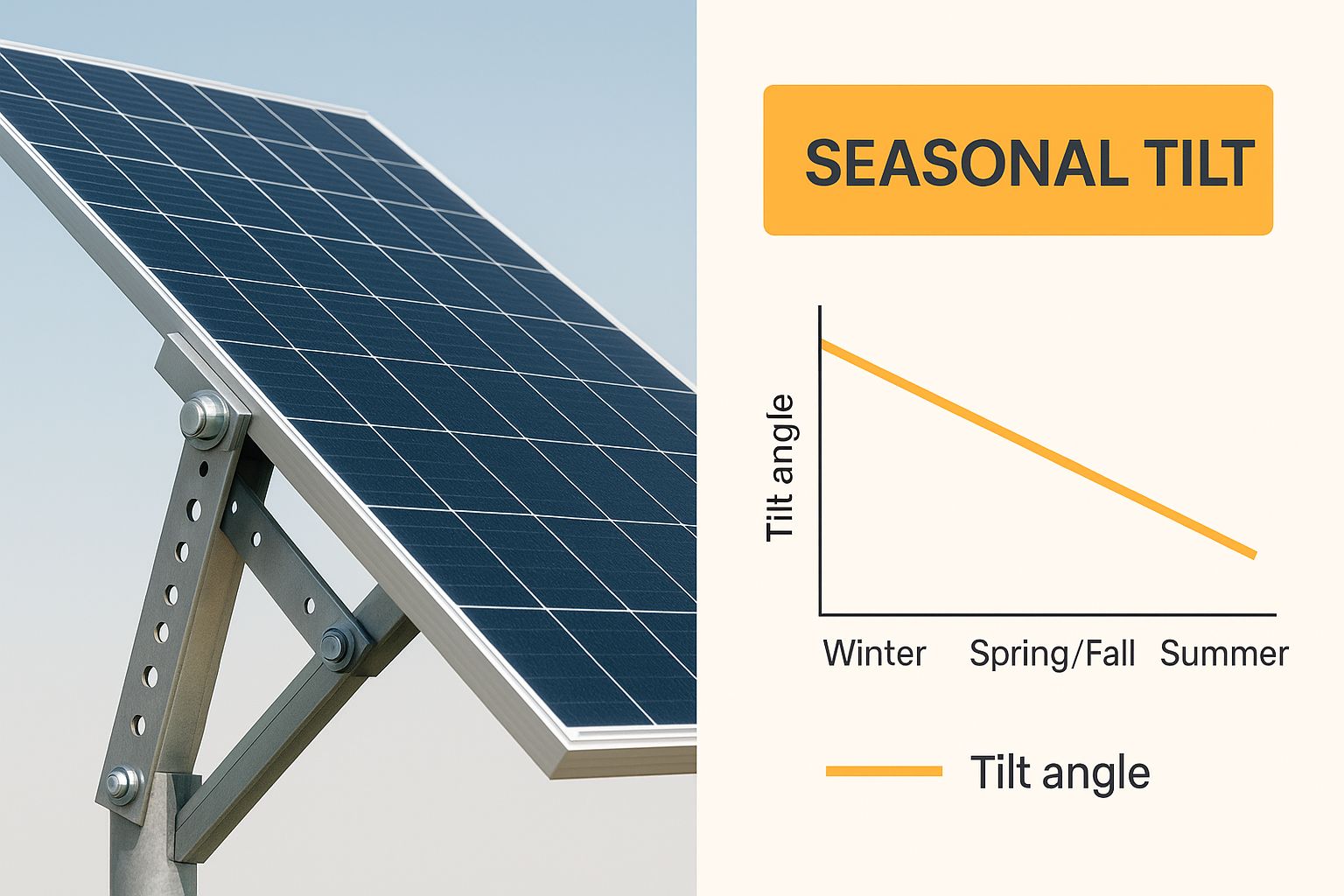
As you can see, tilting the panel to follow the sun's seasonal path can give your energy production a serious boost.
Fine-Tuning Tilt for Seasonal Performance
For property owners with ground-mounted systems or adjustable racks, you can squeeze even more power out of your panels by tweaking the tilt with the seasons. The strategy is simple: you’re just re-angling the panels to more directly face where the sun is spending most of its time.
- Winter Tilt (Steeper Angle): The winter sun is low in the sky. To catch those rays, you’ll want a steeper angle—think your latitude plus 15 degrees, putting you around 55 to 60 degrees. This angle looks "down" toward the horizon and has a great side benefit: snow slides right off.
- Summer Tilt (Shallower Angle): In summer, the sun is almost directly overhead. A shallower angle of your latitude minus 15 degrees (around 25 to 30 degrees) lets the panels look "up" and soak in that intense energy, right when your AC is working its hardest.
For New Yorkers, understanding these seasonal adjustments can be a game-changer. Here's a quick breakdown of the optimal angles throughout the year.
Optimal Solar Panel Tilt Angles for New York by Season
| Season | Recommended Tilt Angle (Degrees) | Primary Benefit |
|---|---|---|
| Spring & Autumn | 40-45° (Matches Latitude) | Provides a strong, balanced performance during the transitional months. |
| Summer | 25-30° (Latitude – 15°) | Maximizes capture of the high, direct sun during the longest days of the year. |
| Winter | 55-60° (Latitude + 15°) | Catches more energy from the low-hanging sun and helps shed snow buildup. |
While a fixed-tilt system set to your latitude is highly effective, these seasonal tweaks for adjustable systems ensure you're capturing every possible ray of sun, no matter the time of year.
Fixed vs. Adjustable Systems: What’s Practical for You?
Seasonal adjustments sound great on paper, but practicality is key. For the vast majority of homeowners looking into residential solar in Lake Ronkonkoma, a fixed-tilt system is the go-to solution for good reason.
Fixed-Tilt Rooftop Systems are by far the most common. The panels are installed at an optimal angle for year-round production and then left alone. They’re secure, maintenance-free, and built to perform for decades without you ever having to touch them.
Adjustable Ground-Mounted Systems, on the other hand, are a great option for those with enough land. These setups allow you to manually change the tilt a couple of times a year to align with the seasons, which can boost your overall output by a few extra percentage points.
Ultimately, there’s no guesswork involved. A professional site assessment from NYS Essential Power will pinpoint the perfect tilt for your property. We look at your exact location, roof pitch, and energy needs to design a system that delivers maximum power and savings.
What If My Roof Doesn't Face South?
This is one of the first questions we get from homeowners across New York, and it's a good one. There's a common belief that if you don't have a perfectly south-facing roof, solar just isn't worth it. The truth is, that's simply not the case anymore.
While a southern exposure is technically the ideal for maximizing raw, year-round production, it's absolutely not a dealbreaker. Modern solar panels are incredibly efficient, and a smart system design can deliver fantastic savings on almost any roof. In fact, for many families, an east or west-facing system can be a smarter financial move.
The Real-World Power of East and West-Facing Panels
Let's think about how your family actually uses electricity. It’s probably not a steady hum throughout the day. For most households in Suffolk and Nassau counties, energy use spikes in the morning and again in the late afternoon. This is where an east-west orientation really shines.
- East-Facing Panels: These panels catch the first rays of sun. They start generating power right as you're flipping on lights, brewing coffee, and getting the kids ready for school, offsetting your energy costs from the moment you wake up.
- West-Facing Panels: These are the evening workhorses. They hit their peak production late in the afternoon, just as you're coming home, cranking up the AC, cooking dinner, and settling in for the night.
This isn't just a coincidence; it's a strategic advantage. By generating your own solar power during these high-demand periods, you're directly avoiding pulling expensive electricity from the grid when you need it most.
For many New York homeowners, an east-west solar installation provides power exactly when it's needed most. It synchronizes energy generation with daily life, leading to significant cost savings and greater energy independence.
Even though the total annual energy output might be slightly less—typically only 10-20% lower than a south-facing roof—the practical, real-world savings can be just as impressive. You're maximizing the value of every single kilowatt-hour by using it when it matters most.
How New York's Policies Make Every Roof Viable
What really makes solar a no-brainer for almost any New York home is the state's fantastic pro-solar policies, especially net metering. Think of net metering as a financial safety net for your solar investment.
Here’s how it works: Let's say your west-facing panels are cranking out more power than you need on a sunny afternoon. That excess electricity is automatically sent to the grid, and your utility company credits your account for it. Later that night, when the sun is down, you draw power from the grid and use those credits to pay for it.
Net metering ensures you get full value for every bit of clean energy your system produces, no matter the time of day or the direction your panels face. It effectively balances out production and consumption, making solar financially solid even for roofs that aren't perfectly oriented.
Our team at NYS Essential Power is full of experts who specialize in designing systems for the unique challenges of New York properties. We look at your roof's specific layout, your family's energy habits, and what you want to achieve financially to build a plan that's perfect for you. Learn more about us and see how we tailor every project.
So, don't let a "less-than-perfect" roof direction hold you back. The real question isn't just "which way should my panels face?" but "what's the smartest solar design for my home and my life?" Let us show you what's possible by requesting a free quote today.
Advanced Option: Solar Tracking Systems
For commercial property owners in New York serious about wringing every possible watt from their solar array, a fixed-panel system is just the starting point. A perfectly aimed, south-facing setup is great, but solar tracking systems take efficiency to a whole new level.
Think of it this way: a fixed panel is like a sunflower that's stuck facing one direction all day. A solar tracker, however, is a sunflower that actually follows the sun from the moment it rises in the east until it sets in the west. These systems automatically tilt and turn your panels, keeping them in the sweet spot of direct sunlight all day long.
This constant repositioning gives your energy production a serious boost, far beyond what even the best-oriented fixed panels can achieve.
How Single-Axis Trackers Work
The most common and practical option for commercial applications is the single-axis tracker. It’s a beautifully simple concept: the system is set up on a single axis (imagine a long pole) and rotates the panels to follow the sun’s daily arc across the sky.
This one movement makes a huge difference. It keeps the panels pointed directly at the sun for many more hours each day compared to a static installation. For large, ground-mounted systems—like you might see on a Long Island farm or powering a commercial building up in Albany—this can dramatically increase energy harvest, especially during those peak afternoon hours.
The Ultimate in Performance: Dual-Axis Trackers
For those who want the absolute peak performance, dual-axis trackers are the answer. These are the gold standard. They don't just follow the sun from east to west; they also adjust for the sun's height in the sky, which changes dramatically between summer and winter.
A dual-axis tracker accounts for both the daily journey of the sun and its seasonal angle. This means the panels are always at the perfect ninety-degree angle to the sun's rays, maximizing energy capture every single day of the year.
This is truly the pinnacle of solar technology, ensuring your investment is working as hard as it possibly can. By constantly re-orienting, advanced trackers can improve your total energy capture by an incredible 20-30% over a fixed system. The market for this tech is growing fast, as you can see if you learn more about the solar tracker market.
Because of the moving parts, these systems are almost exclusively for ground-mounted arrays. But the gains are massive. For a business trying to erase a huge electricity bill or a landowner aiming for total energy independence, the return on investment from a tracking system is hard to beat.
At NYS Essential Power, we specialize in designing and installing these advanced commercial solar solutions for businesses all over New York. If you're ready to see what your property is truly capable of, contact us and we can explore how a tracking system could maximize your energy production.
Get a Professional Solar Plan for Your NY Property
So, you've got the basics down. You know that pointing your panels south is the gold standard, but you also see that it's not the whole story. The best setup for your home or business is a unique puzzle—a mix of your roof's direction, its pitch, any tricky shadows, and what you want to achieve with your energy. Knowing what direction solar panels should face is a great starting point, but it's just that—a start.
The only way to truly dial in a design that gets you the most bang for your buck is with a professional site assessment. Before a single panel goes up, this always includes a thorough roof inspection to make sure your roof is in solid shape and ready to support the system for years to come.
Your Custom Solar Blueprint
This is where we come in. Let our local New York experts take the guesswork out of it. We dig into the specifics of your property, whether you’re on Long Island or up in the Hudson Valley, and craft a plan that squeezes every last drop of sunshine out of your roof.
Our designs are built around:
- Precise Azimuth and Tilt: We don't just guess. We find the exact compass direction and angle to capture the maximum amount of sunlight, year-round.
- Shade Analysis: We'll map out any trees or buildings that could cast a shadow and design the layout to minimize their impact on your power production.
- Your Energy Usage: We look at how and when you use electricity to build a system that’s sized perfectly for your needs, not someone else's.
A customized solar plan isn't about generic advice. It's a detailed strategy, engineered from the ground up to deliver the biggest cost savings and environmental impact for your specific property right here in New York.
Our commitment is to design a system that works hard for you for decades. We create a solar blueprint that paves the way for real long-term savings and a much smaller carbon footprint.
Ready to see what a professional plan looks like for your home or business? Contact NYS Essential Power today for a free, no-obligation quote and get a solar design that’s truly made for you.
Frequently Asked Questions About Solar Panel Direction
Thinking through the specifics of a solar installation naturally brings up a lot of questions. We've gathered some of the most common ones we hear from New York homeowners and business leaders to give you clear, straightforward answers about how panel direction really works.
Does the Best Direction Change for Different Parts of New York?
That's a smart question, but the fundamental answer is no—the core principle holds true across the entire state. The ideal direction is always true south, whether you're in Buffalo or way out on the eastern tip of Long Island. Facing south is simply the best way to catch the most sun throughout the day here in the Northern Hemisphere.
What does change, however, is the ideal tilt angle. Because of the slight difference in latitude, a building in Buffalo (at 42.9° N latitude) will get the best results from a slightly steeper panel angle compared to a home on Long Island (around 40.7° N). A professional installer will dial this in perfectly for your exact location to squeeze every possible kilowatt-hour out of your system year-round.
What If My South-Facing Roof Is Shaded by Trees?
Shade is a huge consideration in any solar design, but it's rarely a showstopper. Modern solar technology has come a long way, and we now have great tools to keep your system humming along, even with some partial shading.
During our site assessment, we conduct a thorough shade analysis. This maps out exactly how shadows from trees or other buildings will move across your roof at different times of the day and throughout the year. If shading on a prime southern roof is a problem, we can design the system with components like power optimizers or microinverters.
These brilliant little devices let each solar panel work independently. So, if one panel gets covered in shade, it won't tank the production of the entire string of panels. You still get strong, consistent energy output.
In some situations, a completely unshaded east- or west-facing roof might actually produce more power than a south-facing roof that's covered in shadows for part of the day. We run the numbers on every option to find the sweet spot for your property.
Is Direction Important for a Flat Commercial Roof?
Absolutely, and in the best way possible. A flat roof, which you see on commercial buildings all over New York City and Syracuse, is basically a perfect blank slate for solar. You aren't limited by an existing roof pitch or direction, which gives our engineers complete freedom to design for maximum output.
On a flat roof, we use a ballasted racking system. This setup lets us mount the panels without drilling into the roof, and more importantly, it allows us to point every single panel directly south and lock in the perfect tilt angle for your building’s latitude. This guarantees you’re getting the most efficient system and the best possible return on your investment—a top priority for any commercial project.
Can I Adjust My Rooftop Panels for Each Season?
While you can eke out a small gain in production by adjusting panels seasonally, it's just not practical or safe for the vast majority of rooftop systems. For almost every homeowner, a fixed-tilt system is the way to go. It’s installed professionally, set at the optimal angle, and then you never have to touch it again.
We calculate the best fixed-tilt angle to give you a great balance of energy production all year long. This gives you a powerful, low-maintenance system that performs reliably through every New York season. Adjustable mounts are much more common for ground-mounted systems where they can be accessed easily and safely from the ground.
Ready to take control of your energy future and reduce your carbon footprint? The experts at NYS Essential Power can perform a detailed site assessment to design a system that maximizes both your energy production and your financial savings.