Think of a solar inverter as the brain of your solar power system. It’s the essential piece of hardware that takes the raw, direct current (DC) energy generated by your solar panels and converts it into the usable alternating current (AC) electricity that powers your home or business.
Simply put, without a solar inverter, all that beautiful New York sunshine hitting your roof is useless for powering your property. It's the critical link that unlocks cost savings, energy independence, and a smaller carbon footprint for property owners across the state.
The Heart of Your Solar Energy System
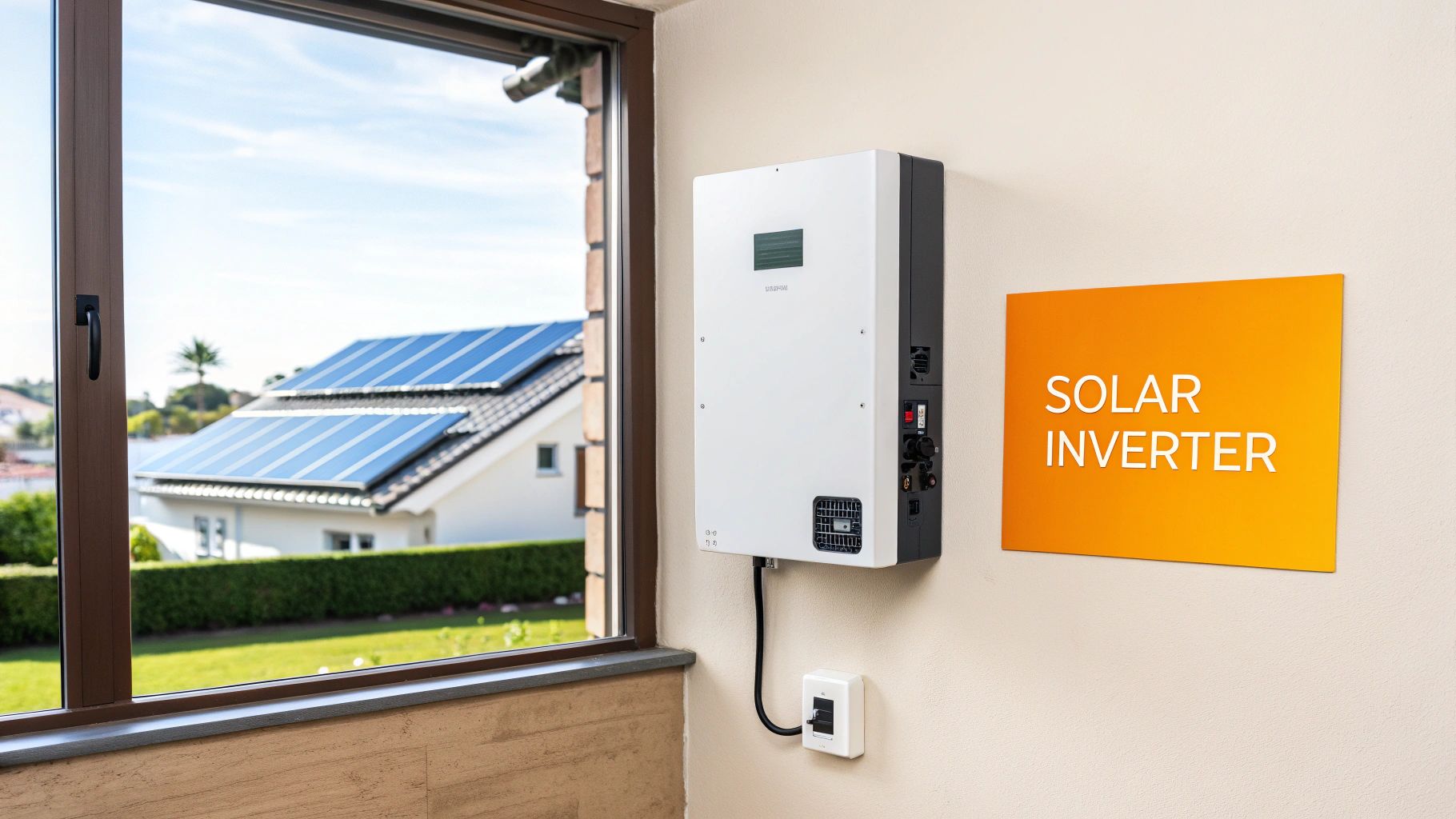
Let's use an analogy. Your solar panels are like a power plant generating a specific type of electricity called Direct Current (DC). It's potent, but it’s not what your appliances, from the coffee maker in your Albany kitchen to the servers in your Long Island office, are designed to run on. Everything in your property speaks a different electrical language: Alternating Current (AC).
This is where the solar inverter steps in. It's the master translator.
The inverter expertly converts the DC electricity from the panels into the AC electricity that powers your daily life. This single conversion process is what makes energy independence possible, helping New Yorkers slash their high utility bills and take advantage of local incentives like the NY-Sun program.
Getting to Know the Main Inverter Types
As you start exploring solar for your home or commercial property, you'll find there are a few different types of inverters to choose from. They all have the same fundamental job, but they go about it in different ways, each with its own set of strengths.
Understanding the basics is key to designing the right system for your property.
- String Inverters: These are the traditional, time-tested workhorses. They work by connecting a group of panels together in a series (called a "string"), which then feeds all the DC power into one central inverter box.
- Microinverters: This is a more modern approach. A small, individual inverter is installed on the back of every single solar panel. This lets each panel perform at its peak, independent of its neighbors.
- Hybrid Inverters: Think of these as the future-proof choice. A hybrid inverter not only converts power for your property but can also intelligently manage a battery, like a Tesla Powerwall. It directs any extra solar energy into your battery for you to use later.
To make this even clearer, here's a quick breakdown of how these inverters stack up for a typical New York property.
Solar Inverter Quick Guide
| Inverter Type | Best For | Key Feature |
|---|---|---|
| String | Simple, south-facing roofs with no shade | A single, centralized unit handles all power conversion. |
| Micro | Complex roofs, or those with partial shading | Each panel operates independently for maximum output. |
| Hybrid | Homeowners & businesses wanting battery backup now or later | All-in-one inverter and battery management. |
Choosing the right inverter is one of the most important decisions you'll make, as it directly affects your system's performance, cost, and long-term savings. Now, let’s dive a bit deeper into how this amazing technology actually works.
How Solar Inverters Turn Sunlight Into Power
To really get what a solar inverter does, let's trace the path of energy from the sun all the way to your light switch. It's a neat process, but luckily, it's not overly technical. It all begins the second sunlight hits your solar panels.
When photons from the sun strike the solar cells in your panels, they get electrons moving, which creates a flow of energy. This initial electricity is called Direct Current, or DC power. A good way to think of DC power is like a one-way street—the energy flows in just one, steady direction.
While that's perfect for things like charging a battery, it’s not the kind of electricity that runs your home or business.
The Great Electrical Translation
Your refrigerator, office computers, and all the outlets in your walls are designed to use a different kind of power: Alternating Current (AC). AC power is more like a busy two-way highway, where the current switches direction back and forth very quickly. This is the standard for the entire U.S. electrical grid.
This is where the solar inverter steps in to do its most important job. It acts like a brilliant translator for your property's electricity.
The solar inverter takes the raw DC power from your panels and converts it into the stable, usable AC power that your property runs on. Without this crucial step, all the energy your panels produce would be completely useless.
This conversion process is what guarantees a safe and reliable power supply, whether you're running a powerful air conditioner on a hot Long Island summer day or powering sensitive equipment in a commercial building. It’s the final, critical link that makes the switch from traditional energy to solar a practical reality for New York property owners.
But the inverter does more than just convert power; it optimizes it. Modern inverters are constantly monitoring your panels' output to squeeze every last drop of energy out of them. This smart management directly boosts your energy savings and helps you see a faster return on your investment.
Choosing Your Inverter: String vs. Microinverters
Picking the right solar inverter is one of the most important decisions you'll make when going solar. This single piece of equipment has a massive impact on your system's efficiency, overall cost, and how well it performs for decades to come. Let's break down the main technologies on the market so you can make a smart choice for your New York property.
The two most common options you'll come across are string inverters and microinverters. You can think of it like choosing between a central furnace for your whole house versus having individual heaters in every room—both warm the house, but they go about it in completely different ways.
This infographic lays out the basic journey of solar energy, from sunlight hitting your panels to the usable AC power that runs your home.
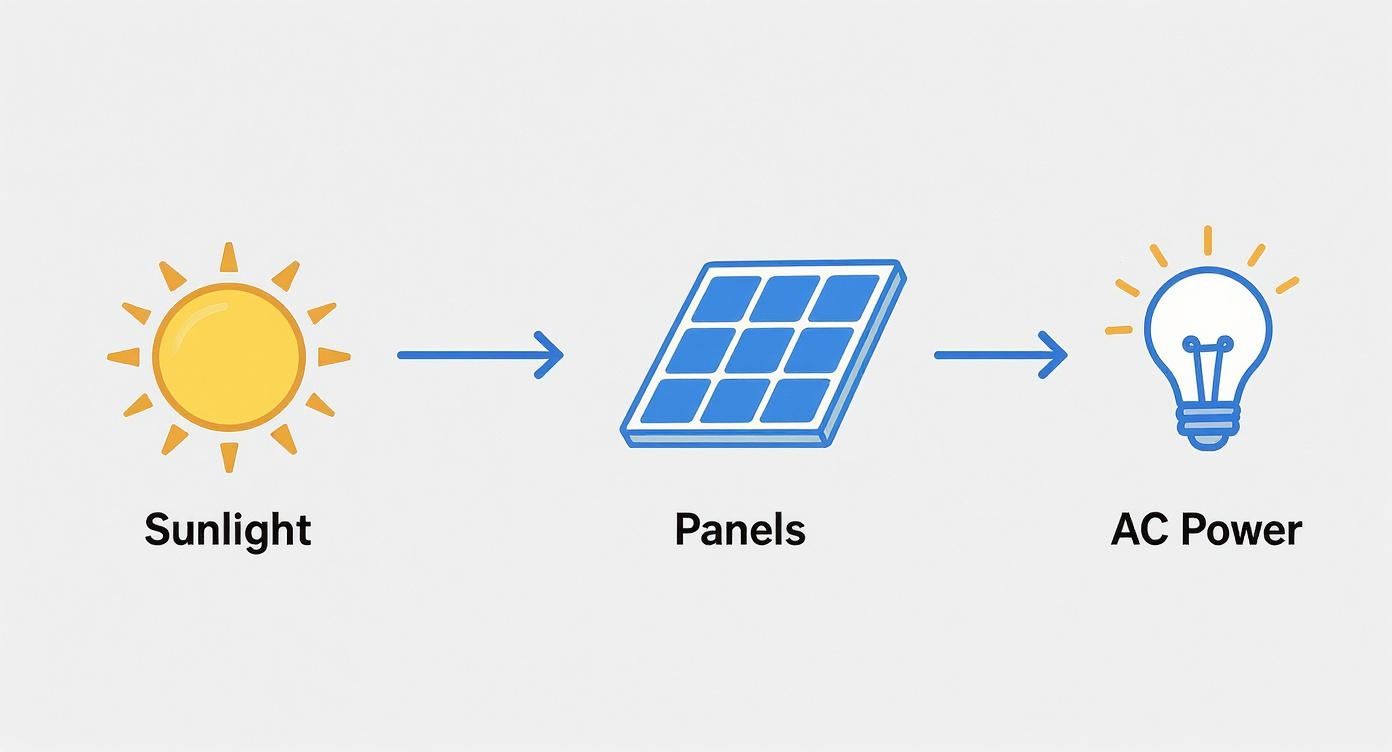
That conversion step is the crucial part, and it’s where your choice of inverter technology really comes into play.
The Classic String Inverter
For a long time, string inverters were the industry standard, and for good reason—they're reliable and cost-effective. The setup is straightforward: your solar panels are wired together in a series, forming a "string." All the DC electricity produced by that entire string flows down to a single, central inverter box, which then converts it into the AC power your property can use.
This system is a perfect fit for homes or commercial buildings with simple, unshaded roofs, like you might see in many neighborhoods from Syracuse to Buffalo. If you’ve got a big, south-facing roof with nothing blocking the sun, a string inverter is a fantastic, budget-friendly option.
But there’s a catch. Since all the panels are linked like old-school Christmas lights, they're only as strong as their weakest link. If just one panel's output dips because of shade from a tree, a pile of leaves, or even a passing cloud, the production of the entire string drops to match that single underperforming panel.
The High-Performance Microinverter
Microinverters are a more modern, sophisticated approach. Instead of one central box, a small, powerful microinverter is installed on the back of every single solar panel. This simple change has a huge effect: each panel becomes its own independent, power-generating unit.
This technology is a game-changer for many New York properties. If your roof has multiple angles and pitches, or if you get partial shade from nearby trees—a common issue in places like Westchester and all over Long Island—microinverters are hands-down the better choice.
Because each panel is optimized on its own, a shaded panel can't drag down the rest of the system. This allows you to squeeze every last drop of energy out of your roof, which means bigger savings on your utility bills over the long run. To see how we tailor systems for unique roofs, take a look at our custom solar solutions.
With microinverters, you get the absolute most out of every single panel. This panel-level optimization ensures your investment delivers the highest possible return, even on days with less-than-perfect sun.
The Future-Proof Hybrid Inverter
There’s a third option that's quickly becoming the go-to for savvy property owners: the hybrid inverter. This clever device does two jobs in one, acting as both a standard solar inverter and a battery charger. It's the ideal choice for anyone looking to add battery storage, like a Tesla Powerwall, to achieve true energy independence.
A hybrid inverter lets you store the extra solar power your panels generate during the day and save it for later, like at night or during a blackout. This gives you genuine energy security, keeping the lights on and your essentials running even when the grid goes down. It’s a forward-thinking choice for anyone planning for battery backup, now or in the future.
Innovations like these are why the solar inverter market is projected to skyrocket to $27.23 billion by 2029. You can explore more about the technological trends driving it and see how the industry is evolving.
Inverter Comparison For New York Homes
To make the decision clearer, here’s a quick side-by-side look at how these three inverter types stack up for a typical New York property.
| Feature | String Inverter | Microinverter | Hybrid Inverter |
|---|---|---|---|
| Cost | Lowest upfront cost. | Higher upfront cost, but often better long-term value. | Highest upfront cost, as it includes battery-ready tech. |
| Shade Performance | Poor. One shaded panel reduces the entire string's output. | Excellent. Each panel performs independently. | Same as a string inverter, but pairs with a battery for backup. |
| Battery Readiness | Requires extra equipment to add a battery later. | Requires an AC-coupled battery system. | Seamless. Designed to work directly with a battery from day one. |
Ultimately, the best inverter depends entirely on your property, your budget, and your goals for the future. Each option has its place, from the straightforward string inverter to the fully-featured hybrid.
The Real Payoff of a High-Quality Solar Inverter
Choosing the right solar inverter isn't just a minor technical detail—it's a decision that will directly affect your bottom line and your peace of mind for the next couple of decades. A good inverter is what unlocks the true financial and lifestyle benefits of going solar in New York. It's the difference between having a simple power source and a powerful asset for your property.
The most immediate benefit? You'll generate more power. A more efficient inverter means less energy gets wasted when converting that DC electricity from your panels into the AC power your home or business uses. Over the 25-year lifespan of your solar panels, even a tiny gain in efficiency can add up to thousands of dollars in extra savings on your Con Edison or PSEG Long Island bills.
Deeper Savings and Real Energy Independence
Today's inverters, particularly microinverters, are built to squeeze every possible watt out of your panels. Think about it: they optimize each panel on its own. That means a little shade from a neighbor's tree in Queens or some morning fog rolling through Rochester won't drag down your entire system's performance. This steady, maximized output leads directly to bigger credits on your utility bill through net metering.
This kind of technology is a huge reason solar is taking off globally. The solar inverter market was valued at around $14.31 billion in 2024 and is still climbing, which just goes to show how critical these devices are. You can dig into more details about the global solar inverter market to see the worldwide trend.
But the advantages don't stop at savings. For a lot of New Yorkers, energy security is a real concern, especially as we see more and more severe weather events.
A high-quality inverter is your gateway to true energy resilience. It's the component that enables you to add battery storage, giving you a reliable backup power source when the grid fails.
Unlocking True Energy Resilience
This is exactly where hybrid inverters come into their own. They're built from the ground up to manage a home battery, letting you store the extra solar energy you generate during the day. So, when a storm knocks out the grid, a hybrid inverter instantly and automatically switches your home over to its stored battery power. Your lights stay on, the fridge keeps running, and your essential devices don't miss a beat.
For anyone serious about energy independence, pairing a solar battery backup system with a quality inverter is a game-changer. It elevates your solar setup from just a bill-saving tool into a full-blown energy security solution for your property. That inverter isn't just a box on the wall; it's the command center for your energy freedom.
Key Factors for Selecting Your NY Inverter
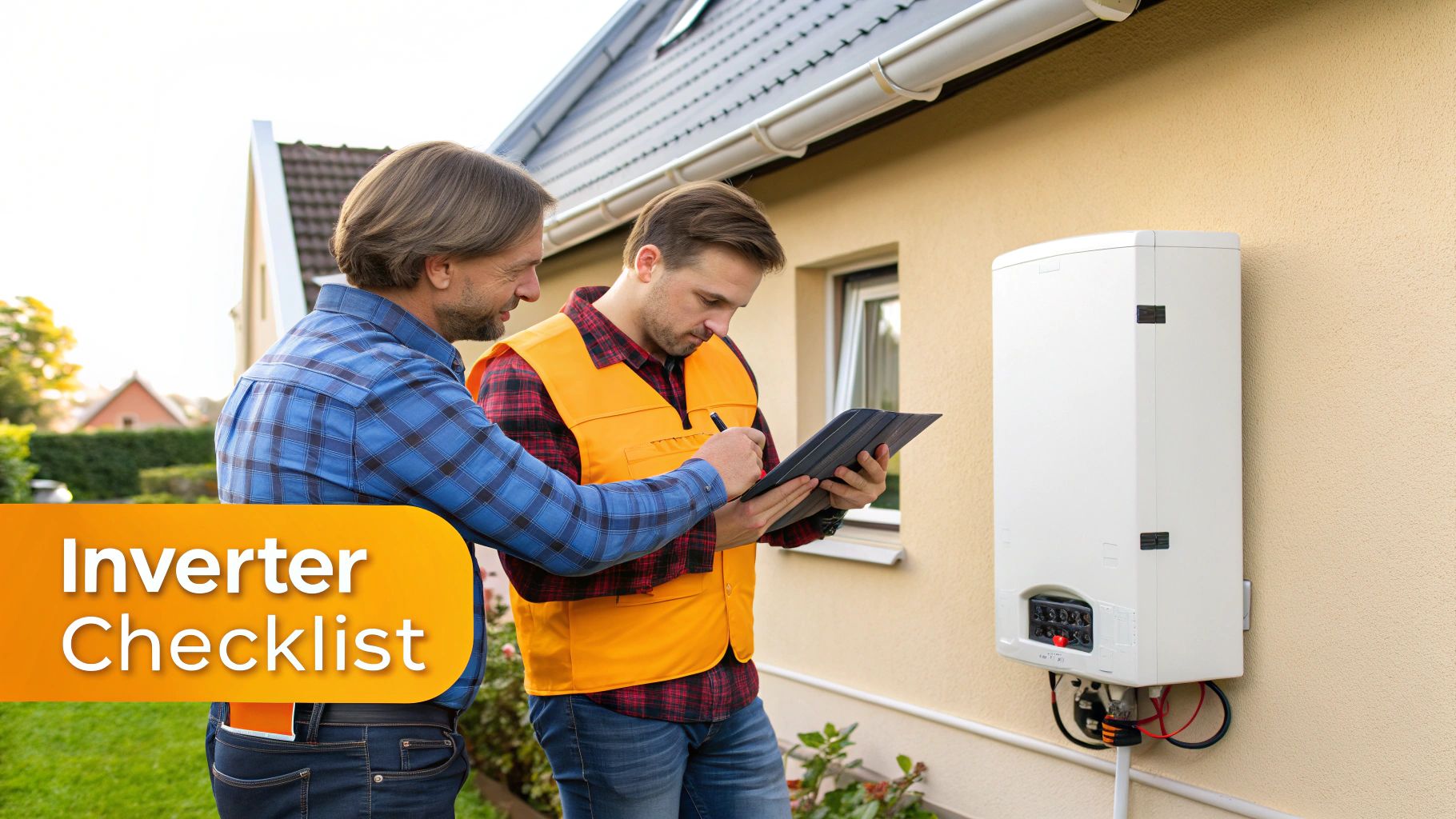
Choosing the right solar inverter is more than just a purchase; it's a long-term investment in your property's energy independence. To make the best call for your New York home or business, you have to look past the sticker price. What really matters are the factors that dictate performance, reliability, and ultimately, the value you get for your money.
Getting these details right will help you ask your installer the tough questions and ensure your system is built to last. A great place to start is with the inverter's efficiency rating.
Think of it this way: an inverter’s job is to convert DC electricity from your panels into the AC electricity your property uses. A little bit of energy always gets lost during this conversion. The higher the efficiency rating, the less energy is wasted. That means more power from your panels and bigger savings on your utility bills.
Durability and Warranty
New York’s climate can be brutal. From frigid winters to hot, humid summers, any outdoor equipment is going to be put to the test. That's why you need an inverter from a manufacturer known for building tough, durable products—and one with a solid warranty to prove it.
At a minimum, look for warranties that cover 10-12 years for string inverters. For microinverters, you should expect a 25-year warranty. Don't just glance at the number, though. Read the fine print to see what’s actually covered, like parts, labor, and shipping costs. This is your safety net against unexpected problems down the road.
Monitoring and Scalability
Modern inverters have come a long way, and many now offer incredible monitoring tools right on a mobile app. This lets you track your system's energy production in real-time, see how individual panels are performing (a key feature of microinverters), and spot potential issues before they become major headaches. This data is pure gold for understanding your energy habits and squeezing every last drop of savings from your system.
It's also smart to think about the future. Do you see yourself adding more solar panels in a few years? What about an EV charger?
Choosing a scalable system is crucial. Ensure your inverter and electrical setup can accommodate future expansion without requiring a complete and costly overhaul.
This is also a good time to think about your property's existing infrastructure. Opting for comprehensive electrical panel services when you install your solar system ensures your electrical panel can safely and efficiently handle the new flow of energy. A little foresight now prevents major headaches later.
The demand for high-quality, reliable inverters is exploding worldwide. In the Asia Pacific market alone, sales are projected to hit $11.23 billion by 2034. This global growth underscores just how important it is to stick with established brands and top-tier components for your own system.
Let Us Help You Power Your Future
As we've seen, the solar inverter is far more than just a box on the wall; it’s the hardworking brain of your entire solar power system. Making the right choice between a string, micro, or hybrid inverter is a decision that will shape your system's efficiency, your long-term savings, and your energy independence for decades.
Whether you're running a busy commercial building in Queens or enjoying a quiet home in Rochester, the right inverter technology truly makes all the difference.
The great news? You don't have to figure this out on your own.
Our team at NY Essential Power lives and breathes this stuff. We specialize in designing solar systems that are perfectly matched to the unique demands of New York properties. We're here to walk you through the options, answer every question, and design a solution that fits your goals and your budget.
Ready to take the next step toward lower energy bills and a more secure energy future?
Contact us today for a free, no-obligation quote and let's discover how the right solar setup can power your home or business.
Answering Your Questions About Solar Inverters
Let's tackle some of the most common questions we hear from homeowners and business owners across New York about solar inverters and how they really perform.
How Long Do Solar Inverters Last in a New York Climate?
This is a big one, especially with our tough four-season weather. A standard string inverter is a workhorse and usually comes with a solid 10 to 15-year warranty. For many projects, it's the perfect balance of reliability and cost-effectiveness.
If you're looking for maximum longevity, microinverters are built to go the distance. They typically boast a 25-year warranty, putting them on par with the lifespan of the solar panels themselves. Considering New York's humid summers and icy winters, investing in equipment with a proven track record and a strong warranty is always a smart move.
Will My Inverter Work During a Power Outage?
This is a crucial question, and the answer isn't a simple yes or no—it all comes down to your system's design.
For safety, standard grid-tied systems (which include most string and microinverter setups) are designed to shut down automatically when the grid goes down. This is a critical feature that prevents them from sending electricity back into the utility lines while crews are working to restore power.
But what if you want to keep the lights on? That's where a hybrid inverter paired with a solar battery comes in. This combination can safely disconnect your home from the grid, creating your own personal microgrid to power essential appliances. It’s the key to true energy independence when you need it most.
Where Is the Solar Inverter Usually Installed?
The placement really depends on the type of inverter. A central string inverter is a single, larger unit. We typically install it in a protected, out-of-the-way spot like a garage, basement, or on a sheltered exterior wall.
Microinverters are a different story. These small devices are installed discreetly on the racking right behind each individual solar panel on your roof. This keeps them completely out of sight, giving your installation a much cleaner look. Our team at NYS Essential Power always finds the safest and most efficient location for your specific property. You can dive into more topics like this on our solar energy blog.
Ready to discover which inverter is the perfect fit for your property? The experts at NY Essential Power are here to design a system that maximizes your savings and energy independence. Contact us today for a free, no-obligation quote!