
Imagine pulling into your driveway on Long Island, plugging in your electric vehicle, and knowing it’s being fueled entirely by sunshine captured on your own roof. This isn't a futuristic concept; it's a practical reality for a growing number of New Yorkers, from Westchester homeowners to business owners across the state. A solar-powered EV charging station is your direct path to energy independence, cutting ties with unpredictable utility rates from providers like Con Edison and PSEG Long Island, and the constant volatility of gas prices.
A Smarter Way to Power Your Drive in New York
We’re going to walk through exactly how you can use New York's abundant sunshine to power your daily commute, shrink your carbon footprint, and make a seriously smart financial investment. For homes and businesses alike, pairing solar panels with an EV charger is more than just a green choice—it’s a powerful strategy for long-term cost savings and energy security.
The shift to electric vehicles is accelerating across New York. The demand for solar EV charging is growing right alongside the explosion in EV adoption, which jumped by a massive 35% in 2023 alone. And it's not just cars; electric bikes and scooters are part of this bigger movement toward cleaner transportation.
Why New Yorkers Are Making the Switch
This isn't just a trend on the West Coast; it's happening right here in our backyard. From Buffalo to Montauk, people are realizing they can create their own clean fuel. Think of this as your roadmap to taking back control of your energy, whether you're in one of our core service areas or just beginning to explore the idea.
A solar EV charging system is more than just equipment. It’s a visible statement about your commitment to a sustainable future, giving you real control over your energy costs while breaking free from the grid and fossil fuels.
The logic behind the switch is simple and powerful:
- Energy Independence: Why pay the utility when you can generate your own clean power? Say goodbye to stressing over the next rate hike from your local provider.
- Serious Cost Savings: You can dramatically lower—or even completely eliminate—your fueling and electricity costs over the life of the system.
- A Greener Footprint: You'll actively reduce your household or business's carbon emissions, contributing to cleaner air for your entire New York community.
This is all part of a larger movement, with folks everywhere winning with green energy generation. Next, we’ll get into how the technology works in simple terms and break down the fantastic New York-specific incentives that can help you make the switch.
How Solar Energy Travels from Your Roof to Your EV
It might sound complex, but the path energy takes from a sunbeam to your EV's battery is actually quite straightforward. Think of the solar panels on your property as your own personal power plant. When sunlight hits them, they immediately start generating direct current (DC) electricity—the raw energy from the sun.
That DC power then travels to a crucial piece of hardware called an inverter. The inverter has one simple but vital job: it converts the raw DC electricity from your panels into alternating current (AC). This is the same type of electricity that powers everything else in your New York home or business, including your EV charger.
Once converted, that clean AC power is ready to go. Your EV charger pulls this solar-generated electricity and sends it straight to your vehicle. It's a clean, efficient, and cost-effective way to refuel, right in your own driveway or parking lot.
Grid-Tied vs Off-Grid Systems
To get the most out of your solar EV charger, it helps to understand how it connects with the local power grid. Most setups you'll see across Long Island and the Hudson Valley are grid-tied systems, which offer the best of both worlds.
On a sunny day, you'll power your car directly from the sun. If your panels produce more energy than you're using, that excess power doesn't go to waste. You can actually sell it back to utilities like Con Edison or PSEG Long Island through a program called net metering, earning credits that lower your electricity bill.
This infographic lays out the beautiful simplicity of the energy flow—from the sun, to your home, and finally, to your car.

What about cloudy days or charging at night? That's where the "grid-tied" part comes in. Your system automatically draws power from the utility whenever your panels aren't producing, so you're never left without a charge. It's a seamless, reliable solution.
Achieving True Energy Independence with Battery Storage
If you're looking for total energy freedom, adding a battery storage system like a Tesla Powerwall is the final step. Think of a battery as your personal energy reserve, filled with sunshine.
Instead of sending all your excess solar energy back to the grid, a battery stores it for later use. This means you can charge your EV overnight using the sunlight you captured during the day, completely bypassing utility power and its peak-hour rates.
This is a game-changer during power outages, which are a real concern for many New York communities. With a battery, your solar panels can keep charging your system, powering your home and EV even when the grid goes down. It’s the ultimate setup for resilience and self-sufficiency.
To take your property's resilience even further, you can explore how our solar canopy solutions can be integrated with battery storage systems.
Designing The Right Solar Charging System For Your Needs
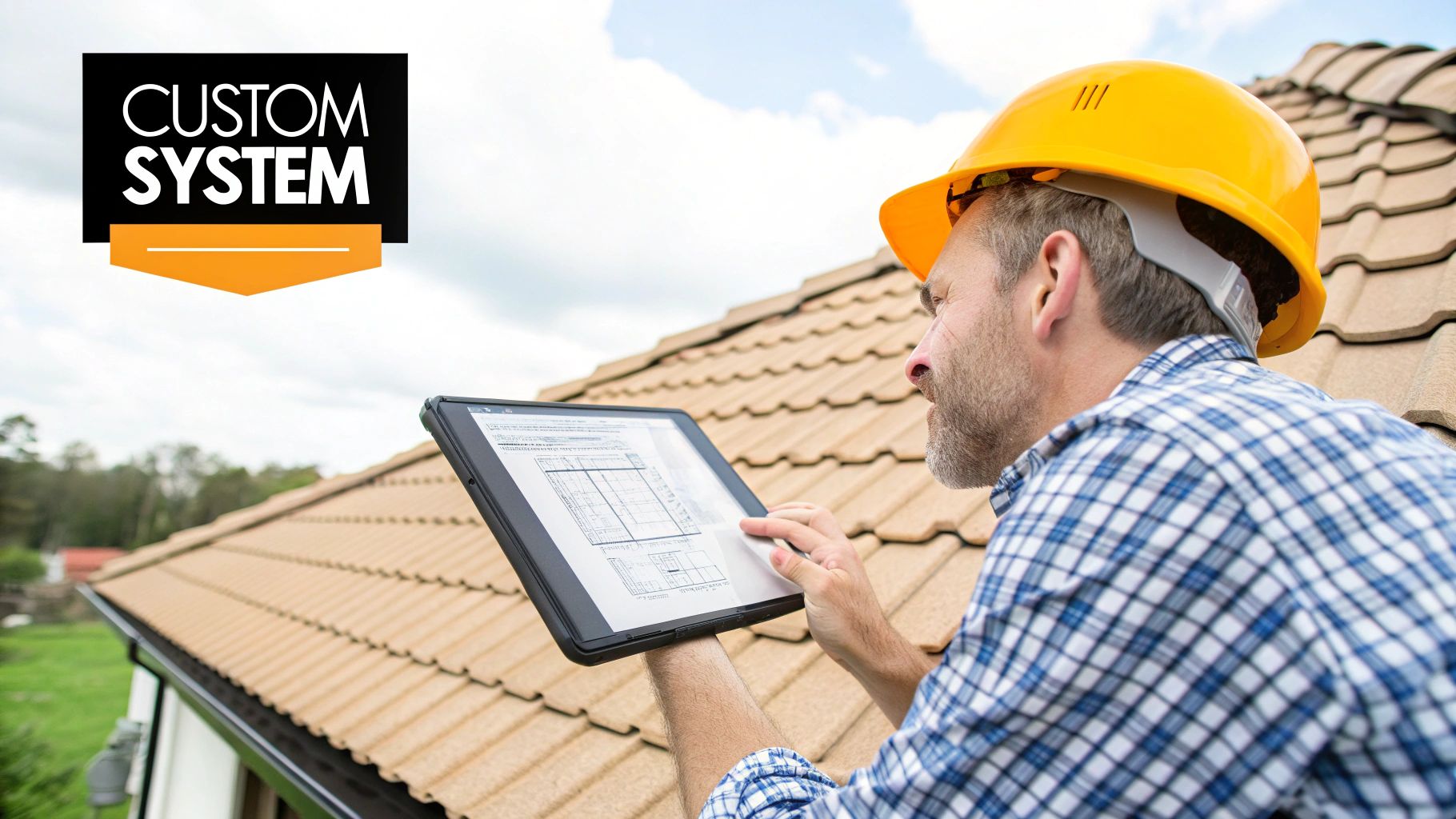
A great solar-powered EV charging station isn't a one-size-fits-all product. It’s a system carefully designed to fit your property, your energy goals, and your lifestyle. Whether you're a homeowner in Nassau County or running a business in Albany, getting the design right is what makes it a worthwhile investment.
For a homeowner, the process begins with a look at your property's specific characteristics. We analyze practical details like your roof's orientation—in New York, a south-facing roof is ideal for maximizing sun exposure. We also need to understand your daily routine, such as your average commute. This information helps us determine exactly how much power your system needs to generate.
Then comes the charger itself. A Level 1 charger is the simplest option, plugging right into a standard wall outlet for a slow, overnight charge. On the other hand, a Level 2 charger delivers a much faster charge but requires professional installation. The best choice depends on your daily driving habits.
Tailoring Systems For New York Homeowners
Putting together the right components is what makes or breaks a residential system. A thorough site assessment is the first step, helping us answer a few key questions.
- How many solar panels do you need? We calculate this based on your daily commute, your home's total electricity usage, and the amount of usable, unshaded space on your roof.
- Is a Level 2 charger worth it? If you have a long daily drive or need the flexibility of a quick top-off, the speed and convenience are often essential.
- Will you need battery storage? Adding a battery, like a Tesla Powerwall, lets you store the excess solar energy you generate during the day. This means you can charge your car overnight with pure sunshine, giving you true energy freedom and protection from outages.
Scaling Up For Commercial Properties
For commercial properties—like a retail center in Suffolk County or an office park in the Hudson Valley—the scope and goals are different. Here, the aim isn't just about charging one vehicle; it's about offering a high-value amenity for employees, customers, or tenants.
Offering EV charging is a fantastic way to attract and retain both talented employees and environmentally-conscious customers. In fact, studies consistently show that workplace charging is a highly desired perk that boosts employee satisfaction.
For a business, a solar-powered EV charging station is more than an energy solution—it's a visible commitment to sustainability and a forward-thinking amenity that boosts property value and brand image.
Commercial setups often require a mix of charging speeds. Level 2 chargers are ideal for employees who park for the workday. For a shopping center or rest stop, DC Fast Chargers make more sense, as they can provide a significant charge in under an hour for customers on the go.
One of the most effective and visually impressive solutions for businesses is the solar carport or canopy. These structures serve a dual purpose: they generate clean electricity while also providing sheltered parking, a welcome feature during New York's harsh winters and hot summers. They send a clear message about your company's dedication to clean energy. You can see how we bring these projects to life by checking out our work with solar canopies on Long Island.
When designing a system, it's crucial to understand the different scales and goals for homeowners versus businesses. Here's a quick comparison of what that looks like in New York.
Comparing Home vs Commercial Solar EV Charging Systems
| Factor | Typical for Homeowners | Typical for Businesses |
|---|---|---|
| Primary Goal | Reduce personal energy costs and carbon footprint. | Provide an amenity for customers/employees; create a new revenue stream. |
| System Size | 5-15 kW solar array, sized for household and one or two EVs. | 50 kW to 1 MW+, often designed as large-scale solar carports or roof mounts. |
| Charger Type | One or two Level 2 chargers. | Multiple Level 2 chargers and potentially DC Fast Chargers. |
| Energy Storage | Optional, but a single battery pack (e.g., Tesla Powerwall) is common. | Often includes larger battery systems for demand-charge management. |
| Installation | Typically a straightforward roof-mounted installation. | Complex projects involving parking lots, structural engineering, and grid upgrades. |
| Key Consideration | Maximizing self-consumption of solar energy. | ROI, user management, public accessibility, and branding. |
Ultimately, whether for a home or a business, a professional site assessment is the essential first step. It’s where our experts analyze your property’s potential, understand your energy needs, and design a system that will maximize your solar generation and deliver the best possible return on investment.
The Financial Side: Costs and New York Incentives
Let's talk numbers. Installing a solar-powered EV charging station is a significant investment, but in New York, it's one of the smartest you can make. While there's an upfront cost for the hardware—solar panels, an inverter, the charger, and perhaps a battery system—that's only part of the story.
The true value comes from the massive savings on your utility bills and the incredible state and federal incentives available to New Yorkers. These programs are designed to dramatically reduce your initial cost and accelerate your break-even point. For homeowners and businesses alike, this isn't just an energy upgrade; it's a long-term financial strategy that pays for itself.
Stacking Your Savings: Federal and State Incentives
New York is one of the best states in the country for solar incentives, and stacking these programs is key to maximizing your savings.
It all starts with the federal Residential Clean Energy Credit. This is the cornerstone of affordability, allowing you to claim a tax credit for 30% of the total system cost—including panels, battery storage, and labor. There's no cap on this credit, making it a powerful financial tool for any solar project.
Then, New York State adds its own powerful incentives:
- NY-Sun Initiative: Administered by NYSERDA, this program provides a direct, upfront rebate to lower the cost of your solar panel installation. The exact amount varies by region and system size, but it provides an immediate reduction in your out-of-pocket expense.
- New York State Solar Energy System Equipment Credit: On top of the federal credit, New York offers its own state tax credit of up to $5,000 for the purchase of a solar energy system.
- EV Charging Equipment Tax Credit: The state also offers a separate tax credit specifically for the purchase and installation of your EV charger, covering up to another $5,000 of that cost.
What's Your Return on Investment Look Like?
Consider a family in the Hudson Valley. By combining the 30% federal credit, the NY-Sun rebate, and both state tax credits (one for solar, one for the EV charger), they could reduce the total project cost by more than 50%. A system that might have taken a decade to pay for itself could now break even in just a few years.
This strong financial upside is fueling incredible market growth. Globally, the solar-powered EV charging station market is projected to reach about USD 220.4 million in 2025 and is expected to climb from there. You can dig into the numbers in this solar EV charging market trends and forecasts report.
For commercial properties, the numbers are just as compelling. When these incentives are combined with business-specific benefits like accelerated depreciation, the result is a powerful ROI that slashes operating costs and increases property value.
Businesses have a massive opportunity here. Navigating commercial incentives can be complex, but the payoff is significant. Our expertise with commercial solar for Long Island properties helps businesses unlock these financial benefits, achieving both their sustainability and bottom-line goals.
The Bigger Picture: Environmental and Community Impact
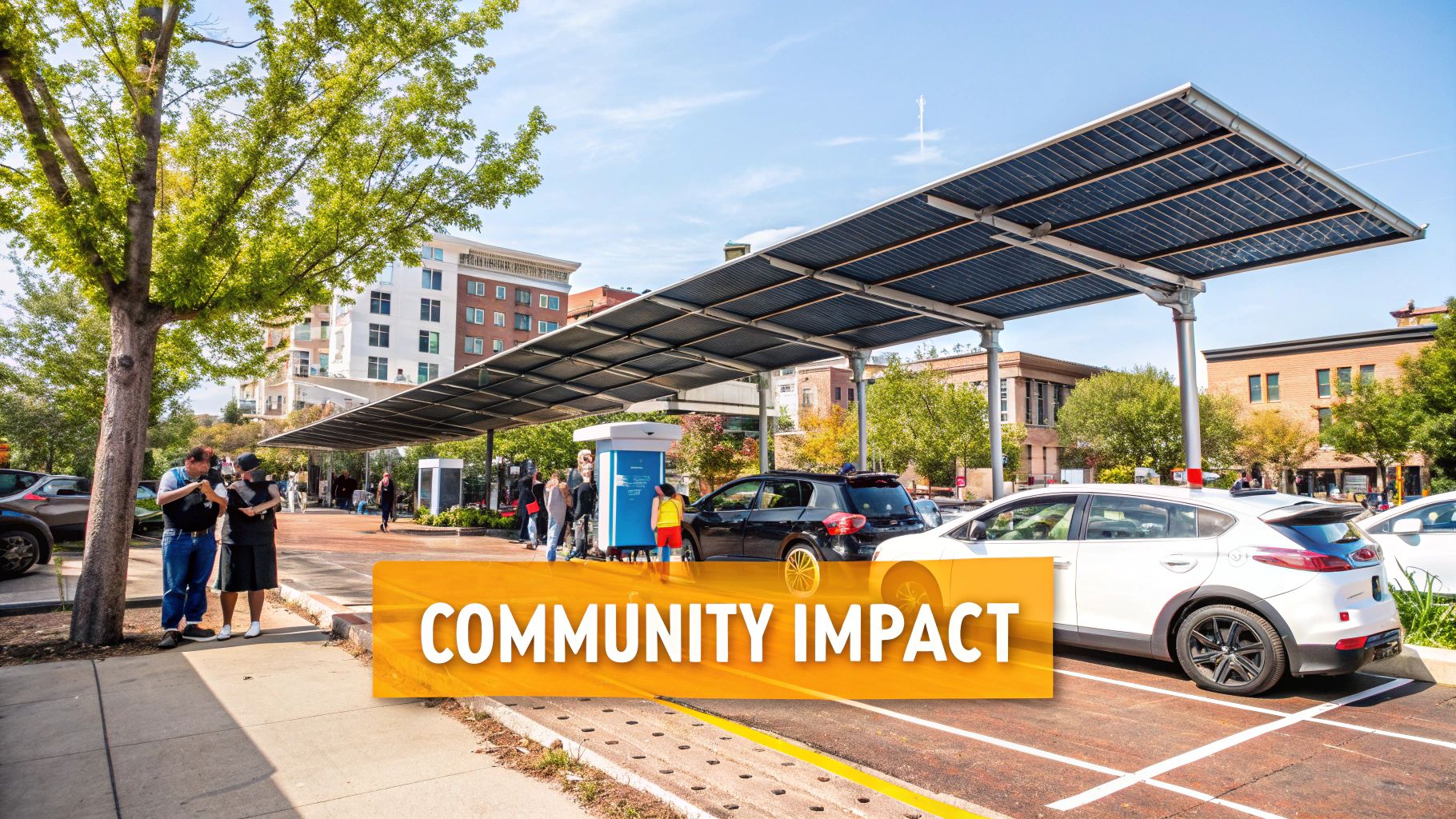
When you install a solar powered ev charging station, you're doing much more than just cutting your fuel and electricity bills. It's a choice that creates positive ripple effects, benefiting your property, your wallet, and your entire New York community.
Every time you charge your EV with solar power, you are actively shrinking your carbon footprint. It’s a simple action, but when multiplied across entire neighborhoods—from Rochester down to the Rockaways—the effect is tangible. It helps clean our local air by reducing both tailpipe emissions and the demand for grid power from fossil fuel plants.
Aligning with New York's Climate Goals
Your decision also connects you to a much larger initiative. New York State has established ambitious targets with its Climate Leadership and Community Protection Act (CLCPA), aiming for a carbon-neutral economy. By generating your own clean power, you're not just a bystander; you become an active participant in this transition, helping the state move closer to its goals.
For a business, this impact scales up dramatically. Adopting solar EV charging is one of the most visible and effective ways to bolster your Environmental, Social, and Governance (ESG) credentials.
It's not just a smart financial move. It's a public declaration of your commitment to sustainability that speaks directly to a growing number of eco-conscious customers, helps attract top-tier talent, and cements your reputation as a forward-thinking community leader.
A Growing Market for a Greener Future
This push for clean energy is fueling explosive growth. The global market for solar EV charging stations was valued at USD 502.2 million in 2024 and is projected to skyrocket to USD 7.78 billion by 2033. That incredible jump isn't just a trend; it's proof of a fundamental global shift toward sustainable transportation. Discover more insights about solar charging market growth.
This isn't just about abstract numbers, either. It’s about building healthier, more resilient communities right here at home. The benefits of making this switch are clear and compelling:
- Improved Public Health: Less dependence on fossil fuels means cleaner air for everyone to breathe.
- A Stronger Local Grid: When you generate your own power, you help ease the strain on the central grid, which is especially important during those sweltering summer peak hours.
- Enhanced Property Value: Homes and commercial buildings with modern, green infrastructure are simply more appealing to today's buyers and tenants.
In the end, choosing a solar EV charging solution is an investment in the future—the future of your community and the planet. It’s a practical, powerful step toward creating a cleaner, more sustainable New York for us all.
Your Next Move: From Sunshine to Horsepower
We've walked through the ins and outs of powering your EV with New York sunshine. You've seen how a solar powered EV charging station isn't just a futuristic idea—it's a smart, practical investment you can make right now, bringing together real cost savings, energy security, and a much lighter environmental footprint.
The bottom line is simple: you can keep paying the utility company, or you can start producing your own clean fuel. This is your chance to take genuine control over your energy costs and join a growing number of New Yorkers building a more resilient, independent future.
An investment in solar EV charging is more than just an upgrade to your property. It's a powerful statement about energy independence and a concrete step toward a sustainable future for your home or business.
So, what's the next step? It's easier than you think.
Let's Design Your Energy Future
Contact NY Essential Power for a free, no-obligation consultation. Our team of experts specializes in creating custom solar and EV charging systems designed specifically for New York properties, from homes on Long Island to commercial facilities in the Hudson Valley.
We handle the entire process for you—from the initial site assessment and system design to securing all local permits and ensuring you capture every incentive you're entitled to.
Let's explore how a custom solar solution can be tailored to meet your unique needs. It's time to build your path to energy independence, together.
Common Questions About Solar EV Charging
Switching to a solar-powered EV charging station is a big decision, and it’s natural to have questions, especially here in New York. Let's tackle some of the most common things people ask so you can feel confident about this investment.
What Happens When It's Cloudy or Dark?
This is easily the number one question we get. What happens when the sun isn't shining? The short answer is: your car still charges, no problem.
On an overcast day, your solar panels are still producing power, just not at their peak capacity. For times when there’s no sun at all, like at night, a grid-tied system automatically and seamlessly pulls power from your utility company, whether that's PSEG Long Island or Con Edison. If you've opted for a battery storage system, you'll simply use the solar energy you stored during the sunny parts of the day.
How Much Upkeep Is Involved?
You'll be happy to hear that solar energy systems require very little maintenance. The panels themselves are built to withstand New York's variable weather, from summer heatwaves to heavy winter snow.
A simple cleaning now and then to clear off any accumulated dust, leaves, or debris is usually all that’s needed to keep them performing optimally.
Modern solar panels are incredibly resilient and almost always come with a 25-year warranty. The other components, like the inverters and chargers, are also built for the long haul, making it a true "set it and forget it" solution for most property owners.
Can I Just Add an EV Charger to My Existing Solar Panels?
Yes, absolutely. If your home or business already has a solar installation, adding an EV charger is typically a straightforward process. Our team would first assess your current system's output to ensure it can handle the additional load from charging your vehicle.
In some cases, we might recommend adding a few more panels to your array. This ensures you have enough power to cover both your property's needs and keep your EV charged with clean, solar energy.
How Long Does Installation Take?
The exact timeline can vary depending on the complexity of the project, but here’s a general breakdown of what to expect in New York.
- Design and Permitting: This phase typically takes a few weeks. We finalize your system's design and handle all the necessary permits with your local municipality and utility company.
- Installation: The physical work of mounting the panels, wiring the system, and setting up the charger is surprisingly quick—often completed in just a few days.
- Final Inspection: Once the installation is complete, a final inspection is required before the system can be officially activated.
All in, the entire process from start to finish can range from several weeks to a couple of months. We manage every step to keep things moving as smoothly as possible for you.
Ready to power your drive with the sun? The team at NY Essential Power is here to design a custom solar EV charging solution for your home or business. Request a free, no-obligation quote today and take the first step toward energy independence.