
When it comes to your solar investment in New York, the panels are only half the story. The real secret to squeezing every last kilowatt-hour out of your system lies in how they’re positioned. We’re talking about the solar power angle—a combination of the vertical tilt and the directional orientation (azimuth)—a detail that is absolutely critical but often overlooked.
Getting this angle right is the difference between a good solar system and a great one. It directly impacts your energy production, your cost savings, and your journey toward energy independence, whether you're a homeowner on Long Island or a business owner in Albany.
Unlocking Peak Solar Performance in New York
Think of your solar panels like a sunflower. They need to be in the perfect spot to soak up as much sun as possible. Here in New York, from Buffalo to the East End, the sun's path takes a dramatically different route across the sky from summer to winter.
An angle optimized for our northern latitude ensures your panels are always in the prime position to catch direct sunlight, not just on a flawless day in July but throughout the entire year. This isn't just a minor tweak; it has real, tangible benefits for your home or business.
- Maximized Energy Production: Even a few degrees of adjustment can lead to a surprising jump in the kilowatt-hours your system generates, boosting your system's efficiency.
- Greater Cost Savings: More power produced means a lower utility bill. It’s that simple. This also accelerates the payback period for your investment, so you start seeing pure profit sooner.
- Enhanced Energy Independence: A high-performing system reduces your reliance on the grid, giving you peace of mind and more control over your energy future, especially when paired with battery storage.
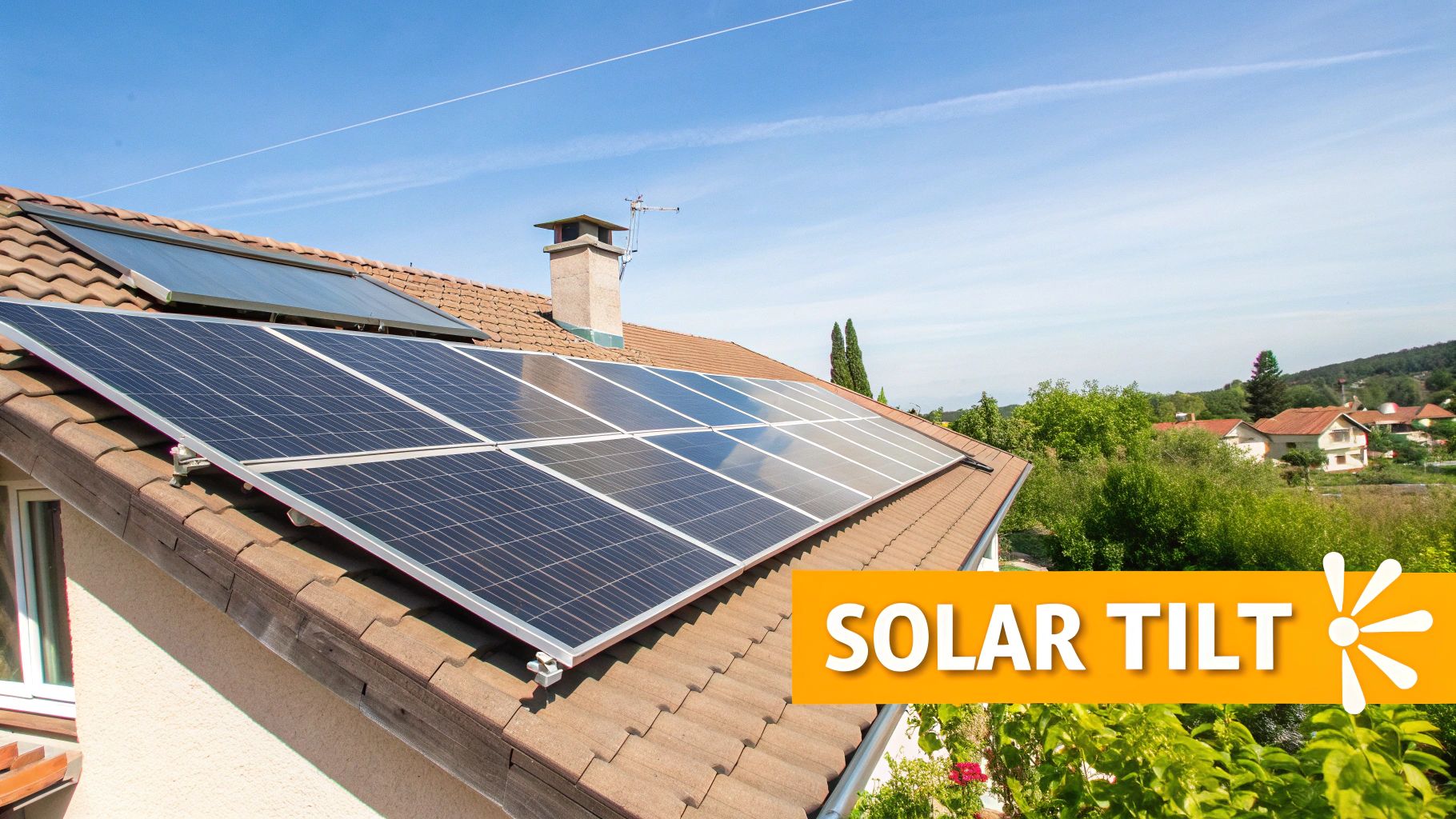
Why Position Is Everything
So, how much does the angle really matter? A lot. The traditional rule of thumb for maximizing annual energy capture has always been to set the panel tilt to match the property's latitude. For most of New York, that’s around 42 degrees.
Research has consistently shown that even small deviations from this optimal angle can slash a system's annual output by 5% to 10%. That’s a significant amount of lost energy and savings over the 25+ year lifespan of your panels.
This is precisely why a professional installation is non-negotiable. Whether you're in one of our main service areas or another part of the state, our team doesn't guess. We calculate the ideal orientation based on your specific roofline, local weather patterns, and any potential shading from nearby trees or buildings.
For New York homeowners and businesses, getting the solar power angle right isn't a minor detail—it's the foundation of a successful solar energy system that delivers reliable savings for decades.
This principle of capturing maximum solar energy isn't just for rooftops. It applies everywhere solar is used. For instance, a solar boat recently completed an emission-free voyage to Alaska, showcasing solar power's diverse capabilities. This just goes to show how vital effective positioning is, no matter the application. Your journey to a smaller carbon footprint and lower energy bills starts with this same fundamental step.
To help you visualize how this works throughout the year, here's a quick reference for ideal fixed-tilt angles in our region.
Quick Guide to Ideal Solar Angles in New York
| Time of Year | Recommended Tilt Angle for New York (approx. 42° Latitude) | Reasoning |
|---|---|---|
| Winter | 57° (Latitude + 15°) | The sun is much lower in the winter sky, so a steeper angle is needed to catch its direct rays. |
| Summer | 27° (Latitude – 15°) | In the summer, the sun is high overhead. A shallower tilt helps capture this more direct sunlight. |
| Spring/Fall | 42° (Latitude) | During the equinoxes, setting the panels to match your latitude provides a good balance. |
| Year-Round Fixed | 35-40° | This is the sweet spot for a fixed (non-adjustable) system, balancing winter and summer performance for the best overall annual output. |
While adjustable mounts exist, most residential and commercial systems use a fixed tilt optimized for year-round production. As the table shows, this often means an angle slightly less than the latitude to better capture the intense, longer days of summer sun, which is when we tend to use the most electricity for things like air conditioning.
Why Panel Position Impacts Your Energy Savings
Let’s talk about how a seemingly small detail like the solar power angle directly affects your wallet. Here in New York, the sun's path across the sky changes dramatically throughout the year. It travels in a high, powerful arc during our long summer days and makes a much lower, quicker trip in the winter. This shift is something you really notice in places like Albany and Buffalo.
It's a bit like trying to read a book with a lamp sitting way off to the side. What do you do? You instinctively tilt the book toward the light to get a better view. Solar panels are no different. When a panel is angled correctly, it catches the most direct, perpendicular sunlight, and that's the secret to getting the most electricity out of your system.
From Kilowatts to Cash in Your Pocket
When your panels are positioned to capture that direct sunlight, they simply produce more kilowatt-hours (kWh). This isn't just some abstract number you see on a monitoring app; it has a very real impact on your home or business finances.
For you, this translates to:
- Bigger Savings: Every extra kWh your system generates is one you don’t have to purchase from utilities like Con Edison or PSEG Long Island. This directly lowers your monthly bills and protects you from rising energy costs.
- Faster ROI: A system that produces more energy pays for itself much faster. This accelerates your return on investment and gets you into the profit zone sooner, especially when combined with powerful incentives like the NY-Sun program.
- Reliable Year-Round Power: Getting the angle right ensures your system performs as well as it can during New York's shorter, often cloudier winter days, giving you more energy independence when you need it most.
The Advantage of Flexible Placement
This idea of perfect positioning is especially important for buildings with flat roofs, which are common for businesses all over NYC and Long Island. A flat roof is like a blank canvas, giving an installer the kind of flexibility you just don't get with a pitched roof.
On a flat roof, we aren't stuck with a pre-existing slope. We can use specialized mounting hardware to dial in the perfect solar power angle and orient the panels to face true south, capturing the maximum amount of sunlight all day. This often results in a system that outperforms one on a sloped roof that isn't facing the ideal direction.
This freedom allows an installation team to design a layout that's truly optimized for your specific property. It's a massive advantage that drives better long-term performance and bigger savings. For businesses, this same principle makes solar canopies incredibly effective, as they can also be angled for peak production.
At the end of the day, the position of your panels is the engine that drives your savings. It’s what ensures you're not just going solar but doing it in the smartest, most efficient way for New York’s unique climate. Getting this right is absolutely fundamental to achieving the financial goals and environmental benefits you're looking for.
Ready to see how the right angle can impact your savings? Contact NY Essential Power today for a personalized quote.
Getting the Angle Right: How to Position Your Panels in NY
Let's get down to the nuts and bolts. For any solar setup in New York, two things really drive performance: azimuth (the direction your panels face) and tilt (their vertical angle). Nailing these two is what separates a decent solar investment from a truly exceptional one.
In the Northern Hemisphere, true south (180 degrees) is the gold standard for azimuth. Pointing your panels south means they get the most exposure to the sun as it travels across the sky each day. But let's be realistic—not every roof in Brooklyn or Queens has a perfect, unobstructed southern exposure. That's perfectly okay. A skilled installer can work with roofs facing southwest or southeast and still design a system that cranks out plenty of power.
Finding the Sweet Spot for Tilt
Once you’ve figured out the best direction, it’s time to set the tilt. This angle is critical for catching the sun's direct rays, which, as any New Yorker knows, change dramatically from season to season.
A great rule of thumb for solid year-round production is to set your panel tilt to match your latitude. For most of New York State, that puts you somewhere between 40 and 43 degrees. This angle strikes a fantastic balance, capturing plenty of energy from both the high summer sun and the low-hanging winter sun.
This infographic breaks down the basic idea of seasonal adjustments.
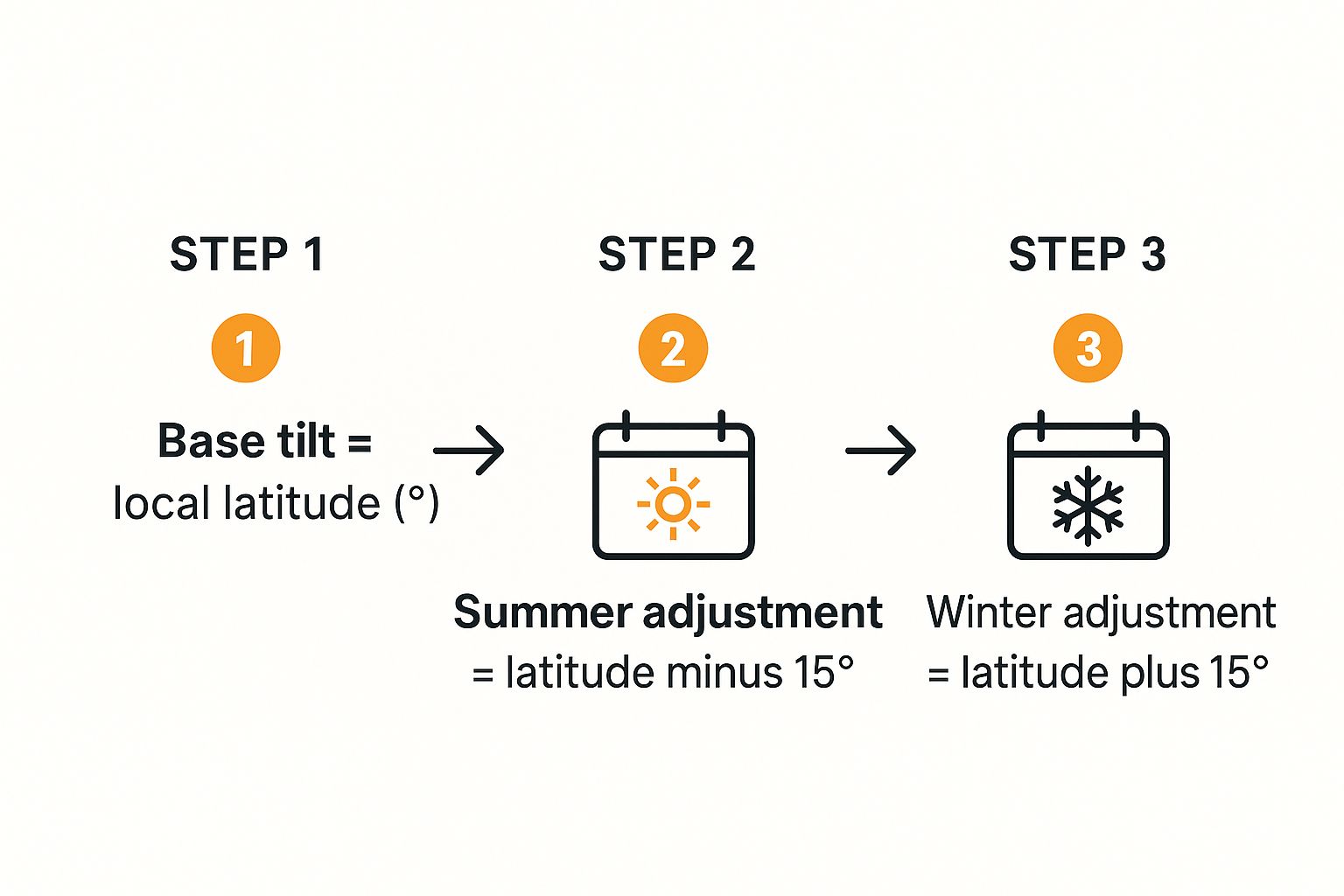
As you can see, a steeper angle is better in the winter to catch the low sun, while a shallower angle works best in the summer when the sun is high overhead. Since most home and business systems are fixed in one position, installers find that happy medium that delivers the best overall output all year long.
The Science Behind the Angle
Perfecting a solar panel’s angle isn't just about maximizing your own savings; it's a key part of a much bigger picture. On a global scale, optimizing these angles directly boosts power capacity and efficiency. The International Renewable Energy Agency reported that renewable power capacity shot up by a record 15.1% in 2024, and solar was a huge piece of that pie. Getting the tilt right helps us hit those big targets by squeezing every last watt out of each installed panel. You can explore the full report on renewable capacity growth here.
So, what does this mean for your home or business? It means the angles we're talking about aren't just guesses; they're based on proven science that makes your system work smarter, generate more clean energy, and slash your bills.
For a fixed system on Long Island, for example, a tilt of around 35-40 degrees is often the sweet spot. This angle slightly favors summer production when A/C units are running full blast, but it doesn't give up too much ground during the winter.
This calculated approach takes the guesswork out of the equation. By locking in the best year-round angle, we can ensure you get the fastest possible return on your investment and the most energy independence.
Ready to find the perfect solar power angle for your property? The experts at NY Essential Power use advanced modeling to calculate the most productive tilt and azimuth for your specific location. Request your free, no-obligation quote today.
Fixed Mounts vs Solar Trackers in New York
When you're ready to mount your solar panels, you'll face a fundamental choice: a sturdy, stationary fixed mount or a dynamic solar tracker that follows the sun. The right decision really comes down to your property, your budget, and what you want to achieve with your system. Each option has a direct impact on both your initial investment and your long-term energy production.
Let's break down the trade-offs to help you make the right call for your New York property.
The Standard Choice: Fixed-Tilt Mounts
For the vast majority of homes and businesses in New York, fixed-tilt mounts are the go-to solution, and for good reason. They are simple, incredibly durable, and have zero moving parts. This robust, no-fuss design is exactly what you want to handle our demanding Northeast weather—from heavy snow dumps upstate to the harsh coastal storms on Long Island.
Since these mounts don't move, your installer will do the math to find the perfect year-round solar power angle and lock the panels into that one sweet spot. It's a proven approach that delivers a fantastic balance of performance, low maintenance, and affordability, making it the most practical choice for most situations.
Here’s a quick rundown of why fixed mounts are so common:
- Cost-Effective: Their simpler design means lower equipment and installation costs, which gets you to your break-even point faster.
- Built to Last: They are engineered to withstand decades of New York's snow, ice, and wind without a problem.
- Minimal Upkeep: With no motors or gears, there's virtually nothing to service or replace over the life of the system.
- Versatile Installation: They work perfectly on standard sloped roofs, flat commercial buildings, and even in ground-mounted arrays like solar canopies over parking lots.
The High-Performance Option: Solar Trackers
On the other side, you have solar trackers. These are more complex systems equipped with motors that automatically tilt and turn your panels to follow the sun's journey across the sky. By constantly optimizing their angle, they squeeze every last drop of energy out of the available sunlight.
This technology can make a huge difference. In large, open areas, dual-axis trackers can boost energy production by a whopping 20% to 35% compared to a fixed system. Just making seasonal adjustments can add an extra 2% to 5% to your annual output, which really adds up. You can discover more insights about these solar technology trends here.
So, what’s the catch? The advanced technology comes with a higher price tag. Trackers also need more space to operate and require ongoing maintenance for their mechanical components.
This makes them a better fit for large commercial projects or agricultural operations where maximizing every square foot of production is the top priority. For the typical residential roof, it’s often overkill.
Comparing Fixed Mounts and Solar Trackers for New York
To help you visualize the differences, here's a side-by-side comparison tailored for our local conditions.
| Feature | Fixed-Tilt Mounts | Solar Trackers |
|---|---|---|
| Energy Production | Good to excellent, based on a single optimized angle. | Highest possible, with gains of 20-35% over fixed mounts. |
| Upfront Cost | Lower, more affordable initial investment. | Significantly higher due to motors and complex hardware. |
| Maintenance Needs | Virtually none. Set it and forget it. | Regular maintenance required for motors and moving parts. |
| Space Requirements | Minimal, works well on most rooftops and smaller lots. | Requires more ground clearance for movement. |
| Weather Durability | Excellent. Fewer failure points in snow and high winds. | Good, but moving parts introduce more potential risks. |
| Best Suited For | Most residential, commercial rooftops, and carports. | Large-scale solar farms, agricultural, and utility projects. |
Ultimately, for most homeowners and businesses here in New York, the proven reliability and outstanding value of a professionally installed fixed-mount system hit the sweet spot. It remains the smartest path to long-term energy savings and independence.
Why Professional Placement Makes a Difference
Getting the hang of the basic solar power angle is a great start, but actually turning that theory into a high-performance solar array is another story entirely. It takes real precision and hands-on experience. This is where a certified New York installer steps in to make sure your system is set up to generate the most power possible, saving you money for years to come.
A true professional doesn't just go by the general rules. They use sophisticated software to build a detailed 3D model of your specific property. Think of it as a digital twin of your home or business. This model accounts for every little thing that makes your location unique, from the exact pitch of your roof in Westchester to the shade cast by a neighbor's big oak tree on Staten Island.
Beyond the Basics a Pro Delivers
This kind of meticulous planning catches things you'd never see with the naked eye.
- Precise Solar Pathing: A pro can model the sun’s exact path across your roof for every day of the year.
- Shade Analysis: They identify how even small things, like chimneys or vents, will create shadows at different times and in different seasons.
- Local Weather Patterns: This process even factors in regional data, like the typical cloud cover you get on Long Island, to create much more accurate production forecasts.
This in-depth analysis is what guarantees your solar power angle is truly dialed in for your property. While getting the angle just right is a huge piece of the puzzle, the system's long-term effectiveness really hinges on a solid installation. If you're curious about the foundational steps, you can find more in a practical solar panel installation guide.
The Value of Guaranteed Performance
When you work with an expert team like NY Essential Power, all the guesswork is gone. We don't just design your system for peak energy production; we guarantee it's installed safely and meets every single New York state and local building code. That professional oversight is the final piece of the puzzle that makes your solar investment a sure thing.
The technology behind solar is always improving to capture more energy. In fact, over the last decade, the costs for new photovoltaic (PV) systems have plummeted by 64% for homes and 69% for businesses worldwide. Smarter optimization is a big reason why. You can read more about these global solar power trends.
This commitment to expert placement and quality installation ensures every panel works as hard as it possibly can. It’s how a leading solar company in Islip and across New York delivers real, measurable results.
Ready to see what a professionally designed system could do for your energy bills? Contact NY Essential Power for a custom solar quote today.
Common Questions About Solar Panel Angles
Even after getting a handle on the basics, most New York property owners still have a few lingering questions about getting that solar power angle perfect. That's completely normal. Let's walk through some of the most common things people ask right before they're ready to move forward.
These are the practical, real-world concerns that pop up when you start thinking about how solar will actually fit on your roof or commercial building.
Do Solar Panels Work on a Flat Roof?
They sure do. In fact, flat roofs can be a dream to work with, often allowing for an even better setup than a sloped roof. Think of a flat roof—common on commercial buildings in NYC and many homes out on Long Island—as a blank canvas.
Unlike a pitched roof that locks you into its existing slope and direction, a flat roof gives us total freedom. We can use specialized mounts to point the panels directly at true south and dial in the absolute perfect tilt for year-round sun. It’s a massive performance advantage for many businesses.
Is My Roof Angle Too Steep or Too Shallow?
This is a great question, especially in New York where you see everything from steep A-frames upstate to low-slope suburban roofs. While there's an "ideal" window, a good installer can make almost any roof pitch work.
The secret is a custom design, not a one-size-fits-all approach. If your roof is too shallow, we can use tilt kits to raise the panels to a better angle. If you have a steep, south-facing roof, you might already be in a great position to capture that low winter sun.
How Much Energy Do I Lose If My Roof Doesn't Face South?
This is the big one, but the answer is probably less than you think. While true south (180°) is the benchmark, an east- or west-facing roof can still host a powerhouse solar array. It's all about understanding your energy usage patterns.
- An east-facing system is your morning workhorse, generating power early in the day.
- A west-facing system hits its stride in the afternoon, which is perfect for many families and businesses.
That afternoon peak often lines up perfectly with when you get home and crank up the air conditioning. A well-designed east-west system can easily produce 85-95% of the energy of an ideal south-facing one. For most properties, that's more than enough to deliver incredible savings.
Do I Need to Adjust My Panels Seasonally?
For almost every home and business system, the answer is a firm no. You might see adjustable mounts or solar trackers on the market, but they introduce extra cost and moving parts—which means more maintenance.
Modern fixed-mount systems are designed with a single, optimized solar power angle that provides the best year-round average. This "set it and forget it" design gives you what you really want: maximum energy production with minimum hassle for the next 25+ years.
At NY Essential Power, we obsess over these details so you don't have to. Our team uses sophisticated modeling software to design a system that's perfectly tuned to your roof, your location, and your financial goals.
Ready to see what the right angle can do for your energy bills? Request your free, no-obligation quote from NYS Essential Power today!