
A solar payback period calculator is a vital financial tool for any New Yorker considering a switch to solar energy. In simple terms, it tells you exactly how long it will take to recoup your initial investment in a solar panel system through energy savings. Think of it as your financial roadmap to energy independence. It analyzes your project costs against your estimated energy savings to pinpoint the moment your solar system has officially paid for itself by eliminating your utility bills.
Figuring Out Your Solar Break-Even Point
If you're a New York homeowner or business owner, the payback period is likely the single most important number you'll consider. It directly answers the critical question: "When does this investment start making me money?" Calculating this timeline transforms the abstract idea of "going solar" into a concrete financial forecast for your property.
This isn't just about saving a few dollars on your electric bill; it’s about achieving energy independence. When you understand your payback period, you see a clear path to freedom from the unpredictable rate hikes of utilities like PSEG on Long Island or Con Edison in Westchester.
Your payback period is the tipping point where your solar panels transform from an expense into a high-performing asset. Once you break even, every single kilowatt of energy your system produces is pure profit, putting money back into your pocket for the next 25+ years.
The national average for a solar break-even point typically lands between 7 and 10 years. Of course, this can swing significantly depending on local energy prices and available incentives. You can get a closer look at how this payback period is calculated across the U.S. to see how different states compare.
Here in New York, we have a significant advantage. Powerful state incentives, like the NY-Sun program and a generous state tax credit, can dramatically shorten that timeline. This means you're not just making an environmentally conscious choice; you're making a savvy financial one with a clear, and often speedy, return on investment.
This guide will walk you through using a solar payback period calculator to get real numbers for your specific situation, giving you the confidence to make an informed decision for your home or business.
What You Need for an Accurate Calculation
Any reliable calculation starts with solid data, not guesswork. Before you use a solar payback period calculator, you'll want to gather a few key details. Think of it as your pre-flight checklist; getting these inputs right ensures your result is a reliable financial forecast, not just an estimate.
First, you need to know exactly how much electricity you use. The best way is to gather the last 12 months of your utility bills—whether from PSEG Long Island, Con Edison, or another New York provider—and find your total kilowatt-hour (kWh) consumption for the year. This provides a complete picture, accounting for seasonal spikes from running the A/C all summer in Levittown or heating a commercial space in Albany.
Next, calculate what you're actually paying for that power. Simply divide your total annual electricity cost by your total annual kWh usage. This gives you your average price per kWh, which is the baseline for measuring your future solar savings.
Sourcing Your System Costs and Incentives
To determine the payback period, you must know what you’re paying upfront. A realistic gross system cost from a trusted New York installer is essential. This quote should be all-inclusive, covering panels, inverters, labor, and all necessary permits.
Also, consider any additional components. For many homeowners, this is the perfect time to add reliable home battery backup systems for true energy independence during outages. If you're a commercial property owner in a place like Ronkonkoma, you'll also want to analyze how solar and battery storage can slash those hefty demand charges on your utility bill.
The final, and most crucial, step is subtracting all available incentives. Your true cost is the number after all credits and rebates have been applied.
This is where investing in solar in New York truly pays off. You must account for every incentive you qualify for, as they can dramatically shorten your payback period. The key ones include:
- The 30% Federal Solar Tax Credit: A powerful incentive that lets you deduct 30% of your total system cost directly from your federal tax liability.
- The NY-Sun Megawatt Block Rebate: This state-level incentive is paid directly to your installer, reducing your upfront cost right off the top.
- New York State Solar Tax Credit: Another fantastic state credit worth 25% of your system cost, capped at $5,000 for residential projects.
Getting these inputs right is the key to an accurate estimate. With this data in hand, you’re ready to see your real-world payback timeline.
How the Solar Payback Formula Actually Works
Let's pull back the curtain on how a solar payback period calculator determines its results. At its core, the formula is refreshingly simple:
Total System Cost ÷ Annual Energy Savings = Payback Period in Years
However, the devil is in the details, especially for New York property owners. Each part of that equation has critical nuances that must be addressed correctly.
Nailing Down Your Total System Cost
First is your total system cost. This is the most important number to lock down, and it's more than just the sticker price on a proposal. What we're really looking for is the final, net cost after you’ve subtracted every single available incentive.
For New Yorkers, this means factoring in:
- The 30% federal tax credit
- The valuable NY-Sun rebate
- The 25% ($5,000 max) NYS tax credit
These programs dramatically slash your initial investment. Getting a handle on these credits is the first step to an accurate calculation. For a deeper look at what goes into that initial price tag, it's worth understanding the cost of solar panels on Long Island.
Calculating Your Annual Savings
The other side of the equation is your annual energy savings. Think of this as the money you will no longer send to your utility company each year.
You find this number by multiplying your solar system's expected yearly energy production (in kWh) by your current electricity rate. It's easy to see why this varies so much across the state. A homeowner in Queens facing high Con Edison rates will see a much larger savings figure than a business upstate with a lower commercial rate. Greater savings mean a faster payback.
This visual helps to illustrate the relationship between your upfront cost, your annual savings, and how quickly you break even.
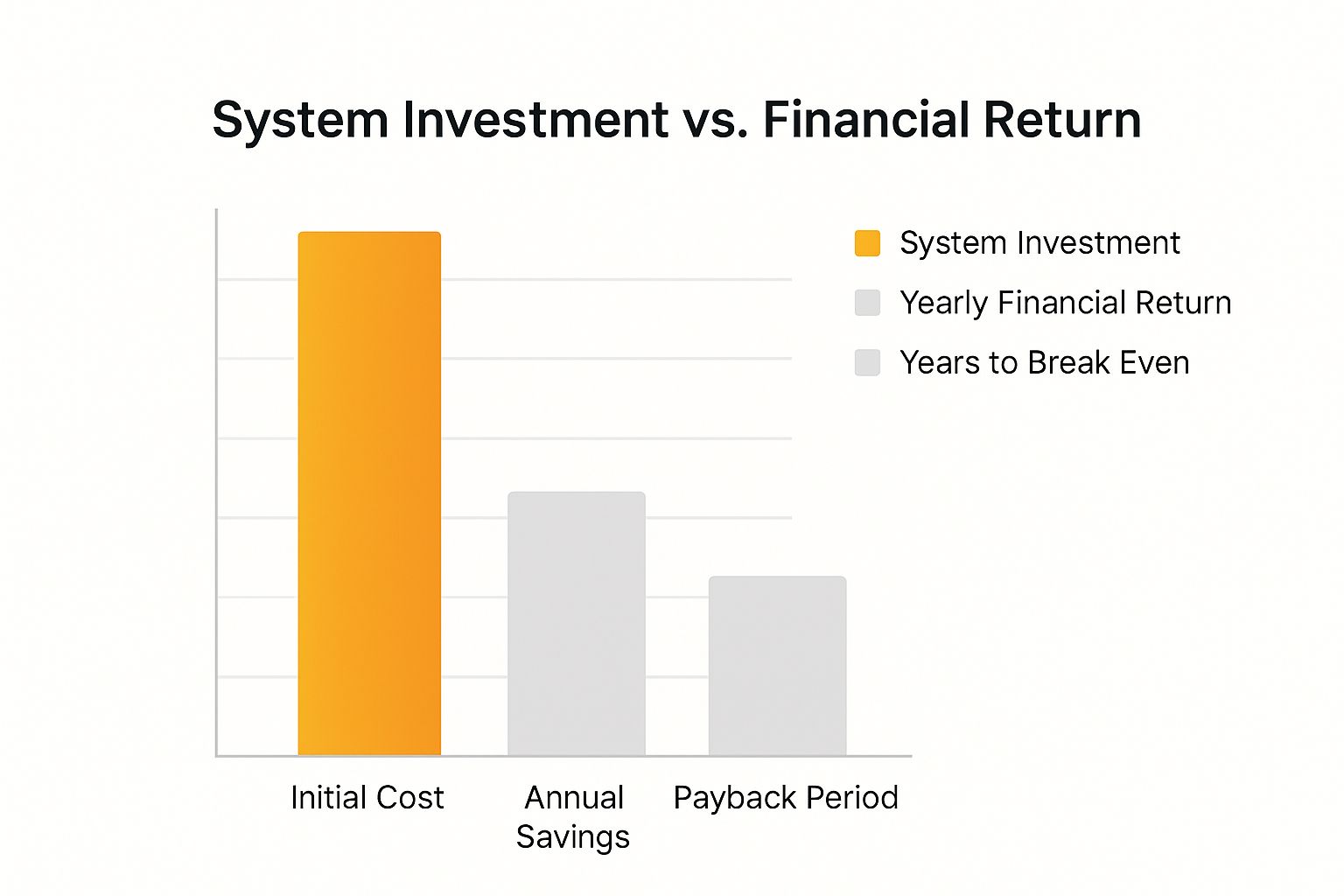
As the graphic shows, the more you save each year, the shorter the path to your payback point becomes.
Let's use a quick example. Say your system's net cost is $16,000 after all credits and rebates. If that system saves you $2,000 a year on your electric bills, your payback period is a solid eight years ($16,000 / $2,000 = 8).
Why Your Location in New York Matters
Where you live has a huge impact on your payback timeline. A property in New York City or on Long Island almost always breaks even faster than one in an area with cheaper power. Why? Because the savings per kilowatt-hour are just so much higher.
Key Takeaway: Higher local utility rates mean faster payback. Your savings are directly tied to the cost of the energy you’re no longer buying.
To see this in action, the table below shows how payback periods can shift based on regional electricity costs, using a standard 8kW residential system as our benchmark.
Estimated Solar Payback Periods in New York Regions
This table illustrates how local energy costs and solar incentives can affect payback periods across different areas of New York, assuming a standard 8kW residential system.
| Region | Average Electricity Rate (cents/kWh) | Estimated Annual Savings | Estimated Payback Period (Years) |
|---|---|---|---|
| New York City | 24¢ | $2,496 | 7 – 9 Years |
| Long Island | 22¢ | $2,288 | 8 – 10 Years |
| Upstate NY | 13¢ | $1,352 | 10 – 12 Years |
As you can see, the higher electricity rates in NYC and Long Island translate directly into larger annual savings and, ultimately, a quicker return on your solar investment compared to areas upstate.
What Your Payback Period Result Really Means
So, the calculator provides a number—let's say it's eight years. What does that actually tell you? It's not just a piece of data; it's the finish line for your initial investment. For a solar project right here in New York, anything under 10 years is generally considered a fantastic financial decision.
When you think about it, that timeline often makes solar a much more predictable investment than the stock market. Of course, this varies. The U.S. average is around 10 years, but it can swing anywhere from 5 to 15 years depending on local sun exposure and utility rates. If you're curious, you can get a better sense of how solar payback is calculated in different regions to understand the full picture.
The Real Value Starts After You Break Even
Here’s what truly makes solar exciting: the real magic begins after you hit that break-even point. Once your system has paid for itself, it is no longer an expense you're paying off. It becomes an asset that generates pure, tangible savings.
From that day forward, every single kilowatt-hour your panels produce is money that stays in your bank account instead of going to the utility company. Considering your panels have a 25+ year lifespan, this adds up to tens of thousands of dollars in your pocket over time—all from clean, reliable energy you own.
The payback period marks the end of your solar cost and the beginning of your solar profit. From that moment on, your system is a cash-positive asset working for you every single day the sun shines.
The Hidden Accelerator: Utility Rate Hikes
There's one huge factor that most simple calculators don't account for: rising electricity costs. Your calculation is based on today's rates, but we all know that companies like Con Edison and PSEG don't keep their prices flat. They go up.
As the cost of grid electricity increases, the value of the power your panels generate also increases. This means your savings actually grow each year, creating a powerful effect—it actively shortens your payback period. That eight-year estimate you started with could easily shrink to seven or even six years as utility bills continue to climb.
Think of your initial calculation as a conservative snapshot. In reality, your financial outcome is likely to be even better.
What Happens After the Payback Period?
A quick payback period is a great sign, but it's really just the beginning of your solar investment's story. Your system is built to last for 25+ years, so the real financial magic happens after it has paid for itself.
For business owners in Albany or commercial property managers in Buffalo, comparing capital investments is routine. This is where a metric like the Internal Rate of Return (IRR) comes in handy for a more technical audience. It allows you to see how a solar project stacks up against other capital investments, often proving to be a surprisingly competitive option that boosts your bottom line.
The Benefits You Can't Calculate
A payback period calculator is great with numbers, but it can't measure the peace of mind that comes from producing your own power. For many New Yorkers, the biggest win is breaking free from unpredictable utility companies and their endless rate hikes. That kind of financial security and energy independence is priceless.
And let's not forget about property value. A solar installation is a surefire way to make your property more attractive on the market. Better yet, thanks to New York's solar property tax exemption, you get that value boost without seeing an increase in your property taxes.
The true value of solar lies in securing both financial freedom and energy resilience. It's an investment in predictable costs, a higher property value, and a tangible contribution to a cleaner environment for your community.
Taking a Deeper Look at Long-Term Value
While the payback period gives you a great snapshot, other metrics offer a more complete financial picture. The Levelized Cost of Energy (LCOE), for example, tells you the average cost of every kilowatt-hour your system will produce over its entire life.
You can get a feel for this with a solar panel area and LCOE calculator. Digging into these advanced numbers is especially smart when comparing the various solar financing options for Long Island homeowners or commercial clients.
Ultimately, your solar system will keep delivering value long after it has paid for itself.
Common Questions About Solar Payback in New York
Even with a reliable solar payback period calculator, New York property owners often have specific, practical questions about the numbers. It's smart to dig into the details. Let's walk through the most common concerns we hear.
How Much Does the NYS Tax Credit Actually Help?
A great deal. New York's state solar tax credit is one of the most generous in the country, covering 25% of your system's cost, up to a $5,000 maximum for residential systems. This isn't just a small discount; it's a direct reduction of what you owe on your state taxes.
Think of it this way: for a typical system, that $5,000 credit can easily knock a full year, sometimes more, off your payback timeline. It's a huge factor that makes going solar in New York so financially attractive.
Expert Tip: Remember, this is a tax credit, not a rebate. It lowers your tax bill. When you're calculating your true, final cost for the payback period, this credit is one of the last and most important pieces of the puzzle.
Will My Property Taxes Go Up After I Install Solar Panels?
This is a great question, and the answer is no, they won’t. New York has a fantastic incentive that prevents this from happening: a 15-year property tax exemption for the value your solar panels add.
So, while your home's market value gets a nice boost from the solar installation (a great perk!), your tax assessment won't increase because of it. This policy is specifically designed to ensure higher property taxes don't erode the savings you gain from your solar panels.
What Happens if I Move Before My System is Paid Off?
Many people worry they'll lose money if they sell their home before the solar payback period is complete, but it almost always turns into a financial win.
Studies have consistently shown that homes with solar panels sell for a premium. That higher sale price often covers the entire remaining cost of the system, meaning you recoup your investment instantly at closing. It becomes a major selling point for buyers looking for a home with lower energy bills, whether you're in Suffolk County, Queens, or anywhere else in the state.
If you want to explore the potential for your own project, our solar power services page is a great place to start.
Time to Calculate Your Real Solar Payback
You now understand the theory behind the solar payback period. It’s time to move from theory to practice and discover what this looks like for your specific property here in New York.
Generic online calculators are a decent starting point. They'll give you a ballpark figure, but they often miss the nuances that make a huge difference in the real world. A proper assessment must account for the unique pitch and direction of your roof, your family's or business's actual energy consumption patterns, and the specific rate structures of your local utility—whether you're dealing with PSEG on Long Island or Con Edison in the city.
The most accurate solar payback period calculator isn't a simple online tool—it's a comprehensive analysis performed by a professional who understands New York's specific energy landscape and incentive programs.
This is where we come in. At NY Essential Power, we create a complete, no-obligation analysis tailored to you. We'll show you the exact costs, your real potential savings, and a payback timeline you can actually count on.
It’s time to move past broad estimates and get concrete answers for your home or business. Let's see just how quickly you can start generating your own clean power and turn this investment into significant, long-term returns.
Ready to discover your property's solar potential? The team at NY Essential Power is here to build your free, detailed solar proposal and answer all your questions. Contact us today at https://vqssw04szvz.c.updraftclone.com to request your complimentary quote and take the first step toward energy independence.