
Staring at your latest Con Edison or PSEG-LI bill and wondering when those solar panels on your neighbor's roof will actually start paying for themselves? That’s what we call the solar panel payback period. It's the time it takes for your savings on electricity to completely cover the cost of your solar installation, achieving energy independence and boosting your bottom line.
For most New Yorkers, this breakeven point arrives much sooner than they expect. Our state's high utility rates and some of the best incentives in the country—like the NY-Sun program—work together to dramatically accelerate your return on investment.
Understanding Your Path to Profitability
Think of it like buying a high-end espresso machine to replace your daily $5 coffee shop habit. At first, it's an expense. But after a few months, the machine has paid for itself in saved coffee runs. From that day forward, every latte you make is pure savings. Your solar system works the same way, but on a much larger scale.
Once you hit that payback milestone, every single kilowatt-hour your panels generate is free electricity. You’re not just saving money and gaining energy independence; you're enjoying decades of predictable, clean power and making a tangible environmental impact.
Whether you’re a homeowner on Long Island or a commercial property manager in Rochester, getting a handle on this timeline is the first step toward making a smart financial move. This isn't just about environmental benefits—it's about swapping a volatile, rising utility bill for a predictable, value-adding asset that increases your property's worth.
Why Your Payback Period Matters
The payback period gives you a crystal-clear metric for your return on investment (ROI). It answers the big question: "When will my solar system start making me money?" A shorter payback means a faster return and more years of pure profit over the system's 25+ year lifespan.
A few key variables really drive this timeline:
- Total Installation Cost: The all-in price for your panels, inverters, and labor.
- Available Incentives: Federal tax credits and New York's generous solar incentives are huge here, slashing your upfront cost.
- Annual Energy Savings: This is all about how much you save on your electric bill each year, which depends heavily on your local utility rates from providers like Con Edison or National Grid.
- System Performance: Simply put, how much power your panels produce based on sunlight and equipment quality.
In New York, our notoriously high electricity costs are a double-edged sword. They're painful now, but they dramatically accelerate your solar payback period because every kilowatt-hour you generate yourself is that much more valuable.
To make it even clearer, here’s a quick breakdown of the factors at play.
Key Variables Affecting Your Payback Period
| Factor | How It Impacts Your Payback | New York Specifics |
|---|---|---|
| Upfront System Cost | A lower initial cost means a faster breakeven point. | Quality installation is key, but NY's competitive market and incentives help manage costs. |
| Federal & State Incentives | These credits and rebates directly reduce your net cost, shortening the payback time significantly. | The 30% federal tax credit combined with NY-Sun rebates and state credits can cover a huge portion of the cost. |
| Local Utility Rates | The higher your electricity rates, the more money you save each month, speeding up ROI. | New York has some of the highest rates in the nation, making solar savings incredibly impactful in areas like Westchester and Long Island. |
| Energy Consumption | The more electricity you use, the more you stand to save by generating your own power. | Larger households or businesses with high energy needs see some of the fastest payback periods. |
| System Production | More sunlight and higher-efficiency panels mean more energy produced and faster savings. | While not the sunniest state, NY gets ample sunlight for solar to be highly effective, especially with quality equipment. |
Understanding these variables is the key to seeing just how quickly solar can become a powerful financial asset for your home or business.
The National Average vs New York's Reality
Across the country, the numbers for solar are looking better than ever. A recent analysis shows the average solar panel payback period in the U.S. is around 7.1 years. This accounts for a typical home system where incentives lower the net cost and energy savings quickly eat away at the initial investment.
After hitting that breakeven point, a system can generate anywhere from $31,000 to $150,000 in total savings over its life. You can explore more details on how solar ROI is improving nationwide to see the bigger picture.
Here in New York, though, the story is often even better. Our state's aggressive rebates and sky-high utility rates frequently lead to faster payback times than the national average. At NY Essential Power, we specialize in designing systems that take full advantage of these local conditions to get you to profitability as quickly as possible.
How to Figure Out Your Solar Payback Period
Calculating your solar panel payback period sounds more intimidating than it really is. At its heart, the idea is simple: you just divide the final cost of your system by the money you save on electricity each year. The result is how many years it'll take for the investment to pay for itself.
The basic formula looks like this:
Payback Period (in Years) = Net System Cost / Annual Energy Savings
Of course, the real trick is getting those two numbers right: your net system cost and your annual energy savings. Let's walk through exactly how a New Yorker can nail down these figures.
It's a straightforward process. Your initial cost and what you save each year are the two puzzle pieces that determine your payback timeline. Getting each step right is the key to an accurate estimate, giving you a clear picture of how you get from investment to pure profit.
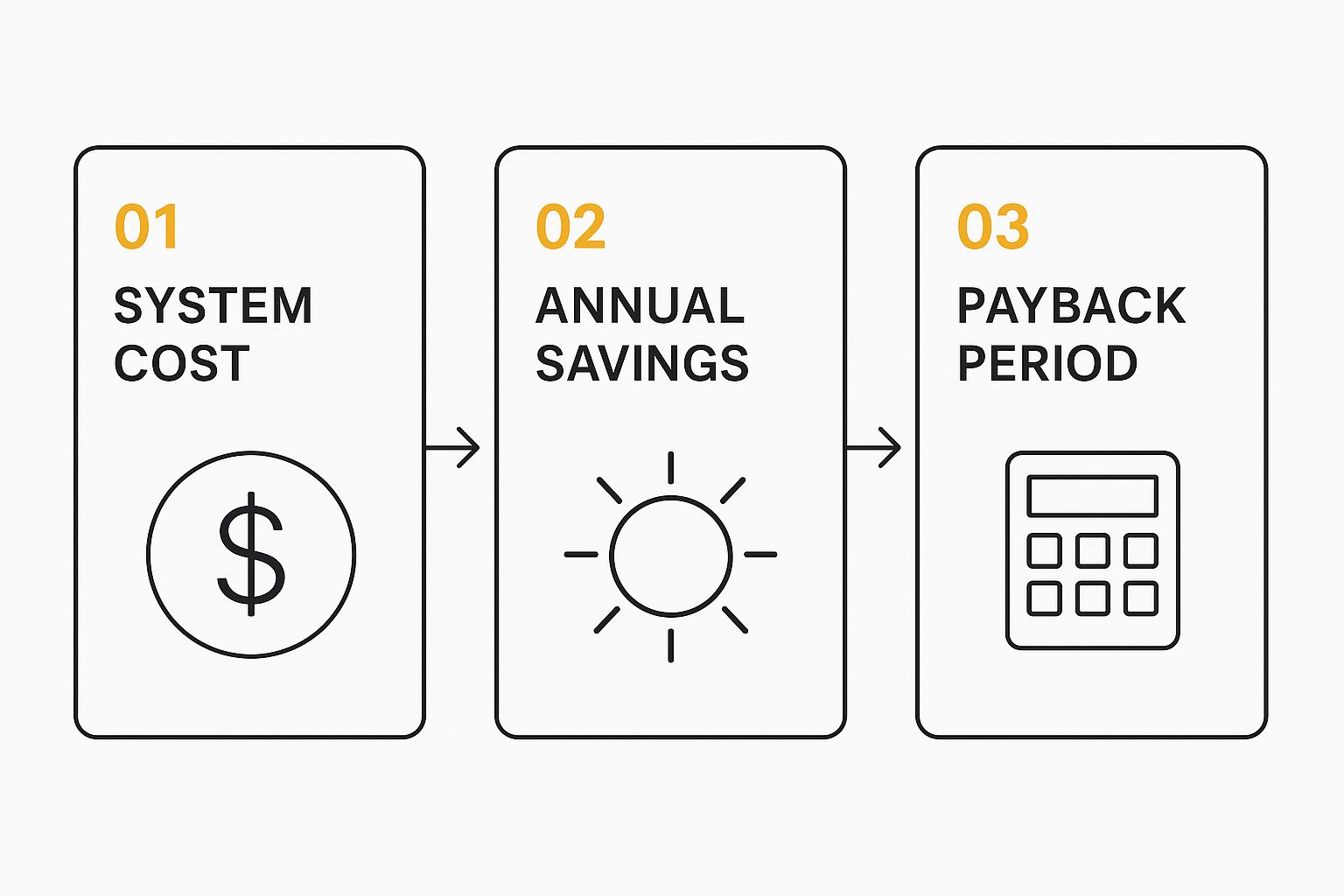
Think of this as your road map. You start with the sticker price, subtract all the discounts and incentives, and then see how your yearly energy savings chip away at that final number until you hit zero.
Step 1: Determine Your Net System Cost
Your starting point is the total price tag for the solar installation, but here’s the good news: you’ll never actually pay that full amount. A handful of powerful incentives are designed to slash that number down significantly.
First, you need the gross system cost. This is the all-in price—equipment, labor, permits, the whole shebang. The only reliable way to get this number is from a professional quote provided by a certified installer like NY Essential Power.
Next, you subtract all the available incentives to find your net system cost. This is what you'll actually be responsible for out-of-pocket.
For homeowners and business owners in New York, these incentives are game-changers:
- Federal Solar Tax Credit: This is the big one. It lets you knock 30% of your total system cost right off your federal income tax bill. It’s a true dollar-for-dollar reduction of what you owe.
- New York State Tax Credit: On top of the federal credit, the state gives you its own incentive worth 25% of your system cost, with a cap of $5,000.
- NY-Sun Megawatt Block Incentive: This is an upfront rebate paid directly to your installer, which means they just charge you less from the get-go. The amount changes by region (like Long Island vs. Upstate) and shrinks as more people go solar, so it pays to act sooner rather than later.
Once you subtract these powerful credits and rebates from the gross price, you're left with your true investment cost. For a deeper dive into these numbers, check out our complete guide to breaking down the cost of solar panels on Long Island.
Step 2: Calculate Your Annual Energy Savings
With your net cost figured out, the next move is to see how much money your solar panels will save you every year. This is the engine that powers your payback.
The most direct way to do this is to grab your old electricity bills. Pull together your last 12 months of statements from your utility—whether that's PSEG-LI, Con Edison, or National Grid.
Add up the total you paid for electricity over that year. That number is your potential annual savings, assuming your new solar system is sized to cover 100% of your needs. For instance, if you were paying about $250 a month, your total annual electricity cost comes out to $3,000.
That $3,000 is now your estimated annual savings. It's money that stays in your pocket instead of going to the utility company, and it’s what will be paying back your solar investment year after year.
Step 3: Put It All Together with an Example
Okay, let's connect the dots with a real-world scenario for a family in Suffolk County, Long Island.
- Gross System Cost: Let's say a top-tier system perfectly sized for their home comes in at $30,000.
- Calculate Net Cost:
- Federal Tax Credit: $30,000 x 30% = $9,000
- NYS Tax Credit: $30,000 x 25% = $7,500 (but it’s capped at $5,000)
- NY-Sun Rebate (for this example): $1,000
- Total Incentives: $9,000 + $5,000 + $1,000 = $15,000
- Net System Cost: $30,000 – $15,000 = $15,000
- Calculate Annual Savings: A look at their PSEG-LI bills shows they spend $2,500 per year on power.
- Calculate the Payback Period:
- $15,000 (Net Cost) / $2,500 (Annual Savings) = 6 years
In this typical Long Island scenario, the solar panel payback period is just 6 years. After that, the system is generating over $2,500 in pure, tax-free savings every single year for the next two decades or more.
Factors That Speed Up Your Solar ROI in New York
Several key elements come together in New York to create a perfect storm for a rapid solar panel payback period. It’s not just one thing; it’s a combination of high energy costs, incredible government support, and smart system design. Understanding how these pieces fit together is the key to maximizing your return.
Here in New York, the environment is primed to help you get a faster return on your solar investment. At NY Essential Power, we design systems that strategically use these local factors, ensuring you move from initial cost to pure profit as quickly as possible.
High Electricity Rates Work in Your Favor
Let's be honest: New Yorkers pay some of the highest electricity prices in the entire country. While that stings every month when the utility bill arrives, it actually becomes a massive advantage once you go solar.
Every single kilowatt-hour (kWh) your solar panels generate is a kWh you don't have to buy from Con Edison or PSEG-LI. When rates are high, the value of that self-generated power is magnified. This means bigger monthly savings and a much shorter path to breaking even.
Think of it this way: Saving 25 cents per kWh in Westchester County pays back your system much faster than saving 12 cents per kWh somewhere else. Your high electric bill becomes the fuel for your solar investment's success.
This dynamic is exactly why going solar in places like Long Island and New York City is one of the smartest financial moves a property owner can make.
Powerful State and Federal Incentives
New York doesn't just leave it up to high utility rates to make solar a good deal. The state has put together a robust stack of incentives that directly slash your upfront costs, which is the most direct way to shorten your solar panel payback period.
These programs work together to dramatically reduce what you actually pay out of pocket:
- The Federal Solar Tax Credit: This is the big one. It allows you to deduct a full 30% of your total system cost right off your federal taxes.
- NYS Solar Energy System Equipment Credit: On top of the federal credit, New York gives you a state tax credit for 25% of your system cost, up to a $5,000 maximum.
- The NY-Sun Program: This program provides an upfront rebate based on your system's size, lowering the initial price tag before you even write the check.
When you combine these, many New Yorkers can cut their initial solar investment nearly in half. You can get the full breakdown in our detailed guide to 2025 solar incentives and tax credits for New York homeowners.
The Importance of Optimal System Design
Finally, how your system is designed and installed plays a huge role in its performance and your payback speed. A poorly designed system will simply underproduce, stretching out the time it takes to recoup your investment. It’s that simple.
A few key design factors really matter:
- Panel Orientation: Here in New York, a south-facing roof is the gold standard for capturing the most sunlight all day long.
- Tilt Angle: The angle of the panels isn't random. It’s carefully calculated to optimize sun exposure based on our northern latitude.
- Shade Avoidance: A professional installer will meticulously map out any potential shading from trees or nearby buildings. Even a little bit of shade can significantly impact performance.
An expert installation ensures your system is engineered to wring every possible drop of energy from the sun. This maximizes your annual production, which translates directly into higher savings and a faster ROI.
Real-World Payback Scenarios Across New York
Alright, let's move past the formulas and see what this looks like on the ground. The solar payback period isn't just a number on a spreadsheet; it's a real-world timeline that changes depending on where you are in New York, how much power you use, and the type of property you have.
Seeing a few different examples really brings the investment to life, whether you're a homeowner on Long Island or running a business upstate.
Scenario 1: A Suburban Family Home in Nassau County
Let's start with a classic example: a family in a Nassau County suburb. They're getting hit with PSEG-LI bills that keep creeping up, now averaging around $275 a month. That’s $3,300 a year just to keep the lights on. The good news? They have a big, south-facing roof that’s perfect for solar.
They decide on an 11 kW rooftop system, which is big enough to cover pretty much 100% of their annual electricity needs. Here’s how the math shakes out for them:
- Gross System Cost: $33,000
- Federal Tax Credit (30%): $9,900
- NYS Tax Credit (Capped): $5,000
- NY-Sun Rebate: $1,100
- Total Incentives: $16,000
- Net System Cost: $17,000
With $3,300 in annual savings, the calculation is simple: $17,000 / $3,300 = 5.15 years. So, in just over five years, this Long Island family's system has paid for itself. After that, it’s decades of free power. We took an even deeper dive into this, exploring what the ROI on solar looks like in Suffolk County, which often follows a very similar financial path.
Scenario 2: A Commercial Warehouse in Rochester
Now, let's head upstate to a medium-sized commercial warehouse in Rochester. They've got a massive energy footprint from lighting, heating, and machinery, costing them about $22,000 a year.
To tackle this, they install a 90 kW rooftop solar array. This is where things get interesting, because commercial projects get access to powerful incentives that homeowners don't, completely changing the financial picture.
For businesses, the federal tax incentives are a game-changer. Beyond the standard 30% tax credit, they can use bonus credits and accelerated depreciation (MACRS). This lets them write off a huge chunk of the system's value from their taxes in the very first year.
- Gross System Cost: $211,000
- Federal Incentives (Tax Credit + MACRS): Roughly $105,000 in first-year tax benefits.
- NY-Sun Rebate: $9,000
- Net System Cost: $97,000
With $22,000 in annual energy savings, their payback period is $97,000 / $22,000 = 4.4 years. This kind of quick return makes solar a no-brainer for New York businesses trying to cut down their overhead.
Scenario 3: An Agricultural Operation in the Hudson Valley
For our last example, let's look at a farm in the Hudson Valley. Between irrigation pumps, barn operations, and processing equipment, their utility bills are hitting around $18,000 a year.
They opt for a 75 kW ground-mounted solar system on a patch of unused land. Farms and other agricultural businesses can tap into some really unique funding opportunities.
On top of the standard commercial tax breaks, this farm qualifies for a USDA REAP Grant. This is a federal program specifically designed to help farms and rural small businesses go green, and it can cover up to 50% of the project cost.
- Gross System Cost: $187,500
- Federal Tax Benefits (Credit + MACRS): $93,750
- USDA REAP Grant: $46,875
- Net System Cost: $46,875
By stacking these incredible incentives, the farm’s out-of-pocket cost is slashed. With $18,000 in annual savings, their solar panel payback period is just 2.6 years. It’s a perfect illustration of how leveraging the right programs can deliver an almost immediate return, turning a major expense into a powerful asset.
New York Solar Payback Scenario Comparison
To give you a clearer picture, let's put these scenarios side-by-side. The table below compares the key financial details for each of our New York examples.
| Customer Profile | Location | System Size | Net Cost After Incentives | Estimated Payback Period |
|---|---|---|---|---|
| Suburban Homeowner | Nassau County | 11 kW | $17,000 | ~5.2 years |
| Commercial Warehouse | Rochester | 90 kW | $97,000 | ~4.4 years |
| Hudson Valley Farm | Hudson Valley | 75 kW | $46,875 | ~2.6 years |
As you can see, your profile and ability to tap into specific incentives dramatically influence how quickly you break even. While a homeowner can expect a solid return in about five years, commercial and agricultural operations can see that timeline cut nearly in half by taking full advantage of available grants and tax strategies.
The Long-Term Value Beyond Your Payback Period
Hitting your solar panel payback period is a great feeling, but it’s not the finish line. Think of it as the starting line for decades of pure profit. Once the system has paid for itself, every single kilowatt-hour it produces is money that stays in your pocket. This is where the real financial power of your solar investment kicks in.
Your solar panels are built for the long haul. Most high-quality systems come with a 25-year warranty and are expected to keep working for 30 years or more. If your payback period is six years, you're looking at a minimum of 19 years of generating electricity that's virtually free. For a New York homeowner saving $3,000 a year, that adds up to $57,000 in tax-free savings after breaking even.
This kind of long-term gain isn't just a local phenomenon. Around the world, solar payback periods are being tracked, with markets in the UK showing similar timelines of 7 to 10 years. After that breakeven point, a standard UK system can deliver total savings over £38,000 (about $48,000) during its lifespan. It’s a testament to the consistent value solar offers globally. This consistency is a big reason the market keeps expanding, and you can discover more insights about global solar energy statistics to see the bigger picture.
Lock In Your Energy Costs and Gain Independence
Beyond the raw savings, going solar offers something truly valuable in New York's unpredictable energy market: cost certainty. Utility rates are anything but stable and have a long history of climbing. When you generate your own power, you essentially fix your electricity costs for the next couple of decades.
This energy independence acts as a buffer against:
- Sudden rate hikes from utilities like Con Edison or PSEG-LI.
- Seasonal price spikes that always seem to hit during the hottest summer months.
- Geopolitical events that can send fossil fuel prices through the roof.
While your neighbors in Westchester or on Long Island are anxiously opening their next utility bill, yours will be predictable, stable, and low. For a business trying to manage a budget for the long term, that kind of stability is priceless.
Your solar array isn't just an energy source; it's a financial shield. It insulates your home or business from the inflation and volatility that define the traditional energy market, giving you control over an essential expense.
Increase Your Property Value and Environmental Legacy
A solar installation is also a major property upgrade. Study after study has shown that homes with solar panels sell for more—and often sell faster—than similar homes without them. For a potential buyer, seeing a solar-equipped home means they get to enjoy lower utility bills from day one, which is a huge selling point.
Finally, your investment leaves a positive mark on the environment. A typical residential solar system in New York can offset the same carbon emissions as planting over 150 trees every single year. By choosing solar, you're not just making a savvy financial move; you're helping build a cleaner, healthier New York for generations to come. It’s this powerful blend of financial return, energy independence, and environmental stewardship that makes going solar such a compelling choice.
Ready to Start Your Own Solar Journey?
You’ve now got a solid handle on the solar panel payback period and a clear picture of the incredible value waiting on the other side. Here in New York, the road to energy independence isn't just a dream—it's more accessible than ever, with homeowners and businesses from Long Island to the Hudson Valley taking back control of their power bills.
Don't just watch another expensive utility bill land in your inbox. While the numbers in this guide give you a great starting point, the real magic happens when you move from a general estimate to a precise calculation for your own property. Every home and business has a unique energy fingerprint, and a custom analysis is the only way to uncover your true savings potential.
Get Your Custom Solar Roadmap
At NY Essential Power, we live and breathe New York solar. Our entire focus is on designing systems that deliver the fastest possible payback and the biggest lifetime savings for our fellow New Yorkers. We know the local incentives, the specific utility company policies, and the regional building codes like the back of our hand. That deep-seated expertise means we can build a solution that truly makes financial sense for you.
The next step is getting real numbers for your roof, your energy bills, and your specific situation. A generic online calculator can only get you so far—this is where a professional consultation makes all the difference.
We're with you every step of the way. From the first look at your property and crunching the numbers to handling all the permits and flipping the switch, we make the entire process straightforward and transparent. Our mission is to draw you a clear map from where you are today to a future of energy freedom.
It's time to take control. Stop wondering what your solar payback period might be and find out the exact answer. Request a free quote today from NY Essential Power, and let us build your personal roadmap to decades of clean energy and serious financial savings.
Your Top Questions About Solar Payback, Answered
When you’re thinking about going solar, it’s completely normal for the financial side of things to be top of mind. Getting a handle on the solar panel payback period is what helps most people decide if it's the right move for them. We hear the same great questions from New Yorkers all the time, so we’ve put the answers right here for you.
Think of this as the final piece of the puzzle. We'll cover what happens after you hit that magic break-even point and how things like batteries and incentives can shift your timeline. Let's clear up the details.
What Happens After My Solar Payback Period Ends?
Hitting your payback milestone is a huge win, but honestly, that’s when the real fun begins. Once your system has officially paid for itself through energy savings, the most profitable part of your solar journey kicks off.
From that day forward, every bit of electricity your panels generate is pure savings in your pocket. Your system will keep producing clean energy for the rest of its 25+ year lifespan, effectively turning a major monthly bill into a source of long-term financial gain. It's like getting decades of free electricity for your home.
Does Adding a Solar Battery Change My Payback Period?
It does. Adding a solar battery storage system, like a Tesla Powerwall, will almost always extend your payback timeline. The battery is an additional upfront cost, so it naturally takes a bit longer for your energy savings to offset the total investment.
But a battery offers incredible value that a simple payback calculation doesn't capture. It’s what gives you true energy independence and resilience. You get:
- Crucial Backup Power: When the grid goes down, your lights stay on. For a business, that means avoiding thousands in lost revenue. For a family, it's about safety and comfort.
- Maximum Solar Usage: A battery lets you store the extra energy you produce during the day and use it at night, cutting your reliance on utilities like PSEG-LI even further.
So, while the initial payback takes longer, a battery dramatically boosts your long-term savings and provides peace of mind you really can't put a price on.
A solar battery transforms your system from a simple money-saver into a complete energy security solution. It’s an investment in resilience, especially with the increasing frequency of grid disruptions in our region.
Will New York's Solar Incentives Last Forever?
Definitely not. Solar incentives are designed with a built-in expiration date. They exist to help the technology get established, and as solar becomes more common, the programs are designed to phase out. This creates a real sense of urgency for anyone on the fence.
The two big ones to watch in New York are:
- The Federal Solar Tax Credit: This fantastic 30% credit is already scheduled to step down and eventually disappear. There’s no guarantee it will be around forever.
- The NY-Sun Program: This state-level rebate works in "blocks." As more people in an area (like Long Island) install solar, the incentive amount for the next group of homeowners gets smaller.
The bottom line is, waiting to go solar almost guarantees you’ll get less financial help. Acting now locks in today's more generous rates, which makes a direct and positive impact on shortening your solar panel payback period.
How Much Do Local Electricity Rates Affect My Payback?
Your local electricity rates have a massive impact on how quickly you break even—maybe more than any other single factor. It’s simple: the higher your rates, the more money you save for every kilowatt-hour your panels produce.
Here in New York, we’re dealing with some of the highest utility costs in the entire country. If you’re a Con Edison customer in Westchester or you're on Long Island with PSEG-LI, this is actually a huge advantage for going solar. Because you’re avoiding such an expensive product (utility power), your savings add up incredibly fast.
A homeowner in a state with cheap power might see a 10–12 year payback period. A New Yorker can often get there in just 5–7 years, all because the energy we're generating on our roofs is so much more valuable.
It's time to move from general questions to specific answers for your property. The team at NY Essential Power is ready to provide a detailed, no-obligation analysis of your potential savings and precise payback period. Discover how you can achieve energy independence and start your journey to a more profitable future.