When you start comparing solar panels, "efficiency" simply means how much sunlight a panel can turn into electricity. Today's high-quality residential panels typically land in the 20-23% efficiency range—an incredible jump from the 6% models that first appeared in the 1950s. For New York homeowners and businesses, this means you can generate the power you need with fewer panels, a huge advantage when space is limited. This guide will help you understand how a solar panel efficiency comparison can lead you to significant cost savings, greater energy independence, and a smaller carbon footprint.
What Solar Panel Efficiency Means for New Yorkers
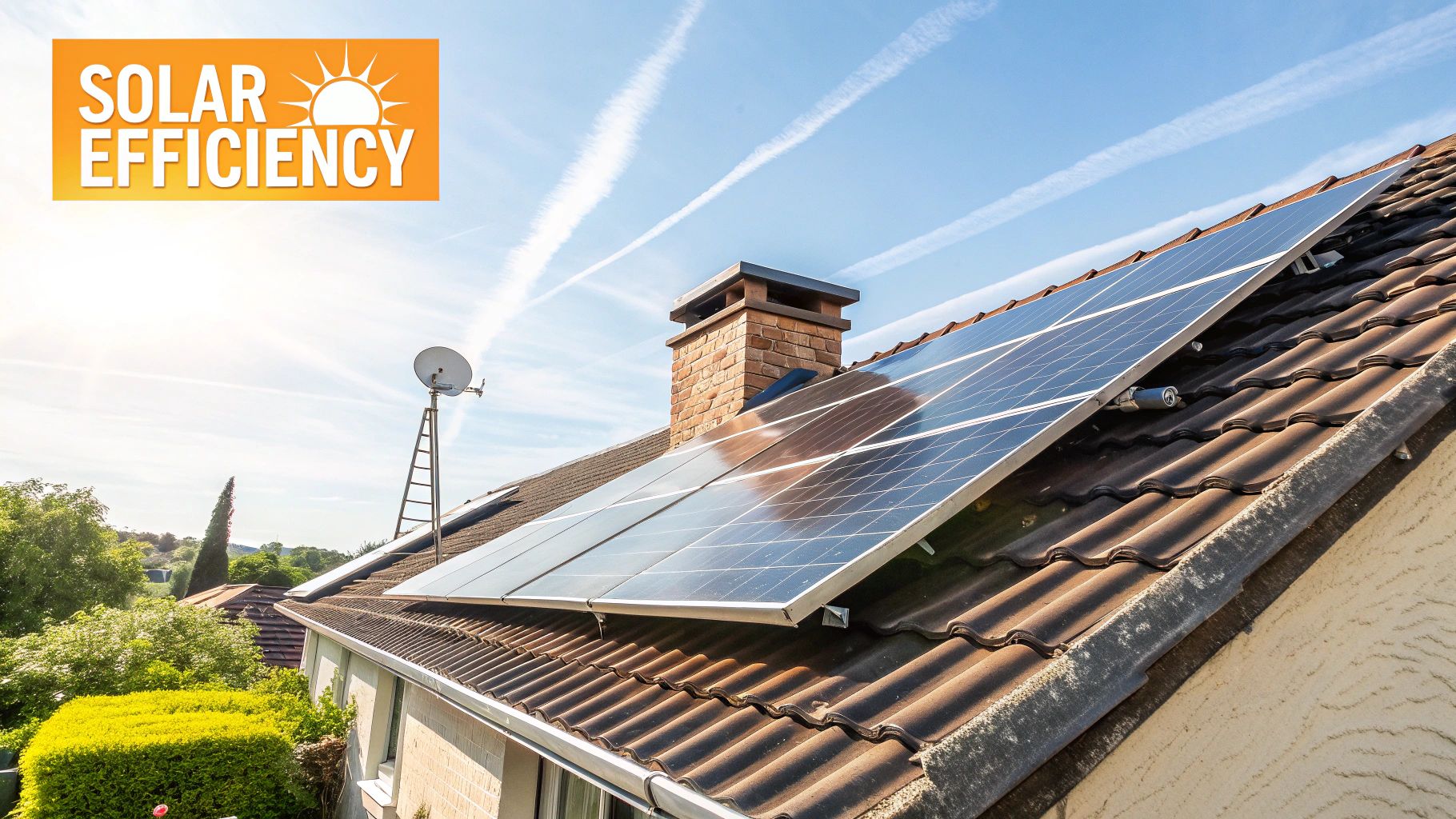
Understanding solar panel efficiency is the first step toward a smart energy investment. That percentage tells you how much of the sun's energy hitting the panel's surface gets converted into usable electricity for your home or business. For a homeowner in Buffalo with a smaller roof or a business on Long Island aiming for maximum output, a higher efficiency rating isn't just a number—it's the key to unlocking greater savings and achieving energy independence.
This is especially true here in New York. We need to maximize our peak sun hours to offset energy costs throughout the year. Better efficiency means you generate more clean power, which leads directly to bigger savings on your utility bills and a faster return on your investment.
Why Efficiency Matters in Your Area
Whether you're in a dense urban neighborhood or a sprawling suburb, efficiency defines your system's potential. A more efficient panel simply squeezes more power out of a smaller footprint.
- Space-Constrained Properties: For a Brooklyn brownstone or a commercial building in Queens, roof space is a premium asset. High-efficiency panels are essential for generating significant power when you don't have a lot of room to work with.
- Long-Term Energy Production: Panels with higher efficiency ratings are built with superior technology. This means they degrade slower and will continue producing more clean electricity over their entire 25+ year lifespan, locking in savings for decades.
The progress in solar technology has been remarkable. The first practical silicon solar cell, built in 1954, was only about 6% efficient. Today, we routinely install panels that reach 20-23% efficiency, while labs are already pushing beyond 47%.
The Impact on Your Energy Bills
Ultimately, comparing solar panel efficiency comes down to your bottom line. A more efficient system generates more kilowatt-hours (kWh), which directly reduces what you owe to utilities like Con Edison or PSEG Long Island. It also means you can earn more credits through New York's net metering program, which allows you to sell excess power back to the grid and further accelerate your return on investment.
For New Yorkers, every percentage point of efficiency counts. It can be the difference between cutting 80% of your energy bill and eliminating it entirely.
Choosing the right panel depends on your specific property, your energy consumption, and your financial goals. We help homeowners and businesses across all our New York service areas find the perfect balance between performance, cost, and long-term value.
Comparing Key Solar Panel Technologies
When you explore the world of solar, you'll find three main types of panel technology. Each has its own strengths, and the right choice for your New York property depends on your goals, budget, and available space. A direct solar panel efficiency comparison is the best way to determine which technology delivers the most value for your investment.
This infographic provides a clear side-by-side look at how they compare.
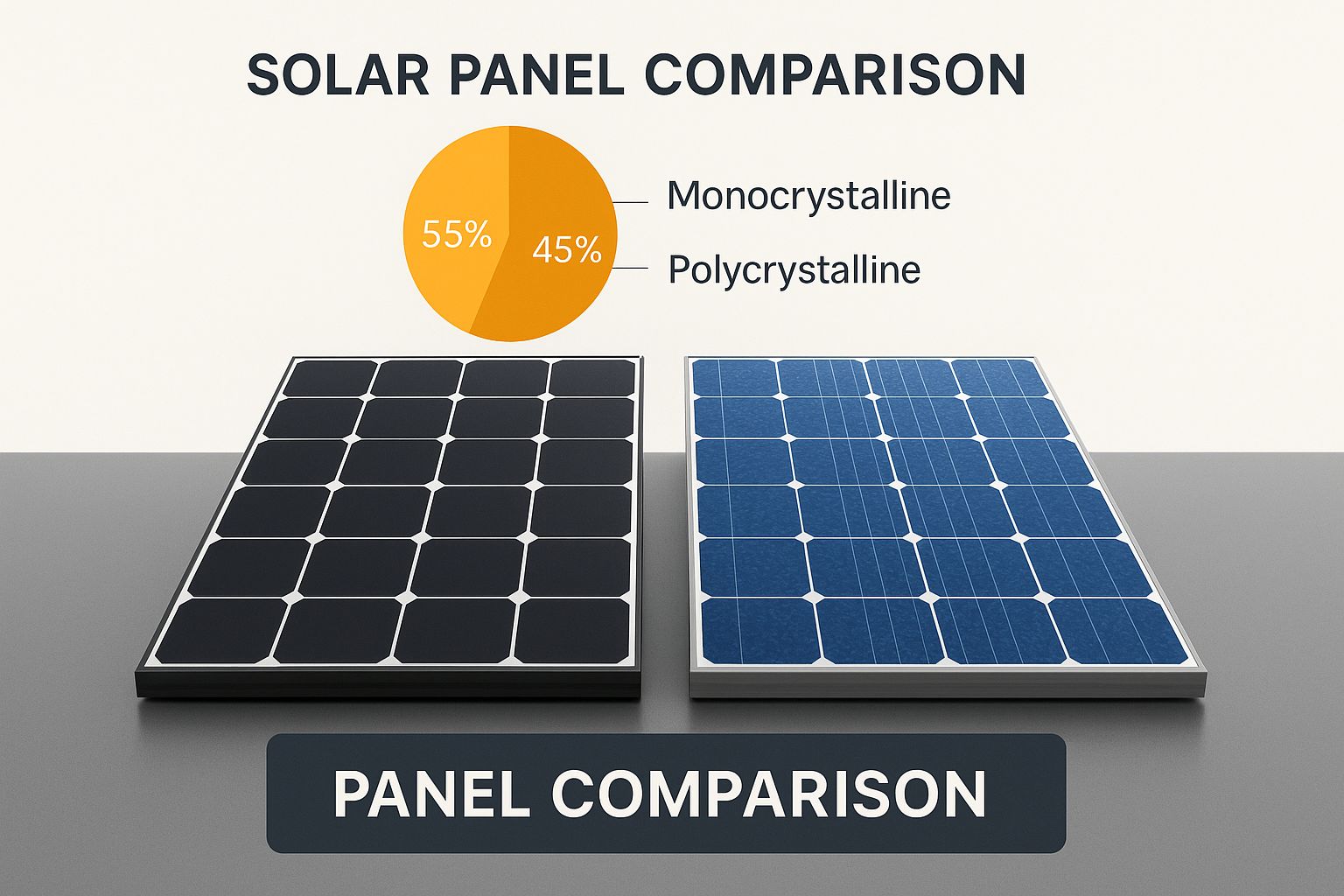
As you can see, the physical differences between them result in distinct performance levels and aesthetics for each type of panel.
Monocrystalline Solar Panels: The Efficiency Leader
Monocrystalline panels are the premium option, delivering the highest performance. They are crafted from a single, high-purity silicon crystal, which gives them their sleek, uniform black appearance and, more importantly, their superior efficiency ratings.
For a homeowner in New York City with a tight rooftop or a Long Island business trying to maximize every watt of potential power, monocrystalline panels are the ideal choice. Their exceptional efficiency means you generate more electricity from a smaller area. While solar panel efficiency varies, monocrystalline panels often reach 20-23%, whereas polycrystalline panels are typically in the 15-17% range. Thin-film cells, though less common for rooftops, are usually around 11-13%. You can learn more about how panel cost and efficiency have evolved at FormeSolar.com.
Their all-black look also offers a modern, clean aesthetic that blends seamlessly with various roof styles, making them a top choice for residential and commercial projects where both performance and curb appeal matter.
Polycrystalline Solar Panels: A Balance of Cost and Performance
Polycrystalline panels are easily identified by their blue, marbled appearance. They offer a strong balance between solid performance and affordability. The manufacturing process involves melting multiple silicon fragments together, which is simpler and less expensive.
While not as efficient as their monocrystalline counterparts, they are an excellent choice for projects with ample space. For a commercial building in upstate New York or a warehouse in Suffolk County with a large, unobstructed roof, polycrystalline panels can meet energy goals without the premium price tag.
By installing a slightly larger array, you can generate the same amount of power as a smaller monocrystalline system for a lower upfront cost. This makes them a practical and cost-effective solution for large-scale commercial installations where budget is a primary concern.
Key Takeaway for New Yorkers: Monocrystalline panels are your best bet for maximizing power on limited city or suburban rooftops. Polycrystalline panels offer a more budget-friendly path to energy independence if you have ample space for a larger system.
Thin-Film Solar Panels: Flexible and Versatile
Thin-film technology is fundamentally different. Instead of solid silicon wafers, these panels are made by depositing ultra-thin layers of photovoltaic material onto a flexible substrate like glass or plastic. This process makes them lightweight, flexible, and less expensive to produce.
Thin-film panels have the lowest efficiency of the three but offer unique advantages, such as better performance in low-light conditions and high heat. This can be beneficial during New York's overcast winter days.
Their flexibility allows for applications where rigid panels are not suitable, such as on curved roofs. However, because they produce less power per square foot, they are not typically the first choice for residential rooftops where space is precious. They are better suited for large-scale, utility-level solar farms.
To help you visualize how these technologies fit into a New York context, here's a quick breakdown.
Solar Panel Technology Comparison for New York Properties
| Technology | Average Efficiency | Best Use Case in NY | Cost Profile | Aesthetic |
|---|---|---|---|---|
| Monocrystalline | 20-23% | Homes with limited roof space (e.g., NYC, Long Island suburbs) | Higher upfront cost, best long-term value | Sleek, uniform black |
| Polycrystalline | 15-17% | Large commercial roofs, properties with ample space (e.g., warehouses, rural homes) | Lower upfront cost, great for budget-focused projects | Blue, speckled appearance |
| Thin-Film | 11-13% | Large-scale solar farms, specialty architectural applications (e.g., curved surfaces) | Lowest cost, but requires the most space | Varies; often dark and uniform, but flexible |
Ultimately, choosing the right panel means weighing these factors carefully. That’s why at NY Essential Power, our first step is always a detailed analysis of your property and energy needs, making sure you get the perfect technology to meet your goals.
Top Solar Panel Brands and Their Performance
Once you understand the different types of solar technology, the next step is choosing a brand. This is just as critical as selecting the right tech, as the manufacturer impacts everything—from real-world performance to the warranty protecting your investment for the next 25 years.
At NY Essential Power, we are highly selective about the manufacturers we partner with. We exclusively work with industry leaders known for quality, innovation, and bankable warranties. This ensures that whether we're installing on a family home in Syracuse or a commercial property in Manhattan, our clients receive a system that delivers reliable performance, long-term savings, and true energy independence.
Leading Brands for New York Properties
While many good manufacturers exist, a few consistently stand out for their superior efficiency, durability, and proven performance. Brands like SunPower, REC, Panasonic, and Qcells have earned their reputations by pushing solar technology forward and backing their products with industry-leading warranties.
This chart from the National Renewable Energy Laboratory (NREL) highlights the rapid pace of innovation, showing how quickly PV cell efficiency is climbing. These breakthroughs are constantly being incorporated into the top-tier panels available today.
For you, this upward trend means that lab research is directly translating into more powerful panels for your home or business, leading to a better return on your clean energy investment.
SunPower: A Legacy of High Efficiency
For years, SunPower (now produced by Maxeon Solar Technologies) has set the gold standard for high-efficiency panels. Their Maxeon line, featuring advanced N-type back-contact (BC) cells, consistently achieves efficiency ratings that surpass the industry average, often reaching an impressive 23-24%.
This makes them the premier choice when roof space is at a premium, such as on a townhouse in Albany or a commercial rooftop in Queens where maximizing every square foot is critical.
Why SunPower Stands Out: Their panels are engineered for an incredibly low degradation rate, meaning they lose less power-producing capability over time than most other panels. Combined with a rock-solid 25-year product and performance warranty, SunPower offers genuine peace of mind and long-term value.
REC Group: Balancing Performance and Value
REC is another top-tier brand respected for its innovative designs and reliable output. Their Alpha series, which utilizes advanced heterojunction (HJT) cells, delivers outstanding efficiency that often exceeds 22%.
This HJT technology also gives their panels an excellent temperature coefficient. For a property on Long Island that experiences hot summer sun, this is a significant advantage. It means the panels lose less power as temperatures rise, generating more energy when you need it most to run your air conditioning. You can learn more about our solar philosophy on our company blog.
Panasonic: Endurance and Reliability
Panasonic is a name synonymous with quality, and their solar panels uphold that reputation. Similar to REC, they use HJT cell technology to create panels that are both highly efficient and incredibly durable.
Their EverVolt series boasts efficiency ratings in the 21-22% range. Panasonic also provides an excellent all-in-one warranty covering performance, parts, and labor, making them a solid and dependable choice for any solar project in New York.
Qcells: A Leader in Innovation and Quality
Qcells has become a powerhouse in the residential and commercial solar markets by delivering high-quality, high-performance panels at a competitive price. Their Q.PEAK DUO series, for example, uses proprietary Q.ANTUM DUO Z technology to achieve efficiencies of over 21%.
They offer a fantastic blend of performance, aesthetics, and overall value, making them a versatile workhorse suitable for a suburban home in Westchester or a large commercial installation. Their strong warranty and financial stability make them a reliable partner for decades of clean energy production.
To make this solar panel efficiency comparison easier, here’s a quick look at how these leading brands stack up.
| Brand | Flagship Series | Avg. Efficiency | Key Advantage for NY | Warranty (Product/Performance) |
|---|---|---|---|---|
| SunPower (Maxeon) | Maxeon 7 | 23-24.1% | Maximum output for limited roof space | 25-year / 25-year |
| REC Group | Alpha Pure-R | 21-22.3% | Excellent performance in high summer heat | 25-year / 25-year |
| Panasonic | EverVolt HK Black | 21-22% | High reliability and comprehensive warranty | 25-year / 25-year |
| Qcells | Q.PEAK DUO | 20-21.5% | Strong balance of performance, cost, and quality | 25-year / 25-year |
The "best" brand ultimately depends on your specific needs—a balance of budget, available space, and performance goals. At NY Essential Power, our job is to help you navigate these choices and design a system that’s a perfect fit. Request a free quote today to get a personalized recommendation from our experts.
How New York Weather Really Affects Your Solar Panels
A solar panel's efficiency rating is measured under perfect lab conditions. In the real world of New York, local factors like heat, cold, and cloud cover play a significant role in your system's actual power output.
Understanding how our unique climate impacts performance is crucial. It’s also why a professional site assessment is non-negotiable, whether you're in the snowy Adirondacks or on the sunny shores of Long Island.
What the Temperature Coefficient Means for NY Summers
It may sound counterintuitive, but solar panels are not fans of extreme heat. As they get hotter, their power output drops. This effect is measured by the temperature coefficient—a number indicating how much efficiency is lost for every degree Celsius the panel rises above the standard test temperature of 25°C (77°F).
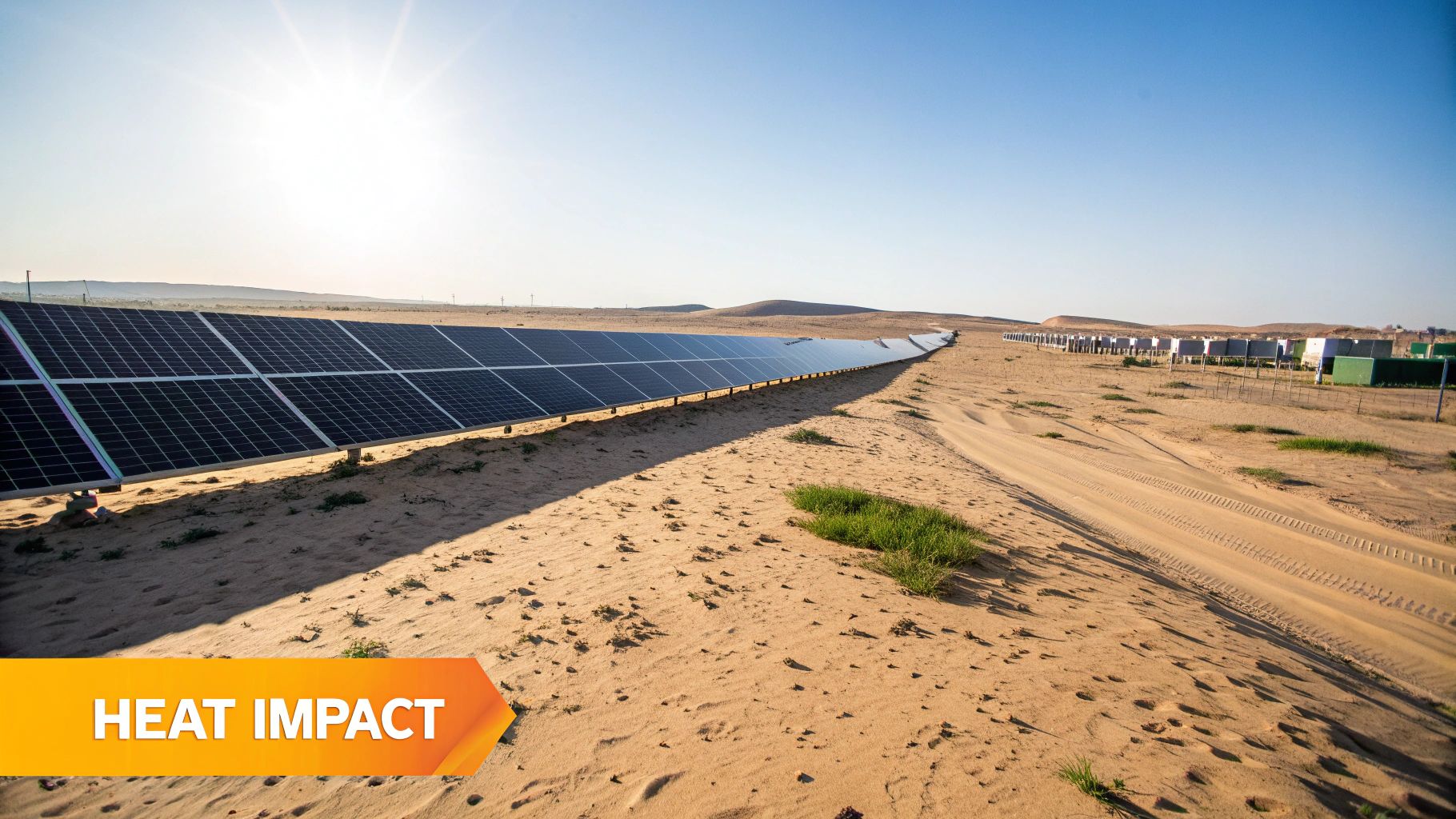
On a hot summer day, a Long Island rooftop can easily heat panels to over 120°F. A panel with a lower temperature coefficient will retain more of its power-producing capability in that heat.
Think of it this way: a panel with a temperature coefficient of -0.35%/°C will outperform one rated at -0.45%/°C on a scorching July afternoon. That small percentage adds up, especially when your AC is running full blast.
Performance on Cold, Cloudy Days
Here's the good news: solar panels love the cold. On a crisp, bright winter day upstate, your panels can actually perform better than their official rating. The cold helps the electronics work more efficiently, converting sunlight into electricity with less energy loss.
Of course, New York also has its share of gray, overcast days. While production dips without direct sun, modern panels are designed to capture scattered and ambient light, meaning they still generate power even when it's cloudy. We design systems based on annual sunlight data for your exact location, so these less-than-perfect days are already factored in.
Shading: A Major Hurdle in Crowded Areas
Nothing compromises a solar system's output faster than shade. A shadow from a large oak tree, a neighboring building in Brooklyn, or even your own chimney can significantly reduce your energy production.
This is where smart system design is essential. A professional installer from NY Essential Power will conduct a thorough shade analysis to:
- Map shadows: We determine exactly where shadows will fall on your roof throughout the day and year.
- Optimize panel layout: We place panels where they will receive the most sun, avoiding known shade spots.
- Use the right tech: For complex situations, we can use power optimizers or microinverters to prevent a small amount of shade from affecting the performance of your entire system.
The Critical Role of Angle and Orientation
For maximum sun exposure in New York, solar panels should ideally face south. The optimal tilt angle is usually close to your property's latitude, ensuring the panels receive the most direct sunlight year-round. While a south-facing roof is the gold standard, east- and west-facing roofs are also excellent for solar.
Proper positioning is key; even a minor mistake can impact your annual output. For homes and businesses with flat roofs or limited space, we can explore other options like ground-mounted systems or creative structures. Learn more by checking out our guide to installing solar canopies on Long Island.
When we talk about solar panel efficiency, we're really talking about your bottom line. It's not just about the tech specs; it's about getting the most out of your investment. In New York, the entire incentive structure—from state credits to federal tax breaks—is built to reward energy production. This makes choosing higher-efficiency panels a smart financial move.
The logic is simple: more efficient panels produce more electricity. More electricity means a faster payback period and bigger savings over the long haul.
Look at net metering, for example. When your system generates more power than you're using, that extra energy flows back to the grid. Utilities like Con Ed and National Grid give you credits for that surplus, which you can cash in later when the sun isn't shining. A more efficient system generates more surplus energy, which means larger credits. Your roof literally becomes a more profitable asset.
Connecting Efficiency to Key NY Solar Programs
Opting for panels with top-tier efficiency ratings is the best way to squeeze every drop of value from New York's fantastic solar programs. The difference really adds up across a few key incentives.
- Federal Solar Investment Tax Credit (ITC): This is a big one. The federal government lets you deduct 30% of your total system cost right off your federal taxes. While the credit isn't technically based on efficiency, a more productive system makes this powerful incentive even more valuable.
- NY-Sun Megawatt Block Incentive: This program offers an upfront rebate that's determined by your system's size. High-efficiency panels let you pack more power into a smaller footprint, which is a huge advantage for maximizing your rebate, whether you're on Long Island or in Upstate NY.
- New York State Solar Energy System Equipment Credit: On top of the federal credit, homeowners can claim a state tax credit for 25% of their system cost, with a cap of $5,000. Once again, a more efficient system starts delivering more value from day one, pushing you toward energy independence faster.
Maximizing your return isn't just about covering your energy bills—it's about designing a system that strategically captures every available incentive. Higher efficiency is the key, especially on New York properties where roof space is often at a premium.
Beyond New York's programs, it's worth exploring other federal and private funding opportunities. Guides on available renewable energy grants can help you see if you qualify for even more support. For more local tips and solar news, check out the articles on our NY Essential Power blog.
In the end, pairing high-efficiency panels with a smart incentive strategy is what slashes your ROI time. Our team lives and breathes this stuff, and we specialize in designing systems perfectly tuned for New York's financial landscape.
What's Next for Solar Panel Efficiency?
The solar industry isn’t just growing; it's evolving at a breakneck pace. The efficiency gains we're seeing now are impressive, but they're really just a glimpse of what's to come. For New Yorkers weighing a solar investment, knowing what's on the horizon helps put the long-term value of a high-quality system into perspective. The next wave of technology promises to squeeze even more power out of smaller spaces and deliver a faster return on your investment.
When you install a top-tier solar array today, you're not just buying a product for now—you're building on a foundation of quality designed to perform for decades. The core principles of durability and high performance that define today's best panels are precisely what's driving the innovations of tomorrow.
New Technologies on the Horizon
Two innovations, in particular, are poised to make a huge impact: perovskite cells and bifacial panels. They might sound complex, but their benefits for New York properties are incredibly practical.
- Perovskite Solar Cells: This is probably the most exciting development in solar right now. Perovskite is a unique material that can be layered directly onto traditional silicon cells, creating what are known as "tandem" cells. This one-two punch allows the panel to capture a much wider spectrum of sunlight, which could dramatically increase efficiency without making the panels bigger or heavier.
- Bifacial Solar Panels: Just like the name implies, these panels work on both sides. They pull in direct sunlight from the top and capture reflected light from the bottom. When installed over a bright surface or on an elevated structure like a solar canopy above a Suffolk County parking lot, they can boost energy production by up to 25%.
These aren't just lab curiosities. Advancements like these mean a future solar installation on a tight Brooklyn rooftop could generate far more power, or a commercial warehouse in Albany could cover its energy needs with a smaller, more potent system.
The ultimate goal is simple: get more power out of every single square foot. This is especially vital in space-crunched areas across New York, from dense city neighborhoods to packed suburban cul-de-sacs.
Pushing the Boundaries of Performance
If you want proof of how fast things are moving, just look at the lab results. These records are the best predictor of what will be available to consumers in the near future.
Researchers at leading institutions like the Fraunhofer Institute are constantly setting new benchmarks. Lab-tested monocrystalline silicon has already hit 27.4% efficiency, while perovskite cells are close behind at 25.2%. Even more specialized multi-junction cells have achieved a staggering 47.6% efficiency. For anyone who wants to dive into the numbers, this full report on photovoltaic advancements offers a fascinating look.
This relentless drive for improvement ensures the solar industry will keep delivering more powerful and affordable solutions. By working with a forward-thinking installer like NY Essential Power, you’re not just buying panels—you’re investing in a clean energy future that gets better and brighter every single year.
Common Questions About Solar Panel Efficiency
It’s completely normal to have a few lingering questions when you’re digging into the details of solar panel efficiency. To help you put the final pieces of the puzzle together, we’ve answered some of the most common things we hear from New York homeowners and business owners.
Is the Most Efficient Panel Always the Best Choice?
Not always. The "best" solar panel is really the one that makes the most sense for your specific situation.
If you're working with limited roof space—think a townhouse in Albany or a city home with dormers—then a high-efficiency panel is definitely the way to go. You need to squeeze every last watt out of the space you have to hit your savings goals.
On the other hand, if you have a big, wide-open roof out in a more rural part of New York, you might get a better return on your investment with a slightly less efficient but more affordable panel. It's all about finding that sweet spot between cost, space, and your family's energy needs.
How Much Does Panel Efficiency Decrease Over Time?
Every solar panel experiences a tiny, gradual drop in performance over its lifetime, a process called degradation. Top-tier manufacturers back their products with a performance warranty that guarantees a certain level of output after 25 years, which is usually between 85-92% of what it was on day one.
The year-over-year degradation rate is incredibly low, typically between 0.25% to 0.5%. As you might guess, higher-quality panels tend to have lower degradation rates, meaning they keep performing at a high level for decades. Keeping them clean is also key; this complete how-to guide for solar panel cleaning is a great resource for maintaining peak output.
Do Solar Panels Work Well in New York Winters?
Absolutely. Today's high-efficiency panels are built to perform well even in the low-light and overcast conditions we get during New York winters. While you’ll always get the most power from direct sun, your panels will still generate a surprising amount of energy on cloudy days.
Here's something most people don't realize: solar panels are actually more efficient in colder temperatures. A bright, crisp winter day can be a powerhouse for your system. We design your system based on the annual sunlight your specific location gets, factoring in all the seasonal shifts to make sure you meet your energy goals for the whole year.
How Does NY Essential Power Help Me Choose the Right Panels?
Our process starts with a deep dive into your property and your goals. We'll analyze your past energy bills, look at your roof's size and orientation, and check for any shading issues. This lets us recommend the perfect panel technology and brand for you.
We provide you with a straightforward, customized solar panel efficiency comparison so you can see exactly what you're getting. Our only goal is to provide you with the information you need to make a confident decision that leads to maximum savings and true energy independence.
Ready to see which solar panels are the perfect fit for your New York property? Take control of your energy future and start saving today. Contact the experts at NY Essential Power for a free, no-obligation solar quote and a personalized efficiency comparison. Visit https://vqssw04szvz.c.updraftclone.com to get started.