Are you a New York City homeowner or business owner wondering what it really costs to go solar? In a city with some of the highest electricity rates in the nation, taking control of your energy bill is a powerful financial move. This guide breaks down the numbers, incentives, and long-term value of investing in solar power for your property.
For a typical 6.9-kilowatt (kW) residential solar system, the average solar panel cost in NYC is approximately $16,632. This figure already accounts for the significant 30% federal tax credit, which dramatically reduces the upfront investment for property owners across the five boroughs.
Of course, this is a starting point. The final price depends on your specific property—whether it's a home in Staten Island or a commercial building in the Bronx—but it provides a realistic benchmark for your budget. By switching to solar, you’re not just making an eco-friendly choice; you're securing energy independence and locking in predictable costs for decades to come.
What Is the Real Cost of Solar Panels in NYC?
It's helpful to stop thinking of solar panels as just another purchase. Instead, think of it like a strategic property upgrade—one that actually pays you back over time. Just like a modern kitchen boosts your property's value, a solar energy system is a powerful investment in your financial future and your freedom from unpredictable utility bills from providers like Con Edison.
This guide will break down all the numbers, so you know exactly what to expect when considering solar for your home or business.
A Look at Average Solar System Costs
The total cost for your solar installation isn't one-size-fits-all. It's shaped by a few key things: the size of your system, the specific equipment you choose, and the unique layout of your roof—whether that’s a historic brownstone in Brooklyn or a flat-topped commercial building in Queens.
As of 2025, the going rate for solar panel installation in New York City is about $3.30 per watt. This is the core number that helps us calculate the total cost. After applying the 30% federal solar tax credit, which is a major incentive to help property owners make the switch, a standard residential system lands right around that $16,632 mark.
To bring this to life, let’s look at some common system sizes. A smaller setup might be perfect for offsetting a good chunk of your Con Edison bill, while a larger commercial property would need something more substantial to cover its energy needs. And while this guide focuses on the five boroughs, you can also check out our detailed breakdown of the cost of solar panels on Long Island to see how prices compare regionally.
Let's put some real numbers to these system sizes.
Estimated NYC Solar System Costs After Federal Tax Credit
Here's a quick look at what you might expect to pay for common residential solar system sizes in New York City, with the all-important federal credit already applied.
| System Size (kW) | Average Cost Per Watt | Estimated Total Cost (After 30% Federal Credit) |
|---|---|---|
| 5 kW | $3.30 | $11,550 |
| 7 kW | $3.30 | $16,170 |
| 10 kW | $3.30 | $23,100 |
| 15 kW | $3.30 | $34,650 |
Think of these numbers as an investment in your property that leads directly to stable, predictable energy bills and significant long-term savings.
Ultimately, the final solar panel cost NYC residents and businesses pay will be shaped by the hardware you choose and local labor rates. In the next sections, we’ll dive deeper into what actually makes up your solar quote and explore the other powerful incentives that make going solar in the city more affordable than ever.
Ready to see your custom numbers? Contact NY Essential Power today for a personalized, no-obligation quote.
Decoding Your Solar Quote: What Are You Paying For?
When you first look at a solar quote, it can feel like you're trying to read a foreign language. To really get a handle on the solar panel cost NYC property owners can expect, it helps to break down exactly where your money is going.
The most straightforward part of the cost is the hardware. This is the physical equipment: the solar panels, the inverter (which converts DC power to AC power for your property), and the racking that holds everything securely in place on your roof.
But the hardware is only part of the story. A huge chunk of what you pay for falls under the umbrella of soft costs.
Understanding Soft Costs
Think of soft costs as all the essential background work that makes your project happen. These aren't physical products, but they are absolutely critical for a safe, legal, and effective installation, especially in a place as complex as New York City.
You might be surprised to learn that for many NYC solar projects, soft costs can make up over 60% of the total system price. This is why having an experienced installer who knows how to navigate the city’s requirements is so important.
So, what are these costs? They include a whole range of services and fees:
- NYC Department of Buildings (DOB) Permits: Navigating the bureaucracy to get all the right permits so your project is fully compliant and up to code.
- System Design and Engineering: An engineer will map out a custom system for your specific roof to maximize power generation, whether you have a brownstone in Brooklyn or a warehouse in Queens.
- Labor and Installation: This covers the skilled team that physically installs the panels and connects everything.
- Interconnection with Con Edison: We handle all the paperwork and coordination to get your system safely connected to the utility grid, which is how you get credit for the extra power you generate.
This visual gives you a great snapshot of how all these different pieces fit together to determine your final cost.
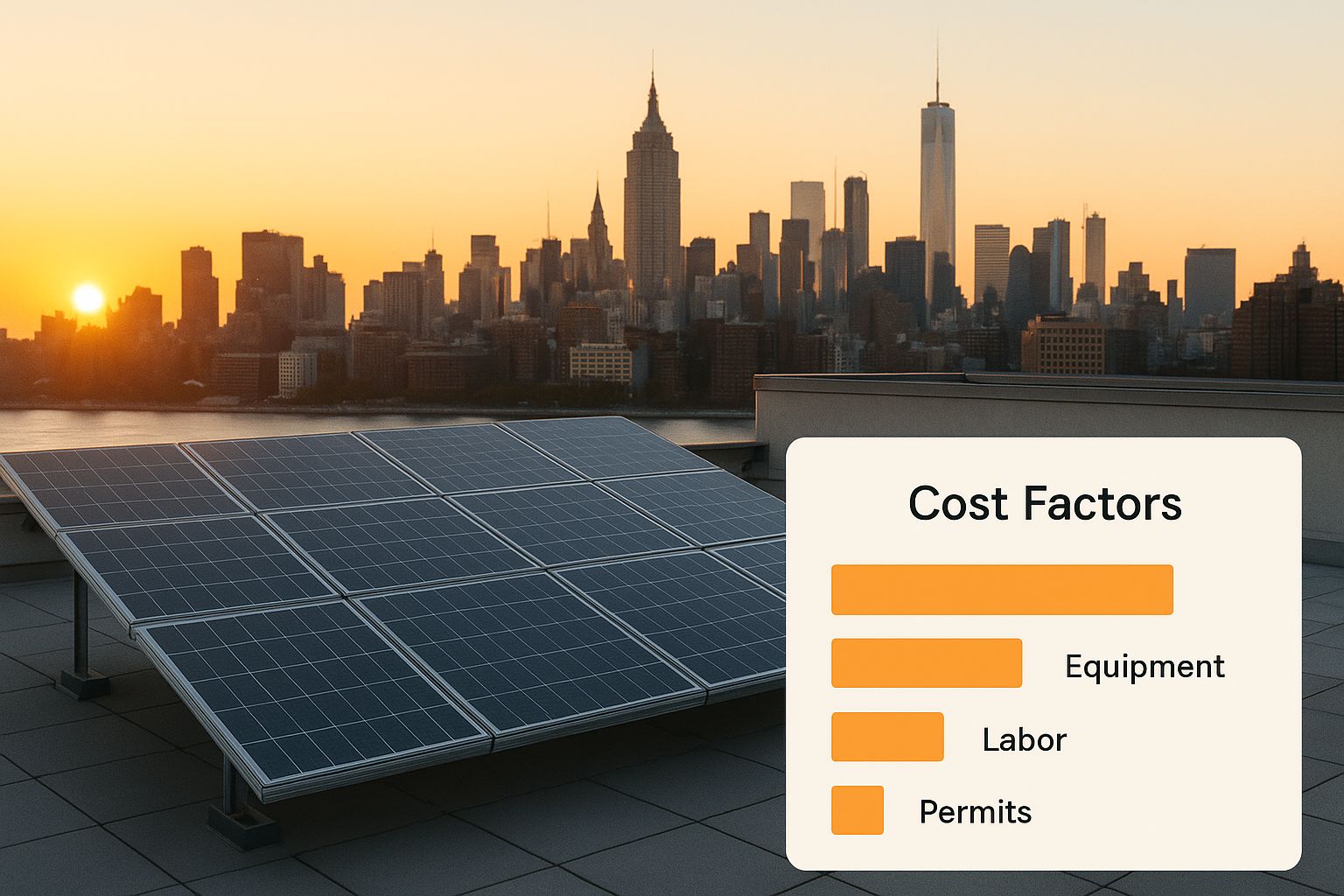
As you can see, both the visible hardware and the less-visible soft costs are equally important parts of your total investment.
On top of the core system, you can also add optional upgrades. A popular choice for both homeowners and businesses is a Tesla Powerwall battery storage system. This provides backup power if the grid goes down and can help you use more of your own solar energy, giving you even greater energy independence and peace of mind.
Once you understand these different components, you can look at any solar quote and know exactly what you’re paying for.
How NYC and State Incentives Slash Your Final Solar Cost
That initial price tag you see for a solar installation? That's just the starting point. For New York City residents and businesses, a powerful combination of federal, state, and local incentives work together to bring the actual solar panel cost NYC property owners pay way down. These programs are specifically designed to make clean energy a realistic and affordable option.
Think of it like getting several manufacturer and store rebates on a major appliance, all at once. Each incentive chips away at the gross cost, making the final number much more manageable. When you stack them all up, these credits and rebates can easily slice your out-of-pocket expense in half, sometimes even more.
The Big Three Solar Incentives for New Yorkers
Jumping into government programs can feel a little overwhelming, but the savings really boil down to three main sources. Each one comes from a different level of government—federal, state, and local—and they’re meant to be used together for maximum impact.
Here's the powerful trio that does the heavy lifting:
- The Federal Solar Tax Credit: This is the big one. It allows you to claim a credit worth 30% of your total system cost directly against what you owe in federal income taxes. It's a true dollar-for-dollar credit, not a simple deduction, which makes it incredibly valuable.
- The New York State Solar Tax Credit: On top of the federal help, New York offers its own tax credit. You can claim another 25% of your system's cost, though this one is capped at $5,000.
- The NY-Sun Megawatt Block Incentive: This isn't a tax credit; it's a straight-up rebate that gets deducted from your installation cost right from the start. The exact amount depends on your utility and the current funding "block," but it typically shaves off thousands of dollars before you even think about taxes.
By layering these three incentives, a typical NYC property can see its initial solar investment cut by 50% or more. This synergy completely changes the financial picture of going solar, turning it into a smart and compelling choice.
Putting It All Together: A Real-World Example
So, how does this actually play out? Let's walk through a realistic scenario for a homeowner in Queens with a system that has a gross cost of $30,000.
-
First, the NY-Sun Rebate is applied. We'll say it's $1,400 for their specific system. This immediately knocks the project cost down to $28,600.
-
Next, they calculate the 30% Federal Tax Credit on that reduced amount ($28,600 x 0.30), which comes out to a credit of $8,580.
-
Finally, they do the math for the 25% State Tax Credit ($28,600 x 0.25), which equals $7,150 but hits the $5,000 cap.
After all is said and done, their final net cost is just $15,020—a huge drop from the original $30,000. It’s a perfect illustration of how effective these programs are at making solar energy an accessible, high-value investment. For a more detailed breakdown, check out our complete guide to 2025 solar incentives and tax credits for new york homeowners.
It's no surprise that since 2016, the average size of a residential solar installation in New York has grown by 53%, while the price per kilowatt has plummeted by 42%. Programs like NY-Sun are a massive driver behind this growth. You can learn more about how New York's solar costs have evolved on solar-to-the-people.com.
Ready to see how much you can save? Contact NY Essential Power today for a personalized quote that includes all the incentives available for your property.
Why Solar Is a Smarter Investment Than Ever Before
When you first look at the solar panel cost NYC property owners are quoted, it’s easy to focus only on that initial number. But the real story here is about long-term value and financial freedom.
Think about your monthly Con Edison bill. You're essentially renting your electricity. It's a payment that never ends, and you can be sure the price will keep climbing over time. A solar panel system flips that entire model on its head. It’s an asset you own—one that pays for itself and then starts putting money right back into your pocket.
This shift in perspective is everything. You aren't just buying equipment; you're investing in a predictable, stable source of power that will last for decades. For a homeowner, this means finally getting control over a major, volatile household expense. For a commercial property manager in Manhattan or the outer boroughs, it means locking in operational costs and boosting your property's environmental credentials in one of the most unpredictable energy markets in the country.
Falling Costs Meet Rising Utility Rates
The financial argument for going solar has never been stronger, thanks to two powerful, opposing trends. The first is the massive drop in the cost of solar technology itself.
If you look at the history of solar panel costs in New York, the prices have plummeted over the last couple of decades. Back in the early 2000s, you were looking at nearly $15 per watt—that's five times higher than today’s typical range of $3.00 to $3.30 per watt. This dramatic price drop is the direct result of better technology and more efficient manufacturing. You can dive deeper into New York's solar cost trends on harvestpowersolar.com.
The key takeaway is simple: you are buying an advanced, high-efficiency asset at a historically low price. This creates an incredible opportunity for New Yorkers to invest in their energy future.
At the exact same time, the rates from traditional utilities like Con Edison have been on a relentless upward march. This creates a widening gap between what it costs to buy power from the grid and what it costs to produce your own clean energy. Every single time the utility raises its rates, your solar investment becomes that much more valuable, and your path to savings gets even shorter.
Calculating Your Payback Period
This brings us to a crucial concept: the payback period. It's a straightforward way of figuring out how long it will take for your solar system to pay for itself through energy savings.
The math is simple. You just divide the net cost of your system (what you pay after all incentives are applied) by the amount of money you save on electricity each year.
For a typical NYC installation, the payback period usually lands somewhere between 7 to 10 years. Once you hit that break-even point, every kilowatt-hour your panels produce is pure profit for the remaining 25+ year lifespan of the system.
This isn't just about getting your money back; it's about generating a significant return on your investment. Once the system is paid off, you're looking at decades of virtually free electricity while your neighbors are still stuck dealing with ever-increasing utility bills. You can learn more about starting your journey to energy independence on our blog.
Ready to see what your own payback period looks like and calculate your long-term savings? Contact NY Essential Power for a free, personalized quote today.
Financing Your NYC Solar Project for Any Budget
That initial price tag for a solar system can feel intimidating, but don't let it stop you from looking deeper. Paying cash upfront is far from the only way to get solar panels on your roof. The truth is, the solar panel cost NYC property owners see today is incredibly flexible, with solid financing paths that fit almost any financial situation.
Solar Loans: The Path to Ownership
For most New Yorkers, a solar loan is the most popular route to owning their system. It works a lot like a standard home improvement loan. You borrow the money to cover the full installation cost, and from day one, those panels are yours.
This is a huge deal because it means you—not a third-party company—get to claim all the lucrative tax credits and rebates. Owning the system yourself is the key to getting the biggest possible financial return and increasing your property value.
Solar Leases and PPAs: Savings Without the Upfront Cost
What if you want the savings without the price tag or long-term commitment? That's where a solar lease comes in. With a lease, another company owns and maintains the panels on your roof. Your part is simple: you just pay them a fixed monthly fee for the clean energy the system produces, which is almost always less than what you’d be paying Con Edison. It’s a fantastic way to see immediate savings with little to no money down.
A Power Purchase Agreement (PPA) is similar to a lease. Instead of a flat monthly payment, you agree to buy the actual power your panels generate at a set price per kilowatt-hour. That rate is locked in below the utility's price, giving you predictable savings without having to worry about owning or maintaining the equipment.
The core decision you'll make is between direct ownership (paying with cash or a loan) and a service-based model (a lease or PPA). Ownership delivers the greatest long-term financial benefits, while leases and PPAs provide instant savings with zero upfront investment.
Comparing Solar Financing Options in NYC
So, how do you decide what's right for your home in Brooklyn or your business in the Bronx? Seeing how these options compare side-by-side makes it much clearer. Each one offers unique advantages depending on what your financial goals are.
Here’s a simple breakdown of the key differences:
| Financing Option | Ownership | Upfront Cost | Incentive Eligibility | Best For |
|---|---|---|---|---|
| Cash Purchase | You own it | High | You receive all of them | Maximizing long-term ROI and property value. |
| Solar Loan | You own it | Low to None | You receive all of them | Homeowners who want full ownership benefits without a large cash outlay. |
| Solar Lease | Company owns it | None | The company receives them | Property owners seeking immediate, predictable savings with no maintenance worries. |
| PPA | Company owns it | None | The company receives them | Renters or those who prefer to pay only for the power they use, not for the equipment. |
These different models mean that just about every New Yorker can tap into the benefits of solar energy. Whether your goal is to maximize your investment through ownership or just start saving money tomorrow with a zero-down plan, there's a clear path forward for you.
To get a better sense of what the process looks like from start to finish, you can check out this guide on the typical solar installation timeline in NYC.
Ready to find the financing solution that’s right for you? Contact NY Essential Power today to discuss your options and get a free, personalized quote.
Take the Next Step on Your NYC Solar Journey
We've walked through the costs, the incredible savings available through incentives, and the real, long-term value that solar brings to your property. The bottom line is clear: for New Yorkers, going solar is not just an eco-friendly choice, but a smart financial move that puts you back in control of your power and protects you from rising utility costs.
Now, you've done the research. It's time to see what this looks like for your property.
The next step is straightforward and comes with zero pressure. While understanding the general solar installation timeline in NYC is helpful for planning, nothing beats seeing the exact numbers tailored to your home or business.
Reach out to NY Essential Power for a personalized, no-obligation quote. Our team of local experts will analyze your property and energy usage to show you exactly how much you can save. It's time to declare your independence from unpredictable utility rates and invest in a sustainable future.
Common Questions About NYC Solar Costs
When you start digging into the numbers, it's natural for a few questions to pop up. Here are some of the most common ones we hear from New Yorkers, with straight-up answers to help you understand the real cost of going solar in the city.
How Long Does It Take to Break Even on Solar Panels in NYC?
For most property owners in New York City, the payback period for a solar panel system lands somewhere between 7 to 10 years. That might sound like a while, but with Con Edison's rates always seeming to creep up, many people find they break even even sooner.
What really speeds things up? A few things: how much electricity you use, the final price you pay after all the great incentives, and how much utility rates increase in the coming years. Once you hit that break-even point, every bit of energy your panels produce is pure savings, for decades to come.
Does My Roof Type Change the Installation Cost?
Absolutely. The type of roof you have is a big factor in the final installation price. If you have a standard asphalt shingle roof, that's usually the easiest and most affordable scenario for a solar installation.
But in NYC, we see a lot of different materials. Slate, tile, and the flat roofs common on brownstones and apartment buildings often need special mounting equipment and a bit more labor to get the job done right. This can nudge the overall cost up a bit.
The only way to know for sure is to have a professional take a look. A proper site assessment will tell you everything you need to know about your roof's condition and what it will take to install a system correctly, giving you a truly accurate quote.
How Does Con Edison's Net Metering Program Work?
Net metering is the policy that makes solar such a great deal in NYC. Think of it as a credit system for the extra power your panels generate.
On a sunny afternoon, your panels are often making more electricity than your property is using. That excess power doesn't go to waste; it flows back into the grid, and Con Edison gives you a credit for it on your bill. Later, when it's dark or cloudy and you need to pull power from the grid, you just use up those credits. It's a simple system that ensures you get full value for every single kilowatt-hour your panels produce.
Ready to get clear answers for your property? The team at NY Essential Power can provide a detailed, no-obligation quote that breaks down your costs, savings, and payback period. Contact us today to start your solar journey.