
Thinking about going solar in New York? The first tool you should reach for is a solar energy savings calculator. It's the best way for homeowners and commercial property managers alike to get a real-world preview of what solar can do for your bottom line. Whether you're in Suffolk County or upstate in Albany, this simple step provides a solid estimate of your potential savings, payback period, and environmental impact before you even speak to an installer.
Your First Look at Solar Savings in New York
Making a smart decision about your energy future starts with good information. Before getting into the details of quotes and system designs, a solar savings calculator offers a powerful sneak peek. It cuts through the jargon and turns the abstract idea of "solar savings" into concrete numbers relevant to your property.
This is especially true for New Yorkers, who face some of the highest electricity rates in the country. From a home in Westchester County to a commercial building on Long Island, those steep utility bills from providers like PSEG and Con Edison make solar a highly attractive investment. A calculator helps you see just how attractive it can be, highlighting immediate cost savings and long-term energy independence.
What the Calculator Reveals
To get the most out of a calculator, you need to understand what it's showing you. It’s not just a single savings number; it’s a comprehensive snapshot of your potential solar journey.
Here’s a breakdown of what you'll typically find out:
- Estimated Monthly and Lifetime Savings: This is the headline number. You'll see how much you could reduce your electric bill each month and, more importantly, the total savings you could accumulate over the 25+ year lifespan of the solar panel system.
- System Payback Period: This tells you how many years it will likely take for your energy savings to completely cover the initial solar panel installation cost. It’s your break-even point on the path to free, clean energy.
- Environmental Impact: The results often put your clean energy production into perspective, translating it into easily understandable metrics, like the equivalent number of cars taken off the road or acres of forest planted.
Think of a solar calculator as your personal financial roadmap. It takes your actual energy usage and local New York solar data to build a baseline, showing you a clear path from today's high utility bills to long-term energy independence and environmental stewardship.
The New York Advantage
One of the most important functions of a good calculator is accounting for local incentives, and this is where New York truly shines. The state's programs are generous and can dramatically improve your return on investment for both residential and commercial properties.
Any quality calculator for a New York address should automatically factor in powerful financial boosts like the 30% Federal Solar Tax Credit along with New York's own state-level programs that help slash your upfront costs.
By providing a few details about your property and electricity usage, you get a personalized estimate that already has these powerful incentives baked in. In this guide, we'll walk you through gathering the right information to get the most accurate results, from finding your average PSEG or National Grid bill to assessing your roof's solar potential.
If you're just starting your research, it's also a great idea to understand the basics of the installation process. Our guide on solar panels for your home is the perfect place to get up to speed.
Gathering the Right Information for an Accurate Estimate

Any solar savings calculator is only as sharp as the data you feed it. To move from a vague, ballpark figure to a truly reliable estimate, you’ll need a few key details. The more specific your numbers are, the more accurate your projected savings will be.
Don't worry, this isn't complicated. The goal is to give the calculator a clear snapshot of your current energy profile and property setup. This ensures the results are grounded in your reality, not generic averages.
Your Electric Bill Is the Starting Point
First, grab your latest utility bill. Better yet, gather a few from different seasons. A full year's worth of statements is the gold standard, as it shows how your usage fluctuates from a hot Long Island summer to a cold upstate winter. However, even three to six months of data provides a solid foundation.
Once you have your bills, you're looking for two key pieces of information:
- Average Monthly Kilowatt-Hour (kWh) Usage: This is the most critical number. It shows how much electricity your home or business consumes, which is the primary factor in determining the right size for your solar panel system.
- Average Monthly Cost: Knowing what you currently spend is essential for the calculator to determine your potential savings and the system's payback period. You can learn more about all the factors that go into the final price by breaking down the cost of solar panels on Long Island.
For commercial property decision-makers in New York City or Nassau County, there’s one more critical detail on your bill: demand charges. These fees are based on your peak electricity usage and can constitute a significant portion of your monthly cost. The good news is that a well-designed solar and battery storage system can slash these charges, delivering even greater savings.
Quick Property Check: Sizing Up Your Roof's Solar Potential
Next, you'll want to assess your property's solar-readiness. The physical layout of your roof and any surrounding obstacles have a major impact on how much power a solar system can generate.
You don't need to get on a ladder for this. A quick look at your property on Google Maps using the satellite view can provide most of what you need.
Here’s what to look for:
- Roof Orientation: In New York, a south-facing roof is ideal as it receives the most direct sunlight throughout the day. However, east or west-facing roofs are also excellent candidates for solar and can produce significant amounts of energy.
- Potential Shading: Make a mental note of anything that could cast a shadow on your roof during the day, such as tall trees, a neighboring building, or even your own chimney. Shading can reduce a panel's output, so it's a critical piece of the puzzle.
To make this even easier, here’s a quick checklist of the information you’ll want to have handy before you start plugging numbers into a calculator.
Information Needed for Your Solar Calculation
| Data Point | Where to Find It | Why It's Important |
|---|---|---|
| Monthly kWh Usage | Your utility bill | Directly determines the size of the solar system needed to offset your energy consumption. |
| Average Electric Rate | Your utility bill (or divide total cost by kWh) | Calculates your current spending and provides a baseline for projecting savings. |
| Roof Direction | Google Maps (Satellite View), compass app | A south-facing roof is optimal for sun exposure in New York. |
| Roof Shading | Visual inspection, Google Maps | Trees or buildings that cast shadows can reduce the system's energy production. |
| Zip Code | Your address | Helps the calculator factor in local sunlight data (solar irradiance) and New York-specific incentives. |
Gathering these few key details is a small step that makes a huge difference. It empowers the solar calculator to give you a forecast genuinely built for your New York home or business, giving you confidence as you explore your energy options.
How to Use a Solar Calculator and Get Real Answers
Alright, you’ve done the prep work and have your electricity bills in hand. Now comes the exciting part: plugging those numbers into a solar savings calculator and seeing what's possible. Getting a truly accurate estimate isn't just about filling in boxes; it's about understanding what those boxes mean.
Let's walk through this together using a realistic scenario. Picture a family living in Albany, New York. They have a decent south-facing roof, and after reviewing their National Grid bills, they know they use about 850 kWh of electricity each month.
With that single piece of information, they're ready to start.
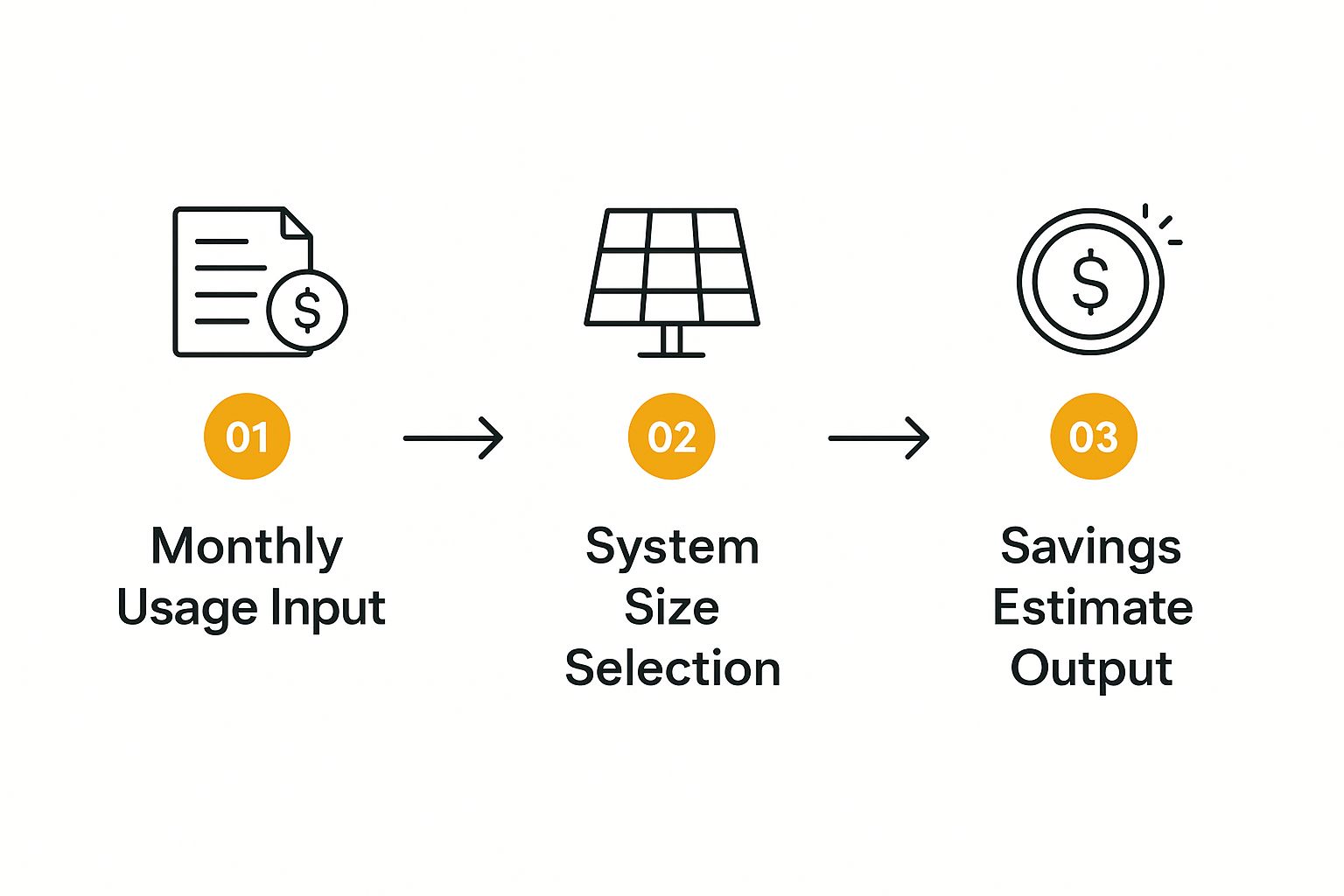
As you can see, the process is straightforward. You start with what you know—your energy use—and the calculator helps connect the dots to system size and, ultimately, your savings.
Punching in the Right Numbers
When you first open a solar calculator, you’ll be met with a few key fields. Let's break them down.
-
Average Monthly Electric Bill: This one’s easy. Just enter the typical dollar amount you pay the utility company. For our Albany family, let's say their bill is usually around $180. This figure becomes the benchmark the calculator uses to calculate how much you'll save.
-
Your Utility Provider: Don't skip this! Choosing your specific provider—whether it's Con Edison, PSEG Long Island, or National Grid—is a crucial step. It allows the tool to pull the correct, up-to-date electricity rates, making your savings estimate much more accurate.
Figuring Out Your System Size
This is where many people get tripped up, but it’s simpler than it sounds. The System Size, measured in kilowatts (kW), is the total potential power output of your solar panels. It's directly linked to your electricity consumption.
Think of it this way: the average U.S. home uses around 10,000 kWh per year. To cover that, a 7.5 kW solar system is usually a good starting point. You can dive deeper into how system size and production impact the grid by reading about solar energy's environmental impact.
For our Albany family using 10,200 kWh a year (850 kWh/month x 12), a system in the 7 kW to 8 kW range is likely the sweet spot. That would be enough to offset nearly 100% of their electricity consumption.
Pro Tip: Don't just guess your system size. The most common mistake is picking a number out of thin air. Always start with your annual kWh usage to get a realistic recommendation. A professional installer will later refine this based on your roof's unique angle, shading, and available space.
Making Sure New York Incentives Are Included
Any solar calculator worth its salt will account for the lucrative incentives available here in New York. These programs are what make the numbers truly compelling, drastically reducing your upfront cost and shortening your break-even timeline.
-
Federal Solar Tax Credit: This is the big one. It allows you to claim 30% of your total system cost as a credit on your federal taxes. A good calculator will automatically subtract this, showing you a much lower net cost right away.
-
NY-Sun Megawatt Block Program: This is New York's fantastic state-level rebate. It provides an upfront cash incentive based on your system's size. A calculator designed for New Yorkers will factor this in, further reducing your initial investment.
By taking a minute to enter this information carefully, you turn a generic estimation tool into a personalized financial forecast. The numbers it generates will give you a solid, reliable baseline for deciding if solar is the right move for your home and budget.
What Your Solar Savings Results Really Mean
So, you've plugged your numbers into a solar savings calculator, and now you’re looking at a screen full of projections. It’s exciting, but what does it all actually mean for your wallet and your property? Let's decode those results and translate them into real-world value for a New York property owner.
The big number that usually grabs attention first is the Estimated Lifetime Savings. This is the grand total the calculator projects you’ll save on electricity over the entire 25 to 30-year life of your solar panels. For the average U.S. homeowner, this can be a staggering figure—often around $52,000. This number isn't pulled from thin air; it's a calculation based on your system's size, the amount of sun your roof gets, and local New York energy costs. To get a better feel for the math behind this, you can check out how solar savings are typically calculated.
Payback Period and ROI: The Two Most Important Numbers
Beyond lifetime savings, you'll want to zoom in on two critical metrics: the payback period and the return on investment (ROI).
First up is the Payback Period. This is straightforward: it’s the time it takes for your energy savings to completely pay off the initial cost of your solar installation. Here in New York, thanks to excellent state incentives, most homeowners find their payback period lands somewhere between 6 to 9 years. Once you cross that finish line, every bit of energy your panels produce is pure profit—free, clean power for decades to come.
Then there's the Return on Investment (ROI). While the payback period tells you when you break even, ROI tells you how profitable the investment is over its lifespan. A strong ROI shows that your system is doing more than just paying for itself—it’s actively generating a financial return. Local factors play a huge role here, as you can see in our deep dive on the ROI for solar in Suffolk County.
For a commercial property manager in a high-cost area like Westchester, these numbers mean long-term budget stability. They can essentially lock in their electricity costs for the next 25+ years, turning a volatile operational expense into a predictable, manageable line item. That kind of financial reliability is invaluable for any business.
Putting the Environmental Impact into Perspective
Cost savings are a primary driver, but a good calculator also illustrates the environmental benefits of your investment. You’ll probably see a "CO2 Offset" figure, but it’s hard to visualize what a ton of CO2 looks like.
That's why most calculators translate this into terms we can actually picture:
- Cars Removed from the Road: Your system might generate enough clean power to equal taking several cars off the road each year.
- Acres of Forest Planted: The carbon-absorbing power could be equivalent to planting hundreds of new trees.
These comparisons bring the impact home, showing exactly how you’re contributing to a healthier environment right here in New York, a key goal for both families and socially-conscious businesses.
Keep in mind that these calculator results are your starting point—a powerful, data-driven forecast of what's possible. They give you the confidence and information needed to move forward. The next step is a professional consultation to tailor these initial estimates into a custom-designed system for your specific property.
Maximizing Your Savings Beyond the Calculator

A solar savings calculator provides a fantastic financial preview, but it’s just the starting line. Your actual, real-world savings can exceed those initial estimates if you approach solar as the core of a complete energy strategy.
One of the best moves you can make is to boost your property's energy efficiency before a single panel goes on your roof. Simple, low-cost upgrades can significantly change the financial equation of your solar project.
Smart Upgrades Before You Go Solar
By reducing your electricity consumption first, you can often install a smaller, less expensive solar array that still covers 100% of your needs. This means a lower upfront investment and a shorter payback period. It’s about working smarter, not harder.
Here are a few high-impact upgrades to consider:
- Switch to LED Lighting: If your home or commercial space still uses old incandescent or fluorescent bulbs, swapping them for LEDs is the lowest-hanging fruit. It’s a quick, inexpensive fix that immediately slashes daily electricity use.
- Seal Air Leaks: Drafts around windows and doors force your HVAC system to work overtime, which is a massive energy drain during New York's tough winters and humid summers.
- Invest in ENERGY STAR Appliances: Older appliances are energy vampires. Replacing them with modern, efficient models can make a serious dent in your base energy load, reducing the overall size of the solar system required.
Adding a Solar Battery for True Energy Independence
To take full control of your power, pairing your panels with a solar battery is the ultimate step toward energy independence. This is especially true on Long Island and in other areas prone to power outages from storms. A battery stores the excess solar energy your panels generate during the day instead of sending it all back to the grid.
A solar battery transforms your system from a simple money-saver into your own personal power plant. You get blackout protection, less reliance on an aging grid, and the ability to sidestep peak utility rates. It’s total control and peace of mind for your home or business operations.
The Urgency of Acting Now
The solar industry has seen explosive growth, with over 163 gigawatts of solar capacity now installed across the U.S. However, the financial incentives that fueled this growth won't be around forever. To maximize your savings, it is crucial to investigate the current federal solar tax credits and local programs available right now.
That generous 30% federal tax credit is a game-changer for affordability, but its future is not guaranteed. For a complete breakdown, check out our guide on 2025 solar incentives and tax credits for New York homeowners. Acting sooner rather than later ensures you lock in these powerful savings before they change.
By combining smart efficiency upgrades, adding technology like battery storage, and taking advantage of current incentives, you can move far beyond a calculator estimate and achieve the best possible financial return on your investment.
Answering Your Questions About New York Solar Savings
Even with a great solar savings calculator, it's natural to have questions. Seeing the numbers is a fantastic start, but what do they really mean for your home or business here in New York? We hear the same practical questions from people all over the state, from Long Island to the Capital Region.
Let's address some of the most common ones to help you feel confident about what comes next.
How Accurate Are These Online Solar Calculators?
Think of an online calculator as a very reliable first look. It's an excellent way to get a solid ballpark estimate of your potential savings and return on investment without any sales pressure. They use regional data, local utility rates, and the numbers you provide to paint a clear financial picture.
However, for a final, binding quote, nothing beats a professional on-site assessment. An online tool can't see the specific pitch of your roof, a large tree that casts a shadow after 3 PM, or the unique details of your local utility’s interconnection policy.
A calculator gives you a smart financial forecast to start the conversation. The professional consultation is what turns that forecast into a precise, actionable plan tailored to your specific property.
What Happens If My Panels Make More Power Than I Can Use?
This is where going solar in New York becomes particularly rewarding. Thanks to a policy called net metering, you receive full credit for every kilowatt-hour of extra energy your system produces.
It's a simple yet powerful concept. When your panels generate more electricity than you need, that surplus power automatically flows back to the utility grid. In return, your utility provider—whether it's PSEG Long Island, Con Edison, or National Grid—places credits on your account.
Then, at night or on a cloudy day, when you draw power from the grid, you'll use those banked credits to offset the cost. This system ensures none of your solar energy is wasted and you receive the maximum financial benefit. It essentially allows you to use the grid as a giant, free battery.
Are There Any Solar Incentives Specifically for New Yorkers?
Absolutely! New York offers some of the best solar incentives in the nation, which is a major reason the payback period is often so short here for both residential and commercial projects.
On top of the 30% federal tax credit available nationwide, New York has its own programs designed to make going solar much more affordable. The main incentives include:
- The NY-Sun Megawatt Block Program: This is an upfront cash incentive that directly lowers the initial cost of your installation. The amount is based on the size of your system and your region.
- New York State Solar Energy System Equipment Credit: This is a state-level tax credit that can reduce what you owe on your state income taxes by as much as $5,000.
When you combine these powerful state incentives with the federal credit, it makes solar one of the most intelligent financial decisions a New Yorker can make, accelerating your path to lower bills and energy independence.
Ready to turn your calculator estimate into a firm, personalized proposal for your home or business? The team at NY Essential Power has the local expertise to design a system that maximizes your savings and meets your energy goals. Request your free, no-obligation quote today!