A solar battery backup system is a powerful energy storage solution that saves the excess power your solar panels generate. You can then use that stored energy whenever you need it—whether at night, during a storm, or when the utility grid is down.
Think of it as your own personal power reserve, right at your home or business. It provides uninterrupted power, significant cost savings, and greater control over your energy future, giving you peace of mind and a smaller environmental footprint.
Your Guide to Uninterrupted Power in New York
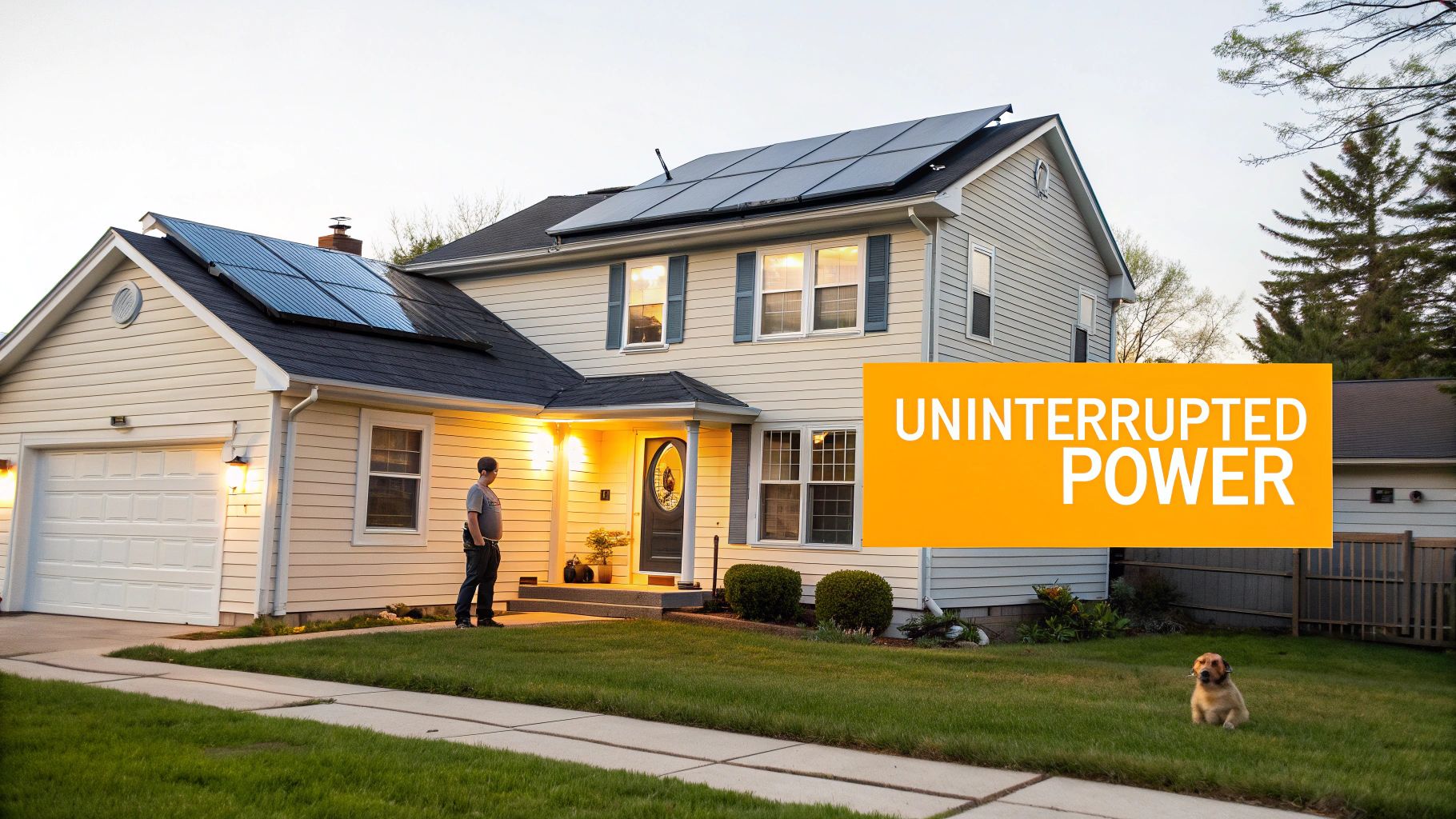
If you're a homeowner or business decision-maker in New York, you know that severe weather is a fact of life. From fierce winter nor'easters that hit Westchester to summer heatwaves that strain Long Island's grid, power outages are always a possibility. A reliable backup power source is no longer a luxury; for many, it’s essential.
This guide will explain how solar battery backup systems for homes deliver the security and reliability you need. But these systems offer much more than just emergency power. They are a smart investment in your energy independence, giving you more control over volatile utility costs and helping you reduce your carbon footprint.
We will cover exactly how they work, the tangible benefits for New Yorkers, and what you need to know to choose the right system for your property.
Why Energy Independence Matters in NY
For property owners everywhere from Suffolk County to the Hudson Valley, energy independence has become a practical necessity. With a solar battery, you are no longer solely dependent on an aging and sometimes unreliable power grid.
This shift provides several key advantages:
- Resilience During Outages: Keep the lights on, refrigerators cold, and essential equipment like medical devices or business servers running smoothly when the grid fails.
- Control Over Energy Costs: Use the solar power you stored during the day to power your home in the evening when electricity rates are highest, directly lowering your utility bills.
- A Smaller Environmental Footprint: Maximize the use of the clean energy you generate, reducing your reliance on fossil fuels from the utility company and contributing to a greener New York.
A solar battery backup is your personal energy reservoir. It captures free, clean energy from the sun during the day and holds it for you to use at night or during an outage, ensuring your home remains a safe and comfortable sanctuary.
This guide is designed to provide everything you need to make an informed decision about securing your property’s power. Whether you’re in one of our core New York service areas or elsewhere in the state, understanding these systems is the first step toward true energy freedom. At NY Essential Power, we're ready to help you achieve it.
How Solar Battery Backup Actually Works
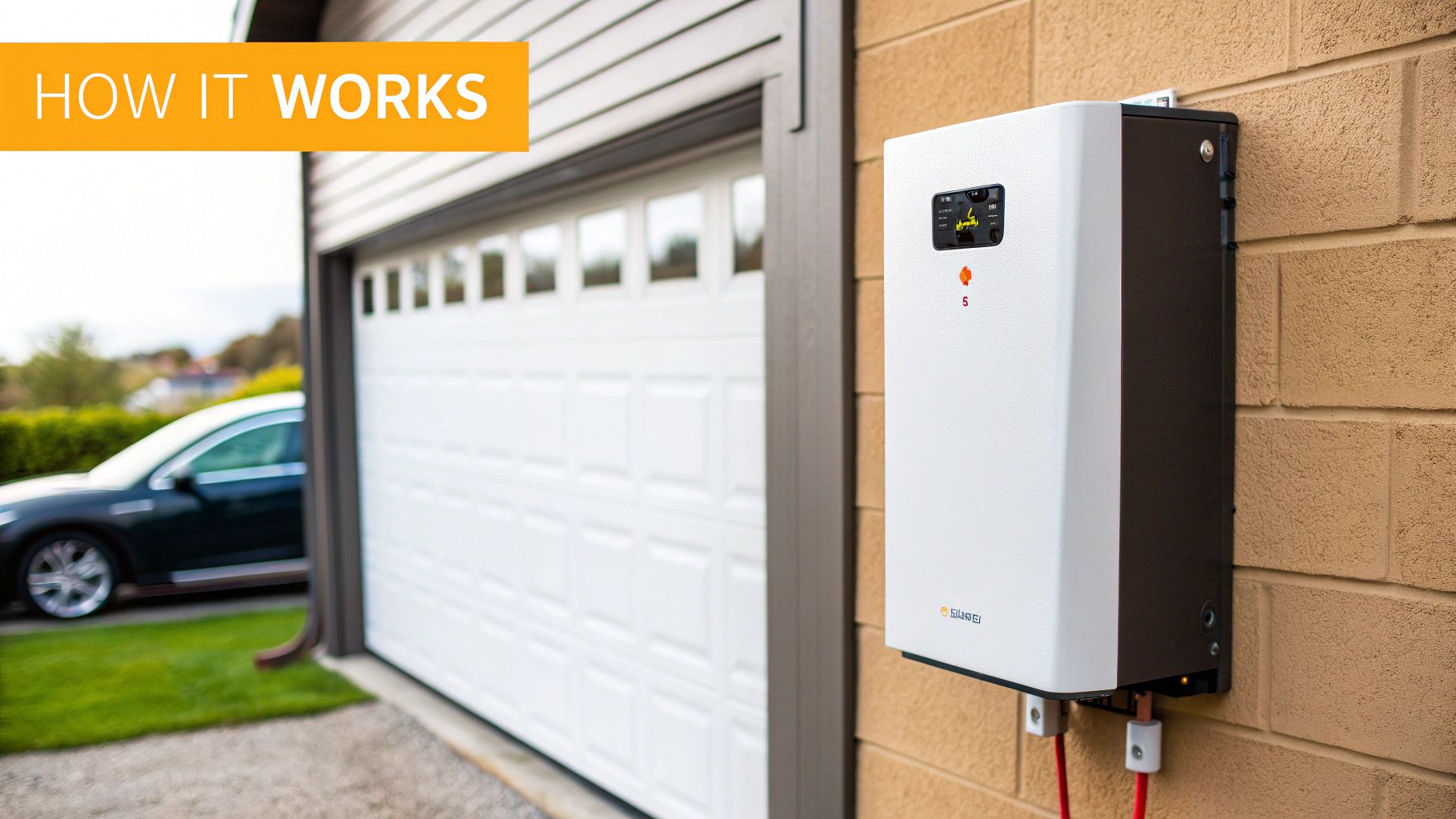
Think of a solar battery as your property’s personal energy reservoir—a savings account for electricity. Instead of sending all the extra energy your solar panels produce back to the grid for a minimal credit, you save it for when you need it most. A solar battery backup system for homes operates on this simple but powerful principle.
During the day, especially on bright, sunny days from the Hamptons to upstate New York, your solar panels generate abundant electricity. Your home uses what it needs to run lights, appliances, and devices. However, your panels often produce far more power than you are using at that moment.
That’s where the battery comes in. Instead of sending that valuable surplus back to the utility, your system intelligently directs it to charge your home battery. This stored energy is then on standby, ready for you whenever you need it.
The Core Components of Your Energy Independence
A home battery system may sound complex, but it boils down to three key components working together. Understanding each part demystifies the path to gaining energy independence from the grid.
-
The Solar Battery: This is the heart of the operation, where excess DC (Direct Current) electricity from your solar panels is stored. Modern batteries, especially Lithium Iron Phosphate (LFP) types, are exceptionally safe, long-lasting, and perfectly suited for daily use in homes and commercial properties.
-
The Inverter: Your solar panels and battery store DC power, but your home’s outlets and appliances run on AC (Alternating Current). The inverter is the essential device that converts the stored DC electricity into usable AC power that runs your property.
-
The Management Software: This is the brains of the system. Smart software constantly monitors how much energy your panels are producing and how much your property is using. It makes intelligent decisions—use solar power now, charge the battery, or draw from your stored reserves.
This smart coordination allows you to maximize your self-generated power, reducing your reliance on utility companies like PSEG Long Island or Con Edison.
From Sunlight to Uninterrupted Power
So, how does this play out over a typical day? During daylight hours, your home runs directly on solar power while the battery charges with any surplus energy. Once the sun goes down and your panels stop producing, the system automatically switches over to your battery, powering your home through the evening and night seamlessly.
The true value of a solar battery backup is revealed when the grid goes down. Your system instantly detects the outage and isolates your home, creating its own personal microgrid. Your lights stay on, the fridge keeps running, and life continues uninterrupted.
It’s this seamless transition that provides homeowners and business owners with true peace of mind. The technology has evolved from a niche product into a mainstream solution for energy resilience. The global market for household energy storage trends is growing rapidly, signaling a major shift in how people view their power—it's no longer just a monthly bill, but a tool for security and control.
The Real Benefits for New York Homeowners
For New Yorkers, adding a battery to a solar energy system is about much more than just keeping the lights on. It’s a strategic decision that delivers three powerful, interconnected benefits: true peace of mind during grid failures, significant long-term savings, and a meaningful step toward a cleaner environment.
This investment transforms your relationship with the utility. You're no longer just a passive customer paying a monthly bill; you're actively managing your property's energy. Each benefit is a compelling reason on its own, but together, they make an undeniable case for home energy storage.
Achieve True Energy Security
Anyone in New York who has experienced a nor'easter or a summer storm that left them in the dark understands this benefit immediately. Energy security is the most tangible advantage—it’s the confidence that your essentials, whether it's a refrigerator, medical equipment, sump pump, or home office, will continue to run when the power grid fails.
This isn’t just about convenience; it’s about maintaining safety and stability.
- Storm Resilience: Whether facing a Buffalo blizzard or a Long Island hurricane, you can ride out the storm in a safe, powered home.
- Grid Instability Protection: The grid is aging and under increasing strain, making unexpected blackouts and brownouts more common. A battery keeps you powered through it all.
- Uninterrupted Daily Life: Your internet stays on for remote work, security systems remain active, and daily life continues without disruption, no matter the weather.
Unlock Significant Cost Savings
While backup power is often the primary motivation, the financial benefits are equally persuasive. A solar battery stores the free, excess energy your panels produce during peak sun hours. This gives you a powerful tool to reduce your monthly bills from utilities like Con Edison and PSEG Long Island.
Instead of being forced to buy expensive power from the grid during peak evening hours, you simply use your own stored solar energy. This strategy, known as time-of-use optimization, is designed to help you avoid the highest utility rates and maximize the return on your solar investment. You can see a detailed comparison in our guide on solar panels vs. traditional energy on Long Island.
A solar battery doesn't just wait for a blackout. It actively works to lower your energy costs every single day by allowing you to use your own stored solar power when utility rates are highest.
To make these benefits easier to digest, here's a quick summary of what a solar battery backup brings to a New York home.
Solar Battery Backup Benefits At a Glance
| Benefit Category | Description for NY Homeowners | Primary Value |
|---|---|---|
| Energy Security | Provides uninterrupted power during grid outages caused by storms, heatwaves, or equipment failure. Keeps critical appliances running. | Peace of Mind |
| Cost Savings | Stores free solar energy to avoid buying expensive grid power during peak evening hours, reducing monthly utility bills. | Financial Return |
| Environmental Impact | Maximizes the use of clean, self-generated solar power, reducing reliance on fossil fuel power plants, especially during peak demand. | Sustainability |
This table illustrates how a single investment addresses multiple priorities, from practical safety to long-term financial health and environmental stewardship.
Embrace Environmental Responsibility
Finally, adding a battery to your solar setup deepens your commitment to a healthier planet. Your solar panels are a huge step, but a battery ensures you use every last kilowatt-hour of clean energy they produce.
This directly reduces your need for grid power, which often comes from less efficient, fossil-fuel "peaker" plants that utilities activate during times of high demand. Your personal choice contributes to a larger, state-wide goal: a more stable and cleaner power grid for all New Yorkers.
Recent industry data validates this. While saving money is always a key factor, a significant 80% of homeowners who add battery storage cite backup power as their primary motivation. This demonstrates that real-world concerns about grid failures and severe weather are driving people to invest in solar battery backup systems for homes. You can explore more homeowner trends in the full solar industry survey.
Sizing Your System and Understanding Costs
Determining the right solar battery backup system for your home is not a one-size-fits-all process. It’s like selecting a heating system for a New York winter—you need the right fit for the job. Correctly sizing your system is the most critical step to ensure you have reliable power when you need it without overpaying for capacity you’ll never use.
The process begins with an analysis of your energy habits. We will walk through the key factors that determine the best size for your property, from average daily electricity consumption to the specific appliances you deem essential during an outage.
How to Determine the Right Battery Size
The ideal battery size depends on three things: what you need to power, how much energy those items consume, and how long you need them to run. Nailing this calculation is what distinguishes a smart investment from an inefficient one.
-
Identify Your Critical Loads: First, make a list of what must stay on during an outage. For a homeowner in Nassau County, this might be the refrigerator, sump pump, internet router, and a few lights. For a commercial property in Westchester, it could be registers, security systems, and servers. These are your "critical loads."
-
Calculate Your Daily Energy Needs: Next, estimate the daily energy consumption of those critical loads. You can usually find the wattage on the appliance's label. A modern refrigerator, for example, might use about 1.4 kWh per day, while your modem and router could use another 0.4 kWh. Summing these up gives you a baseline energy target.
-
Decide on Backup Duration: How long do you need backup power? A few hours? A full day? Or are you preparing for a multi-day outage after a major storm on Long Island? Multiply your daily energy needs by the number of backup days desired. It's also wise to add a 20-30% buffer to account for cloudy days and natural battery degradation over time.
Sizing is a balancing act. The goal is to cover your essential needs comfortably without paying for a system designed to power an entire neighborhood. A professional consultation will help pinpoint the exact capacity that matches your lifestyle and budget.
This straightforward process of listing, calculating, and planning ensures your investment delivers exactly what you expect when the grid goes down.
Breaking Down the Total Investment
The price of a solar battery backup system includes more than just the battery itself. You are investing in a complete energy solution, which includes several key pieces of hardware, professional installation, and the expertise to integrate it correctly and safely.
Here’s a look at what goes into the total cost:
- The Battery: As the core component, this represents the largest portion of the cost. Prices vary based on capacity (measured in kWh), battery chemistry (like LFP), and brand.
- The Inverter: A smart inverter is required to manage the system, converting the DC power stored in the battery into the AC power your home uses.
- Installation & Labor: This covers the certified electricians who will safely wire the system into your property’s electrical panel. This work requires deep knowledge of local codes, especially in places like New York City and Suffolk County.
- Balance of System (BOS): This catch-all term includes all other necessary components—wiring, conduit, breakers, and the essential transfer switch that automatically and safely disconnects your home from the grid during an outage.
How New York Incentives Dramatically Lower Your Cost
Here’s the best part for New York residents: you don’t have to pay the full sticker price. New York State offers some of the most robust incentives in the country, designed to make clean energy and battery storage more affordable for everyone.
This simple flow chart illustrates how New York's programs lead to security, savings, and sustainability.
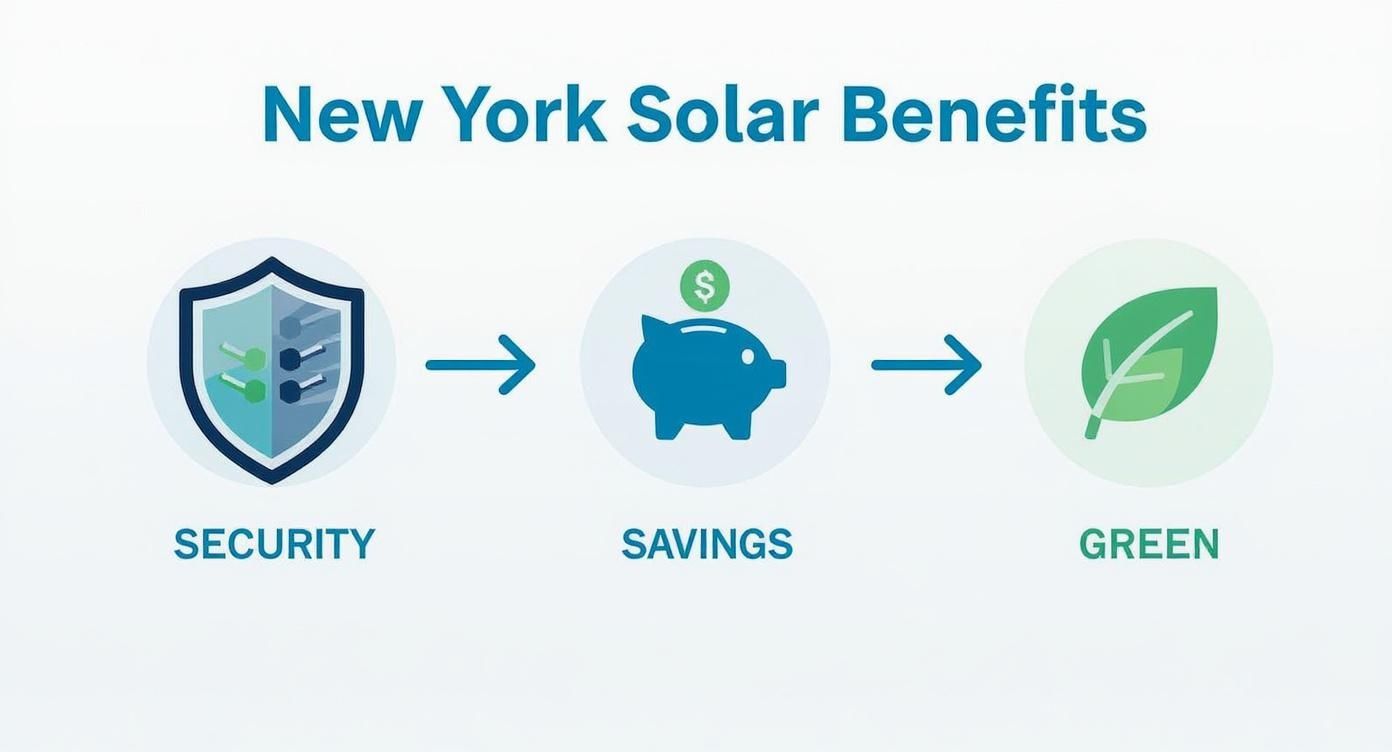
As the graphic shows, investing in solar with battery storage in New York pays off in three major ways, starting with peace of mind and leading to real savings and a smaller carbon footprint.
Here are the incentives that make the biggest difference:
- The Federal Solar Tax Credit: This allows you to claim a 30% credit on the total system cost—including the battery and installation—on your federal taxes. It is a dollar-for-dollar credit, making it incredibly valuable.
- The NY-Sun Program: Administered by NYSERDA, this program provides an upfront rebate that directly reduces the initial cost of your solar panels, which are often installed with a battery.
- New York State Tax Credit: In addition to the federal credit, New York offers its own tax credit for residential solar equipment, further reducing your final cost.
These programs can significantly slash the total price, helping you achieve a faster return on your investment and putting true energy independence within reach. To learn how these incentives might apply to your project, you can explore our resources on solar canopy options on Long Island and other available solutions.
Choosing the Right Technology and Installer
Selecting the right solar battery backup system for your home comes down to two critical decisions: choosing the best technology for your needs and finding a qualified installer you can trust. While well-known brands like the Tesla Powerwall receive a lot of attention, what truly matters for long-term reliability is the chemistry inside the battery and the expertise of the installation team.
Finding the right fit is straightforward once you know what to look for. The first step is understanding the differences between battery types, which will help you choose a system that aligns with your goals for safety, lifespan, and performance.
Comparing Leading Battery Technologies
Most modern home energy storage systems use one of two main types of lithium-ion chemistry. While they may seem similar, their core differences impact everything from safety to longevity.
-
Lithium Iron Phosphate (LFP): Widely regarded as the gold standard for home energy storage, LFP batteries are exceptionally safe and stable. They are not prone to overheating and can endure thousands of charge and discharge cycles before their capacity diminishes, making them a reliable workhorse for daily use in New York homes and businesses.
-
Nickel Manganese Cobalt (NMC): NMC batteries offer higher energy density, meaning they can be lighter and more compact. However, they are less chemically stable than LFP batteries and tend to have a shorter overall lifespan.
For most homeowners and commercial properties, the superior safety profile and longevity of LFP technology make it the clear choice. As you explore different options, it’s helpful to research the best home battery backup systems on the market to see how they compare.
Your Most Important Choice: The Installer
The best battery in the world is ineffective if installed incorrectly. That’s why your choice of installer is even more critical than the specific brand of battery you select. A qualified, local professional ensures your system is safe, compliant with all New York codes, and optimized for peak performance.
The residential solar storage market is expanding rapidly, projected to grow from USD 5.13 billion in 2024 to USD 390.6 billion by 2035. As more installers enter the field, choosing a partner with a proven track record is more important than ever. This growth is driven by falling costs and a rising demand for energy security, with lithium-ion batteries making up 68.1% of the market due to their performance.
An expert installer doesn't just connect wires. They design a system that works seamlessly with your home, navigate all local permitting in places like Suffolk and Nassau County, and stand behind their work with a solid warranty.
Here’s a quick checklist to help you find the right partner:
- NYSERDA Certification: Ensure they are a NY-Sun participating contractor. This is your guarantee that they meet New York State's high standards.
- Proven Local Experience: Ask for examples of projects they’ve completed in your area. This demonstrates their familiarity with local codes and inspection processes.
- Strong Warranties: A reputable installer will offer strong warranties covering both the equipment and their installation work.
- Positive Community Reviews: Check what other local property owners are saying about them. A strong reputation for customer service and reliability is key.
By focusing on both the right technology and a top-tier installer, you ensure your investment in energy independence is a sound one for years to come. This principle also applies to larger-scale projects, such as our work with solar canopies on Long Island.
Got Questions About Solar Batteries? We’ve Got Answers.
Exploring the world of solar battery backup for your home is an exciting step, but it often comes with questions. We hear them frequently from homeowners and business owners across New York, so let's address some of the most common ones.
How Long Can a Solar Battery Actually Power My Home?
This is a key question, and the answer depends on your battery's size and what you choose to run. A correctly sized system will typically keep your essential loads—like the refrigerator, lights, and Wi-Fi—running for 8 to 24 hours or even longer.
The crucial point is that you are in control. By managing your energy use during an outage (e.g., delaying use of an electric oven), you can significantly extend your backup power. During a prolonged outage on Long Island, your solar panels resume recharging the battery each morning. As long as there's some sun, you can create a self-sustaining loop to keep the power on indefinitely.
I Already Have Solar Panels. Can I Add a Battery?
Yes, in most cases, adding a battery to an existing solar panel system is entirely possible. This process is called a "retrofit," and it's an excellent way for current solar owners in New York to upgrade their energy independence.
The primary consideration is compatibility between your current inverter and the new battery. Our team at NY Essential Power can assess your existing system to determine the best way to integrate a battery, allowing you to gain the benefits of energy storage without starting from scratch.
Are These Batteries Safe to Have in My Home?
Absolutely. Safety is the top priority, and modern home batteries are engineered for exceptional stability. The best systems use Lithium Iron Phosphate (LFP) chemistry, which is known for being non-toxic and non-combustible. They also feature sophisticated management systems that prevent any risk of overheating.
Every system we install is certified to meet stringent national and New York-specific safety standards. Our certified technicians handle every installation with precision, providing you with complete peace of mind that the system is safe for your property and family.
Think of a modern solar battery like the advanced safety systems in a new car. They are engineered from the ground up to be stable, reliable, and to operate safely in the background without you ever having to worry about them.
What's the Upkeep Like for a Solar Battery?
This is one of the best features: homeowners and business owners have to do virtually zero regular maintenance. Forget the oil changes, fuel runs, and noisy engine checks associated with traditional generators. A solar battery is a true "set it and forget it" technology.
The system's integrated software monitors its own health and performance 24/7. Necessary software updates typically happen automatically over the internet. You simply get quiet, clean, and completely hassle-free backup power whenever you need it.
It's Time to Secure Your Home's Energy Future
Investing in a solar battery backup system is one of the most impactful decisions you can make for your home, family, or business. This is not just about adding an appliance; it's about declaring your independence from an unreliable grid, gaining control over unpredictable utility costs, and making a tangible commitment to a cleaner environment. Waiting for the next power outage or rate hike is a gamble you don't have to take.
Your Roadmap to Energy Security
Getting started with a home battery system is more straightforward than you might think. The first step is simple: identify your real needs. What appliances are non-negotiable during an outage? How long do they need to run?
Once you have that clarity, the rest falls into place. It’s about choosing proven, safe technology like LFP batteries and, most importantly, partnering with a qualified local installer who understands New York’s codes and incentive programs.
Remember, this is not just an emergency device. It's a smart financial tool that works for you daily. By storing your excess solar energy, you can power your home through expensive peak hours, dramatically reducing your reliance on the utility and making your solar panels work even harder for you.
Making the Right Call for Your Home
You've learned how these systems operate, the concrete benefits they offer New Yorkers, and what goes into choosing the right one. Now, it's time to discover what a system designed specifically for your property can achieve for you.
A solar battery is an investment in stability. It keeps the lights on and your home running, turning it into a safe haven for your family, no matter what’s happening outside.
A professional consultation is the best way to get clear, personalized answers. An expert can help you:
- Determine the perfect battery size based on your family's or business's actual electricity usage.
- Maximize your savings by navigating all available incentives, from the 30% federal tax credit to NY State programs.
- Design a seamless system that integrates perfectly with your property for quiet, reliable, and hassle-free power for decades.
Don't let grid failures and rising energy costs control your budget and peace of mind. The power to secure your home’s energy future is here now.
Take the first step toward energy independence. The team at NY Essential Power is ready to provide a free, no-obligation quote and show you just how achievable a solar battery backup system is for your property. Request Your Free Quote Now.