
As electricity rates from Con Edison and PSEG Long Island continue to climb, more New York homeowners and commercial property decision-makers are looking to the sun for relief. Photovoltaic (PV) solar panels offer a powerful path to energy independence, lower utility bills, and a smaller carbon footprint. But is this technology the right move for your Long Island home or your commercial property in the Hudson Valley? Making an informed decision requires a clear-eyed look at the realities of solar energy in New York.
This comprehensive guide breaks down the essential photovoltaic panels pros and cons, providing the clear, trustworthy insights you need to make a smart investment. We’ll cut through the technical jargon and focus on what truly matters for New Yorkers: local incentives, real-world cost savings, and the practical challenges of our regional climate.
From the impressive financial returns driven by state and federal tax credits to the logistical considerations of New York's variable weather, this list provides a balanced view. We will explore everything from long-term durability and energy independence to upfront costs and aesthetic impacts. This detailed breakdown will help you determine if solar is your key to a brighter, more affordable energy future.
1. Pro: Unlock Significant Long-Term Savings & Boost Property Value
While the initial investment for photovoltaic panels can seem significant, the long-term financial rewards offer one of the most compelling arguments for going solar in New York. For a typical New York home, a system can range from $15,000 to $25,000 before incentives, but this upfront cost unlocks decades of energy savings and enhances property value. Solar systems are engineered for durability, lasting 25 to 30 years or more, and typically pay for themselves within 6 to 12 years in our state.
Over the system's lifespan, property owners can expect to save between $20,000 and $40,000 on electricity costs, effectively shielding themselves from volatile utility rate hikes. For instance, a homeowner in Ronkonkoma could see their system pay for itself in just 8 years and generate over $35,000 in savings. Beyond monthly bill reduction, solar is a high-value property improvement. National studies consistently show that homes with solar panels sell faster and for a premium, often adding 3-4% to the resale value. In competitive markets like Nassau and Suffolk County, this boost provides a major financial advantage at closing.
Actionable Tips:
- Calculate Your Payback Period: Use your current PSEG or Con Edison bill to accurately forecast your specific payback timeline and total savings.
- Factor in All Incentives: Before evaluating cost, ensure you account for the 30% federal tax credit, the NY State tax credit, and the NY-Sun Megawatt Block Program rebate.
- Maximize Energy Independence: Ask your installer about pairing solar panels with a battery storage solution like the Tesla Powerwall to maximize self-consumption and provide critical backup power during outages.
By understanding the difference between the upfront cost and the long-term value, you can better compare the financial benefits of solar panels vs. traditional energy sources. This perspective transforms the installation from an expense into a strategic, wealth-building investment.
2. Pro: Environmental Benefits and Reduced Carbon Footprint
Beyond the financial gains, one of the core advantages of adopting photovoltaic panels is the significant positive impact on the environment. Solar energy is a clean, renewable power source that generates electricity without emitting harmful greenhouse gases. By switching to solar, you directly contribute to combating climate change and reducing air pollution in communities across New York, from Queens to Montauk.
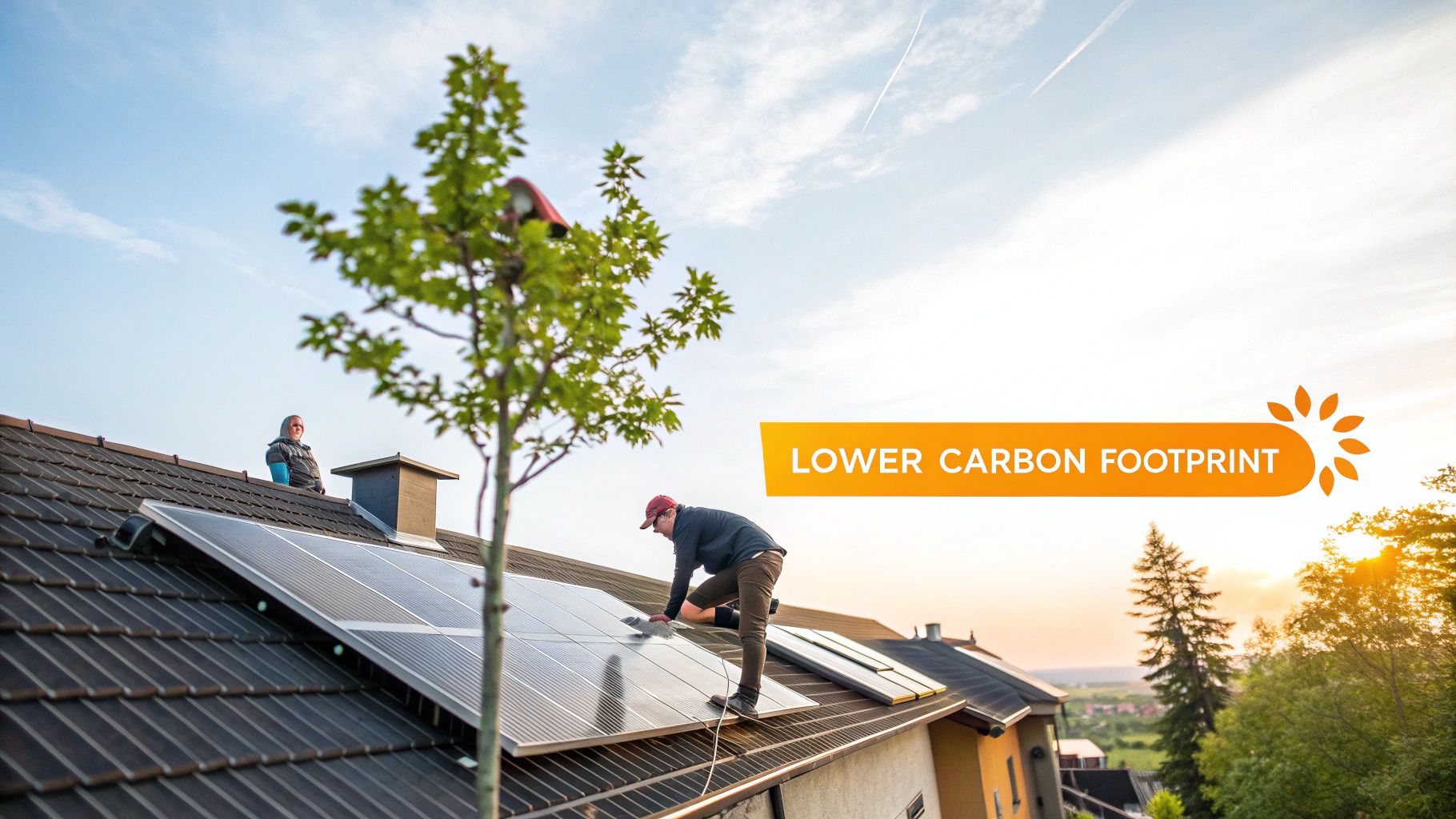
A typical residential solar system in New York can offset between three to four tons of carbon dioxide annually. To put that in perspective, this is the environmental equivalent of planting over 40 trees every single year. This powerful action reduces our collective reliance on fossil fuels, which are not only finite but also major contributors to environmental degradation. By embracing solar, both homeowners and businesses can play a vital role in creating a more sustainable energy future for the entire region. This transition is essential for preserving New York’s natural resources for generations to come.
Actionable Tips:
- Calculate Your Carbon Payback: While solar panels generate clean energy, their manufacturing has an energy cost. Ask your installer about the system’s "carbon payback period," which is typically just 1 to 4 years.
- Choose Sustainable Manufacturers: Look for panel manufacturers committed to sustainability, such as those with comprehensive recycling programs and low-impact production processes.
- Maximize Your Green Impact: Pair your solar panel system with an electric vehicle (EV) to power your transportation with clean energy, drastically reducing your household's total carbon footprint.
3. Con: Weather Dependency and Seasonal Variability
One of the primary drawbacks of photovoltaic panels is their inherent reliance on sunlight, which makes their energy output variable and dependent on weather and seasons. For property owners in New York, this means power generation will naturally decrease during the shorter, often overcast days of winter compared to the long, sunny days of summer. On a heavily cloudy or rainy day, a system can produce 70-90% less electricity than it would under direct sunlight, a significant factor when evaluating the pros and cons of photovoltaic panels.
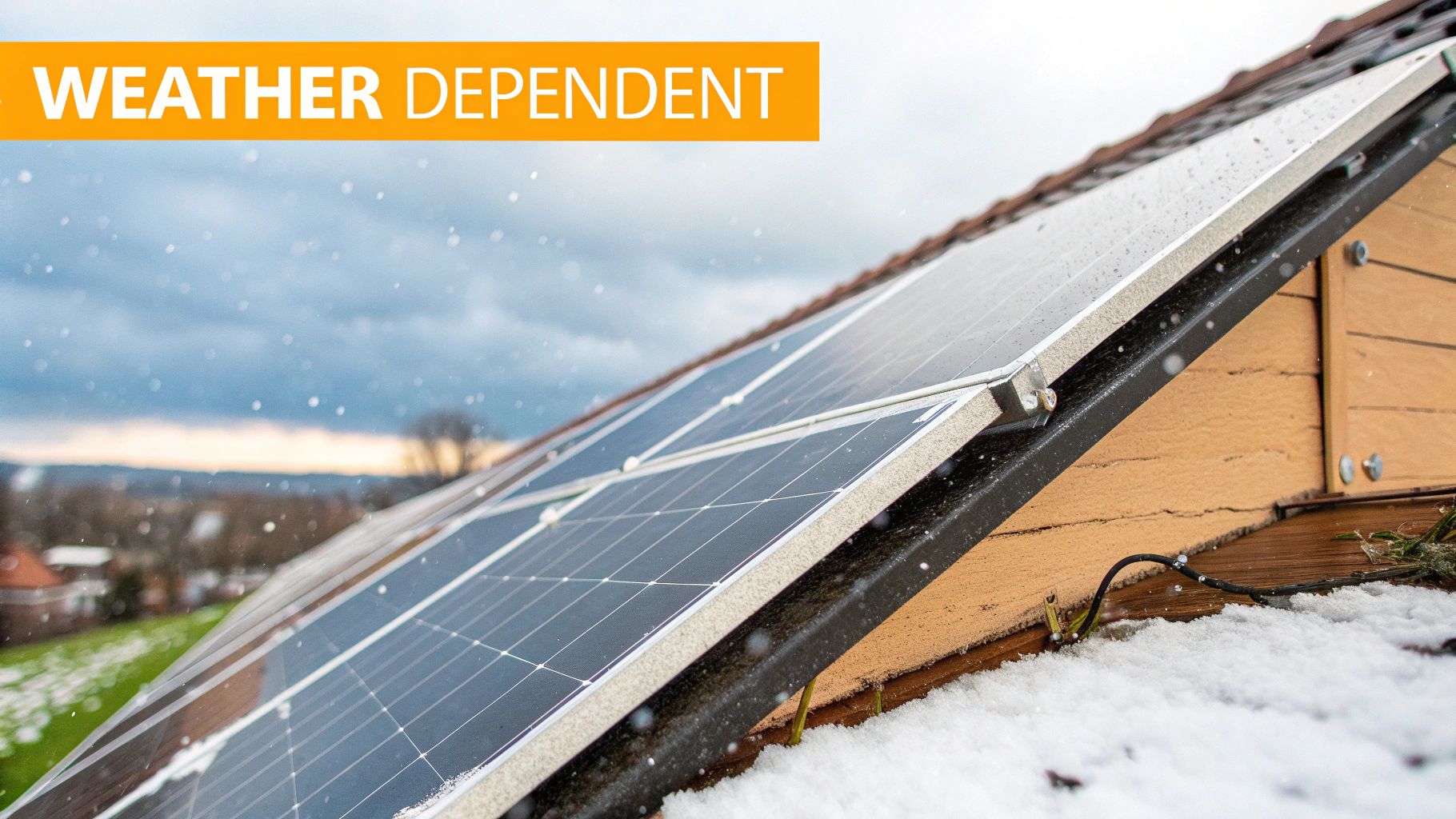
This variability is especially pronounced in the Northeast. While a location like Phoenix, AZ, enjoys consistent, high-intensity sunlight year-round, Long Island and the greater NYC area experience distinct seasonal shifts that impact annual energy production. Although modern panels are increasingly efficient in low-light conditions, this dependency remains a fundamental limitation. However, this challenge is often addressed through system design and grid-tied benefits like net metering, which allow you to bank excess energy credits generated during peak summer months to offset lower production in winter.
Actionable Tips:
- Bank Summer Energy with Net Metering: Work with your utility, like PSEG or Con Edison, to enroll in net metering. This allows you to receive credits for surplus energy you send to the grid in the summer and use them during less productive winter months.
- Install Battery Storage: Mitigate daily and seasonal variability by adding a battery system. A battery stores excess solar energy for use at night, during cloudy days, or during power outages, providing true energy independence.
- Optimize Panel Orientation: Ensure your installer positions panels at the optimal angle and orientation (typically south-facing) for your specific latitude to maximize sun exposure throughout the year.
By understanding how weather impacts performance, you can implement strategies to create a reliable and consistent energy supply, turning a potential weakness into a manageable aspect of your solar investment.
4. Con: High Initial Installation Costs and Financing Barriers
The most significant hurdle for many considering photovoltaic panels pros and cons is the substantial upfront investment. For a typical residential property in New York, a full solar installation can cost between $15,000 and $25,000 before any incentives are applied. While federal and state credits significantly reduce this figure, the remaining balance can still pose a considerable financial barrier, particularly for low-to-moderate-income households or small businesses without immediate access to capital.
This initial cash outlay can prevent otherwise ideal candidates from adopting solar energy, even when the long-term savings are clear. While financing options exist, not everyone qualifies, and the prospect of taking on a large loan can be daunting. This challenge led to the rise of alternative models like solar leases and Power Purchase Agreements (PPAs), which offer a low-to-no-cost entry point. Additionally, community solar programs across New York democratize access by removing the need for a large personal investment, but the high initial cost of direct ownership remains a primary deterrent for many.
Actionable Tips:
- Explore Leases & PPAs: Look into solar lease or Power Purchase Agreement (PPA) options, which often require little to no money down and allow you to pay a fixed monthly rate for solar energy.
- Get Multiple Quotes: Always obtain at least three quotes from different certified installers to ensure you are getting a competitive price for your system.
- Investigate All Incentives: Before calculating your final cost, thoroughly research federal, NY State, and any local Long Island-specific rebates or programs that can drastically lower your initial expense.
- Consider Community Solar: If a rooftop installation is not financially viable, joining a local community solar project allows you to benefit from solar energy without installing panels on your property.
Understanding these financial hurdles is the first step toward finding a viable path to solar ownership. To explore financing options tailored to your specific situation, you can get in touch with our team for a personalized consultation. This helps clarify the true cost and makes the investment more manageable.
5. Con: Space and Roof Requirements
A significant hurdle in the list of photovoltaic panels pros and cons is the physical space required for an effective installation. A typical residential system in New York needs 160 to 270 square feet of clear, unobstructed roof space. This can be a challenge for properties in dense urban areas like Queens or Brooklyn, where rooftops may be small, heavily shaded by adjacent buildings, or oriented improperly away from the sun. Structural integrity is also a key factor; older roofs may not be able to support the weight of a solar array without costly reinforcements.
This limitation is a major reason why an estimated 30% of U.S. renters and many condominium owners cannot access rooftop solar. For many Long Island homeowners, issues like heavy tree coverage or complex roof designs with dormers and skylights can make a viable installation impossible. While community solar programs in New York offer an alternative for those without suitable roof space, the physical constraints of a property remain a primary barrier for many would-be solar adopters. Creative solutions, however, are becoming more common, such as using ground space or building structures like solar canopies for parking lots.
Actionable Tips:
- Assess Your Roof Remotely: Use free tools like Google Earth or the PVWatts Calculator to get a preliminary idea of your roof’s size, orientation, and potential shading issues.
- Explore Ground-Mounted Systems: If your roof is unsuitable but you have available land, a ground-mounted system can offer greater efficiency and easier maintenance.
- Investigate Community Solar: Look into New York's community solar programs, which allow you to subscribe to a large, off-site solar farm and receive credits on your utility bill.
- Consider Structural Alternatives: For commercial properties or homes with large yards, you can explore solar canopies as a versatile alternative to traditional rooftop installations.
6. Pro: Low Maintenance and 25-30+ Year Lifespan
Photovoltaic panels are an exceptionally durable energy-generating asset, designed to withstand harsh New York weather and operate with minimal human intervention for decades. Unlike complex mechanical systems, solar panels have no moving parts, significantly reducing the likelihood of failure. This inherent reliability is a key factor when considering the pros and cons of photovoltaic panels. For property owners in New York, this means installing a system and enjoying clean energy without the burden of constant upkeep, making it a true "set-it-and-forget-it" investment.
Modern panels are engineered for longevity, with leading manufacturers offering 25- to 30-year performance warranties that guarantee they will retain at least 80-92% of their original output. Real-world evidence supports this durability; institutional solar farms often operate effectively for over 35 years. The most significant maintenance cost is typically an inverter replacement every 10-15 years, but otherwise, annual costs for inspections and cleaning are minimal, often just $150-$300. This long-term reliability ensures your solar investment continues delivering value for a generation.
Actionable Tips:
- Plan for Inverter Replacement: While panels last 30+ years, budget for an inverter replacement (around $2,000-$5,000) after 10-15 years to ensure uninterrupted performance.
- Verify All Warranty Terms: Ask your installer to clarify the separate warranties for performance, product (workmanship), and labor, as coverage can vary significantly.
- Schedule Pre-Installation Roof Maintenance: Address any potential roof issues before installing your panels to avoid the costly process of removing and reinstalling them later.
7. Pro: Achieve Energy Independence and Grid Resilience
One of the most powerful advantages of photovoltaic panels, especially when paired with battery storage, is the ability to achieve true energy independence and resilience against grid failures. For homeowners and businesses in New York, where storms like Hurricane Sandy have highlighted the grid's vulnerability, this benefit goes beyond simple cost savings. A solar-plus-storage system allows you to generate, store, and use your own electricity, creating a personal microgrid that keeps the lights on during widespread power outages caused by severe weather or equipment failure.
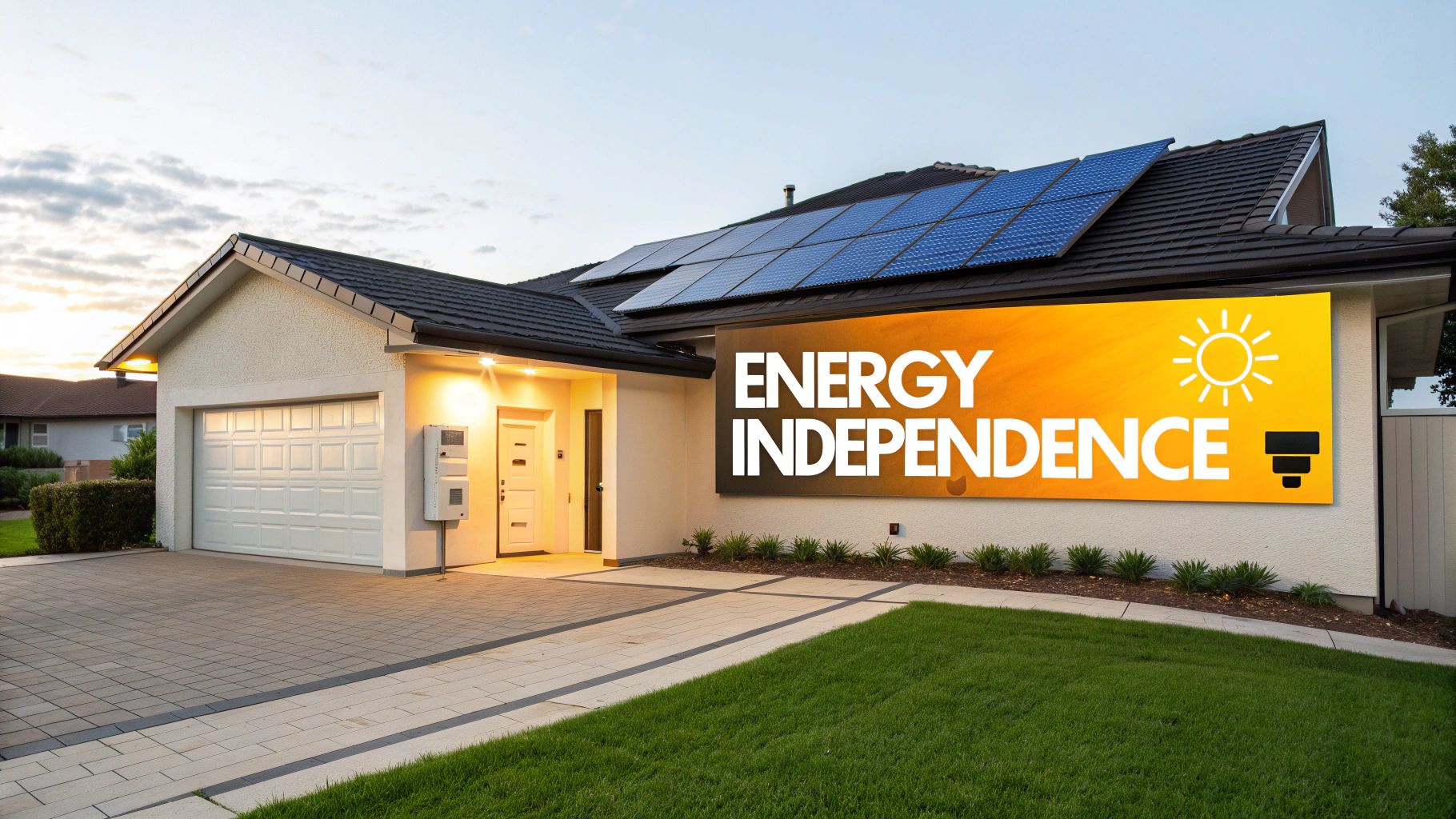
This resilience provides immense peace of mind. In New York, this means a facility manager in Queens or a homeowner in Suffolk County can maintain power to critical systems like refrigerators, medical devices, and communication equipment when the main grid goes down. By detaching from reliance on an aging infrastructure, you gain security and operational continuity, transforming your property into a self-sufficient energy hub. This is a crucial element of energy independence and a major pro for anyone concerned with reliability.
Actionable Tips:
- Size Your Battery for Essentials: Instead of backing up your entire home, focus on essential circuits. A 10-15 kWh battery like a Tesla Powerwall can typically provide 1-2 days of autonomy for critical loads.
- Install a Critical Load Panel: Ask your installer to wire essential appliances to a separate sub-panel that your battery will power during an outage, maximizing backup duration.
- Combine for Ultimate Resilience: For facilities requiring 100% uptime, consider integrating a solar-plus-storage system with a backup generator for multi-layered protection against extended grid failures.
Understanding the pros and cons of photovoltaic panels includes appreciating their role in personal security. This capability shifts the conversation from just saving money to ensuring stability and peace of mind during unpredictable events.
8. Con: Aesthetic and Roof Damage Concerns
While the financial and environmental benefits of photovoltaic panels are clear, a primary drawback for many New York homeowners involves aesthetics and potential roof integrity issues. Solar panels fundamentally change a home's appearance, and traditional blue-speckled panels with bulky silver racking can clash with certain architectural styles, particularly in historic Long Island towns like Port Jefferson or Garden City. Beyond visual appeal, improper installation poses a genuine risk of roof damage, including cracked tiles, shingle damage, or leaks if penetrations are not properly sealed, which can complicate future roof repairs.
These structural and aesthetic concerns are significant enough to limit adoption, especially in communities with strict homeowners' association (HOA) guidelines or historic district regulations. For example, some historic areas in Westchester County may have restrictions on visible solar installations to preserve neighborhood character. Concerns over curb appeal and the potential for roof complications are valid points to consider when evaluating the pros and cons of photovoltaic panels, requiring a careful balance between long-term energy goals and property preservation.
Actionable Tips:
- Opt for Sleek Designs: Ask your installer about all-black panels and low-profile mounting hardware that blend more seamlessly with dark-colored roofs.
- Prioritize Strategic Placement: If possible, position panels on less visible roof facets, away from the street-facing front of your home, to minimize visual impact.
- Verify Installer Credentials: Ensure your chosen installer is fully licensed, insured, and has a strong track record of roof-safe installations, including proper flashing and sealing techniques.
By discussing these concerns upfront with a qualified installer, you can explore design-forward solutions and ensure the installation process protects your roof's integrity. This proactive approach helps mitigate the potential downsides of installing solar panels on your property.
9. Pro: Substantial Government Incentives & Tax Benefits
One of the most significant financial advantages of adopting photovoltaic panels in New York is the array of powerful government incentives designed to make solar more affordable. These programs dramatically reduce the net cost of a system and shorten the payback period. For New York residents and businesses, the cornerstone incentive is the 30% federal Investment Tax Credit (ITC), which allows you to deduct 30% of the total system cost directly from your federal taxes. For a typical $25,000 system, this translates to a $7,500 credit.
New York State further enhances these savings with its own set of benefits. The NY-Sun program offers substantial rebates, and homeowners can claim the NYS Solar Energy System Equipment Credit, which is worth 25% of the system cost, capped at $5,000. When combined, these federal and state incentives can slash the upfront cost of a solar installation by more than half. For example, a homeowner in Smithtown, NY, could see their initial investment significantly lowered, making the financial case for solar overwhelmingly positive when evaluating photovoltaic panels pros and cons.
Actionable Tips:
- Confirm Tax Liability: The federal ITC is a non-refundable credit, so ensure your federal tax liability is sufficient to take full advantage of it.
- Layer State and Federal Incentives: Work with your installer to apply for both the 30% federal credit and the 25% NYS credit to maximize your total savings.
- Understand Your Utility's Policies: Familiarize yourself with your utility’s net metering policy, as this directly impacts your long-term savings by crediting you for excess energy your system produces.
10. Con/Pro: Manufacturing, Supply Chain and Technological Advancement
The journey of a photovoltaic panel from factory to rooftop is a double-edged sword, presenting both vulnerabilities and incredible opportunities. The manufacturing process itself is energy-intensive and depends on a complex global supply chain, which can create significant headwinds. For example, during 2022-2023, disruptions caused installation delays of 3 to 6 months for many New York projects. This reliance on international markets introduces potential risks related to geopolitical tensions and sourcing.
However, this same industrial engine is driving relentless innovation and cost reduction. The U.S. Inflation Reduction Act is actively incentivizing domestic manufacturing, aiming to secure the supply chain for American consumers. Simultaneously, panel prices have plummeted roughly 90% over the last decade, while efficiency continues to climb. Innovations like perovskite and tandem cells promise a future of even more powerful and affordable solar energy, turning today's challenges into tomorrow's breakthroughs. This rapid technological progress is a major long-term pro for the industry.
Actionable Tips:
- Prioritize Supply Chain Transparency: Ask your installer about their panel sourcing and partner with manufacturers who provide clear documentation on ethical labor and material origins.
- Focus on System Value, Not Just Peak Efficiency: Instead of chasing the highest lab-tested efficiency rating, evaluate the system's overall value, including warranty, manufacturer stability, and projected payback period for your specific property.
- Verify End-of-Life Plans: Inquire about the manufacturer’s recycling or extended producer responsibility programs to ensure your system is handled sustainably after its 25+ year lifespan.
By understanding both the risks and the rapid progress in the solar industry, you can make a more resilient and forward-thinking investment. This balanced view helps you appreciate the long-term value embedded in the technology, moving beyond immediate supply chain hurdles to secure decades of energy savings.
Photovoltaic Panels — 10-Point Pros & Cons Comparison
| Item | Implementation Complexity | Resource Requirements | Expected Outcomes | Ideal Use Cases | Key Advantages |
|---|---|---|---|---|---|
| Long-Term Cost Savings and Return on Investment (PRO) | Moderate — requires design, permits, financing decisions | High upfront capital ($15k–$25k), roof/ground space, possible batteries | Payback 6–12 years; $10k–$30k lifetime savings; 25–30+ year generation | Homeowners planning long-term residence; high utility-rate areas | Reduced bills, predictable energy costs, increased resale value |
| Environmental Benefits and Reduced Carbon Footprint (PRO) | Low–moderate — standard installation with environmental choices | PV panels, minimal operational water; manufacturing energy footprint | Offsets ~3–4 tons CO2/year per home; supports emissions goals | Eco-conscious households, EV owners, community solar participants | Zero operational emissions, lower air/water pollution |
| Weather Dependency and Seasonal Variability (CON) | Low — plus site assessment and possible storage for reliability | Sunlight hours vary by location; batteries or grid connection to mitigate | Variable output; large seasonal and cloudy-day reductions | Sun-rich regions or hybrid systems with storage/grid backup | Still produces in low light; inverters improve low-light performance |
| High Initial Installation Costs and Financing Barriers (CON) | Moderate — requires financing, incentives navigation | Significant upfront cost pre-incentives ($15k–$25k); credit or leases needed | Upfront barrier for many; long-term savings if financed properly | Buyers with access to loans, leases, or incentive programs | Financing options, leases/PPAs and tax credits can lower entry cost |
| Space and Roof Requirements (CON) | Moderate — roof assessment and possible structural upgrades | ~140–200 sq ft for 5 kW; south-facing, unobstructed roof preferred | Insufficient space reduces system size and generation | Detached homes with adequate roof/yard; those considering ground-mount | Alternatives: ground-mounted, community solar, canopy solutions |
| Low Maintenance and 25–30+ Year Lifespan (PRO) | Low ongoing — periodic cleaning, inspections; inverter replacement | Minimal annual upkeep ($150–$300); inverter replacement $2k–$5k | 25–30+ year lifespan with ~0.5–0.8%/yr degradation; durable performance | Long-term homeowners seeking low-maintenance investments | High reliability, predictable long-term output, low operating costs |
| Energy Independence and Grid Resilience (PRO) | High — integrates batteries, hybrid inverters, islanding setups | Adds battery cost ($8k–$15k+), controls, critical-load wiring | Backup power during outages; limited autonomy (1–3 days typical) | Areas prone to outages, off-grid or disaster-resilient homes | Maintains essential loads, improves resilience and emergency readiness |
| Aesthetic and Roof Damage Concerns (CON) | Moderate — careful placement and mounting techniques needed | Mounting hardware, roof penetrations; possible roof reinforcement | Visual impact; potential for roof leaks or repair complications | Owners in historic or high-aesthetic-value neighborhoods | BIPV and sleek designs reduce visibility; ground options available |
| Government Incentives and Tax Benefits (PRO) | Moderate — requires paperwork, tax liability and timing | Documentation for ITC, state rebates, net metering enrollment | Federal ITC ~30% (through 2032) — accelerates payback and lowers net cost | Homeowners with tax liability and in states with strong incentives | Significant cost reduction, improved economics, net-metering benefits |
| Manufacturing, Supply Chain and Technological Advancement (CON/PRO) | Low for installer choice; high at policy/manufacturing level | Global supply chain, manufacturing energy; evolving tech options | Ongoing efficiency gains and cost declines; supply vulnerabilities exist | Buyers seeking high-efficiency panels or supply-chain transparency | Rapid tech improvements, falling costs, emerging domestic manufacturing |
The Verdict: Is Solar the Right Choice for Your New York Property?
After a thorough examination of the photovoltaic panels pros and cons, the path forward becomes much clearer for New York property owners. The decision to invest in solar isn't a simple yes or no; it's a calculated assessment of long-term value against initial hurdles. For many homeowners from Long Island to the Hudson Valley and businesses across the state, the verdict is increasingly in favor of solar.
The compelling advantages—significant long-term cost savings, a dramatically reduced carbon footprint, and the peace of mind that comes with energy independence—present a powerful case. These benefits are amplified by New York's robust incentive landscape, including the NY-Sun Megawatt Block program and the federal Investment Tax Credit, which substantially lower the financial barrier to entry. While the cons, like the high upfront cost and weather dependency, are valid and require careful consideration, they are not insurmountable obstacles.
Key Takeaways: A Balanced View
To make an informed decision, it's essential to weigh the most critical factors for your specific situation:
- Financial Feasibility: The initial investment remains a significant con, but it must be viewed in the context of available financing, tax credits, and the system's 25-plus-year lifespan of generating free electricity. The pro of long-term ROI often outweighs this initial con.
- Geographic and Property Constraints: Not every roof is suitable for solar. Factors like orientation, shading, and structural integrity are critical limitations. However, modern panel efficiency and professional design can often create viable solutions even for less-than-ideal properties.
- Energy Goals: If your primary goal is grid resilience and protection from blackouts, a solar panel system paired with battery storage becomes an undeniable pro. For those focused purely on environmental impact, solar is one of the most direct ways to achieve a smaller carbon footprint.
Crucial Insight: The conversation has shifted from "if" solar is a good investment to "how" to best implement it. The key is to match the right technology and financing with your property's unique characteristics and your personal or business objectives.
Ultimately, mastering the concepts presented in this guide empowers you to move beyond the surface-level debate of photovoltaic panels pros and cons. It allows you to ask the right questions and accurately evaluate a solar proposal. The true value lies not just in saving money on your utility bill but in taking control of your energy future, enhancing your property's value, and contributing to a more sustainable New York. The next step is to translate this general knowledge into a concrete, data-driven plan for your home or facility.
Ready to see how the pros and cons stack up for your specific property? Contact NY Essential Power for a complimentary, no-obligation solar assessment. Our local experts provide a transparent analysis of your potential savings, system costs, and incentive eligibility to give you the clear answers you need to invest with confidence. Explore your solar potential with NYS Essential Power today!