Staring at a Con Edison or PSEG Long Island bill can feel like trying to decipher a secret code. Between the jargon and the fine print, it’s easy to just pay the total and move on. But understanding your bill is the first step toward controlling your energy costs, gaining independence from the grid, and making smarter financial decisions for your home or business.
The big secret? Your bill is really just two main parts: supply charges (the cost of the electricity you use) and delivery charges (the cost of getting that power to you). For New York property owners, getting a handle on this simple split is the key to unlocking significant savings and paving the way for a more sustainable future.
Why Your NY Electric Bill Can Seem Confusing
For most people in New York, from Long Island to Buffalo, the monthly utility statement is a maze of unfamiliar terms and data. Utilities like National Grid and NYSEG try to be transparent by itemizing every single charge, but this often just adds to the confusion. The good news is you only need to zoom in on a few key areas to find real opportunities for cost savings and energy efficiency.
This breakdown slices your bill into three core pieces—supply, delivery, and usage—so you can quickly see what actually matters for your bottom line.
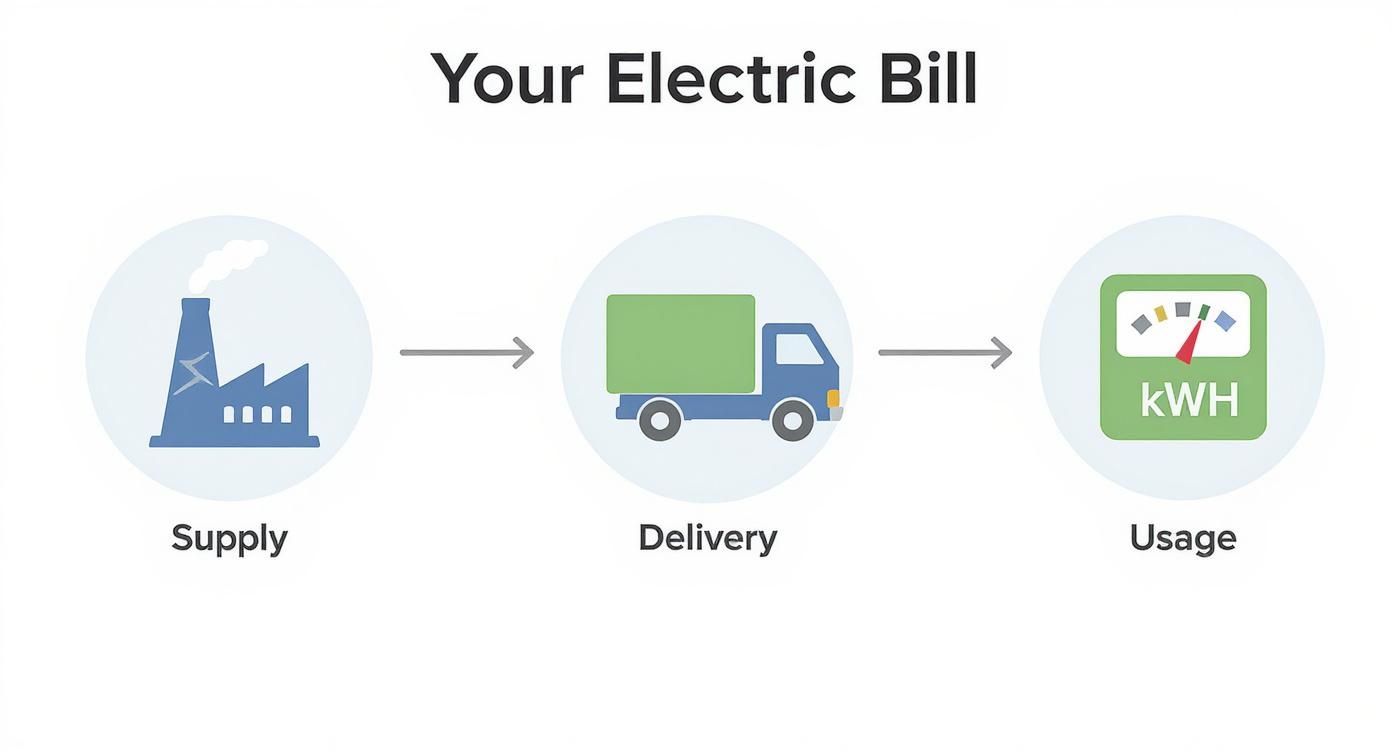
As you can see, your final cost is a mix of the electricity itself (supply), the poles and wires that transport it (delivery), and your total consumption (usage).
Key Information to Look For
When you first glance at your bill, your eyes probably jump right to the total amount due. But the real story—and the opportunities for savings—is buried in the details. Look past that final number, and you'll find the information you need to take control.
Here’s what you should hunt for:
- Total Kilowatt-Hour (kWh) Usage: This is the most critical number on your bill. It’s the raw measure of how much electricity your home or business consumed during the billing cycle.
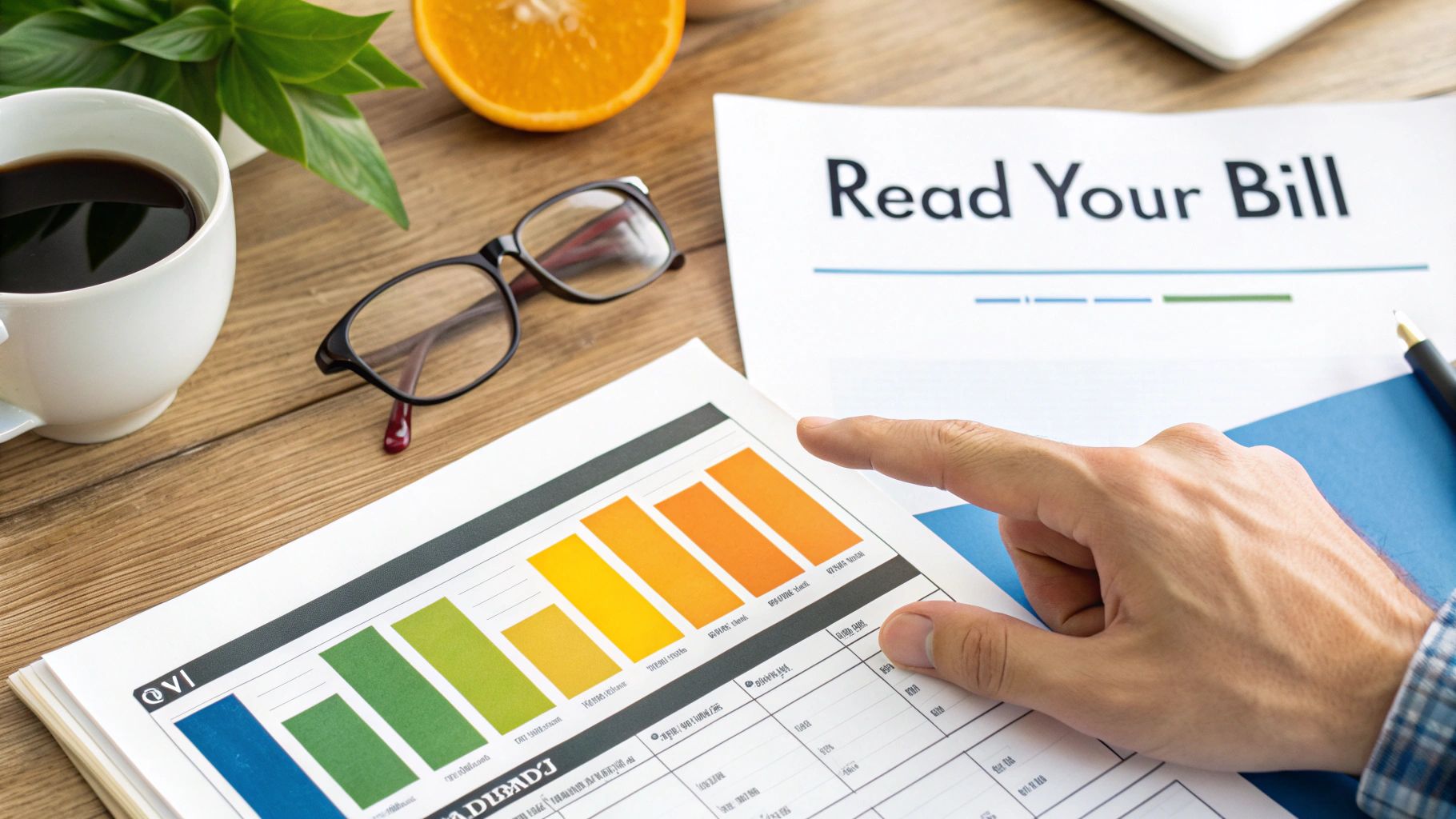
- Usage History Graph: This little bar chart is your best friend for spotting trends. It compares your current usage to previous months and often the same month last year, showing you if your consumption is heading up or down.
- Supply and Delivery Rates: Find the price you’re paying per kWh for both supply and delivery. Since New York has a deregulated market, you have the power to choose your electricity supplier, which directly impacts your supply rate.
The moment you stop just paying the bill and start actively managing your kWh consumption and rate, you've unlocked the key to lower energy costs. This simple shift in mindset makes all the difference.
Key Terms on Your New York Electric Bill
To help you navigate the fine print, here’s a quick guide to some of the most common terms you'll encounter on a typical New York utility bill.
| Term | What It Means for You |
|---|---|
| kWh (Kilowatt-Hour) | The standard unit for measuring electricity consumption. This is what you're billed for. |
| Demand (kW) | The peak rate of electricity usage during a billing period, mostly seen on commercial bills. This can significantly increase costs. |
| Supply Charges | The cost of the actual electricity you consumed. You can often choose your supplier for this portion. |
| Delivery Charges | The cost to transport electricity from the power plant to you via the utility's infrastructure. This is non-negotiable. |
| GRT (Gross Receipts Tax) | A state tax imposed on the gross operating income of utility companies, which is passed on to you. |
| SBC (System Benefits Charge) | A charge that funds New York's clean energy programs, like NYSERDA incentives for solar and efficiency upgrades. |
Familiarizing yourself with these terms will make it much easier to understand where your money is going each month.
Understanding Your Delivery and Supply Charges
Here's something most New Yorkers miss: your monthly electric statement is actually two bills rolled into one. Getting a handle on this split is the first real step toward saving money. Every bill is divided into delivery charges and supply charges, and they cover two very different things.
Think of delivery charges as the non-negotiable part of the deal. These are the fees from your local utility, whether that’s Con Edison in Westchester or National Grid on Long Island. This money goes toward maintaining the massive network of poles and wires that safely get the power to your property. It's essentially the shipping and handling cost for your electricity. You can't change it.
On the other hand, supply charges are the cost of the actual electricity you used. And this is where you have some real power to make a change.
You Have the Power to Choose Your Supplier
Because New York has a deregulated energy market, you're not stuck buying your electricity supply directly from the utility. You can choose a different company, called an Energy Service Company (ESCO), to provide your power, often at a different rate.
Don't worry, your utility still delivers the electricity and handles the billing. The only thing that changes is the price you pay per kilowatt-hour (kWh) for the energy itself. However, the ultimate path to controlling your supply costs and achieving true energy independence is by generating your own power with solar.
Understanding your bill isn’t just about paying what you owe; it's about identifying opportunities. The supply charge is your single greatest opportunity to take control of your monthly energy expenses without changing your usage habits.
What's a Kilowatt-Hour (kWh) Costing You?
To really read your bill, you have to know its fundamental unit of measurement: the kilowatt-hour (kWh). It’s how electricity usage is tracked. For context, the average U.S. home burns through about 10,700 kWh every year, which is quite a bit higher than in many other parts of the world. You can actually see some interesting global energy consumption trends on enerdata.net for comparison.
Your bill will show exactly how many kWh you used and what you paid for them. This is why generating your own solar power is so impactful—it directly eliminates the cost of every single one of those kilowatt-hours.
Using Your Bill's Data to Find Savings
That usage graph on your monthly statement is more than just a colorful chart—it’s a roadmap to potential savings. Think of it as your property's energy story, written month by month. Learning to read it is the first step in turning data into real dollars back in your pocket.
You'll almost certainly notice seasonal spikes. Here in New York, especially on Long Island or in the city, summer air conditioning demand makes those usage bars climb high. A great trick is to compare this year's graph to last year's. If your July consumption jumped 15% despite similar weather, that’s a red flag. It could mean your HVAC system is overdue for a tune-up or an old, inefficient appliance is silently draining power.
Master Your Timing with Time-of-Use Rates
Many New York utilities, including Con Edison, are moving customers toward Time-of-Use (TOU) rates. This completely changes the game. Instead of a flat rate, the price of electricity fluctuates throughout the day. It gets more expensive during peak hours (usually afternoons and early evenings) and becomes much cheaper during off-peak hours (late at night and early in the morning).
This is where you can get strategic. A family in Queens, for example, could see real savings just by making a few small tweaks to their daily routine:
- Run the dishwasher after 10 PM instead of right after dinner.
- Do laundry on weekend mornings when rates are often lower.
- Charge your electric vehicle overnight to tap into the cheapest power available.
These aren't about using less electricity, but about using it smarter. By shifting your heavy consumption to lower-cost periods, you can directly cut down your supply charges.
Getting a handle on your bill's components—from the different rate tiers to those fixed service charges—is the absolute foundation of smart energy management. While bills vary across the U.S., the core principles of consumption and cost per kWh are universal. This knowledge empowers you to hunt down savings. For a broader look, you can discover more insights about global electricity data from IEA.blob.core.windows.net.
If you really want to dig into the numbers and spot trends, it helps to learn how to analyze data in Excel. For more practical tips on making your home more energy-efficient, we’re always sharing new ideas over on our blog.
Teasing Apart the Fees, Surcharges, and Taxes

Ever look at your electric bill and wonder why the total is so much higher than your actual usage charges? You’re not alone. The fine print is often a maze of line items that can significantly inflate what you owe. Let's break down what these charges actually are.
Many of the fees you'll spot are specific to New York and fund crucial statewide initiatives. They might seem like just another tax, but they serve a real purpose in advancing the state's environmental and economic goals. For instance:
- System Benefits Charge (SBC): This helps fund NYSERDA's energy efficiency programs and incentives that both homeowners and businesses can tap into for solar and other clean energy projects.
- Renewable Portfolio Standard (RPS): This charge is a direct investment in New York's clean energy goals, supporting the growth of solar and wind power across the state.
Seeing these on your bill means you're contributing to a more modern and resilient grid for everyone in the state.
The Big One for Businesses: Demand Charges
If you own a commercial property, there's one fee that can absolutely wreck your budget if you're not careful: the demand charge. This one trips a lot of business owners up because it has nothing to do with your total electricity consumption (your kWh). Instead, it's based on the single highest spike of electricity usage during the month, measured in kilowatts (kW).
A single afternoon of running all your heavy equipment simultaneously can set a high demand peak, drastically increasing your bill for the entire month—even if your overall usage is low. This is a critical area where proactive energy management pays off.
Learning to manage these peaks is the key to getting your commercial electric costs under control. This is where solutions like solar paired with battery storage become so valuable. By drawing power from a battery during those high-use moments, a business can flatten its demand curve and avoid those punishing charges. It’s a direct strategy for cutting one of the most volatile expenses on your bill and taking a major step toward energy independence.
How Solar and Net Metering Completely Change Your Bill
Once you go solar, your electric bill isn't just a bill anymore. It becomes a monthly report card for your property's own power plant. Here in New York, we have a system called net metering, and it fundamentally rewrites the script on how you pay for—or get credited for—your electricity. This program is a cornerstone of the state's commitment to renewable energy, offering significant financial benefits.
The focus shifts from what you pulled from the grid to what you produced. You'll start seeing new line items that track the kilowatt-hours (kWh) your panels generated, how much of that power you used on the spot, and—this is the exciting part—how much extra you sent back to the utility company.
Spotting Your Net Usage and Solar Credits
The most important number on your new bill is your "net" usage. Forget just looking at total consumption; this is where the real story is. Net usage is simply the difference between the power you bought from the grid and the excess power your panels exported back to it.
Let's imagine a sunny month for a home in Albany. Your panels might crank out 700 kWh, but your home only needed 500 kWh. That extra 200 kWh doesn't just vanish. It gets pushed onto the grid, and your utility credits your account for it.
These credits are like money in the bank. They'll automatically apply to future bills, which is a lifesaver during those darker, less sunny winter months when your production is lower. You can get a deeper sense of this shift by comparing solar panels vs. traditional energy sources on Long Island.
To make this crystal clear, here’s how to read the net metering section of your statement:
Understanding Your Net Metering Statement
| Line Item | What It Shows | Impact on Your Bill |
|---|---|---|
| Energy Delivered | The total kWh you pulled from the grid (e.g., at night). | This is the electricity you're charged for. |
| Energy Received | The total excess kWh your panels sent to the grid. | This is the electricity that earns you credits. |
| Net Usage | The difference between "Delivered" and "Received." | If positive, you owe money. If negative, you have a credit. |
| Credit Balance | The running total of your banked net metering credits. | This rolls over month-to-month to offset future charges. |
This banking system is the secret sauce behind those tiny—or even zero-dollar—electric bills you hear about.
Think of your utility company as an energy bank. With net metering, you're making big deposits all summer long and then making withdrawals during the winter. It’s a powerful way to achieve year-round savings and a real sense of energy independence.
This cycle of producing, banking, and rolling over credits is what turns your roof from just a roof into a legitimate financial asset. It’s the single biggest reason going solar in New York makes so much sense.
Take Control of Your New York Energy Costs
You've learned how to decode your electric bill. That's a huge first step. You can now tell the difference between supply and delivery charges, spot your usage patterns, and see how solar credits can completely flip the script. But just understanding the bill is only half the battle.
The real goal is to take what you've learned and use it to your advantage. Whether you’re a homeowner on Long Island tired of unpredictable PSEG bills or a business owner in the city feeling the sting of Con Edison's demand charges, you’re now equipped to do something about it.
Your Path to Cost Savings and Energy Independence
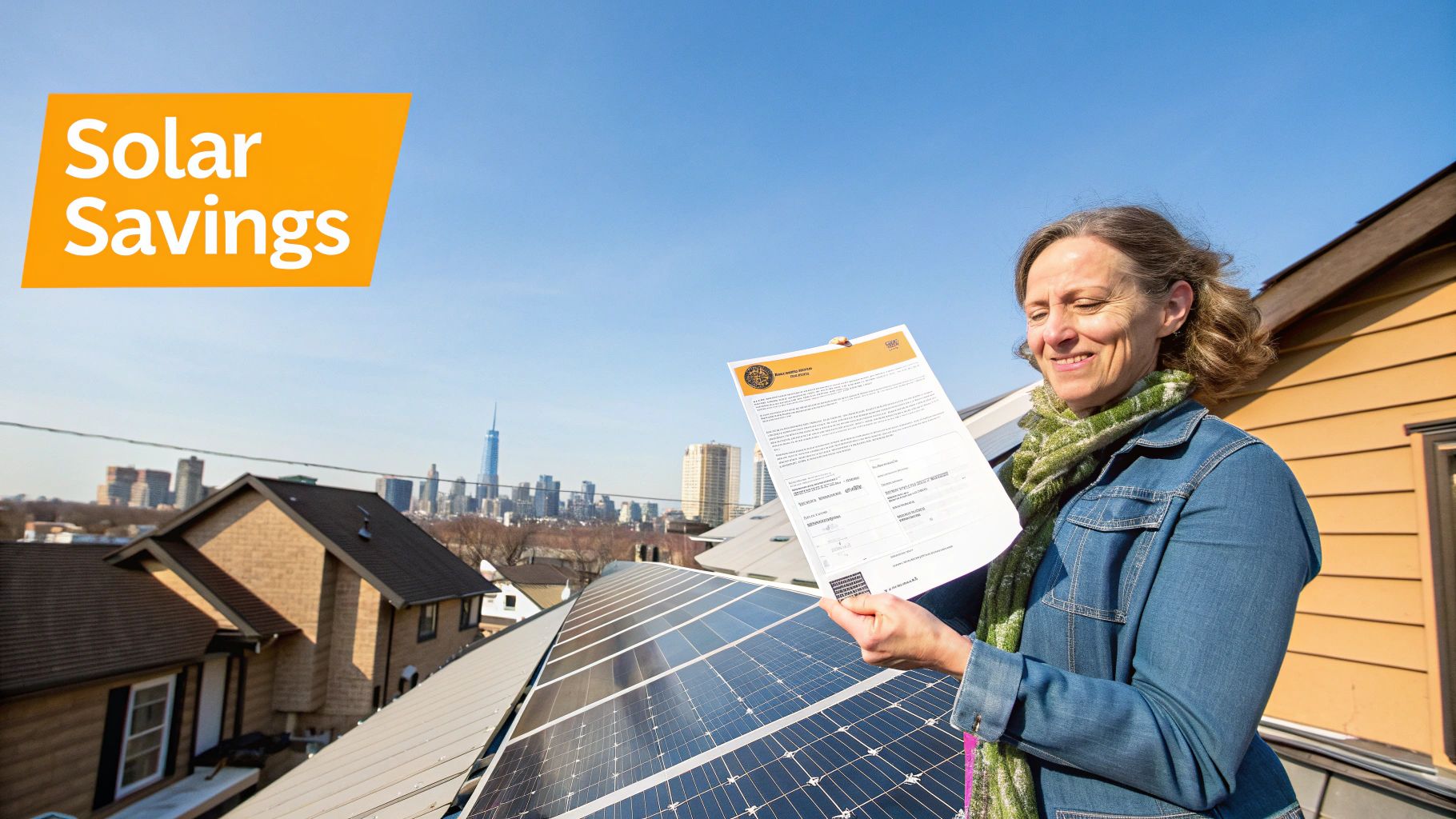
The most powerful way to control your energy expenses is to generate your own clean power. Installing solar isn't just about trimming a monthly bill; it's a smart, long-term investment in your property and your financial future, supported by strong New York State incentives like the NY-Sun program and federal tax credits.
This move gives you:
- Cost Savings: Lock in your energy costs for decades, shielding your home or business from volatile utility rate hikes while benefiting from a cleaner, more sustainable energy source.
- Energy Independence: Reduce your reliance on an aging power grid and take control of your own electricity supply, ensuring more predictable and stable power.
- Environmental Benefits: By going solar, you directly contribute to New York's ambitious clean energy goals and significantly reduce your property’s carbon footprint.
Stop letting the utility company dictate your budget. When you produce your own power with solar, you transform a recurring expense into an asset that adds value for decades.
If you’ve had enough of volatile and confusing utility bills, it's time for a change. You’ve done the hard work of learning to read your bill. The next logical step is to see how solar can eliminate those costs for good.
Ready to find out exactly how much you could save while contributing to a cleaner New York? The team at NY Essential Power can provide a free, no-obligation solar quote tailored to your property. Contact us for your free solar assessment today and take control of your electric bill for good.