
Congratulations on making the switch to an electric vehicle! Now, it's time to set up the most convenient and cost-effective way to charge: right at your own property. Installing an EV charger involves a few key stages: choosing the right hardware, getting a professional site assessment, navigating local permits and incentives, and ensuring a safe, code-compliant installation. While a DIY approach might seem tempting, high-voltage electrical work is a job for certified professionals. This is especially true here in New York, where local codes and utility requirements from providers like Con Edison and PSEG Long Island can be complex.
Your Roadmap to EV Charging in New York
Think of this as your complete guide to getting an electric vehicle charger set up in New York. Whether you’re a homeowner in Suffolk County looking forward to the convenience of overnight charging or a business in Albany aiming to attract EV-driving customers and employees, this is a smart investment. You're not just adding convenience; you're investing in long-term cost savings, energy independence, and a smaller environmental footprint. It all starts with a solid plan to make sure your charger is safe, efficient, and meets all local codes.
This guide is designed to simplify the entire process. We’ll cover everything from selecting the right charger and understanding utility requirements to tapping into New York State incentives that can significantly lower the cost. We'll take you through it step-by-step, so you can see how a professional installation leads to years of effortless EV ownership. Our team at NYS Essential Power has successfully completed countless installations for homeowners and businesses across New York.
The Installation Journey Simplified
To get a quick overview, the path to getting your EV charger installed flows from picking your gear to finally enjoying lower fueling costs and greater energy independence.
This infographic breaks down the main steps in the journey: choosing the right charger, getting it professionally installed, and then cashing in on the savings and environmental benefits.
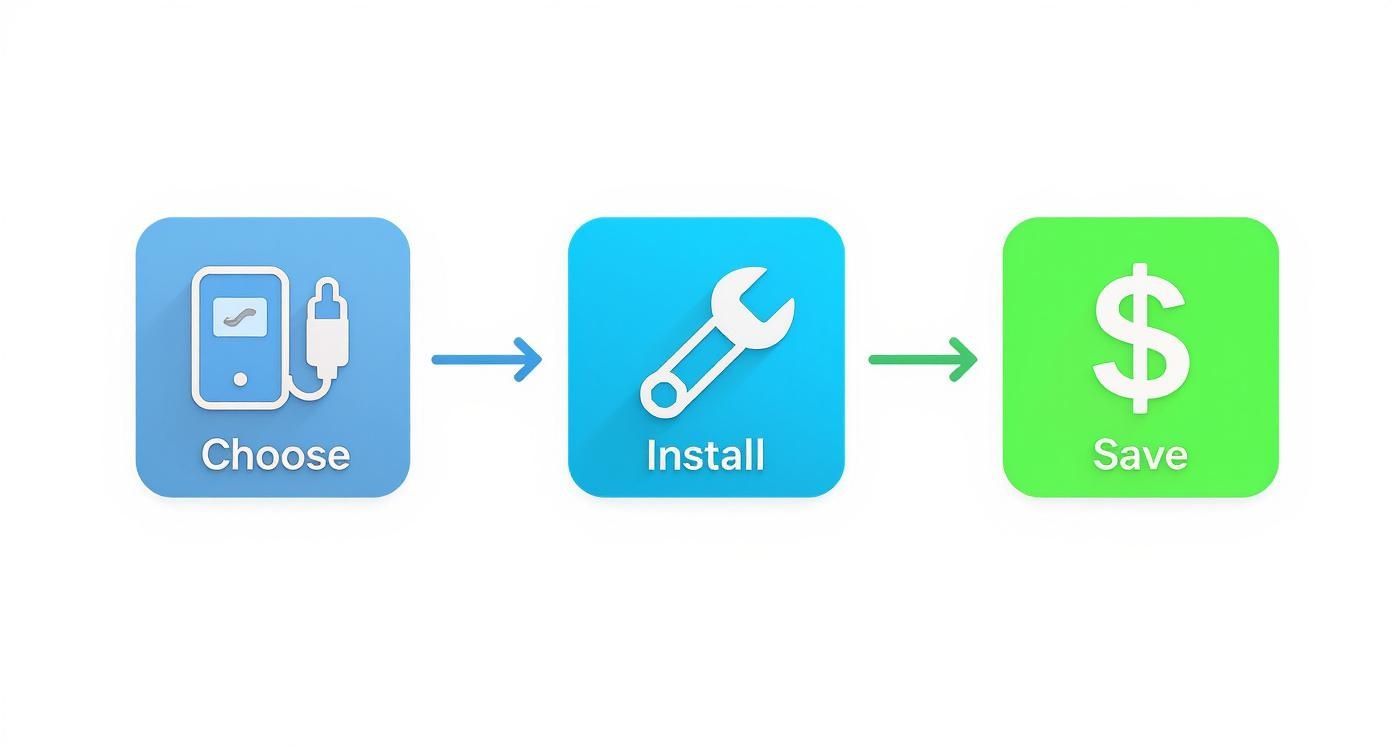
As you can see, a successful outcome hinges on making smart decisions at the start and trusting a certified expert to handle the hands-on work.
If you're the type who likes to dig into the technical nitty-gritty, you can explore some detailed guidance on electric vehicle charging installation. Just keep in mind that specific codes and regulations may differ from what we have here in New York. The core concepts of electrical safety and matching the right equipment, though, are universal.
The goal isn't just to hang a box on the wall. It's about building a safe, cost-effective charging system that integrates seamlessly with your property and lifestyle. For commercial properties, EV charging is quickly becoming an essential amenity for employees, customers, and tenants.
With this roadmap in hand, you'll be much better equipped to make the right calls for your project, whether it's for your home on Long Island or a multi-family building in New York City.
Choosing the Right EV Charger for Your Needs
Before any wiring is planned, your first decision is selecting the right hardware. Not all chargers are created equal, and the best one for you depends entirely on your vehicle, driving habits, and property type, whether it’s for your home in New York or for a commercial facility.
The market is generally divided into three tiers: Level 1, Level 2, and DC Fast Charging. Each serves a different purpose, and understanding the difference is key to a smart investment that fits your daily life and energy goals.
Matching a Charger to Your New York Lifestyle
For most homeowners across New York, the choice comes down to Level 1 versus Level 2.
A Level 1 charger is the most basic option—it plugs into a standard 120-volt wall outlet. While it requires no special installation, the trade-off is speed. It’s very slow, adding only about 3-5 miles of range per hour. This might suffice for a plug-in hybrid with a small battery or a condo owner in Queens with a very short daily commute.
For nearly everyone else, a Level 2 charger is the practical and necessary solution. Imagine a family in Suffolk County commuting on the Long Island Expressway. A Level 1 charger would never fully recharge their EV overnight. A Level 2 unit, however, adds 25-40 miles of range per hour, ensuring their vehicle is fully charged and ready every morning. This is the gold standard for home charging convenience and energy independence.
The right charger turns your garage into a personal fueling station. It’s about more than just convenience; it’s about taking control of your energy costs and reducing your reliance on public charging infrastructure.
To make things clearer, let's break down how these charging levels stack up.
EV Charger Levels at a Glance
| Charger Type | Voltage Required | Charging Speed (Miles per Hour) | Best For |
|---|---|---|---|
| Level 1 | 120V (Standard Outlet) | 3-5 | Plug-in hybrids, short commutes, or when no other option is available. |
| Level 2 | 240V (Dryer Outlet) | 25-40 | The standard for most homes and many businesses. Perfect for overnight charging. |
| DC Fast Charger | 480V+ (3-Phase Power) | 100-350+ | Commercial properties, highway rest stops, and fleet depots. |
As you can see, the jump from Level 1 to Level 2 is significant and is what most EV owners in New York will need for practical, everyday use.
The Commercial Charging Calculation
For business owners and property managers in places like Westchester or Albany, the decision is more strategic. Here, the goal is often to serve customers, support an employee fleet, or create a new revenue stream while showcasing a commitment to sustainability.
- Retail and Hospitality: For a business where customers stay for an hour or more—like a restaurant, hotel, or shopping center—Level 2 chargers are perfect. They provide a meaningful charge that enhances the customer experience and encourages longer visits.
- Workplace Charging: Offering Level 2 charging is a fantastic perk for employees. It supports their transition to electric vehicles and is a powerful tool for attracting and retaining top talent in a competitive market.
- Fleet Operations: Businesses with electric vans or trucks will likely need a mix of charging solutions. Level 2 chargers are ideal for overnight fleet charging, while a DC Fast Charger might be necessary for quick turnarounds during the business day.
DC Fast Chargers are the most powerful option, capable of adding hundreds of miles of range in under an hour. They represent a major investment and are typically found along travel corridors, but for a business aiming to become a premier charging destination, they are a game-changer.
Understanding the Electrical Requirements
A critical factor is your property's electrical system. A Level 2 charger requires a dedicated 240-volt circuit—the same type used for an electric stove or clothes dryer.
Industry data shows that about 90% of EV owners install chargers at home, which underscores how vital it is to have the right electrical capacity. Before any installation, a licensed electrician must perform a load calculation on your electrical panel. This assessment might reveal that your panel needs an upgrade to handle the additional load safely, which can add to the project cost but is essential for safety. You can learn more about the broader trends in the state of the US fast charging industry to see how this fits into the bigger picture.
Don't Skip the Pre-Installation Site Assessment—It's Critical
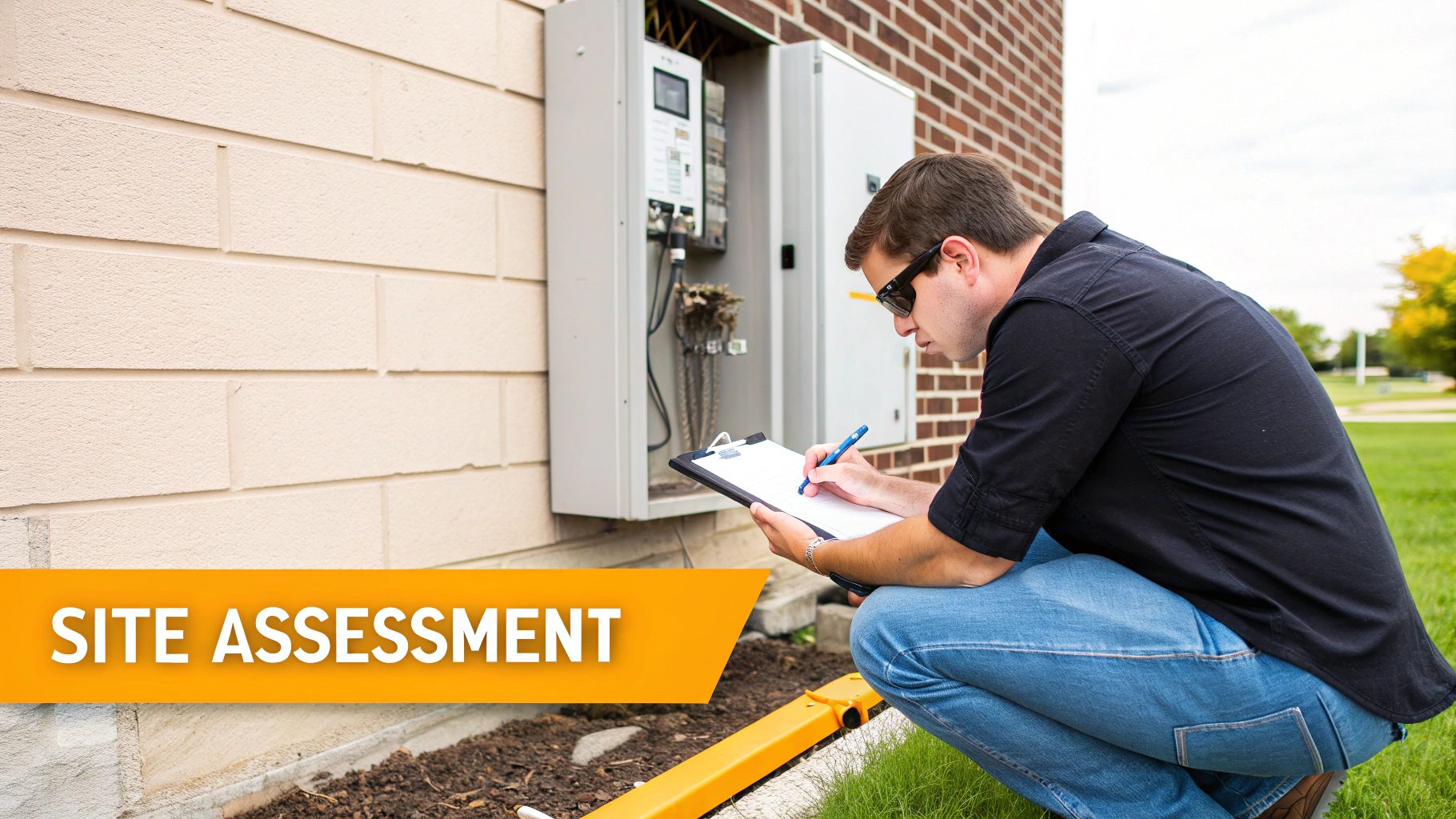
Before a single wire is connected, the most crucial part of any EV charger installation takes place: the site assessment. This is where a professional plan is developed, and it’s the one step that prevents unexpected costs, frustrating delays, and serious safety issues down the road.
Think of it as the foundation for your project. A proper assessment ensures a safe, efficient, and code-compliant setup that you can rely on for years. Our technicians aren’t just looking for a place to hang a charger; they’re analyzing your property’s entire electrical ecosystem to identify potential roadblocks and map out the optimal installation plan.
Can Your Electrical Panel Handle the Load?
The first stop is your electrical panel—the heart of your property's power system. A Level 2 charger is a significant electrical load, similar to a central air conditioner or an electric oven. It’s not something that can be simply plugged in without consideration.
To determine your panel's capacity, our electricians perform a load calculation. This is a methodical, code-required process to ensure your panel can safely handle the added demand of an EV charger without being overloaded.
In many older New York homes, especially historic properties in the Hudson Valley or classic Long Island suburbs, existing electrical panels are often at or near capacity. A 100-amp service was standard for decades, but it is frequently insufficient for a modern home with today's electronics plus an EV charger.
If the assessment shows your panel is maxed out, a panel upgrade to 150 or 200 amps becomes necessary. While it adds to the project's scope, it's a non-negotiable safety measure that also future-proofs your home for other electrical needs. If you're curious about how energy storage fits into this picture, our guide on how Tesla Powerwall works provides valuable context.
The goal of a site assessment isn’t just to find a spot for the charger. It’s to ensure the entire electrical system can support it safely and reliably, protecting your property and your new electric vehicle.
Finding the Right Spot for Your Charger
The charger's location is a blend of convenience, safety, and cost-effectiveness. The ideal location is usually in the garage or driveway, close to where you park your EV. But several factors come into play.
Here’s what we consider when scouting the location:
- Proximity to the Electrical Panel: The closer the charger is to the panel, the shorter the wiring run. This reduces material and labor costs.
- Accessibility and Safety: The charger must be easily accessible, and the cable cannot create a tripping hazard across a walkway or high-traffic area.
- Shelter from the Elements: While most modern chargers are rated for outdoor use, installing them in a garage or under a carport can help prolong their lifespan, especially with New York's harsh winters.
For a homeowner in Nassau County, this might lead to a straightforward installation on a garage wall. For a business owner in Queens, it could involve a more complex layout to serve multiple parking spaces effectively.
Planning for Commercial and Complex Jobs
For commercial properties, the site assessment is significantly more involved. We’re not just planning for one charger today; we’re designing a scalable infrastructure to meet your business’s future needs.
For a business adding charging to a parking lot, our assessment will map out:
- Trenching and Conduit Paths: We identify the most efficient route to run power from the building to the parking stalls, minimizing disruption to your lot and landscaping.
- Scalability: We design the system to be "make-ready" for expansion. This means laying the groundwork now to add more chargers later, which saves significant time and money in the future.
- ADA Compliance: We ensure charger placement meets all accessibility requirements, so every customer and employee can use the service.
This strategic foresight transforms a basic installation into a valuable, long-term asset for your property. By planning ahead, we help you build an EV charging solution that grows with demand. To see how this can pair with on-site generation, check out our page on solar canopies for your NY business.
Navigating New York's Permits and Incentives
Let's discuss the part of the installation process that can feel the most complex: the paperwork. However, this is also where you can unlock significant cost savings that dramatically reduce the upfront investment. Having a seasoned professional guide you through this process turns a bureaucratic maze into a straightforward path to saving money.
For nearly any Level 2 charger installation, an electrical permit is required. This is not red tape; it's a crucial safety validation. The process varies depending on your location. A project in Brooklyn, for example, is handled by the NYC Department of Buildings, while one in Suffolk County will go through the local town's building department. We manage this entire process for our clients, from filing the initial application to coordinating the final inspection.
Tapping Into New York's Financial Perks
Now for the exciting part: the money you can get back. New York offers some of the nation's best programs to make the switch to electric more affordable for homeowners and businesses. These incentives can put thousands of dollars back in your pocket.
Here’s a look at the major programs:
- Federal Tax Credit: The federal government offers a tax credit that covers a percentage of the cost for both the charging hardware and the installation labor, providing a significant boost for homeowners and businesses.
- NYSERDA Drive Clean Rebate: This New York State incentive is a point-of-sale rebate you receive when you buy or lease a qualifying EV, making the vehicle purchase itself more accessible.
- Charge Ready NY 2.0: This NYSERDA program is a game-changer for businesses, municipalities, and multi-unit dwellings. Charge Ready NY 2.0 provides substantial rebates for installing Level 2 chargers, often covering a large portion of the equipment and installation costs.
These are not minor discounts. They are powerful financial tools that make installing EV charging infrastructure a brilliant investment, particularly for commercial properties looking to attract tenants, customers, and employees while meeting sustainability goals.
Pro Tip: Tapping into these state and utility programs is the single best way to lower the cost of your EV charger installation. It turns the project from a simple expense into a smart investment in your property's value.
Don't Forget to Call Your Utility Company
Beyond state and federal programs, your local utility provider is another key partner in saving money. Major providers in our region have specific programs designed to support the grid and reward EV owners.
For example, Con Edison, which serves NYC and Westchester, offers rebates for smart chargers that help manage grid load. On Long Island, PSEG Long Island provides its own rebates for homeowners who install qualified Level 2 smart chargers, along with special time-of-use rates that lower electricity costs.
Enrolling in these time-of-use rates means you pay significantly less for electricity during off-peak hours, typically overnight. By using your smart charger's app to schedule charging, your car will be fully charged by morning—all while you paid the lowest possible price for the power. It's a simple change that maximizes your savings and supports a healthier grid.
Why Government Support Matters
These programs exist for a simple reason: they work. Across the country, government incentives have been essential in accelerating the adoption of EV charging infrastructure. These programs can often cover 30%-40% of a home charger installation or provide a flat rebate of several hundred dollars, removing the initial cost barrier for homeowners. It’s a strategy that has helped dramatically scale up installations and make clean transportation a reality for more New Yorkers. You can see the data on how incentives are fueling EV infrastructure growth for yourself.
When you combine the federal tax credit, NYSERDA rebates, and your local utility's programs, the final cost of installing an EV charger can be reduced dramatically. Our team at NY Essential Power knows these programs inside and out. We make it our job to identify every incentive you qualify for, ensuring you save as much as possible and achieve the fastest return on your investment.
What to Expect on Installation Day
You’ve done the planning—the site assessment is complete, the permits are approved, and the ideal charger has been selected. Now comes the exciting part: installation day. This is where the plan becomes a reality.
Whether we’re working in a residential garage on Long Island or a commercial parking lot in New York City, our goal is always the same: to make the process smooth, clean, and efficient.
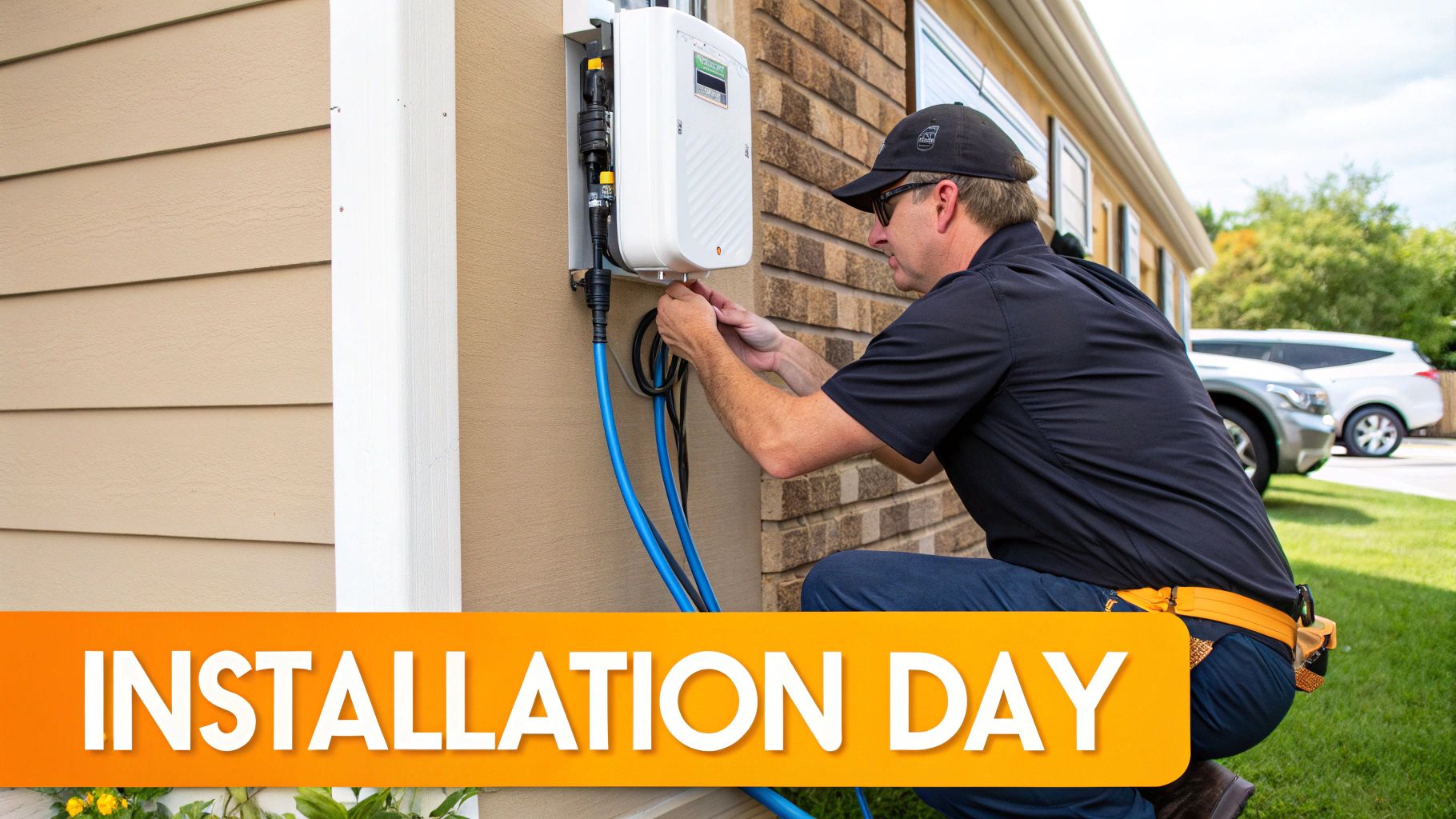
The day begins not with power tools, but with a final confirmation. Our licensed electrician will arrive, walk the site with you one last time, and confirm the exact placement of the charger. This ensures everyone is on the same page and gives you a chance to ask any last-minute questions before we begin.
The Heart of the Installation
At its core, installing a Level 2 charger involves creating a new, dedicated circuit. This is a critical safety requirement. Your charger needs its own exclusive line to the electrical panel to draw the necessary power without overloading your home or business's electrical system.
Our electricians will run a new 240V circuit from your main panel to the charger's location. The path this wiring takes depends on your property's layout.
- Attached Garage (Westchester): This is typically the most straightforward scenario. We can often run wiring from a basement or utility panel directly into the garage through the wall.
- Detached Garage or Outdoor Location: This can be more involved. We might need to route the wiring through a crawlspace or, in some cases, dig a shallow trench to safely bury the conduit underground.
Regardless of the route, all wiring is protected within a durable conduit. This tubing is required by the National Electrical Code (NEC) and local New York codes to shield the wires from physical damage and protect them from the elements.
A professional installation is all about the details. It's not just about getting the charger to turn on. It's about building a system that is safe, compliant, and durable enough to give you total peace of mind for years to come.
With the wiring run, we'll securely mount the EV charger to the wall or pedestal. We always position it at a comfortable, ergonomic height, ensuring the charging cable can easily reach your car's port without being stretched tight or becoming a trip hazard.
Final Checks and System Sign-Off
Once everything is physically in place, we conduct rigorous testing. We don't just flip the breaker and hope for the best. Our team performs a full diagnostic to ensure the entire system is 100% safe and performing to specification.
Here's what our verification process includes:
- Breaker & Circuit Test: We verify that the new circuit breaker is correctly sized for your charger and that all connections at the panel are secure.
- Voltage & Amperage Readings: Using calibrated meters, our technicians measure the electrical flow to confirm the charger is receiving stable, correct power for efficient operation.
- GFCI Protection Test: Every EV charger circuit includes Ground Fault Circuit Interrupter (GFCI) protection. This life-saving feature instantly cuts power if a fault is detected, preventing any risk of electric shock. We test this function to ensure it works perfectly.
Finally, we’ll power up the system. We will walk you through how to use the charger, connect it to your Wi-Fi if it’s a smart model, and show you how to initiate a charging session. We’ll even help you install the manufacturer's app on your phone for monitoring, scheduling, and maximizing your cost savings.
A Clean, Professional Finish
We respect your property as if it were our own. Throughout the installation, our team works cleanly and efficiently, minimizing any disruption to your home or business operations.
When the job is complete and you are satisfied with the result, we perform a thorough cleanup of the work area. You'll be left with nothing but a fully commissioned, ready-to-use EV charger. Our goal is to provide a seamless installation experience and a system you can rely on for years to come.
Wrapping Up Your EV Charger Installation
Your new EV charger is securely mounted, and the installation work is done. But a couple of crucial final steps remain to ensure your system is safe, legal, and ready to deliver long-term value.
First up is the final electrical inspection. This is a mandatory step required by your local municipality, whether you're in New York City or a town in Nassau County. A certified inspector will visit your property to review our work, verifying that every connection and component meets or exceeds all applicable codes. Once they approve the installation, your permit is officially closed, providing you with the peace of mind that comes from knowing the job was done right.
Unlocking Your Charger's Smart Features
With the official sign-off complete, it’s time for the fun part: activating your charger’s smart features. Modern chargers are more than just power outlets; they are sophisticated devices that can significantly reduce your energy bills when configured correctly.
Getting you connected involves a few simple steps:
- Wi-Fi Connection: We’ll guide you through connecting the charger to your home or business Wi-Fi network.
- App Installation: The manufacturer's app is your command center. From your smartphone, you can monitor energy usage, track costs, and schedule charging sessions.
- Scheduling Off-Peak Charging: This is where the real savings happen. We can help you set a schedule so your EV only charges during your utility's off-peak hours—typically overnight when electricity rates are lowest. For a business, this might also involve setting up payment systems or access controls for employees and customers.
This final configuration is what turns your charger from a simple appliance into a powerful energy management tool. It’s how you truly take control of your fueling costs and get the most out of switching to an electric vehicle.
Beyond the daily convenience and savings, installing an EV charger can also boost your home's property value. It’s an attractive, forward-thinking amenity that an increasing number of homebuyers are actively seeking.
Ready to see how a professional EV charger installation can benefit your home or business? Contact NY Essential Power today. We'll provide a comprehensive, no-obligation quote and manage every detail of your project, from the initial site assessment to the final inspection.
Got Questions? We've Got Answers
We speak with New Yorkers every day about making the switch to EV charging at home or at their business, and many of the same questions arise. It makes sense—you're considering timelines, costs, and local regulations. Here are the answers to the questions we hear most often.
How Long Will My EV Charger Installation Take?
For a standard residential installation, we are typically in and out in just a few hours. A typical Level 2 charger setup in a garage with an accessible electrical panel with sufficient capacity often takes only 3 to 5 hours. Our goal is always to get you powered up with minimal disruption to your day.
More complex projects can take longer. If we need to run a long line of conduit, trench for an outdoor pedestal charger, or upgrade your main electrical panel, the work could take a full day or more. After your site assessment, we will provide you with a clear and accurate timeline so you know exactly what to expect.
Can I Just Install an EV Charger Myself?
We strongly advise against it. This is not a simple DIY project like installing a ceiling fan. You're working with a dedicated 240-volt circuit, which is extremely dangerous without the proper training, tools, and license.
Beyond the significant safety risks, a DIY installation can lead to numerous problems. It can void your charger and vehicle warranties, damage your car's sensitive electronics, and create a serious fire hazard.
It's also a legal requirement. Across New York State, from NYC to the towns on Long Island, electrical work of this nature must be performed by a licensed electrician who can pull the necessary permits. This isn't just bureaucracy—it's a critical measure to ensure your installation is safe and compliant with all local codes.
Is My Electric Bill Going to Go Through the Roof?
Your electricity bill will increase, but it's important to put it in perspective: the cost is almost always a fraction of what you were spending on gasoline. The exact increase depends on three factors: how much you drive, your vehicle's efficiency (measured in miles per kWh), and your local utility's electricity rates.
The key to maximizing savings is when you charge. Utilities like Con Edison and PSEG Long Island offer time-of-use (TOU) plans that make electricity much cheaper during off-peak hours, typically overnight. By using a smart charger, you can program it to charge only during these low-cost periods, significantly minimizing the impact on your utility bill.
Ready to make convenient, cost-effective EV charging a reality at your New York home or business? The expert team at NY Essential Power is here to guide you through every step, from planning and incentives to final inspection.