
When you hear "EV fleet charging," don't just think of plugs and cables. Think of it as the energy backbone of your entire operation. These solutions are strategic investments that let New York businesses power their electric vehicle fleets reliably and, just as importantly, affordably. The environmental benefits are clear, but the real win for your company is achieving long-term cost savings and energy independence.
The options run the gamut, from simple Level 2 chargers perfect for overnight top-ups to sophisticated, smart systems that actively manage energy to keep your operational costs down. For any business in New York, from Long Island to Buffalo, getting this right isn't just a good idea—it's a serious competitive advantage.
Why Smart Charging Is a Competitive Edge in New York
The transition to electric fleets is well underway across New York, and a smart charging strategy has moved from a "nice-to-have" to a core business necessity. Whether you’re managing a fleet in Buffalo or Brooklyn, this is about building a dependable and cost-effective energy system for your vehicles that reduces your reliance on volatile gas prices.
A thoughtful approach to EV fleet charging solutions allows you to slash your fuel and maintenance budgets, hit those important sustainability goals, and seriously burnish your brand’s reputation as a forward-thinking New York business.
Maximize Your Operational Uptime
For any fleet, uptime is everything. If the wheels aren't turning, you're not making money. Smart charging ensures your vehicles are always ready to roll without creating budget-busting energy spikes on your Con Edison or PSEG Long Island bills, a major concern for any commercial property owner.
A huge part of gaining that competitive edge comes from effectively measuring operational efficiency within your fleet. By controlling when and how your vehicles charge, you can sidestep peak demand charges and make sure every truck or van has the range it needs for the day's route. This kind of disciplined approach is fundamental for any business serious about reliable service delivery.
This infographic paints a clear picture of how a smart charging depot becomes the central nervous system for a modern, efficient fleet.
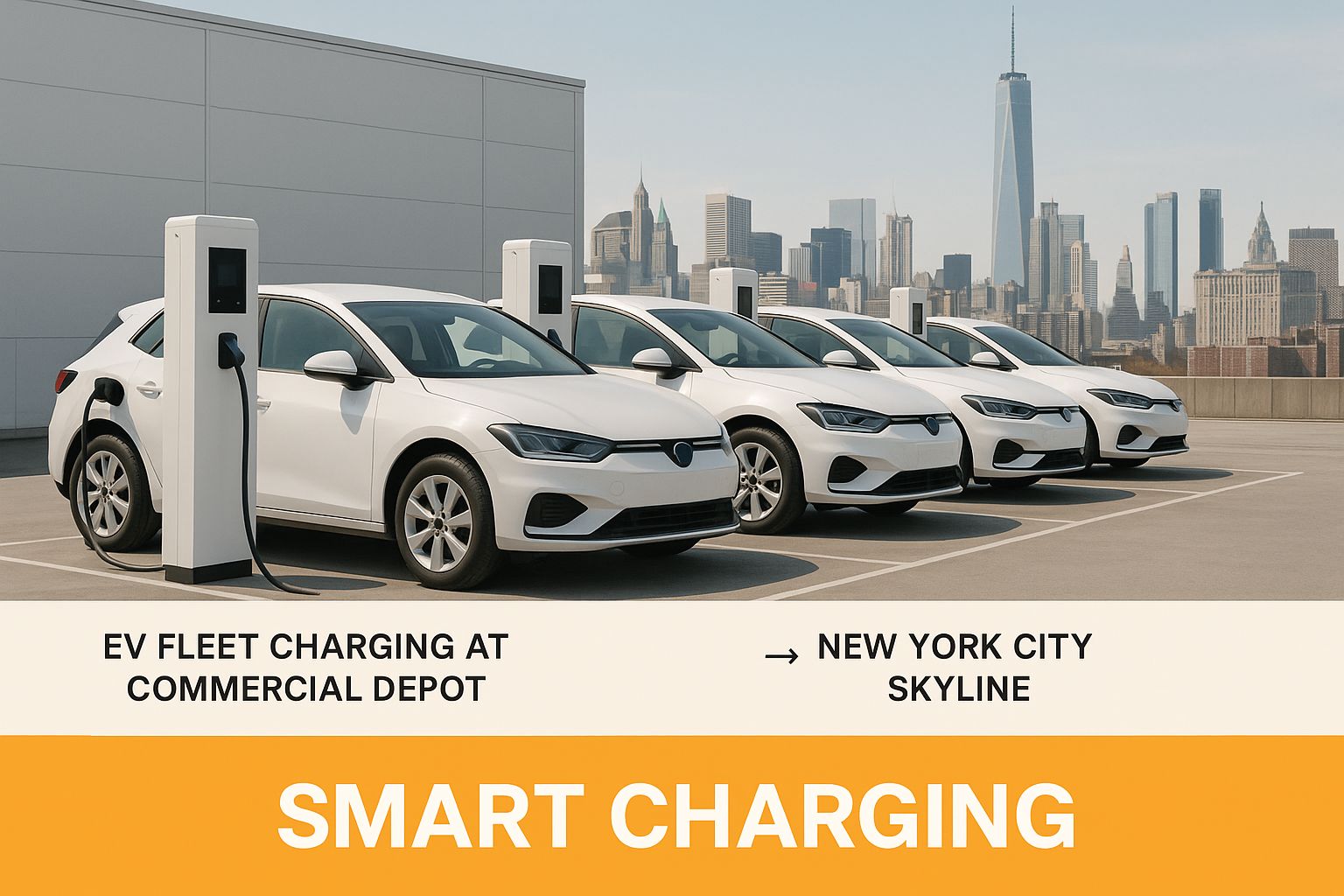
As you can see, smart charging is so much more than just plugging in a vehicle. It's about an integrated ecosystem that supports the fleet's daily mission. This gets even more powerful when you bring renewable energy into the mix. For many Long Island businesses, pairing charging infrastructure with clean power from https://vqssw04szvz.c.updraftclone.com/solar-canopies-long-island/ is the logical next step toward true energy independence and cost control.
Getting to Know Your Fleet's Charging Needs
Before you even think about buying a single charger, the first and most important step is to get a handle on your fleet's unique energy demands. Think of it as creating a custom fueling plan. This process, which we call building a "charging profile," ensures you don't waste money on power you don't need or, even worse, find yourself short on juice when your vehicles need to be on the road.
This is all about mapping out the day-to-day life of your vehicles. For example, a plumbing company in Nassau County whose vans all return to a Ronkonkoma depot every evening has a long, predictable window to recharge. Their needs are worlds apart from a taxi service buzzing around JFK, where every minute a car isn't on the road is lost revenue. Those drivers need a quick power-up between fares.
By figuring out your operational rhythm first, you can walk into a conversation with an installer armed with real data. This helps you design a system that fits your workflow and your budget like a glove.
Mapping Your Fleet’s Daily Rhythm
Building an accurate charging profile isn't as complicated as it sounds. It's really about paying close attention to how your vehicles operate each day.
Start by gathering some basic information:
- What are you driving? A fleet of light-duty delivery vans has completely different batteries and charging needs than a lineup of medium- or heavy-duty trucks.
- How far do they go? Track the average—and maximum—distance each vehicle covers daily. This tells you exactly how much energy you need to put back into the battery.
- When do they stop? This is the golden ticket. We call it dwell time. How long are your vehicles parked, and where? Is it all night at a central depot? For a few hours between shifts? Or just for quick 30-minute lunch breaks?
This information will clearly show you when you can charge and how fast those chargers need to be. Long dwell times, like a vehicle parked overnight, are a perfect match for slower, less expensive charging solutions.
Understanding Your Energy Appetite
Once you know how many miles your vehicles cover, you can figure out your fleet's total energy consumption. A typical electric van, for instance, might consume about 0.4 kWh per mile. If one of your vans drives 100 miles in a day, it's going to need around 40 kWh of energy to get back to a full charge.
Now, just multiply that by the number of vehicles in your fleet. For a 10-van operation, you're looking at a total daily need of 400 kWh. Knowing this number is absolutely critical for making sure your building's electrical service can handle the load and for planning the right infrastructure.
The goal is to match your charging hardware to your fleet's actual energy appetite. Guessing here can lead to expensive mistakes, like paying a premium for ultra-fast chargers when a more practical solution would have done the job perfectly.
This deep dive helps you avoid a common trap: assuming every fleet needs the fastest, most powerful chargers on the market. The reality is quite different. In fact, recent data shows that 68% of all fleet charging sessions happen on Level 2 chargers. For many businesses with vehicles that have predictable downtime, they're the most sensible and cost-effective option. As you start exploring EV fleet charging solutions, it's worth seeing how these real-world patterns could apply to you.
Before we move on, let's break down how these charger types fit into the New York business landscape.
Choosing the Right Charger for Your New York Fleet
This table offers a comparative look at the primary charging technologies available, tailored to different New York business use cases.
| Charger Type | Best For | Charging Speed | Typical NY Use Case |
|---|---|---|---|
| Level 2 AC | Vehicles with long, predictable dwell times (e.g., 6-10 hours). | Slow to Medium (Adds 20-60 miles of range per hour) | A Queens-based HVAC company whose vans park at the depot overnight. |
| DC Fast Charger (50-150kW) | Fleets needing rapid turnarounds to maximize vehicle uptime. | Fast (Adds 100-300+ miles of range per hour) | A last-mile delivery service in Brooklyn that needs to get vans back on the road quickly between shifts. |
| DC Fast Charger (150kW+) | Heavy-duty vehicles or high-utilization fleets where every minute counts. | Very Fast (Can provide a near-full charge in under an hour) | A taxi or ride-share fleet operating out of LaGuardia that can't afford long charging breaks. |
As you can see, the "best" charger really depends on your specific daily operations.
From Profile to Plan
With your detailed charging profile in hand, you’re ready to make some smart decisions. The data you've gathered will point you directly to the right hardware and the right strategy.
- Got overnight dwell time? If your fleet parks for 8+ hours, like those HVAC vans in Queens, you’re in the sweet spot for Level 2 chargers. They're reliable, affordable, and get the job done while your team is off the clock.
- Running a high-turnover operation? For a last-mile delivery fleet in Brooklyn where vehicles are constantly on the move, you'll likely need a strategic mix. You might install Level 2 chargers for most of the fleet but add one or two DC fast chargers for those moments when you absolutely need a quick top-off.
Nailing this analysis is the bedrock of a successful fleet electrification project. It transforms a daunting technical decision into a simple business choice based on how your fleet actually works, saving you from a costly and frustrating setup down the line.
Level 2 vs. DC Fast Charging: What Your Fleet Really Needs
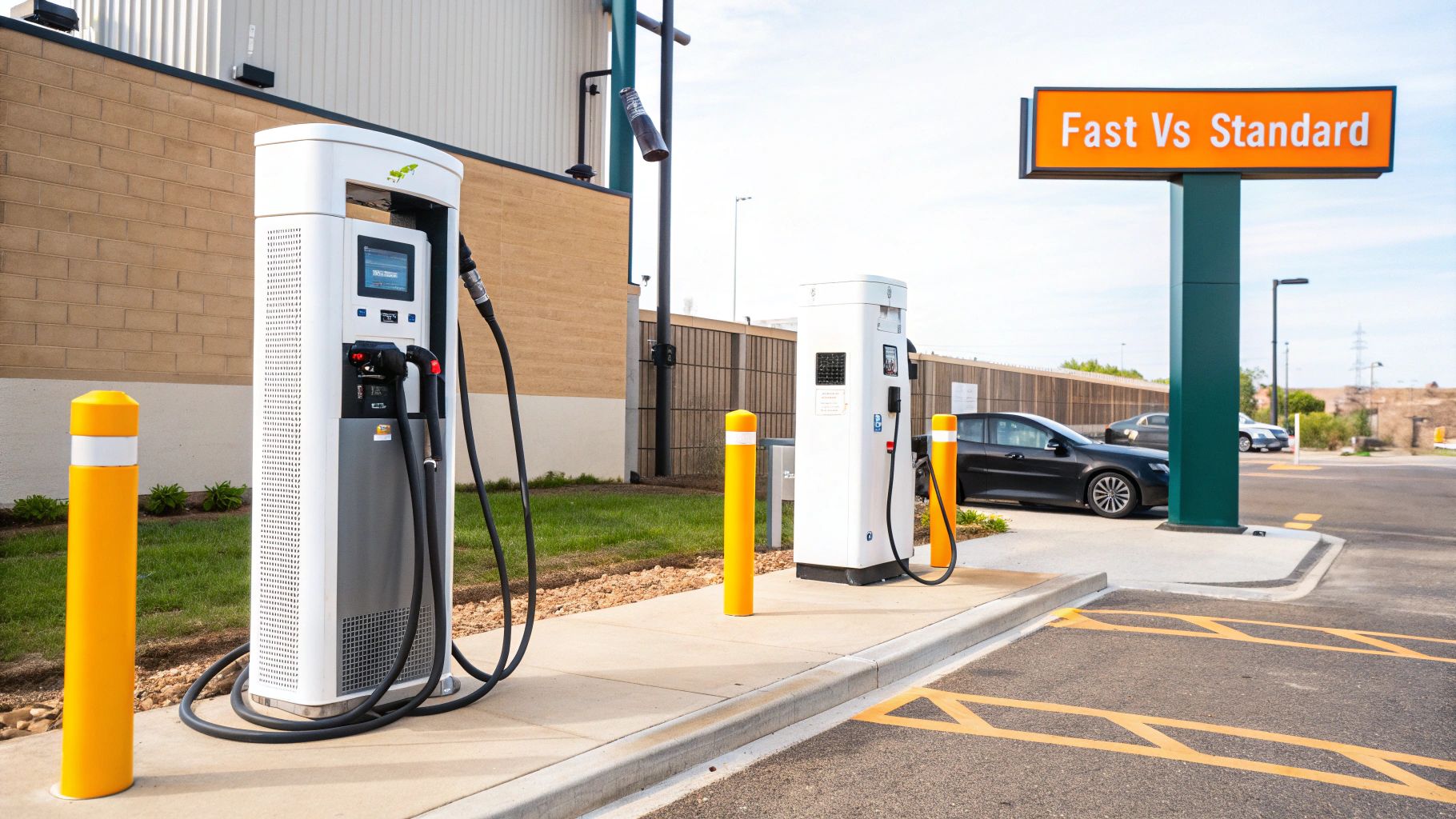
Now that you have a solid handle on your fleet's daily energy appetite, we can get into the hardware. The choice between Level 2 charging and DC Fast Charging (DCFC) isn't about picking a winner; it's about matching the right tool to the job for your specific operations in New York. Each option comes with its own set of pros and cons regarding cost, speed, and the demands it places on your facility.
Getting this right from the start saves you from expensive infrastructure headaches down the line. This single decision shapes everything from your fleet's uptime and your monthly energy bills to the long-term health of your vehicle batteries. Let’s dig into what each one brings to the table.
Level 2 Charging: The Reliable Workhorse
Think of Level 2 charging as the steady, dependable workhorse for your EV fleet. It's the most common commercial charging solution for good reason—it hits a sweet spot between charging speed and installation cost. Running on a 240-volt AC connection (like a home's electric dryer), Level 2 chargers are the perfect fit for vehicles that have long, predictable periods of downtime.
Imagine a construction company in Westchester. Their trucks and vans roll back into the depot at the end of the day and sit parked for the next eight to ten hours. Level 2 is tailor-made for this scenario. Every vehicle gets a full charge by morning without needing a massive, budget-busting overhaul of the site's electrical system. It’s a practical approach that also happens to be gentler on the local power grid.
But there’s more to it than just cost. The slower, steadier flow of electricity from a Level 2 charger is actually better for your vehicle batteries over the long haul. This gentler charging cycle can contribute to a longer battery lifespan and more consistent performance, which is crucial for protecting the most expensive part of your EVs.
Key Takeaway: Level 2 chargers are the cost-effective default for fleets with overnight or multi-hour dwell times. They offer lower upfront costs, are gentler on vehicle batteries, and are easier to install, making them a practical choice for many New York businesses.
DC Fast Charging: The High-Speed Powerhouse
If Level 2 is the workhorse, DC Fast Charging (DCFC) is the high-speed powerhouse. These chargers are built for one purpose: getting vehicles charged and back in service as fast as humanly possible. By converting AC power to DC before it even enters the vehicle, DCFC systems bypass the car's slower onboard charger and pump electricity directly into the battery at an incredible rate.
This kind of speed is a game-changer for high-use fleets where every minute of downtime costs money. Take a last-mile delivery fleet based in Syracuse. Their vans are always on the move, racing to hit tight delivery windows. A DCFC can slam an 80% charge into a vehicle in under an hour, making quick turnarounds between shifts or a critical midday boost possible.
The same goes for shuttle services at LaGuardia or JFK—they simply can't afford to have vehicles sidelined for hours. DCFC keeps them in constant rotation. But all that power comes with some serious trade-offs.
- Higher Upfront Costs: DCFC stations are significantly more expensive to buy and install.
- Major Grid Impact: They demand a substantial electrical service upgrade, often requiring close coordination with utilities like Con Edison and potentially triggering hefty demand charges on your bill.
- Strategic Use: Because the high power can be hard on batteries over time, it’s best to use DCFC strategically for quick top-ups, not for every single charge.
Ultimately, your choice between Level 2 and DCFC should be a direct reflection of how your fleet operates. For many businesses, the answer isn't "one or the other" but a smart combination of both. You might install a bank of Level 2 chargers for the bulk of your fleet's overnight needs and add a single DCFC unit for those moments when speed is everything.
Our team at NYS Essential Power can help you find that perfect balance, ensuring your EV fleet charging station is both powerful and cost-efficient.
Smart Charging Software: The Brain of Your EV Operation
If your chargers are the muscle, then smart charging software is the brain. It's what turns a simple power outlet into a serious asset for your fleet. We're not just talking about sending electricity to a vehicle; we're talking about getting a firm grip on your energy bills, operational flow, and vehicle uptime, all from one place. This software is the key to unlocking the real financial and environmental payoff from your investment in EV fleet charging solutions.
For any business in New York, managing energy costs is a constant battle. Utilities like Con Edison and National Grid have some seriously complex rate structures, especially those peak demand charges that can blow up a budget. Imagine your whole fleet rolling back to the depot at 5 PM and plugging in at once. That sudden power draw could trigger a massive spike in your electricity bill. This is exactly where smart software becomes your most valuable player.
Avoiding Crippling Peak Demand Charges
The number one job of smart charging software is load management. Think of it as an air traffic controller for your depot's electricity. Instead of letting every vehicle charge at full blast the second it's plugged in, the software intelligently juggles the energy distribution.
It makes sure you never cross a preset electrical limit, neatly sidestepping those punishing demand charges. For a warehouse in the Bronx, this could mean charging ten vans overnight using the same electrical service that might have only handled three charging simultaneously without the software. That capability alone can save thousands of dollars a year and, just as importantly, often helps you avoid expensive electrical service upgrades.
A common misconception is that electrifying a fleet automatically means a massive, uncontrollable increase in energy costs. With the right software, you can actually gain more control over your energy spending than you ever had with gasoline or diesel.
Taking Control of Your Charging Schedule
Beyond just balancing the load, these platforms let you schedule every charging session with pinpoint precision. You can tell the system to charge vehicles only during off-peak hours when electricity rates are dirt cheap—usually in the middle of the night. This simple strategy shifts your energy use from the most expensive times of day to the cheapest, which is a direct boost to your bottom line.
- Remote Monitoring: Check the status of every charger from your phone or computer. You'll always know they're working and ready for the next vehicle, which means no more surprises for your drivers.
- Real-Time Alerts: Get instant notifications for any hiccup, like a charging fault or someone unplugging a vehicle unexpectedly. This lets you troubleshoot immediately.
- Usage Reporting: Pull detailed reports on energy use per vehicle, charging costs, and how long sessions are taking. This is the data you need to fine-tune your entire operation.
This level of control is becoming non-negotiable as charging infrastructure gets more critical. The global electric vehicle charging industry is on track to blow past $104 billion by 2035, a surge fueled by fleets just like yours going electric. This growth highlights why smart, scalable solutions are so essential for managing complex energy needs. You can discover more insights about this future outlook and its impact on fleets to get ahead of the curve.
Turning Data into Actionable Intelligence
The real magic of smart software is how it gathers data and turns it into information you can actually use. You can track exactly how much energy each vehicle in your Hempstead delivery fleet is consuming, pinpoint which routes are the biggest energy hogs, and even keep an eye on the long-term battery health of your EVs.
This isn't just data for data's sake. It allows you to optimize routes, coach drivers on efficiency, and make smarter decisions when it's time to buy more vehicles or chargers. You move from simply reacting to fuel needs to proactively managing your energy. That's a real competitive advantage. A well-managed charging system doesn't just power your vehicles—it delivers the insights you need to run a smarter, more profitable operation. Getting the software right is a critical piece of the puzzle for building an electric fleet that lasts.
Taking Control: Pairing Solar and Battery Storage for True Energy Independence
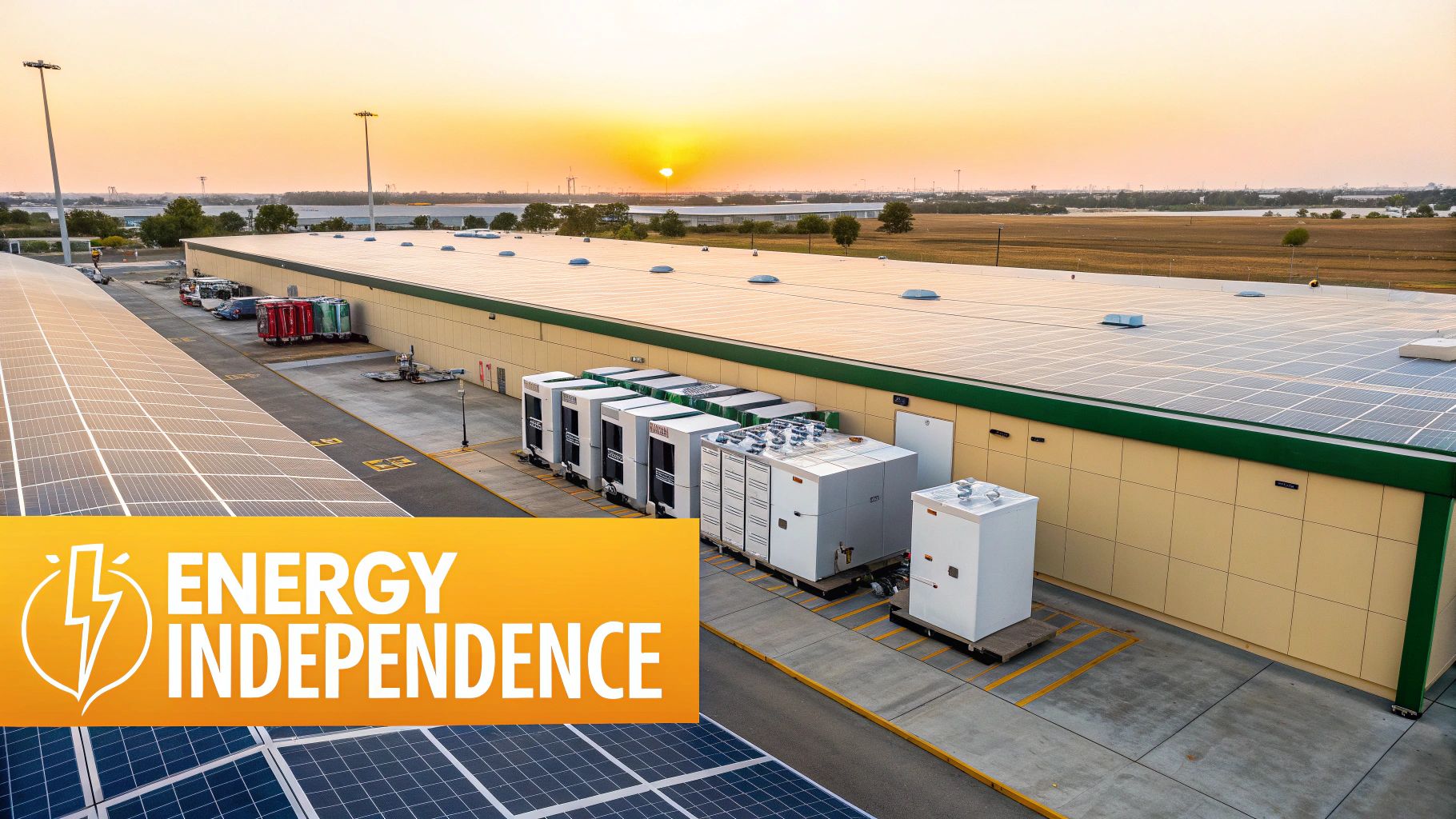
If you're a New York business looking to truly maximize the return on your electric fleet, there's a clear next step: combining your charging infrastructure with solar panels and on-site battery storage. This isn't just about saving money on fuel. It's about turning your property into its own self-reliant energy hub, giving you a level of resilience and cost control that simply isn't possible when you're tied to the grid.
Think about the big, flat roof on your depot in Albany or that sprawling warehouse in the Hudson Valley. Right now, it’s just sitting there. By installing solar panels, you transform that unused space into a private power plant, generating clean, free electricity every time the sun is out. That power can run your operations and, more importantly, charge your fleet, slashing your dependence on the utility and its ever-increasing rates.
Creating Your Own Private Power Grid
Solar is a fantastic start, but the real game-changer is battery storage. A commercial battery system acts as both a financial tool and an operational safety net for your entire business.
During the middle of the day, your solar panels will likely produce far more power than you’re using. Instead of selling that surplus back to the utility for pennies on the dollar, a battery system lets you capture and store every last drop. You're basically creating your own private reserve of clean energy to use whenever you want.
Here’s how you can put that stored energy to work:
- Charge for Free at Night: Use the solar power you saved during the day to charge your vehicles overnight, completely avoiding utility costs.
- Dodge Peak Demand Charges: Those sky-high afternoon electricity rates? Sidestep them entirely by drawing from your battery instead of the grid. This is called peak shaving, and it can save you thousands.
- Keep Rolling During Blackouts: When a storm takes out the local grid, your operations won't miss a beat. Your fleet will stay charged and ready to go, ensuring business continuity when others are down.
The state is pushing hard to build out its public charging network, and that's great for everyone. This screenshot from NYSERDA's ChargeNY program shows just how committed they are.
But by creating your own power on-site, you complement this public effort and make the financial case for your own business overwhelmingly strong.
The Ultimate Return on Investment
When you pair solar and storage with your EV fleet charging solutions, you create a powerful cycle of savings. The solar panels zero out your electricity bill, the battery protects you from peak rates and outages, and your electric fleet runs on clean power you produced yourself. It's one of the fastest paybacks you can find.
By generating and storing your own electricity, you turn a major operational expense into a controllable, predictable asset. This is the foundation of a modern, resilient, and profitable fleet operation in New York.
For businesses on Long Island, where energy costs can be especially punishing, this approach isn't just a smart move—it’s a competitive advantage. Taking a closer look at commercial solar on Long Island is the first step toward building a system that fuels your fleet, protects your profits, and proves your commitment to sustainability. You’ll stand out as a forward-thinking leader, and the financial and environmental wins make it a clear choice for any New York fleet.
Unlocking New York Incentives to Lower Your Costs
Let's be honest: the upfront cost of installing EV fleet charging infrastructure can look daunting. The good news is that New York has some of the most generous programs in the country to help businesses make the jump. Taking advantage of these financial incentives is the first and most important step to making electrification a smart financial move, delivering significant cost savings from day one.
For businesses anywhere in the state, from Long Island to Buffalo, these programs can turn a major capital expense into a manageable, strategic investment. When you learn how to stack state, federal, and local utility benefits, you can cut the price tag on your charging project dramatically.
Maximizing State and Federal Programs
New York State is all-in on EV adoption, and its incentive programs prove it. The big one you need to know about is NYSERDA’s Charge Ready NY 2.0 program. It offers some serious rebates for installing both Level 2 and DC Fast Charging (DCFC) stations at your facility. We're talking rebates that can cover a huge chunk of your equipment and installation bills.
But don't stop there. You can also claim the federal Alternative Fuel Vehicle Refueling Property Credit. This tax credit lets you write off up to 30% of the cost of your commercial charging equipment, with a cap of $100,000 per charger. The real secret is to layer these benefits—combine a NYSERDA rebate with the federal tax credit, and you could easily slash your total project cost by more than half.
The smartest EV fleet projects are the ones that strategically layer multiple incentive programs. This is how you maximize savings and make the financial decision to electrify a no-brainer for New York businesses.
Tapping into Local Utility Rebates
Beyond the big state and federal programs, don't forget to call your local utility. Power companies like Con Edison, PSEG Long Island, and National Grid often have their own programs to encourage smart charging. They might offer extra rebates on hardware, help pay for the "make-ready" electrical upgrades to your site, or give you special off-peak charging rates that lower your electric bill for years to come.
For example, a business in Suffolk County could stack a PSEG Long Island rebate on top of a Charge Ready NY 2.0 grant and the federal tax credit. You have to do your homework here. And while you're looking for savings on electrification, it's also a great time to look for other ways to reduce truck insurance costs to find savings across your entire fleet operation.
Ensuring Your Investment Pays Off
Getting the incentives is one thing; making sure your chargers actually work when you need them is another. Despite all the new charging stations going in, the reality on the ground can be frustrating. Recent data shows that nearly one-third of charging attempts fail, even at stations that report high uptime. This points to real-world problems like spotty network connections or payment glitches that can bring your fleet's productivity to a halt.
This is why combining incentives with smart energy solutions like on-site solar is such a powerful move. The financial case gets even stronger when you're generating your own clean power instead of just relying on the grid. Take a look at this breakdown of solar panels vs. traditional energy on Long Island to see just how compelling the numbers can be. A well-planned project, backed by incentives, doesn't just pay for itself—it becomes the foundation of a more resilient and profitable business.
Where Do You Go From Here?
Taking your fleet electric is a big move, but it's more of a journey than a single leap. We've walked through the major milestones for businesses here in New York, giving you a solid framework for the road ahead. You've now got the tools to analyze your fleet's specific needs, grasp the real-world differences between Level 2 and DCFC chargers, and appreciate what smart software truly brings to the table.
We’ve also seen how pairing your charging infrastructure with solar and tapping into New York's fantastic state incentives can make this transition a financial home run. The goal now is to turn all this knowledge into a smart, strategic investment—one that will pay you back in efficiency, lower costs, and a greener brand for years to come.
Turning Your Plan into a Reality
The next step is the most important one: moving from paper plans to concrete action. This means finding a partner who gets the unique challenges and opportunities of operating in New York, whether that's navigating Con Edison’s demand charges in the city or maximizing the solar potential out on Long Island.
A truly successful project hinges on a partner who can build out one of the best EV fleet charging solutions designed specifically for your business. This is how you ensure your system isn't just installed, but is dialed in for your routes, your vehicles, and your budget right from the start.
The best-laid plans for fleet electrification always start with a thorough site assessment. It’s the single most important step for spotting electrical limitations, logistical hurdles, and hidden cost-saving opportunities before you ever order a piece of equipment. This simple step helps you dodge expensive surprises later on.
Getting an expert to walk your Ronkonkoma depot or your Queens warehouse is critical. It creates a clear roadmap, smoothing out the complexities of picking chargers, integrating software, and filing for incentives.
It's time to take that final step. Let a team with deep local roots guide your transition and make sure your investment starts delivering from the moment your first truck plugs in.
Ready to secure your company's energy independence and significantly reduce operational costs? Contact NYS Essential Power today for a comprehensive site assessment and a customized quote for your EV fleet. Let's build a smarter, more profitable future for your New York business. Visit our website at https://vqssw04szvz.c.updraftclone.com to get started.