
It's a question we hear all the time, from homeowners in snowy Buffalo to commercial property managers on Long Island: “Do solar panels actually work in a New York winter?”
The answer is an emphatic yes. Not only do solar panels work during our chilly winters, but their performance can actually improve in colder temperatures. For New York property owners, this is a critical advantage that leads to year-round energy savings, greater independence from the grid, and a smaller carbon footprint.
Your Year-Round Asset in the Empire State
Many people assume solar panels need heat to generate electricity, but they actually run on light. Think of a solar panel like a high-performance engine; it operates more efficiently in cool, crisp air than on a sweltering summer day. This is a significant, often overlooked, benefit for anyone considering going solar in New York.
Your solar investment is designed to be a year-round asset, powering your property through all four of our distinct seasons. When we design a system for a home in Rochester or a business in the Hudson Valley, we calculate the annual production to account for these seasonal variations, ensuring you get reliable performance and predictable cost savings all year long.
What Really Drives Winter Performance
A few key factors come into play when we look at how your panels will perform from December to March. Understanding these helps paint a much clearer picture of what to expect.
- Cooler is Better: Believe it or not, cold weather helps the electronics inside your panels operate more efficiently. They convert sunlight into usable power with less energy lost as heat.
- Shorter Days: The main reason for lower production in winter isn't the cold—it's simply that there are fewer hours of daylight. We’ll get into how this is balanced out over the course of a full year with programs like net metering.
- The Snow Factor: A heavy blanket of snow can temporarily block sunlight. However, panels are installed at a specific angle, which helps snow slide right off, often with just a little help from the sun.
- Reflected Sunlight (Albedo Effect): Here's a great bonus for New Yorkers. A fresh coat of snow can act like a giant mirror, reflecting extra sunlight back onto your panels and giving your production a surprising boost.
To give you a clearer snapshot, let's break down how these winter elements affect your solar production in New York.
Winter Solar Performance at a Glance
| Winter Factor | Impact on Solar Panels | NY-Specific Consideration |
|---|---|---|
| Cold Temperatures | Positive. Panels are more efficient and generate more power per hour of sunlight. | Our cold, sunny winter days in places like Syracuse and Albany can be surprisingly productive for solar systems. |
| Shorter Daylight | Negative. The sun is up for fewer hours, reducing the total daily generation. | This is the primary reason for lower winter output, and it's factored into your annual savings projections by our design team. |
| Snow Coverage | Negative (Temporary). Heavy, persistent snow can block sunlight and halt production. | Most professionally installed panels are tilted to help snow melt and slide off naturally, minimizing downtime. |
| Albedo Effect | Positive. Light reflected off surrounding snow can increase panel output. | After a snowfall clears, the reflective ground can lead to a production boost, a common benefit across the state. |
As you can see, winter brings a mix of pros and cons, but the system is designed to handle it all. The myth that solar panels stop working in the winter is one of the biggest misconceptions we hear. They generate electricity from photons in sunlight, not from heat, making them perfectly suited for New York's climate. If you want to dive deeper, you can learn more about how solar panels perform in winter and see the data for yourself.
This chart gives you a good idea of the typical output for a residential system during the winter months here in New York.
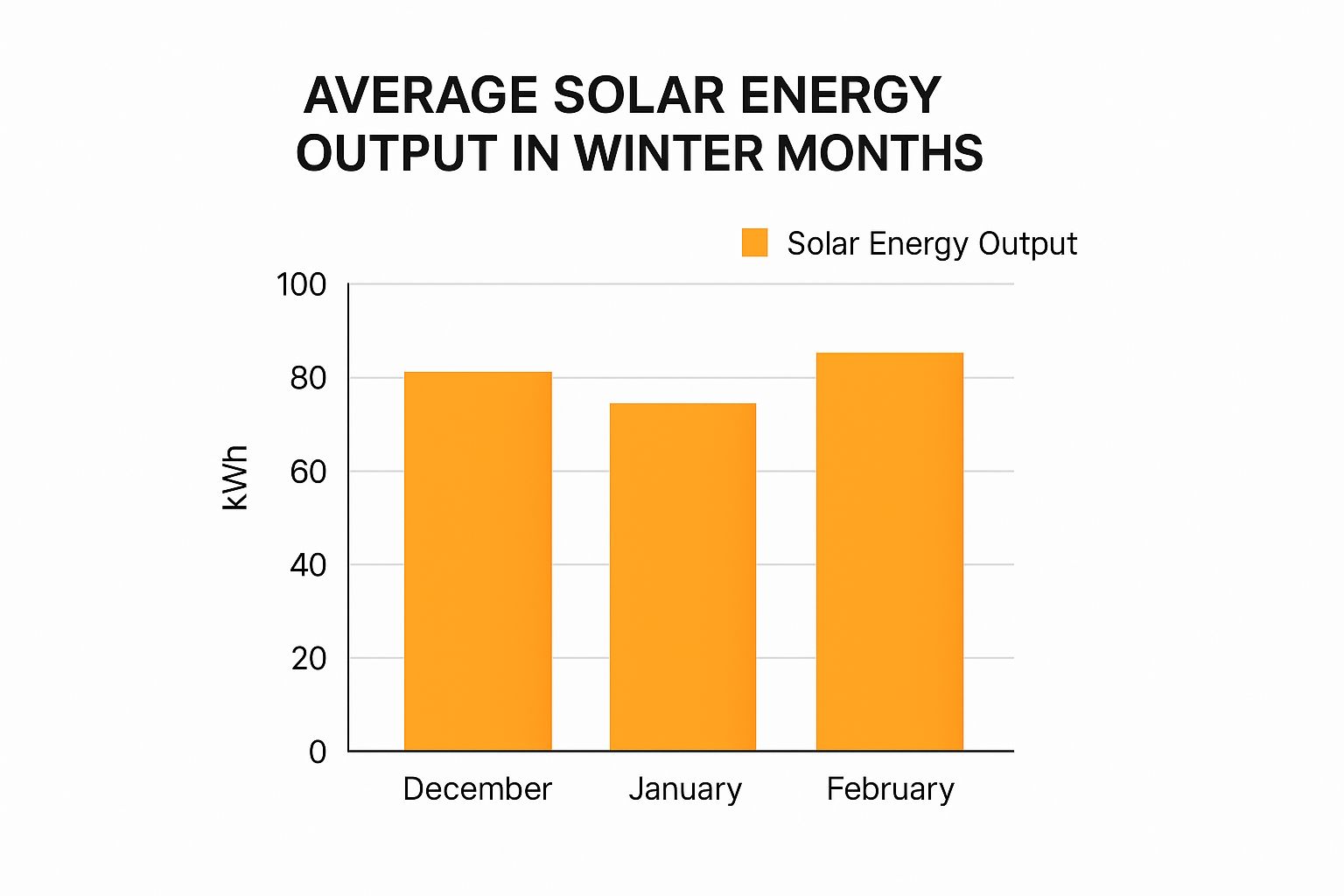
Even on the shortest days of the year, your system is still generating a significant amount of clean energy, helping you reduce your utility bills and increase your energy independence when you need it most.
Why Cold Weather Actually Boosts Solar Panel Efficiency

It’s one of the most common misconceptions about solar power: that the panels need warmth to work. The truth is the opposite. While sunlight is the fuel, excessive heat is an enemy to a solar panel’s performance.
Think of it like your laptop or smartphone. When it gets too hot, it starts to lag and slow down to protect its internal components. Solar panels behave in a similar way. High temperatures create more electrical resistance inside the solar cells, which reduces their overall power output.
This means on a bright, freezing day in the Hudson Valley or a clear afternoon in Syracuse, your panels are actually generating more electricity from each sunbeam than they would on a blistering hot day in July. It's a fantastic, often overlooked benefit that helps maximize your investment and your savings.
The Science Behind Cold-Weather Performance
At a basic level, a solar panel’s job is to convert sunlight (photons) into an electrical current (a flow of electrons). When the panel is cold, those electrons can move more freely and efficiently through the semiconductor material. It’s a fundamental part of the process, which you can learn more about in our comprehensive guide on how solar panels work.
This isn't just a tiny, theoretical improvement—it makes a real-world difference. Most solar panels are rated for performance at a standard temperature of 25°C (77°F). For every degree the temperature climbs above that benchmark, efficiency starts to drop. In fact, some studies show that intense heat can sap a panel's output by anywhere from 10% to 25%.
In simple terms, for every degree the temperature drops below the 77°F standard, your panel's voltage increases, leading to higher power production. This efficiency gain helps offset the shorter daylight hours of winter.
What This Means For Your Energy Savings
For any homeowner or business owner with a solar array in New York, this cold-weather boost is a huge advantage. It means your system is working at peak efficiency during the very same months your heating bills are likely at their highest.
This creates a much more balanced energy production cycle throughout the year. The long, sunny days of summer give you quantity, but the crisp, cool days of winter deliver quality and peak efficiency. This consistent performance ensures you’re always chipping away at your utility bills and moving toward energy independence, no matter what the calendar says.
Managing Snow on Your New York Solar Panels
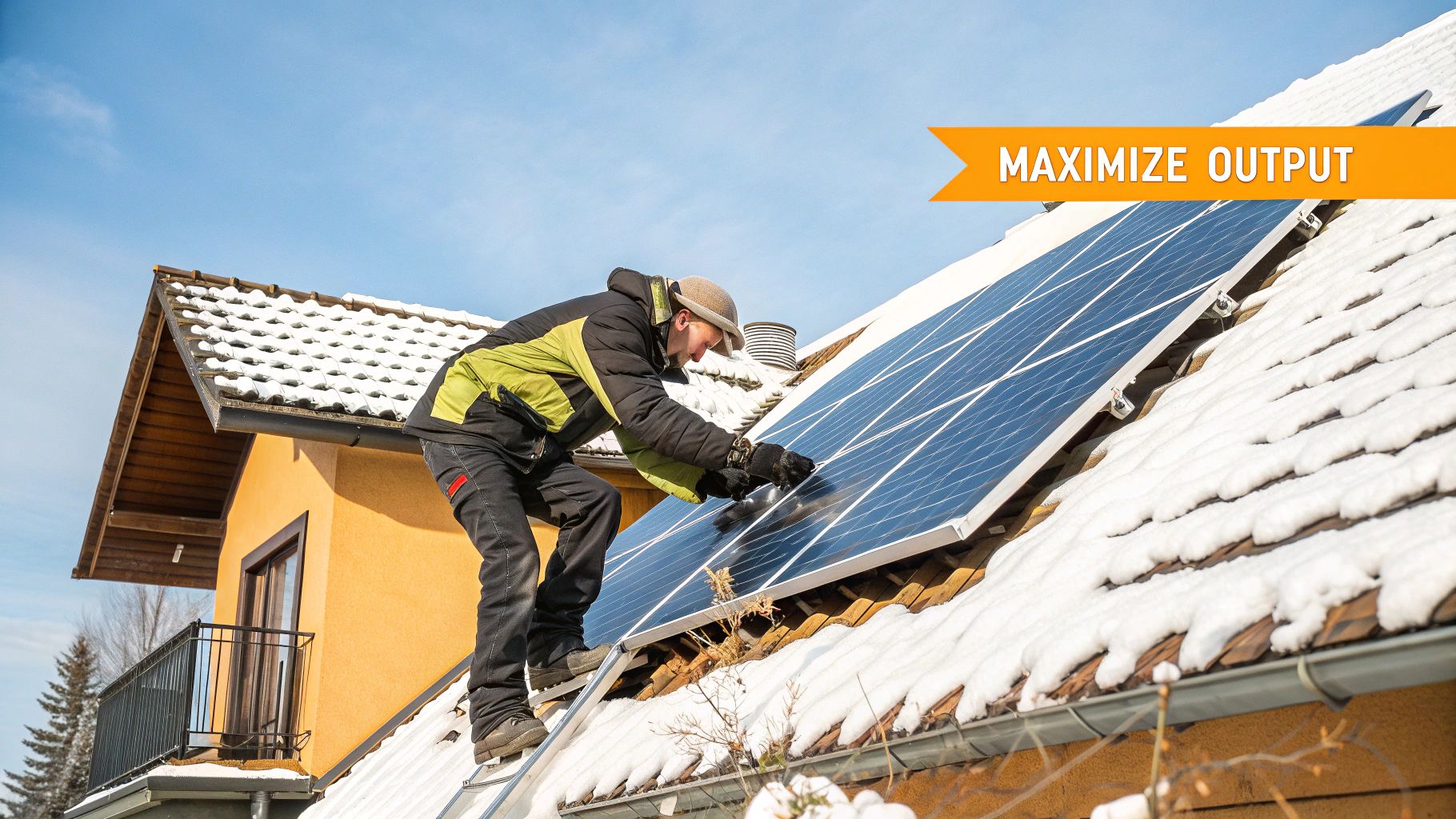
It’s the first question every New Yorker asks, whether you're in Rochester or Ronkonkoma: what about the snow? It’s a fair question. A heavy blanket of snow will temporarily stop your panels from producing power, but it's rarely a long-term problem that impacts your overall savings.
Solar panels are built to withstand the elements. Their dark surfaces absorb heat, and the smooth glass finish gives snow very little to grip. When you add in the optimal tilt angle set by a professional installer, you have a system designed to help snow melt and slide right off as soon as the sun appears. Most of the time, you just need to let nature do its thing.
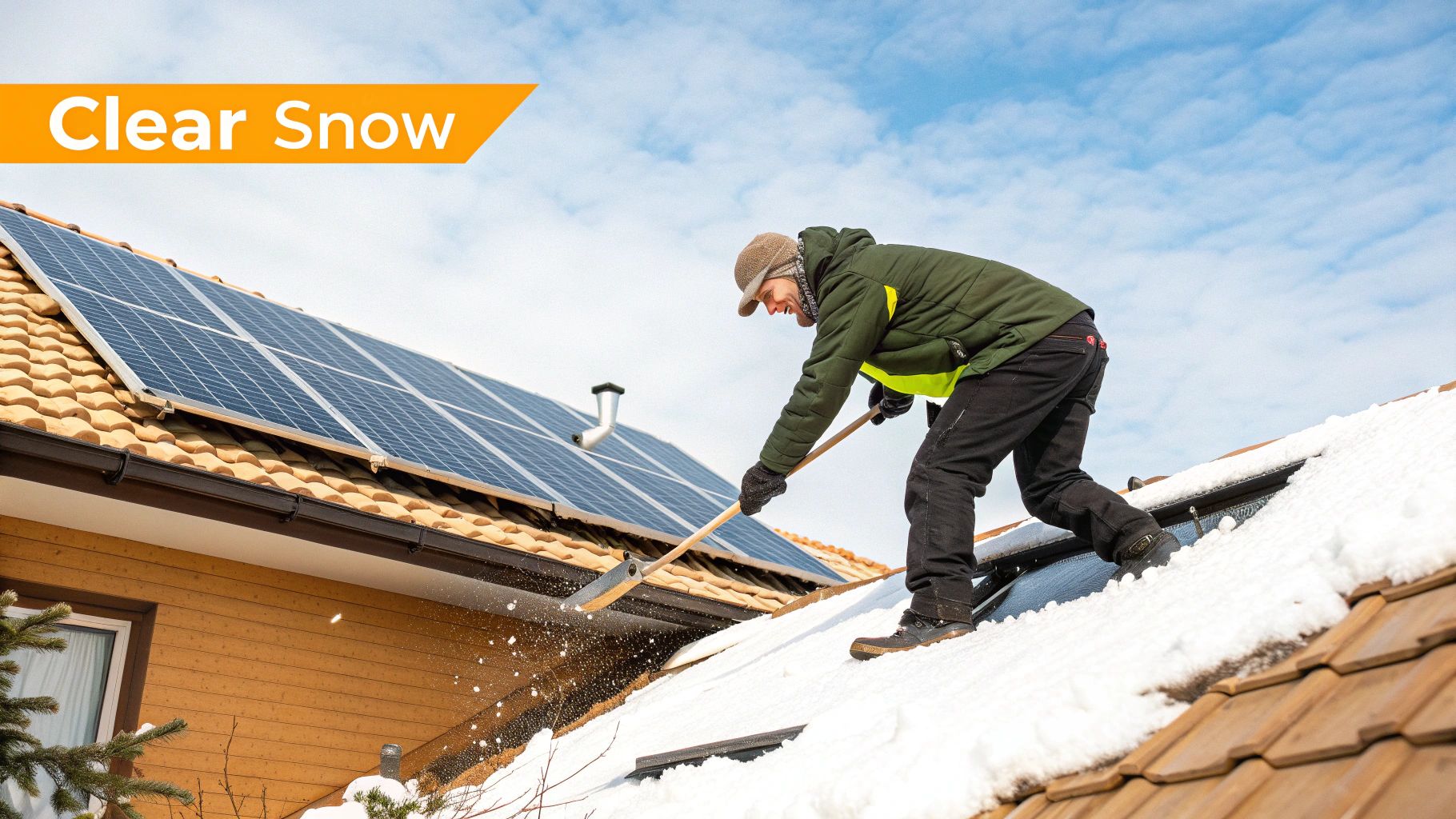
Of course, after a major Nor'easter or one of those legendary lake-effect storms that buries places like Syracuse or Buffalo, you might want to give things a nudge. If you decide to step in, doing it the right way is what separates a smart owner from someone with a costly repair bill.
Safe Snow Removal Practices
First rule: safety is everything. Getting up on a slippery, snow-covered roof is a recipe for disaster. The risk of a fall is simply not worth a few hours of extra energy production.
The best approach is to use a long-handled snow rake made specifically for this job—one with a soft, non-abrasive head. This lets you stay planted safely on the ground while gently pulling the snow off the panels. For a deeper dive into year-round care, our complete guide on solar panel maintenance has you covered.
Crucial Dos and Don'ts for Snow Removal:
- DO use a rake with a soft foam or rubber head to avoid scratching the anti-reflective coating on the glass.
- DON'T use metal rakes, sharp plastic shovels, or anything abrasive.
- DO work from the ground whenever possible.
- DON'T pour hot water on the panels. The thermal shock can crack the glass.
The Surprising Boost From Ground Snow
Here's a winter phenomenon that actually works in your favor: the albedo effect. Once your panels are clear, all that fresh, bright white snow covering your yard acts like a giant natural mirror.
It reflects sunlight that would have otherwise hit the ground right back up onto your panels. On a crisp, sunny day after a snowfall, this bonus reflection can give your energy production a surprising kick. It’s one of winter's hidden perks, turning that blanket of white into an unexpected ally for your system.
Balancing Shorter Days with Annual Energy Production
While cold weather gives solar panels an efficiency boost, the biggest factor impacting winter production is simpler: fewer hours of daylight. The sun rises later, sets earlier, and sits lower in the sky compared to those long summer days.
This means your panels have a smaller window to generate power. But this isn't a surprise or a flaw in going solar; it's a predictable, seasonal rhythm that every solar installation in New York is designed to handle from the start.
So, how do we account for that dip? The key is to stop thinking about energy production day by day and start looking at the big picture—the entire year.
The Power of Net Metering in New York
Think of your solar system as an energy savings account, all made possible by a crucial New York program called net metering. This is the key that balances out your energy costs and makes solar a smart investment year-round.
Here’s a breakdown of how it works:
-
Summer Surplus: From May through September, your panels will be working overtime. On those long, sunny days, they’ll often produce more electricity than your home or business can use.
-
Earning Credits: All that surplus energy is automatically sent back to the utility grid. Your utility provider, whether you have PSEG on Long Island or National Grid upstate, tracks this and gives you credits for every kilowatt-hour you contribute.
-
Winter Withdrawal: Fast forward to winter. When the days are short and your panels are producing less, you’ll naturally pull electricity from the grid. The difference is that now you have a bank of credits from the summer to automatically apply to your winter bills, often reducing or even eliminating your costs.
This annual balancing act is the foundation of solar economics in New York. It’s what turns your rooftop into a power plant that smooths out seasonal highs and lows for consistent, predictable savings.
A Year-Round Financial Strategy
Here’s another way to look at it: your solar panels are like farmers, harvesting sunlight when it's most abundant in the summer. They store the value of that harvest as energy credits, which you then "spend" during the lean winter months when sunlight is less available.
This process ensures that even though solar panels work in winter at a lower daily output, your overall financial benefit remains strong all year long.
It's a smart system that delivers real energy independence and insulates you from unpredictable utility rates. When you work with us at NY Essential Power, we design a system specifically sized to build up that summer surplus, giving you the energy security you need to cruise through even the coldest New York winter.
Getting Your Solar System Ready for a NY Winter
Ensuring your solar investment pays off during a New York winter isn't just about hoping for sunshine. It's about smart planning and professional installation. For homeowners who want real energy independence and businesses aiming to lock in predictable energy costs, a system designed for our winters doesn't just survive—it thrives.
It all starts with how the panels are physically installed on your roof. The angle at which they're set is one of the biggest factors in how well they'll perform when the snow starts to fly.
Why the Installation Angle is So Important
During a New York winter, the sun is low in the sky. A professional installer from NY Essential Power will calculate the perfect tilt for your panels based on your exact location, from Westchester to Buffalo. A steeper angle means the panels face that low-hanging sun more directly, capturing every possible ray on the shortest days of the year.
That's not the only benefit. That steeper angle also gives gravity a helping hand. Snow has a much harder time sticking to a sloped surface. Plus, the dark surface of the panels warms up in the sun, creating a slick layer of meltwater underneath the snow, helping it slide right off. This means your system gets back to generating power much faster after a storm.
The biggest obstacle for solar production in winter is snow cover. If the panels are buried, they can't generate electricity. But with the right tilt, they often clear themselves. You can learn more about how solar panels perform in winter to see how effective this is.
Built to Handle New York Weather
Today's solar panels are incredibly durable. Before they are approved for installation, they undergo intense testing to ensure they can handle heavy snow loads. We're talking ratings of up to 5,400 pascals, which is equivalent to several feet of heavy, wet snow. This durability gives you peace of mind that your investment is built to last through whatever a New York winter throws at it.
True Energy Independence with Battery Storage
If you want the ultimate setup for winter security, pairing your solar panels with a battery system like a Tesla Powerwall is the solution. Winter storms and power outages often go hand-in-hand, shutting down a business or leaving a home in the dark. A solar and battery system creates your own personal microgrid.
Here's how it works: during the day, your panels power your property and use any extra energy to charge the battery. Then, when the sun sets or a nor'easter knocks out the grid, your Powerwall kicks in automatically. You won't even notice the switch. This combination gives you total control, guaranteeing you have reliable power 24/7, no matter the weather. It’s what turns a solar array into a complete energy independence solution.
Ready to Take the Next Step?
The conclusion is clear: solar panels are more than capable of handling a New York winter. The cold can even boost their efficiency. Snow is a temporary hurdle, not a permanent roadblock, and your system is designed from the ground up to provide environmental benefits and financial value all year long.
It's time to stop wondering and start seeing what solar can do for your property.
By going solar, you can lock in your energy costs, avoid the unpredictable swings of utility bills, and gain true energy independence. Whether you're a homeowner on Long Island or a business owner upstate, the advantages of clean, renewable power are too good to ignore.
The question really isn't "do solar panels work in the winter?" anymore. The real question is, "how much could they be saving me?"
There's never been a better time to find out. A powerful combination of New York State and federal incentives can significantly reduce the cost of going solar, making it more affordable than ever. To see exactly what's available, check out our guide on the latest 2025 solar incentives and tax credits for New York homeowners.
Let's get you concrete numbers based on your actual roof and energy usage. Contact NY Essential Power today for a free, no-obligation quote. Our team will show you exactly what a system can do for your property and get you on the path to lower energy bills and a more sustainable future.
Common Questions About Winter Solar in New York
Even after understanding the science, it's natural to have a few more questions. Here are the most common things we hear from New York homeowners and business leaders when they're considering how solar panels will hold up during our tough winters.
Will My Roof Be Damaged By Snow on Solar Panels?
This is a common concern, but you can put this fear to rest. No reputable installer would ever put a system on a roof that can't handle the load.
Before installation, a professional assessment of your roof's structural integrity is a mandatory first step. Every solar installation is engineered to meet or exceed local building codes for snow load, which means the system is designed to handle the combined weight of the panels plus a heavy, wet snowstorm.
How Much Less Energy Do Panels Generate in a NY Winter?
It's true, you'll see a drop in production. You can typically expect winter generation to be 40-60% lower than what you see in the peak of summer.
However, this dip is almost entirely due to shorter daylight hours, not because the panels are less efficient in the cold. This seasonal rhythm is already factored into your system's annual production forecast. The whole idea behind net metering is to build up a bank of credits during the sunny summer months to carry you through the winter, smoothing out your bills year-round.
The annual production estimate is the number that truly matters. A properly sized system—whether in Albany, Rochester, or on Long Island—is designed to generate enough surplus energy in the summer to cover that winter deficit, ensuring you see consistent savings all year long.
Do I Need to Clean Snow Off My Panels?
Most of the time, you can let nature take its course. The dark surface of the panels absorbs sunlight, creating a little heat that helps melt the bottom layer of snow. Combined with their angle, this usually encourages the snow to slide right off after a storm passes.
If you get a heavy, wet snow that doesn't budge, you can use a long-handled snow rake with a soft foam head—but only if you can do it safely from the ground. Never get on a snowy roof, and avoid using abrasive tools or hot water, as you can easily damage the panels.
Are There Special Solar Panels for Snowy Climates?
The vast majority of high-quality panels on the market today are built tough enough to handle snow and ice without any special features. They go through rigorous testing for exactly these kinds of conditions.
That said, some technologies can give you a slight edge. Bifacial panels, for example, can capture light from both sides. This means they can generate some power from the sunlight that reflects off the snow and hits the underside of the panel. Your installer can walk you through the best equipment options for your specific property in New York.
Ready to see exactly how a solar system could perform on your home or business, winter and summer? The team at NY Essential Power can build a free, detailed analysis and quote tailored specifically to your property.