
As a New York property owner, you've likely noticed the surge in electric vehicles on our roads. Investing in commercial EV charging stations is no longer a future-forward idea—it's a smart business decision for today. But what does it actually cost? The price can range from a few thousand dollars for a simple Level 2 setup to over $100,000 for a high-powered DC fast charging plaza.
The final cost of a commercial EV charging station depends on three key factors: the type of charger you choose, the specifics of your property, and—most importantly—the generous New York state and utility incentives that can dramatically reduce your upfront investment. Understanding these elements is the first step for any homeowner's association board, retail manager, or commercial property owner in New York looking to embrace this powerful technology, enhance their property value, and create a new revenue stream.
Understanding Your Initial Investment
For commercial property managers and business owners across New York—from Suffolk County on Long Island to the bustling streets of Syracuse—installing EV chargers is a strategic move. It's a powerful way to attract and retain high-value tenants, signal your commitment to sustainability to eco-conscious customers, and generate a new stream of revenue.
But to build a realistic budget, you need to look beyond the sticker price of the charger. This guide will break down the complete commercial EV charging station cost so you can make a sound financial decision that benefits your property for years to come.
Your primary expenses fall into two main categories: hardware and installation.
- Hardware Costs: This is the price of the charging unit itself. A standard Level 2 charger is ideal for locations where cars park for several hours, such as office buildings, apartment complexes, or hotels. In contrast, a high-powered DC Fast Charger (DCFC) is built for speed, making it essential for sites needing quick turnarounds, like a rest stop on the I-87 or a busy shopping center.
- Installation & Site Preparation: Often called "soft costs," this category includes everything needed to get the station operational. This can involve trenching to run electrical conduits, pouring concrete pads for the units, and potentially upgrading your building's electrical panel or utility transformer—a common need in older buildings found throughout NYC. Of course, this also includes local permitting fees.
Visualizing the Core Cost Components
This infographic helps break down how the main cost elements stack up and, more importantly, how New York's fantastic incentives can bring your total investment down.
As you can see, the final cost is a simple equation: take your total hardware and installation expenses, then subtract all the rebates and tax credits you qualify for.
A professional site assessment is the single most important step in developing an accurate budget. An expert evaluation identifies potential electrical hurdles and ensures your plan complies with local codes, preventing costly surprises down the road.
To give you a clearer picture, here’s a quick breakdown of what you can generally expect for all-in costs in New York.
Estimated Commercial EV Charger Costs in New York
| Charger Level | Typical Use Case | Estimated Installed Cost Per Port (NY) |
|---|---|---|
| Level 2 | Workplaces, Apartments, Hotels, Retail (long-dwell) | $6,000 – $12,000 |
| DC Fast Charger (50-150 kW) | Public Charging, Retail (short-dwell), Fleet Depots | $40,000 – $100,000 |
| DC Fast Charger (150+ kW) | Highway Corridors, Gas Stations, High-Traffic Hubs | $100,000 – $200,000+ |
These figures are a great starting point, but remember that site-specific conditions can cause them to vary.
Whether your property is located in one of our bustling New York service areas or a quieter suburb, a thorough plan is the key to success. Investing in commercial EV charging isn’t just another expense; it’s a long-term asset that boosts your property's value and positions your business for the future of transportation.
Breaking Down Level 2 and DC Fast Charger Costs
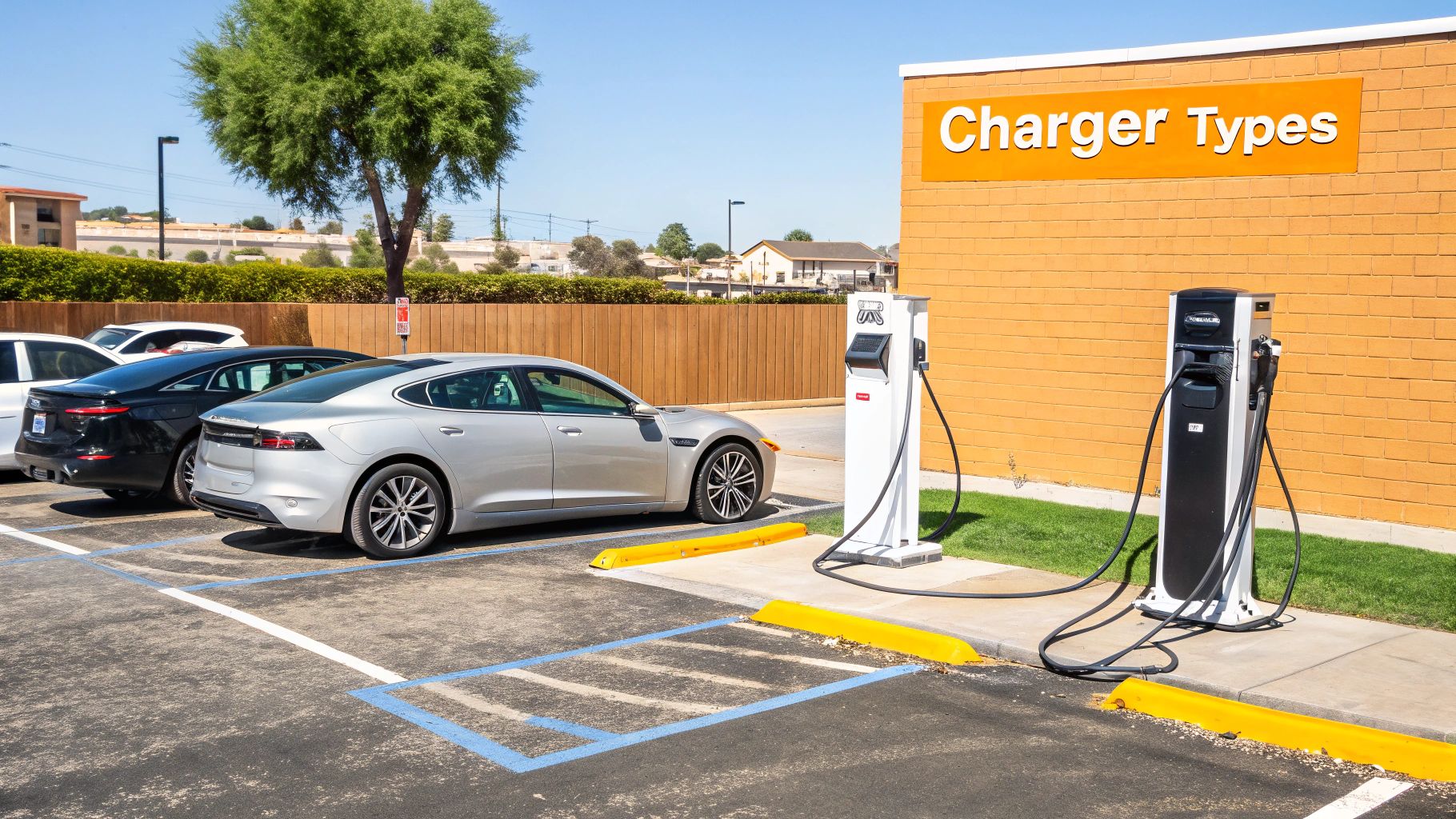
The first major line item in your budget will always be the hardware itself. Picking the right charger is like choosing the right tool for the job—what works perfectly for one property might be complete overkill or totally insufficient for another. For most New York businesses, the choice boils down to two main options: Level 2 chargers or DC Fast Chargers (DCFC).
Think of Level 2 chargers as the steady workhorses of the EV world. They're a perfect fit for places where cars will be parked for a while, like an office park in Rochester or a multi-family apartment building in Queens. They deliver a reliable charge over several hours, which aligns perfectly with the daily routines of employees and residents, providing a valuable and convenient amenity.
DC Fast Chargers, on the other hand, are the sprinters. They deliver a massive amount of power into a battery in a short time, making them ideal for locations that depend on quick turnover. You'll see these at rest stops along the New York State Thruway, busy retail centers in Buffalo, or anywhere a driver needs a fast top-up before getting back on the road.
Comparing Hardware Costs: Level 2 vs. DCFC
You'll notice right away that the cost difference between these two technologies is significant, driven by their power output and complexity. This is a critical factor to nail down early in your budget planning.
Level 2 chargers are relatively affordable, with the hardware typically running from $2,500 to $7,210 per unit. In contrast, the much more powerful DC Fast Chargers—which can get an EV battery up to 80% in about 30 minutes—have much higher hardware costs, usually between $20,000 and $35,800. To put that in perspective, a full Tesla Supercharger station can easily cost over $250,000.
This price gap reflects the advanced engineering inside a DCFC, from sophisticated cooling systems to heavy-duty power conversion equipment.
Your choice of charger should really be driven by how people use your property. If your tenants or customers park for hours at a time, Level 2 offers a fantastic return on a much lower investment. But if you need to attract drivers for a quick stop-and-go visit, the premium for a DCFC is absolutely justified.
To help manage that upfront investment, especially for the pricier units, you can explore various equipment financing options that spread the cost over time. This can make even a high-end DCFC installation much more accessible for your business.
Ideal Applications for Each Charger Type
Matching the charger to your property's specific use case is the key to maximizing your return. The wrong choice can lead to underused equipment and frustrated drivers.
Here’s a practical look at where each type really shines:
-
Level 2 Chargers are Best For:
- Workplace Charging: Employees can plug in when they arrive and leave with a full battery. An office in Albany with a Level 2 setup becomes a huge perk.
- Multi-Family Housing: Residents in a Long Island apartment complex or a condo association in Westchester can charge their cars overnight, just like they do with their phones.
- Hotels and Hospitality: Guests can charge up overnight, ensuring they're ready for the next day's journey.
- Retail with Long Dwell Times: Think movie theaters, sit-down restaurants, or specialty shops where customers linger.
-
DC Fast Chargers are Best For:
- Highway Corridors: They are essential for long-distance EV travel, placed strategically along major routes like I-90.
- Gas Stations & Convenience Stores: They allow EV drivers to "refuel" in a timeframe that feels similar to a traditional gas-up.
- Major Retail Hubs: A busy shopping mall in Syracuse can attract more visitors by offering a quick charging option while they shop.
- Commercial Fleet Depots: Businesses with electric vans or trucks can rapidly recharge their vehicles between shifts.
Getting a handle on these hardware differences is the first, most important step in building an accurate project budget. Next, we’ll need to look at the "soft costs"—everything it takes to get these powerful units installed and running on your property.
Navigating Installation and Site Preparation Costs
So, you’ve selected your charger hardware. That’s a great first step, but it’s just one piece of the puzzle. The next major component of the commercial EV charging station cost is installation and site preparation—what we in the industry often call "soft costs."
These are the costs that can vary wildly from one project to the next, and they’re exactly why getting a professional site evaluation is non-negotiable before you break ground.
Think of it this way: buying the charger is like buying a high-performance engine. It’s powerful, but it’s useless without the car's frame, transmission, and wiring. Site prep is all the work required to build that support system for your new chargers. For many properties, especially older buildings in places like Brooklyn or Buffalo, these costs can easily match or even exceed the price of the hardware itself.
The Major Elements of Site Preparation
To build an accurate budget, you need to understand what actually goes into prepping a site. It's far more involved than just plugging a unit into the wall; it often requires significant electrical and civil work to get the job done safely and up to code.
Here's a breakdown of what a typical installation in New York involves:
- Trenching and Conduit: We must dig channels to run the electrical lines from your building’s main power source to the charger locations. The cost here depends on the distance and the surface. Digging through a landscaped area is one thing; cutting through the thick asphalt or concrete of a Manhattan parking garage is a whole different ball game.
- Concrete Pads: Nearly all commercial chargers require a solid, level concrete pad for mounting. This keeps the expensive equipment stable and protected, ensuring it meets safety regulations.
- Electrical Upgrades: This is the big variable. Your property's electrical system must handle the new load from EV chargers. Many older New York buildings require a panel upgrade or even a new, larger utility transformer to supply enough power. An expert must assess if your current service from a provider like Con Edison or National Grid is sufficient.
- Permitting and Inspections: Every municipality, from Long Island to the Capital Region, has its own set of rules, permits, and inspection schedules. These fees and the time spent on paperwork are a necessary part of the project’s cost.
The single most common reason projects go over budget is a failure to properly account for site preparation. A thorough site evaluation from a qualified installer spots these potential hurdles early, saving you from expensive surprises down the road.
Integrating Solar for Long-Term Savings and Energy Independence
One of the smartest ways to manage infrastructure costs—and slash your long-term operating expenses—is to pair your EV charging project with a solar energy system. When you generate your own clean, renewable electricity on-site, you gain significant energy independence and shield your business from volatile utility rates. This is a powerful step towards environmental leadership and long-term cost control.
For businesses with parking lots, solar canopies are a fantastic solution. These structures provide a dual benefit: they generate clean power and offer covered parking, a valuable perk for customers and employees. You can see how solar canopies on Long Island are turning simple parking lots into valuable power-generating assets. This approach doesn't just offset the electricity bill for your chargers; it can often power a significant portion of your building's needs, too.
Why a Professional Site Evaluation is Non-Negotiable
No two properties are the same. A retail center in Syracuse faces completely different challenges than an office building in Westchester. Simple factors like the distance from the electrical panel, the condition of the parking lot, and local zoning laws all have a huge impact on the final installation cost.
Trying to estimate these costs without a professional evaluation is a recipe for budget overruns and frustrating delays. An experienced installer will assess your property's unique characteristics, determine the most efficient installation plan, and provide a detailed, accurate quote that covers all necessary soft costs. That initial investment in a proper evaluation pays for itself by ensuring your project is completed safely, on budget, and in full compliance with New York's specific regulations.
How New York Incentives Lower Your Upfront Costs
This is where the financial picture for your project gets truly exciting. The total cost you calculate for hardware and installation is just the starting point. In New York, a powerful combination of state, federal, and utility incentives can dramatically reduce that number, making the business case for installing chargers incredibly compelling.
These programs exist to accelerate the adoption of EV infrastructure. By strategically "stacking" these incentives, you can significantly shorten your payback period and achieve a return on your investment much faster than you might think.
The Federal Tax Credit: A Major First Step
The biggest incentive on the national level is the Alternative Fuel Vehicle Refueling Property Credit. For any New York business owner, this is a massive advantage right out of the gate.
This federal program provides a tax credit for 30% of the total project cost, up to a generous cap of $100,000 per charger. This isn’t a simple deduction—it’s a dollar-for-dollar reduction of your federal tax liability. Better yet, it covers the full scope of the project, including the charging hardware, trenching, wiring, and other site preparation costs.
Think of it this way: for a project with a total cost of $80,000, this credit alone could shave $24,000 right off your tax bill. It's the financial foundation for any commercial installation.
This federal credit sets a fantastic baseline for savings, but it's New York's own programs that truly amplify the financial benefits.
New York State's Powerful Charge Ready NY 2.0 Program
The cornerstone of New York's EV support is NYSERDA's Charge Ready NY 2.0 program. This is a direct rebate program aimed at public, private, and non-profit organizations installing Level 2 chargers for their employees or the public.
The program is designed to be straightforward and impactful, offering rebates that immediately reduce your upfront cash outlay.
- Rebate Amount: The program offers a rebate of $4,000 per charging port.
- Eligible Locations: It's available for workplaces, multi-unit dwellings, and public facilities across the state.
- Disadvantaged Communities Bonus: If your property is located in a designated Disadvantaged Community (DAC), NYSERDA may add an extra $500 per port, boosting the total to $4,500.
Imagine a multi-family property in a qualifying Queens neighborhood installing four charging ports. They could get $18,000 back directly from this program. Combine that with the 30% federal tax credit, and the final project cost plummets. Our team is well-versed in this and can help you navigate the NYSERDA application process.
For a quick reference, here’s a look at some of the key programs available to New York businesses.
Key New York & Federal EV Charging Incentives
| Incentive Program | Administering Body | Benefit Type | Ideal Applicant |
|---|---|---|---|
| Charge Ready NY 2.0 | NYSERDA | Direct Rebate | Workplaces, Multi-Unit Dwellings, Public Facilities |
| Alternative Fuel Vehicle Refueling Property Credit | IRS (Federal) | Tax Credit | Any business installing commercial chargers |
| Utility Make-Ready Programs | Con Edison, National Grid, etc. | Infrastructure Cost Reduction | Properties needing significant electrical upgrades |
| Municipal & Local Grants | Various (City/County specific) | Grants/Rebates | Businesses in specific towns or counties offering local funds |
These programs are designed to work together, allowing you to layer different benefits to maximize your savings.
Stacking Incentives: A Real-World Example
Let's walk through how this works for a hypothetical business in Westchester County installing a four-port Level 2 charging station.
Initial Project Cost Breakdown:
- Hardware (4 ports): $24,000
- Installation & Site Prep: $16,000
- Total Project Cost: $40,000
Now, let's apply the incentives:
- NYSERDA Charge Ready NY 2.0: You get a rebate of $4,000 per port, which totals $16,000. This cash rebate immediately lowers your upfront cost.
- Federal Tax Credit: You then apply the 30% tax credit to your original project cost. So, 30% of $40,000 is $12,000.
By stacking these two powerful programs, the initial $40,000 investment is reduced by a total of $28,000 ($16,000 rebate + $12,000 tax credit). Your final net cost for the entire project drops to just $12,000.
This shows how a significant capital investment becomes incredibly manageable. These incentives aren't just minor discounts; they are game-changing financial tools that make investing in EV charging a clear strategic win for New York properties.
At NY Essential Power, we specialize in identifying and securing every available incentive for our clients. Ready to see how much you can save? Contact our team today for a personalized quote and a full breakdown of the incentives your project qualifies for.
Projecting Your Operational Costs and Revenue
Getting your commercial EV charging station installed is the first major step. But once it's up and running, it's no longer just a project—it becomes an active asset for your business. And like any asset, it has ongoing expenses and, more importantly, the potential for powerful revenue streams. Getting a handle on this balance is the key to seeing a real return on your investment.
The upfront cost is just one piece of the puzzle. To keep your chargers reliable and profitable, you'll need to account for a few key operational costs that are pretty standard for any station here in New York.
Understanding Ongoing Expenses
Your operational budget really boils down to three main areas. These costs are completely manageable, but they're essential for keeping your chargers in top shape for your tenants, customers, or employees.
- Electricity Costs and Demand Charges: This will be your biggest ongoing expense. In New York, it’s not just about the raw amount of electricity (kWh) your chargers use. Utilities like Con Edison and PSEG Long Island also apply demand charges, which are fees based on your highest peak of electricity usage during a billing cycle. Smart energy management is crucial to keep these costs under control.
- Network Software Fees: A network provider handles payments, tracks usage, and helps drivers find your station on apps like PlugShare. These services typically have a subscription fee, usually running somewhere between $20 to $50 per charger, per month, depending on the features you need.
- Maintenance and Repairs: Modern EV chargers are built to last, but they require routine check-ups. Think annual inspections, software updates, and the occasional hardware fix. A good rule of thumb is to budget a small percentage of your initial hardware cost each year for upkeep to ensure reliability.
The single best way to slash your biggest operational cost—electricity—is to pair your chargers with a solar energy system. When you generate your own power, you can drastically cut or even eliminate your station's utility bill and sidestep unpredictable energy prices.
Exploring Your Revenue Streams
Now for the exciting part: how your chargers actually make you money. It’s not just about the indirect benefits like attracting high-value customers and tenants. Your stations can generate direct revenue through a few different pricing models.
A popular approach is a straightforward per-kWh fee. You charge drivers for the exact amount of electricity they use, much like a gas pump. Another option is a session-based fee, which is a flat rate for plugging in, often combined with an hourly rate to encourage turnover and prevent drivers from occupying a spot all day.
Your pricing strategy depends entirely on your business goals. A private office in Albany might offer free charging as a compelling employee perk. A busy Syracuse shopping mall, on the other hand, will likely want to set competitive rates to maximize direct revenue.
Profitability comes down to utilization. As a benchmark, Level 2 chargers in moderately busy urban spots often see 5–10 charging sessions daily, bringing in $3 to $5 in revenue per session. In contrast, a DC fast charger in a high-traffic commercial area can handle 10 to 30 sessions a day, with a much higher revenue of $7 to $15 per session. You can find more detailed breakdowns in various industry profitability analyses.
Want to truly boost your bottom line? Integrating your EV charging project with a solar installation is a game-changer. Take a look at our guide on commercial solar on Long Island to see how generating your own clean power can turn your charging station into a seriously profitable asset.
When Do You Start Making Money? Payback Periods and ROI
Alright, let's get down to the most important question for any New York business owner: when does this investment actually start paying you back? After you’ve tallied up the costs for hardware and installation—and subtracted all those great New York incentives—you need a clear picture of profitability. This is where we calculate your payback period and long-term return on investment (ROI).
The calculation is straightforward: take your total net cost (after incentives) and divide it by the annual profit you expect to generate. That profit is simply your revenue from charging fees minus your operational costs—like electricity, network software, and basic maintenance.
The result is the number of years it will take to break even. After that, every dollar generated is pure profit, turning what was once a simple parking spot into a real, revenue-generating asset for your business.
What This Looks Like in the Real World
The commercial ev charging station cost and its payback timeline look very different depending on your business type and location.
-
Scenario 1: An Albany-Area Apartment Complex
Picture a multi-family building that puts in a four-port Level 2 station. Residents plug in overnight, creating a predictable and steady stream of income. It's a low-stress, reliable model that enhances resident satisfaction and property value. -
Scenario 2: A Hudson Valley Convenience Store
Now, imagine a busy shop right off a major route installing a DC Fast Charger. The upfront cost is much higher, but it attracts travelers who need a quick, high-margin charge, generating a completely different—and potentially more lucrative—revenue pattern by capturing on-the-go drivers.
Crunching the Numbers on Your Payback Timeline
To get a clearer financial picture, we can look at some common industry benchmarks.
A typical four-port Level 2 station might run you about $60,000 all-in. If that station brings in around $12,700 a year and costs about $6,500 to operate, you're looking at a payback period of roughly 10 years. That works out to an internal rate of return (IRR) of 5–8%.
For a more ambitious suburban DC Fast Charger installation costing closer to $180,000, the numbers scale up. Higher usage and premium pricing can push annual revenue to $37,500. This can shorten the payback to around 9 years and deliver a healthier IRR of 7–10%, a figure supported by several industry profitability analyses.
The bottom line is this: an EV charging station isn't just an amenity. It’s a long-term asset. When planned correctly, it boosts your property's value, attracts a more desirable customer base, and adds a new revenue stream that will pay dividends for years.
Understanding your potential ROI is what separates a hopeful guess from a smart business decision.
Here at NY Essential Power, we don't do guesswork. We provide a transparent, detailed financial breakdown for every single project. We’ll walk you through your specific payback period and map out a clear path to profitability.
Ready to see what the numbers look like for your property? Contact us for a free, no-obligation quote today.
Your Top Questions Answered
We’ve walked through the A-to-Z of EV charging costs, from the hardware itself to making a profit down the road. To bring it all together, let’s tackle some of the most common questions we hear from property owners across New York.
How Long Does a Commercial Installation Actually Take in New York?
This really depends on your site's needs. A straightforward Level 2 installation where the electrical panel is ready to go might only take a few weeks from planning to completion.
However, if you're looking at a project in a dense area like Long Island that needs major site work or a significant electrical upgrade from Con Edison, you could be looking at several months. The biggest potential delays are almost always the local permitting process and coordinating with the utility company.
The real time-sinks are the upfront stages: site assessment, engineering, and getting those local permits approved. A solid, detailed plan from day one is your best defense against delays.
Are There Hidden Costs Beyond the Electric Bill?
They aren't hidden, but they are important to plan for. Besides the electricity your chargers use, you'll have two main ongoing expenses.
- Network Software Fees: Think of this as the brains of the operation. For about $20-$50 per charger each month, this software handles payments, lets you track usage, and puts your station on the map so drivers can find it.
- Maintenance: You'll want to set aside a small annual budget for check-ups and the occasional repair. This proactive approach is what keeps your investment running smoothly and bringing in revenue year after year.
Can I Really Make Money with Just One or Two Chargers?
Absolutely. Profitability isn't about having a massive number of chargers; it's about having them in the right place. A single, well-placed two-port station at a busy retail center in Syracuse could easily outperform a ten-port setup at an office park that’s empty after 5 p.m. It all comes down to matching the charger to the flow of people at your location.
As you map out your potential ROI, it’s worth digging into strategies on how to maximize earnings from rapid EV chargers. Keeping your chargers online and setting smart prices are the keys to turning even a small installation into a powerful asset for your property.
Ready to see what it would take to turn your parking spots into a new revenue stream and a standout amenity? The team at NY Essential Power can provide a clear, no-nonsense breakdown of the costs, savings, and profit potential for your specific property. We'll help you navigate the incentives and design a system that meets your business goals.