
A successful commercial EV charging installation isn’t just about the hardware you choose; it’s built on a bedrock of smart, upfront planning. Getting this first phase right—whether you're a business in Manhattan or a property manager in Montauk—is what separates a valuable asset from a costly headache. It’s the strategic blueprint that ensures your investment helps you achieve energy independence, contributes to a healthier environment, and meets your business goals.
Why Smart Planning is the First Step to Success
Before anyone even thinks about digging a trench, a deep dive into planning is essential. This isn't just about picking out a few chargers. It’s about understanding what your property can handle, what you want to achieve, and what your customers or tenants truly need. A methodical approach right from the start defines the project's scope, keeps the budget in check, and ultimately determines if you’ll get the cost savings and return you're looking for.
This process might seem overwhelming, but it's really just a series of logical steps. From checking your electrical panel's limits to finding the perfect parking spots, every little detail matters. The end goal is to build a charging ecosystem that’s efficient, easy for people to use, and a financial win for your New York business.
Defining Your Primary Objective
First things first: you need to nail down your "why." This one decision will steer everything that follows. Are you a Brooklyn apartment complex trying to attract and keep high-paying tenants by offering EV charging as a premium amenity? Or maybe you're a corporate office in Westchester looking to give your employees a great perk while boosting your company’s green credentials and environmental image.
On the other hand, a retail center on Long Island might see chargers as a brand-new revenue stream, designed to keep shoppers on-site longer. Each of these goals calls for a totally different strategy when it comes to the hardware, pricing, and placement of your stations.
Key Takeaway: Your business goal is the compass for your entire project. Whether it’s for tenant attraction, employee retention, public revenue, or fleet management, a clear objective ensures your investment delivers the results you expect.
The Critical Site Assessment
A professional site assessment is absolutely non-negotiable. This is where theory meets reality. An experienced installer will come to your property, evaluating several critical factors specific to your New York location.
- Electrical Capacity: We'll get into your electrical room to check out the existing panels and service. Can they actually handle the extra load from multiple EV chargers? This is how we prevent overloads and sidestep the kind of expensive, surprise utility upgrades that can kill a project budget.
- Optimal Charger Placement: Where do the chargers actually go? We look for the sweet spot—factoring in visibility, user convenience, and proximity to a power source to keep trenching and installation costs down. It’s also crucial to make sure everything is accessible and compliant with ADA (Americans with Disabilities Act) standards.
- Future-Proofing: It’s not just about today. Where do you see your EV charging needs in five or ten years? Smart planning means designing the initial infrastructure so it can be expanded easily as EV adoption in New York inevitably grows. This saves a massive amount of money and disruption down the road.
This infographic gives you a bird's-eye view of how a well-planned commercial installation unfolds.
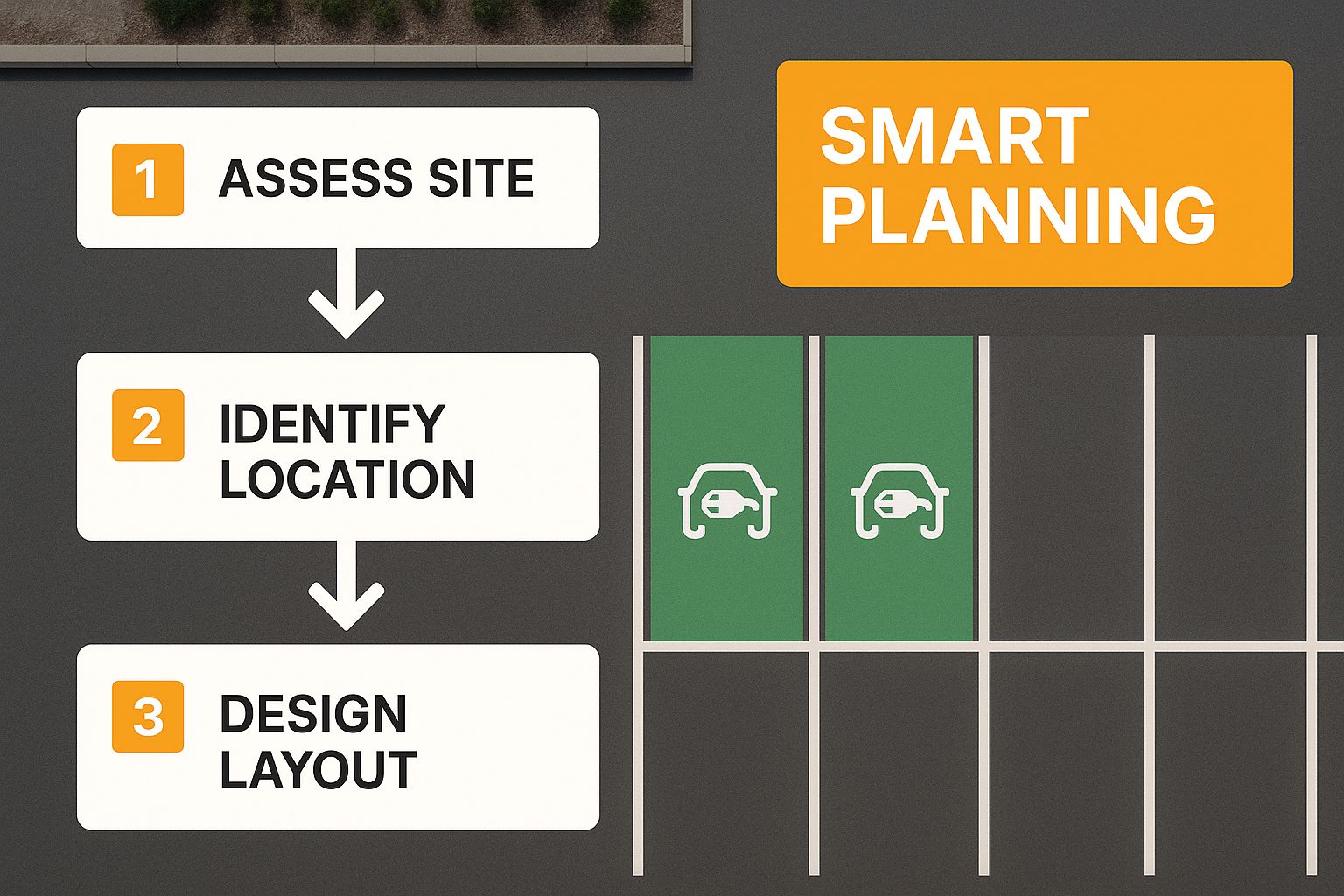
Seeing the workflow laid out like this really helps clarify how each step builds on the last. This kind of methodical approach is crucial for any complex infrastructure project; you can see similar principles at play when it comes to mastering building automation system installation.
Leveraging New York's Energy Landscape
Here in New York, smart planning also means looking for unique opportunities to make your project even more valuable. If you have a large parking area, why not think bigger? Integrating your EV chargers with renewable energy can create a powerful, self-sustaining system, boosting your energy independence and environmental benefits.
For instance, exploring the benefits of solar canopies on Long Island can show you how to generate your own clean power right on-site. This can dramatically lower your reliance on the grid and could even turn your parking lot into an asset that generates power, leading to significant long-term cost savings.
This kind of strategic thinking is more important than ever. The global commercial EV charging market was valued at a staggering USD 39.7 billion in 2024 and is expected to grow at a blistering 24.4% annually through 2034. This growth is being fueled by soaring EV adoption and huge leaps in technology.
Ready to create a strategic plan for your property? Contact NYS Essential Power today for a complimentary site assessment and quote.
Selecting the Right EV Charging Hardware and Software
Once your project is planned out, the next big move is picking the right equipment for your commercial EV charging installation. This can feel a little daunting, but it gets a lot simpler when you boil it down to one thing: matching the technology to the people who will actually use it—your customers, tenants, or employees.
The hardware you choose dictates everything from how fast someone can charge to the overall user experience. It's the foundation of your return on investment. The software, on the other hand, is the brains of the whole operation, handling everything from payment processing to managing your building's energy load to maximize cost savings.
Matching Charger Speed to Your Location
Here in New York, the biggest question is usually how long cars will be parked at your business. This is where the two main options come into play: Level 2 chargers and DC Fast Chargers (DCFC).
-
Level 2 Chargers: These are the reliable workhorses of the EV charging world. They deliver about 25-40 miles of range per hour of charging, which makes them ideal for places where cars will be sitting for a while. Think of a corporate park in Albany where employees park all day, or a multi-family building in Queens where residents plug in overnight. Their lower power requirement also means they're much easier on your building's existing electrical system.
-
DC Fast Chargers (DCFC): As the name suggests, these are all about speed. A DCFC can add hundreds of miles of range in less than an hour, making it a must-have for businesses that thrive on quick turnover. We're talking about a travel plaza on the NYS Thruway near Syracuse or a busy retail center in Yonkers where shoppers are in and out. The trade-off is that they demand a serious electrical infrastructure upgrade and come with a much bigger price tag.
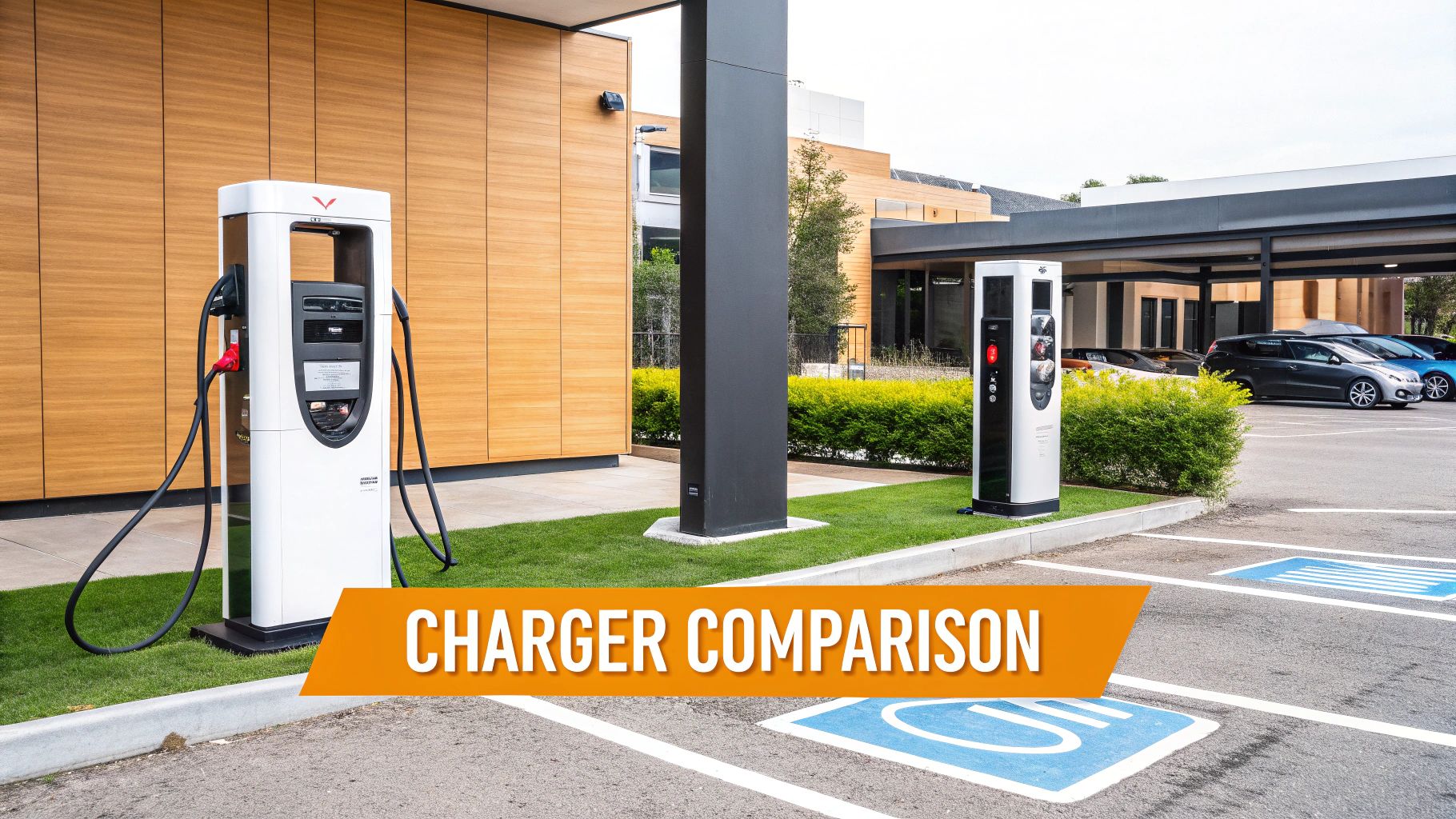
To make this choice clearer, let's break down the key differences.
Level 2 vs DC Fast Charger Comparison for NY Businesses
Choosing between these two types really depends on your goals, your location, and the kind of driver you want to attract. This table lays out the practical differences for a New York business owner.
| Feature | Level 2 Charger | DC Fast Charger (DCFC) |
|---|---|---|
| Charging Speed | Adds 25-40 miles of range per hour | Adds 100+ miles of range in 20-30 minutes |
| Ideal Dwell Time | 2+ hours (overnight, workday) | Under 1 hour (quick stops, travel breaks) |
| Best For | Workplaces, apartments, hotels, destination retail | Highway corridors, gas stations, convenience stores |
| Installation Cost | Moderate | Very High |
| Electrical Needs | Standard 208/240V circuit | 480V 3-phase power, often requires utility upgrade |
| Revenue Model | Lower per-session revenue, attracts long-stay customers | High per-session revenue, attracts transient drivers |
Ultimately, a Level 2 charger is a fantastic amenity for keeping people on-site longer, while a DCFC is a powerful tool for capturing high-volume, quick-turnaround traffic.
Beyond Speed: Essential Hardware Features
While speed is a huge factor, a few other hardware details are absolutely critical for a successful installation, especially in our region.
First up is durability. New York winters are no joke. You need hardware that can stand up to snow, ice, and road salt. Look for chargers with a high IP (Ingress Protection) rating, which tells you how well they're sealed against the elements.
Next, network connectivity is a deal-breaker. A "smart" charger that connects to the internet is the only way to go for a commercial setup. This is what allows for remote management and opens the door to flexible payment systems, from standard credit cards to mobile apps. Check out our various EV charging solutions to see how modern hardware incorporates these features.
Finally, just think about ease of use. The station needs a simple interface, sturdy cables that aren't a pain to handle, and clear instructions. A confusing or clunky experience is the fastest way to make sure a driver never comes back.
Expert Insight: Don't underestimate the power of reliable hardware. A charger that's constantly offline doesn't just lose you money—it actively damages your reputation with every single driver who pulls up and can't get a charge.
The Power of Smart Charging Software
If the hardware is the body, the software—often called a Charge Point Management System (CPMS)—is the brain. This is what turns a simple power outlet into a smart business tool.
One of its most powerful features is dynamic pricing. With a good CPMS, you can set different rates based on the time of day, who is using the charger (like employees vs. the general public), or how long they're plugged in. This gives you the flexibility to maximize revenue and incentivize charging during off-peak hours.
The software also gives you a goldmine of usage data and analytics. You can see exactly how often your stations are being used, track energy consumption, and spot trends. This data is what helps you make smart decisions about managing costs or planning future expansions.
The demand is undeniable. By the end of 2022, Europe already had over 70,000 fast EV charging stations, a whopping 55% increase in just one year. Global projections show we'll need nearly 13 million public chargers by 2030. These EV charging statistics paint a clear picture of the opportunity for businesses that get in now.
Most importantly, smart software is your best defense against punishing demand charges from utilities like Con Edison and PSEG Long Island. By using a feature called load balancing, the software can intelligently manage and distribute power across multiple chargers. This prevents the sudden energy spikes that trigger those massive fees on your utility bill. This one feature alone can save you thousands of dollars a year, making it an essential part of any profitable commercial EV charging installation.
Ready to find the perfect hardware and software for your New York property? Request a quote from NYS Essential Power, and let our experts design a system that fits your goals.
Untangling New York's Permit and Regulatory Maze
Getting a commercial EV charging station built isn't just about pouring concrete and running wires. Honestly, that's often the easy part. The real challenge, and where most projects hit expensive snags, is navigating New York's intricate web of permits and regulations. If you don't get this right from the start, you're setting yourself up for delays and budget overruns.
Don't assume the process is the same everywhere, either. The hoops you'll jump through in New York City are a world away from what you'll find on Long Island or in an upstate city like Rochester. Every single jurisdiction—from the local town building department to the county planning board—has its own checklist, and you have to tick every box before a single shovel can hit the ground.
The Permits You'll Almost Certainly Need
First things first, you need to figure out exactly what paperwork your project requires. While every site has its own quirks, most commercial EV charging jobs in New York will run into a few standard permit requirements.
- Electrical Permits: This is the big one, and it's non-negotiable. A licensed electrician has to submit detailed plans to the local building department. They're checking to make sure everything is up to code and, most importantly, safe for your property and the people using the chargers.
- Building Permits: Are you pouring new concrete pads for the chargers? Trenching across the parking lot? Putting up a canopy? Any significant site work like this will trigger the need for a building permit to ensure the construction itself is sound.
- Zoning and Planning Board Approvals: This is where it can get tricky. Depending on where your property is, you might need a sign-off from the local planning or zoning board. This is almost a guarantee for larger projects or if your site is in a historic district or an environmentally sensitive area. They’ll be looking at everything from the placement of the chargers to how they look and their potential impact on traffic.
Why a Knowledgeable Partner is Your Best Asset
This is exactly why you want an experienced installation team in your corner. An installer who knows the National Electrical Code (NEC)—specifically NEC Article 625, which is all about EV charging systems—and the local New York codes can see problems coming a mile away.
A Pro's Perspective: I've seen it time and time again: the single biggest factor that blows up a project timeline is the permitting process. It can be a few weeks if you're lucky, or it can drag on for months. Having a team with established relationships with inspectors and utility planners in places like Suffolk and Nassau counties can genuinely cut that waiting time down.
Their expertise goes way beyond just filling out forms. A seasoned pro knows how to draw up site plans and technical documents in the precise format that local authorities want to see. That means fewer back-and-forth revisions and a much faster path to approval. They're your guide through all the red tape.
Don't Forget the State and Utility Hurdles
On top of the local permits, you have to coordinate with state agencies and your utility company. This happens alongside your local permitting efforts, and you can't legally power up your station until you get their green light.
A critical piece of this is getting an interconnection agreement from your utility. It doesn't matter if you're with NYSEG, National Grid, or PSEG Long Island—this is the formal contract that allows your equipment to connect to their grid. They'll need to review your project's total electrical load to make sure their local infrastructure can handle it.
And if you're tapping into state incentives, there's another layer. Programs like the NYSERDA Charge Ready NY 2.0 have their own strict technical and reporting rules. If you want to get those valuable rebates, you have to follow their guidelines to the letter. One misstep can put your funding at risk.
To see how we handle this entire process, check out the services we offer at NYS Essential Power. Cutting through this bureaucracy is what we do best, making sure your project gets from blueprint to reality without getting lost in regulatory limbo.
Unlocking Your ROI with New York State Incentives and Rebates
Putting in a commercial EV charging station is a serious investment, but it shouldn't drain your capital budget. Here in New York, we have access to some of the most powerful financial incentives in the country, designed specifically to slash those upfront costs and get you to a positive return on investment much faster.
When you learn how to strategically stack these state, utility, and federal programs, you can knock down the initial price tag significantly. This approach turns a major capital expense into a smart, manageable project that pays for itself by attracting new customers, retaining tenants, and boosting your property's overall value.
Tapping into NYSERDA's Charge Ready NY 2.0
The first place most New York businesses should look is the NYSERDA Charge Ready NY 2.0 initiative. For workplaces and multi-unit dwellings planning to install Level 2 chargers, this program is a true game-changer.
Charge Ready NY 2.0 offers hefty rebates that can cover a massive chunk of your equipment and installation bill. I'm talking up to $4,000 per charging port. An incentive that large makes it far more affordable to add EV charging as a premium amenity, whether it’s for your employees in Westchester or for residents in a Brooklyn apartment building.
Expert Take: The whole point of the NYSERDA program is to remove the biggest hurdle for businesses: the initial cost. By putting cash directly toward the hardware and labor, they’ve made the decision to install chargers a whole lot easier for property owners across the state.
This program is a huge reason New York's charging infrastructure is growing so quickly. While the entire U.S. had nearly 196,000 public charging ports by January 2025, it’s states with robust programs like New York that are really pushing clean energy investments forward. You can dig into the numbers and see how New York compares on the national stage by reviewing the latest data on U.S. charging infrastructure growth.
Powering Up with Local Utility Programs
Don't stop at the state level. New York's local utility companies offer their own fantastic programs, and they often focus on a different—and equally critical—part of the installation.
A perfect example is Con Edison’s PowerReady program, which serves New York City and Westchester County. This incentive is laser-focused on funding the expensive "make-ready" electrical work required to get your site ready for chargers. This can include:
- Upgrading electrical panels to handle the new load.
- Trenching and running new conduit from your electrical room to the parking spots.
- Covering the cost of utility-side service upgrades if your building simply needs more power from the grid.
From my experience, these infrastructure upgrades are often the biggest and most unpredictable expenses in any commercial installation. Having the utility company cover them makes your project budget far more predictable and affordable. PSEG Long Island and other major utilities have similar programs, so it’s absolutely worth checking what’s available in your service area.
Maximizing Your Savings by Stacking Incentives
Here’s where it gets really powerful. The smartest strategy is to combine these programs. You can use a utility program like PowerReady to pay for all the heavy-duty electrical work and then apply NYSERDA rebates to cover the cost of the charging stations themselves.
But why stop there?
You can layer one more incentive on top: the federal Alternative Fuel Vehicle Refueling Property Credit. This federal tax credit lets you claim 30% of the total project cost, capped at a very generous $100,000.
When you combine all three—utility, state, and federal—your final out-of-pocket cost can shrink to a fraction of the original quote. This synergy becomes even more potent if you're looking at other green initiatives. For example, pairing your EV charging project with a commercial solar installation on Long Island creates a truly self-sustaining energy ecosystem. You'll be generating your own clean electricity to fuel vehicles on-site, which drives down your long-term operating costs even further and positions your property as a forward-thinking, sustainable asset.
From Blueprint to Reality: Installation and Long-Term Operations
This is where the rubber meets the road. With the planning done and permits in hand, your commercial EV charging project moves from paper to pavement. Our goal is always to make this process as seamless as possible, minimizing any disruption to your day-to-day business.
It’s a carefully choreographed process. The first thing you’ll likely see is the civil work—that might mean trenching across your parking lot to lay the necessary conduits for the high-voltage wiring. If your chargers need them, this is also when we pour the concrete pads that give them a rock-solid foundation.
Once the groundwork is laid, our certified electricians step in. They’ll pull the heavy-duty wiring through those new conduits and make the precise connections, both at your building's main electrical panel and at the charging stations themselves. This isn't just hooking up wires; it’s a meticulous job that has to be done right, adhering strictly to every New York and National Electrical Code for absolute safety and reliability.
The Commissioning Process: Your Final Quality Check
Just because a charger is bolted down and wired up doesn't mean the job is finished. Before your station ever serves its first driver, it has to go through commissioning. Think of this as the final, critical systems check.
Our technicians power everything up and run the system through its paces to make sure it's 100% ready.
During commissioning, we verify that:
- Every charger is talking to the central management network without a hitch.
- The payment systems, whether it's a credit card reader or an app, are processing transactions correctly.
- All built-in safety features, like ground-fault protection, are active and working.
- The station can actually start, run, and complete a full charging session on a test vehicle.
This is the step that guarantees your investment is ready to perform from day one. While local codes are paramount, looking at a general UK commercial EV charging installation guide can offer some great insights into best practices that apply anywhere.
Shifting Gears to Long-Term Success and Maintenance
Flipping the switch on your new chargers is a huge milestone, but it's really the starting line, not the finish. To protect your investment and keep drivers happy, you need a smart plan for long-term operations and maintenance.
Let's be blunt: a charger that’s constantly "out of order" is worse than no charger at all. It doesn't just sit there not making money; it actively damages your reputation. The EV driver community is tight-knit, and word about unreliable stations travels fast.
Key Takeaway: For a commercial charging station, high uptime is everything. Reliability builds trust, brings drivers back, and ultimately delivers the best return on your investment.
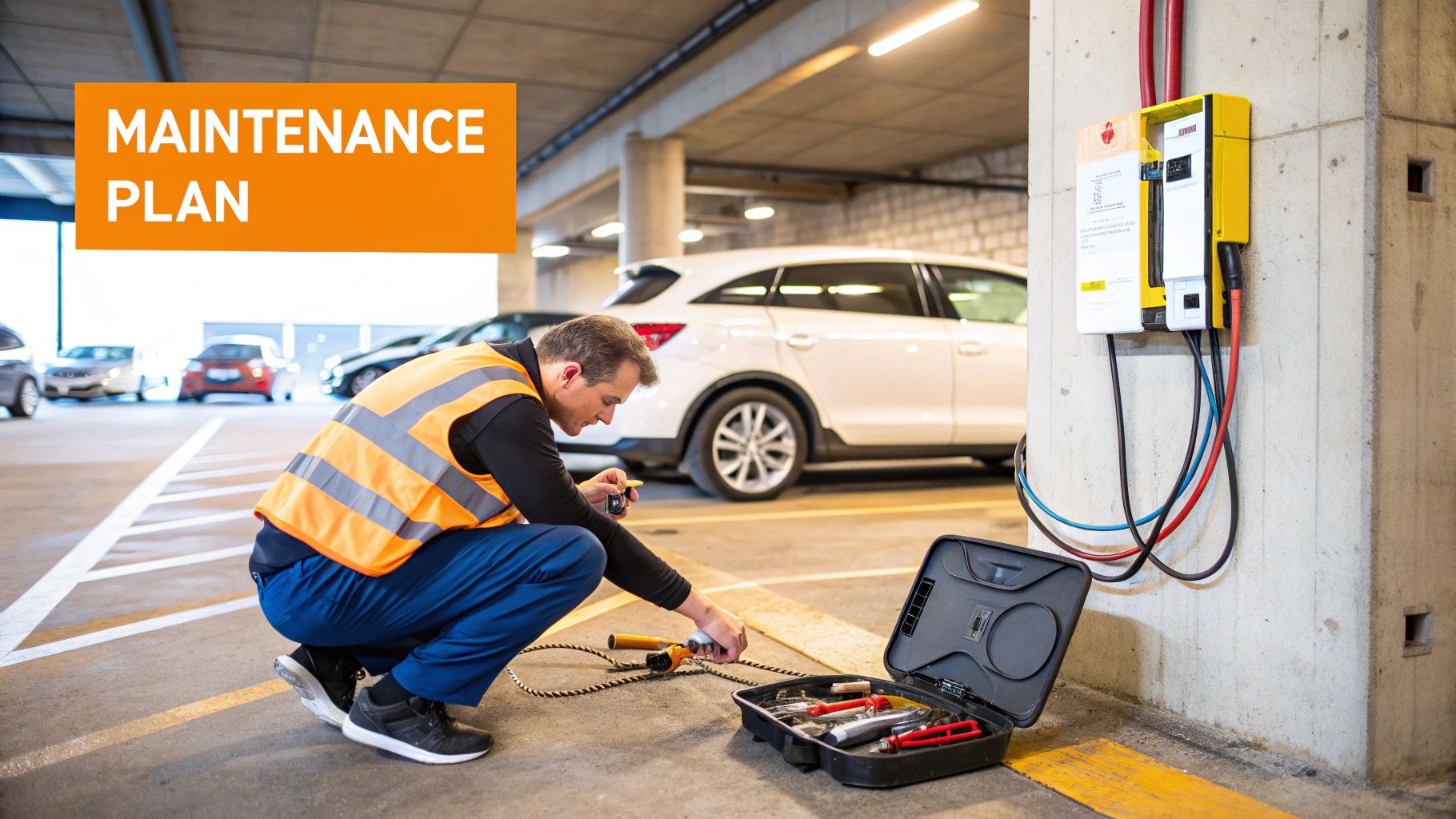
Proactive maintenance should be baked into your budget from the very beginning. This means regular physical inspections to check for wear and tear on cables and connectors, plus keeping the station's software updated to patch security holes and add new features.
Don't Just Build It—Market It
You've just added a fantastic new asset to your property. Now, let's make sure EV drivers can find it. The single most important thing you can do is get your station listed on the major EV charging network maps.
Apps like PlugShare, ChargePoint, and Electrify America are the modern-day road maps for EV drivers. You need to ensure your station's location, number of ports, charging speed, and pricing are all listed accurately. Many drivers simply won't even consider a station if they can't check its status on an app first.
Here are a few simple ways to boost visibility:
- On-Site Signage: Don't make drivers hunt for the chargers. Clear, well-placed signs from the street entrance to the parking spot make for a much better first impression.
- Website and Social Media: Shout it from the rooftops! Announce the new chargers on your website and social media. Frame it as a modern, green amenity you're proud to offer.
- Local Buzz: Let neighboring businesses, hotels, and community groups know you’re open for charging. They can be a fantastic source of referrals.
Taking these steps helps you tap into the growing number of EV drivers across all the New York service areas we work in, turning your new installation from a simple utility into a real destination.
Common Questions About Commercial EV Charging in NY
Even with a great plan, it’s completely normal to have questions when you’re thinking about a commercial EV charging project. This is a big investment in your property's future, so you want to be sure about the costs, timelines, and potential returns.
We've put together the most common questions we hear from New York business and property owners to give you straight, practical answers. Getting these details right from the start helps you move forward with confidence, ensuring your new chargers line up perfectly with your budget and business goals.
How Much Does Commercial EV Charger Installation Cost in New York?
This is always the first question, and the honest answer is: it depends. The final price tag can vary widely based on what you need. A single Level 2 charger installation might run anywhere from $6,000 to $12,000 per port. A DC Fast Charger, on the other hand, is a much bigger project, often starting around $50,000 and can easily climb past $150,000.
What drives that number up or down? A few key things:
- Type of Charger: DC Fast Chargers are a whole different beast—and price point—than Level 2 units.
- Site Conditions: One of the biggest cost factors is simply the distance from your main electrical panel to the parking spots. Longer runs mean more trenching, more wire, and more labor.
- Electrical Upgrades: If your building’s current electrical service can't handle the extra load, a utility upgrade is necessary, and that can be a significant expense.
- Labor Costs: An electrician in Long Island will have a different rate than one in an upstate town.
But here's the good news: programs like NYSERDA's Charge Ready NY 2.0 and other utility incentives can often cover a huge chunk of these costs. This can slash your out-of-pocket expense and make the whole project much more affordable. You can learn more about our specific EV charging solutions and how we approach pricing.
Can I Make Money from My EV Charging Stations?
Absolutely. There are a couple of smart ways to generate revenue from your charging stations.
The most direct route is to set a price for charging. With modern management software, you have total control. You can bill drivers by the kilowatt-hour (kWh), by the time they spend plugged in, or with a simple flat fee per session. This immediately turns your chargers into an active revenue stream.
The other strategy, popular in retail and hospitality, is to offer charging as a free perk. Think of a hotel in the Hamptons or a high-end shopping center in Westchester. For them, the goal isn't profit-per-charge. It's about attracting and keeping high-value customers who will stay longer and spend more. The extra business they bring in can easily dwarf the electricity costs. The right path for you really just depends on your main business goals.
What Are Demand Charges and How Do I Avoid Them?
Demand charges are a nasty surprise if you're not ready for them. Utilities like Con Edison or PSEG Long Island add these fees to your bill based on your single highest spike of electricity use during a billing period. DC fast chargers, which pull a massive amount of power when they start up, are notorious for creating these spikes, leading to sky-high demand charges that can kill your ROI.
Key Insight: Getting a handle on demand charges is non-negotiable for a successful commercial EV charging project. If you don't plan for them, they can quickly become your biggest hidden operational cost.
So, how do you fight back? The answer is smart charging software. This technology is your best defense, letting you:
- Cap Power Output: Set a limit on the maximum energy your chargers can draw during expensive peak hours.
- Schedule Charging: Nudge drivers toward off-peak hours by offering them lower rates when the grid isn't strained.
- Balance the Load: Intelligently share the available power across multiple vehicles, so they aren't all trying to charge at full blast at the same time.
We build these smart solutions into our projects to protect our clients from these costs. Check out our About Us page to see how we put this into practice.
What Is the Timeline for a Full Installation?
From our first conversation to your first customer plugging in, the whole process can take anywhere from a few weeks to several months. The biggest variables are often the things that happen before a single tool comes out of the truck.
Here’s a rough breakdown of a typical project timeline:
- Site Assessment & Planning: 1-3 weeks
- Equipment Procurement: 2-8 weeks (supply chains are still unpredictable at times)
- Permitting & Approvals: 3-10 weeks (this is the wild card)
- Physical Installation: 1-2 weeks
Without a doubt, the permitting phase is almost always the longest and most unpredictable part of the journey. This is where working with an experienced installer who knows the local New York regulations inside and out really pays off. It's the best way to keep the project moving and avoid frustrating, expensive delays.
Ready to bring the future of transportation to your property? The team at NYS Essential Power is here to walk you through it all and design an EV charging solution that fits your exact needs. We help businesses across New York unlock significant cost savings, increase their energy independence, and showcase their commitment to a greener future.
Contact us today for a complimentary consultation and personalized quote!