
Choosing the best solar panels for your New York home or business isn’t just about picking a brand name. It’s about matching the right technology to your unique property, energy needs, and financial goals. Whether you have a spacious roof in Westchester or limited space on a Brooklyn brownstone, the ideal panel is the one that maximizes your energy production, stands up to New York's demanding four-season climate, and delivers the fastest return on your investment through significant cost savings.
Your Guide to Choosing Solar Panels in New York
Selecting the right solar panels is the most critical decision you'll make on your journey toward energy independence and lower utility bills. For property owners across New York, this choice involves balancing factors unique to our region—from the heavy snow loads on Long Island to the hot, humid summers in the city. A smart decision leads to decades of reliable, clean energy and a powerful shield against unpredictable utility costs.
This guide provides a straightforward framework for making an informed, confident choice. We’ll break down the key performance metrics that truly matter, compare the top-tier brands you'll encounter, and show you how to align your choice with powerful state incentives like the NY-Sun program. Our goal is to equip you with the practical knowledge needed to select a system that perfectly fits your property, budget, and long-term goals for energy independence.

Key Decision Factors for NY Property Owners
Before diving into panel specifications, it's essential to understand your property's specific requirements. A home in a historic district, for instance, may have strict aesthetic guidelines. Meanwhile, a commercial property in Queens will need to prioritize maximizing every square foot of roof space to combat high electricity demand charges. Our extensive local experience across our key New York service areas allows us to navigate these regional nuances effectively.
It's also wise to understand your current energy consumption before making a significant investment. Using a home energy audit checklist is an excellent first step. It can reveal simple efficiency improvements that will enhance the performance of your future solar system, maximizing your cost savings.
The "best" panel isn't a single brand; it's the one that delivers the highest long-term value for your specific location, roof characteristics, and financial objectives.
To simplify the process, we've identified the core factors every New Yorker should consider when evaluating solar panels.
At-a-Glance Guide to Key Solar Panel Factors for NY
Here's a quick summary of the most important factors when choosing solar panels for your New York home or business. Use this as a cheat sheet for comparing your options.
| Decision Factor | Why It's Critical in New York | What to Look For |
|---|---|---|
| Efficiency Rating | Maximizes power on smaller or shaded roofs common in NYC and dense suburbs. | Panels with 20% or higher efficiency to generate more electricity per square foot. |
| Durability & Weather Resistance | Must withstand heavy snow loads, high winds from coastal storms, and fluctuating temperatures. | Certifications for heavy snow/wind loads; look for a low temperature coefficient for better summer performance. |
| Warranty Coverage | Protects your long-term investment against defects and performance decline, ensuring decades of savings. | A 25-year product and performance warranty from a financially stable, reputable manufacturer. |
| Overall Value (Cost vs. Performance) | Balances upfront cost with long-term energy production, maximizing your return on investment. | The best combination of efficiency, durability, and warranty for a competitive price per watt. |
Ultimately, a panel that excels in these four areas is almost always a solid investment for a New York property. It ensures your system is productive, resilient, and protected for the long haul, delivering both environmental benefits and financial rewards.
Understanding Core Solar Panel Technologies
Before comparing brands, it's helpful to understand the core technologies that convert sunlight into savings for your New York property. The type of solar panel you choose significantly impacts its performance, cost, and ability to meet your energy goals—especially given the diverse roof sizes found from Queens to Suffolk County. It’s like choosing an engine for a car; some are built for pure power, others for economy.
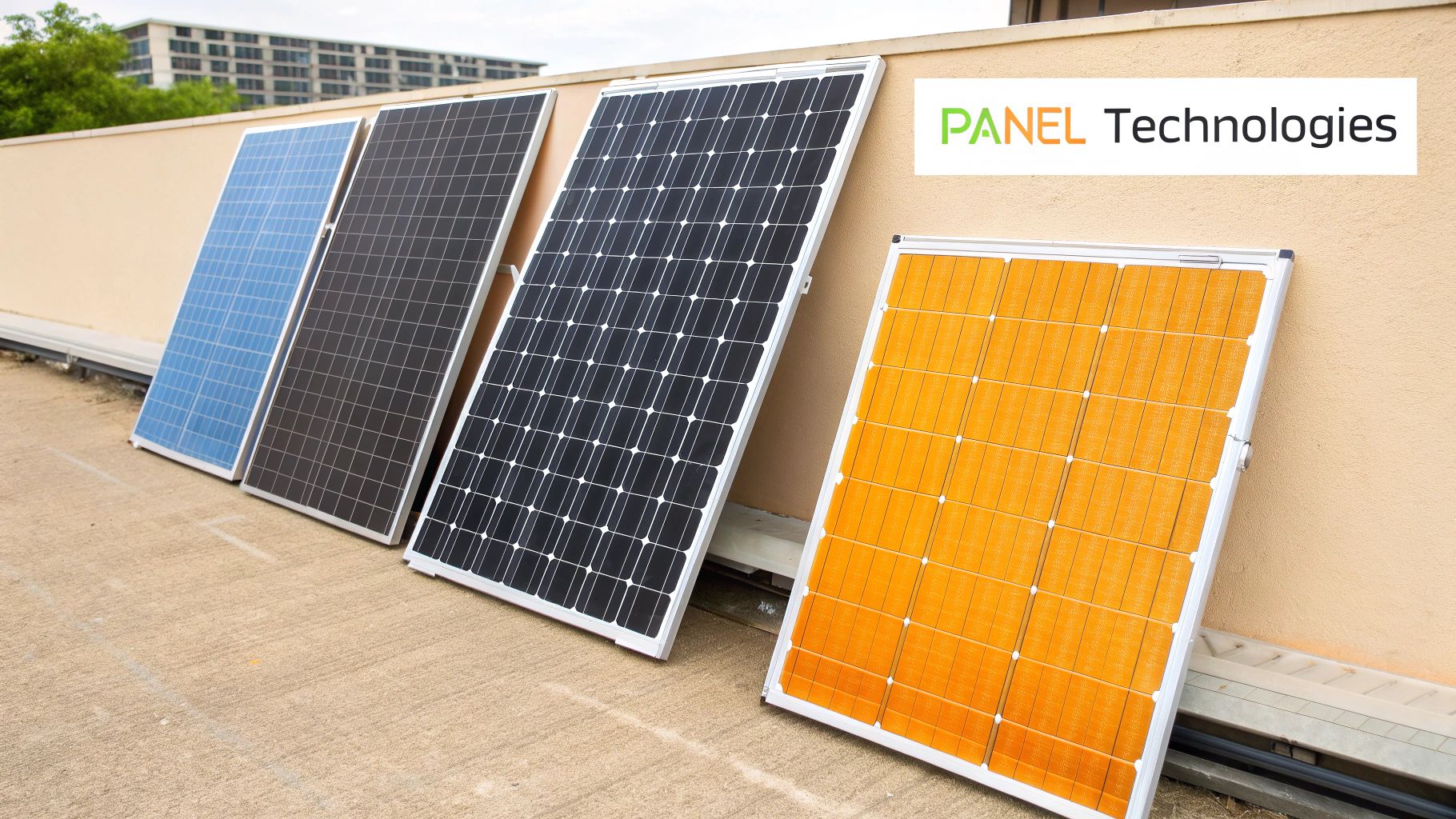
The three main technologies are monocrystalline, polycrystalline, and thin-film. Each has a unique profile, making it a better fit for certain applications and directly influencing your long-term return on investment.
Monocrystalline Panels: The High-Efficiency Leader
Monocrystalline panels are widely considered the premium option for good reason. Made from a single, pure silicon crystal, they feature a sleek, uniform black appearance. More importantly, this purity results in the highest efficiency ratings on the market, typically ranging from 19% to over 22%.
For properties with limited roof space—a common challenge for townhouses in Brooklyn or commercial buildings in dense urban areas—this high efficiency is a game-changer. You can achieve your energy production targets with fewer panels, as each one generates more electricity per square foot. This efficiency translates to maximum cost savings and a cleaner aesthetic.
Polycrystalline Panels: The Value-Oriented Workhorse
Polycrystalline panels are manufactured by melting multiple silicon fragments together, which creates their characteristic blue, speckled look. Because this process is less complex, these panels are available at a more accessible price point than their monocrystalline counterparts.
While their efficiency is slightly lower, typically between 16% and 19%, they offer an excellent balance of performance and cost. For a homeowner in Nassau County with a large, unobstructed roof, polycrystalline panels can generate substantial energy and deliver a faster payback period, making them a smart, budget-conscious choice for achieving energy independence.
Thin-Film Panels: The Niche Innovator
Thin-film technology is fundamentally different. It involves layering a thin photovoltaic material onto a substrate like glass or metal, resulting in a lightweight and flexible panel.
However, the trade-off is lower efficiency, with ratings often between 10% and 16%. This means you need a significantly larger area to generate the same amount of power as crystalline panels. While their flexibility is advantageous for unique applications, they are less practical for most residential and commercial rooftops in New York, where the primary goal is maximizing power generation in a defined space.
The core difference really boils down to your space and your goals. Monocrystalline is all about squeezing maximum power from a small footprint. Polycrystalline focuses on solid performance at a great price, especially if you have room to spare.
The technology behind solar panels has advanced significantly, making them a powerful choice for both homes and businesses. Today’s panels are better at generating more electricity from the same amount of sunlight. For instance, monocrystalline panels, which command about 44% of the market share, are often the top pick for their high output and long-term durability—perfect for places where space is tight. It’s also helpful to see how solar fits in with other renewable energy technologies like geothermal systems. For more local context, check out our detailed guide comparing solar panels vs. traditional energy sources on Long Island.
Comparing the Top Solar Panel Brands for New Yorkers
Once you understand the different panel technologies, the next step is to evaluate the brands that consistently deliver results for New York properties. Choosing the right solar panels is about more than just technical specifications; it’s about selecting a manufacturer with a proven track record of performance and reliability. Your panels must withstand our region's challenging climate—from the blazing summer sun on Long Island to heavy snowfalls upstate.
We will focus on four brands that consistently perform well in New York installations: Qcells, REC, Silfab, and Canadian Solar. Each offers a unique combination of efficiency, durability, and overall value, ensuring a great fit for any project, from a compact rooftop in Queens to a large commercial building in Suffolk County.
This chart provides a quick visual snapshot of how these brands compare on the most important metrics.
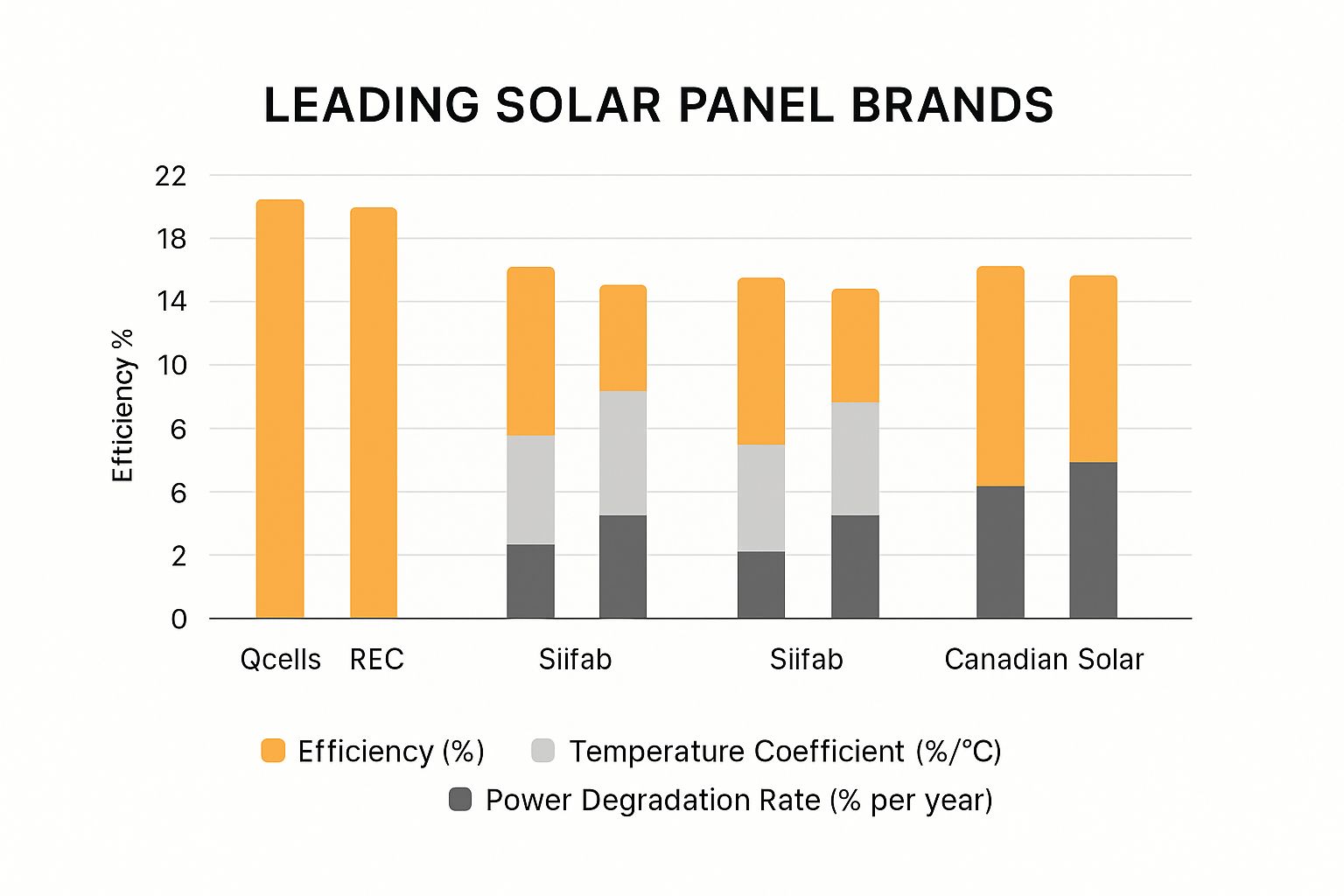
As you can see, there’s no single "best" panel. The right choice depends on your priorities, whether that's maximizing power generation or achieving the best long-term value.
To simplify your decision, here's a detailed breakdown of how these top brands compare on the factors most important to New York home and business owners.
Head-to-Head Comparison of Leading Solar Panel Brands
| Brand | Average Efficiency Range | Temperature Performance | Product & Performance Warranty | Ideal New York Application |
|---|---|---|---|---|
| Qcells | 21.5% – 22.5% | Excellent all-arounder | 25-year product / 25-year performance | The reliable, high-value choice for most residential homes seeking a balance of cost and top-tier performance. |
| REC | 21.7% – 22.6% | Industry-leading, minimal power loss in summer heat | Up to 25-year product / 25-year performance (plus labor) | Homes with limited roof space or unshaded, south-facing roofs where maximizing summer production is critical. |
| Silfab | 20.0% – 21.4% | Very durable, designed for harsh climates | 25-year product / 30-year performance | Property owners focused on long-term investment security, durability, and North American manufacturing. |
| Canadian Solar | 22.0% – 23.0% | Strong performance, very reliable | 25-year product / 25-year performance | Budget-conscious projects and larger commercial installations where a low cost-per-watt is a primary goal. |
Each of these brands has earned its place at the top through distinct strengths. Let's explore what makes each one a trustworthy choice.
Qcells: High-Performance and Market Leadership
Qcells has become one of the most popular brands in the U.S. residential market by mastering the balance between high-quality manufacturing, strong performance, and a competitive price. This makes them a go-to choice for many New York solar installations.
Their panels, particularly the Q.TRON series, consistently achieve efficiency ratings over 22%. This level of performance is a significant advantage for property owners who need to generate substantial power from a limited roof area. Furthermore, Qcells provides a robust 25-year product and performance warranty, offering confidence in your investment for decades.
Best For: Homeowners and businesses looking for a trusted, high-efficiency panel from an industry leader with a major U.S. presence and a fantastic all-around warranty.
REC Group: Premium Efficiency and Durability
REC is a premium brand known for pushing technological boundaries, resulting in exceptional performance, especially in challenging weather conditions. Their Alpha Pure series panels are among the most efficient available, with ratings exceeding 22.5%. For properties where every square inch is valuable, this elite performance is a game-changer.
A standout feature of REC panels is their excellent temperature coefficient, which measures how much power a panel loses as it heats up. In New York's hot and humid summers, a panel that retains its power, like REC's, will generate more electricity when you need it most, maximizing your cost savings.
- Exceptional Heat Tolerance: REC panels lose less power on hot summer days, maximizing your energy production during peak hours.
- Split-Cell Technology: This design enhances durability and performance in partial shade—a common issue for properties with nearby trees or complex roof shapes.
- Strong Warranty: The REC ProTrust warranty is one of the best in the industry, covering product, performance, and even labor costs when you use a certified installer.
Silfab Solar: North American Quality and Warranty
Silfab is a North American manufacturer renowned for producing highly durable panels designed for harsh climates. With factories in the U.S. and Canada, they are a dependable option for those who prefer to support domestic manufacturing.
The Silfab Prime series is known for its rugged construction and sleek, all-black aesthetic. However, its warranty truly sets it apart. Silfab offers a 25-year product warranty and a 30-year performance warranty, backing their equipment longer than most competitors. This provides a strong vote of confidence in the product's ability to withstand decades of New York weather.
Canadian Solar: Value and Reliability
Canadian Solar is a global powerhouse that has secured its position as a top-tier brand by offering dependable, high-performance panels at a very competitive price. For property owners focused on budget, Canadian Solar often provides the ideal balance of cost and quality.
Their modern panels, such as the TOPHiKu series, utilize advanced cell technology to reach efficiencies of up to 23%, rivaling more expensive brands. This allows home and business owners to install a powerful system without a premium price tag, accelerating their return on investment and path to energy independence.
- Cost-Effectiveness: You get a lower cost-per-watt without sacrificing significant performance or quality.
- Proven Bankability: As one of the world's largest solar manufacturers, you can trust their warranty will be honored if needed.
- Versatile Applications: Their diverse product line is suitable for everything from small residential arrays to large-scale commercial projects.
Ultimately, choosing the best brand for your New York property means carefully considering your roof, budget, and energy goals. The most important step is partnering with an experienced installer who can guide you to the right choice. To get a personalized recommendation based on your property, contact NY Essential Power today for a free, no-obligation solar quote.
How to Read a Solar Panel Spec Sheet Like a Pro
To truly compare the best solar panels for your home, you need to understand their technical language. Every proposal from an installer includes a "spec sheet" for the recommended panels. While it may seem like a wall of confusing numbers, grasping a few key metrics will reveal the true story of a panel's performance.
Think of it as the nutrition label for your energy investment. These specifications tell you exactly what you're getting and how the panel will perform in the real world, such as during a sweltering Long Island summer. Knowing these terms empowers you to analyze any quote with confidence.
Key Performance Metrics to Look For
When you review a spec sheet, focus on a few key numbers. These are the statistics that differentiate a premium, high-performance panel from a standard one and are crucial for making a smart choice for your New York property.
Here are the four most important terms to know:
-
Nominal Power (Pmax): Measured in watts (W), this is the panel's maximum power output under ideal lab conditions. A higher number means a more powerful panel, which is critical when trying to maximize energy production on a limited roof space.
-
Panel Efficiency (%): This indicates how effectively the panel converts sunlight into electricity. For example, a 21% efficiency panel will generate more power in the same footprint as a 19% efficiency panel. In dense areas like Queens or Brooklyn, where every square foot counts, higher efficiency is essential.
-
Power Tolerance: This shows the potential variance from a panel's rated Pmax. Look for a tight, positive tolerance like 0/+5W. This is a manufacturer's guarantee that the panel will produce at least its rated power, and possibly up to 5 watts more—but never less.
-
Temperature Coefficient: This may be the most overlooked—and most important—metric for New York property owners. It measures how much power output drops for every degree Celsius the panel's temperature rises above 25°C (77°F). It’s a fact: solar panels become less efficient as they get hotter.
A lower temperature coefficient is always better. It means your panels will perform more reliably during the hottest days of a New York summer, right when your air conditioner is running full blast and your energy demand is at its peak.
Putting It All Together: A Real-World Example
Let's say you're choosing between two panels for your home in Westchester. Panel A has a higher Pmax, which looks impressive. However, it also has a higher (worse) temperature coefficient. Panel B has a slightly lower Pmax but a much better temperature coefficient.
So, which is the better choice? While Panel A seems more powerful, Panel B will likely outperform it through July and August. It will generate more valuable energy when you need it most, leading to greater cost savings. This is the kind of practical insight hidden in a spec sheet—and it helps you and your installer, like the experts at NY Essential Power, choose equipment that delivers superior long-term performance and a faster return on your investment.
Tapping into NY Solar Incentives to Maximize Your Investment
Selecting the right solar panels is a crucial part of the process, but it's only half the story. To maximize the financial benefits of your solar installation in New York, you must leverage the state's outstanding incentive programs. These are designed to dramatically reduce your upfront costs and accelerate your return on investment.
Whether you're a homeowner or a commercial property decision-maker, understanding these incentives is what transforms a good investment into a great one. It's the key to achieving energy independence and locking in long-term savings.
Federal and State Tax Credits: The One-Two Punch
The most significant financial incentive is the Federal Solar Investment Tax Credit (ITC). This is not a simple deduction; it’s a credit that allows you to subtract 30% of your total solar system cost directly from your federal tax liability. This dollar-for-dollar reduction is a powerful tool for making solar more affordable.
New York enhances these savings with its own incentive: the New York State Solar Energy System Equipment Credit. This program lets you claim an additional 25% of your system's cost, up to a maximum of $5,000. When combined, the federal and state credits significantly lower the net cost of going solar.
The NY-Sun Megawatt Block Incentive
In addition to tax credits, the NY-Sun program provides an upfront rebate that lowers your system's cost from day one. The program is structured in regional "blocks," with each area having a set incentive amount per watt of solar installed. As more properties in a region adopt solar, that block fills up, and the incentive for the next block decreases.
This creates a real sense of urgency, especially for property owners on Long Island. The sooner you decide to install, the better your chance of securing a higher rebate amount. Waiting could literally mean leaving money on the table.
This rebate is administered by NYSERDA (New York State Energy Research and Development Authority) and is paid directly to your installer, who then passes the full savings on to you, making the process seamless and simple.
The worldwide momentum behind renewable energy is undeniable. Projections show the solar energy market growing from about $282.25 billion in 2025 to over $334.01 billion by 2029. This growth is a direct reflection of solar becoming more affordable and in-demand. You can discover more insights about this global solar energy trend and what it means for the future.
This layering of incentives is precisely what makes New York one of the best states for property owners to go solar. A knowledgeable, experienced installer will be an expert on these programs and ensure you claim every dollar you are entitled to. To see what these savings could look like for your home or business, contact NY Essential Power for a personalized solar quote today.
Why Your Installer Is as Important as Your Panels
It's easy to get caught up in comparing solar panel specifications, but even the best panel on the market will underperform if installed incorrectly. The reality is that your choice of installer is just as critical as the hardware you select. A top-tier solar panel is only one component of a complex system that requires expert design and flawless execution to deliver reliable power and cost savings for the next 25+ years.
This is where a local, trustworthy professional makes all the difference. An experienced New York installer understands how to position panels to maximize sun exposure throughout our distinct seasons. They also know how to navigate the local permitting processes in towns across Long Island, from Nassau to Suffolk County, ensuring a smooth and compliant installation.
The Value of Expert System Design and Support
A professional system design is far more than just placing panels on your roof. It involves a detailed analysis of your property to ensure every component works together seamlessly for optimal performance and safety.
This includes:
- Optimal Panel Placement: We analyze your roof's angle, orientation, and any potential shading from trees or adjacent buildings to capture every possible watt of solar energy.
- Correct Sizing: We find the sweet spot—calculating the right number of panels to meet your energy needs without oversizing the system and inflating your costs.
- Seamless Integration: We ensure all wiring, inverters, and mounting hardware are installed to the highest safety and quality standards, building a system designed to last.
A great installer doesn't just put panels on your roof and disappear. They become your long-term energy partner, offering support and system monitoring long after the installation is complete to make sure your investment is protected.
The demand for solar is exploding worldwide, and for good reason. By the end of 2024, the total global photovoltaic (PV) capacity shot past 2.2 TW. In that year alone, over 600 GW of new systems came online, thanks to better tech and smart policies. Learn more about global PV market trends.
This massive growth underscores the importance of working with a reputable, established company. Choosing a qualified local team like NY Essential Power means your system isn't just installed—it's engineered for maximum performance, long-term savings, and a durable, productive life. Our hands-on experience with New York's specific energy climate is what makes the difference. To see what makes our approach different, you can learn more about our team and mission.
Ready to pair the best solar panels with an installation to match? Contact NY Essential Power today to request your free, personalized solar quote and start your journey to energy independence.
Got Questions About Solar Panels in New York?
Deciding to go solar is a significant step, and it's natural to have questions. This is a major investment in your property, after all. We've compiled straightforward answers to the questions we hear most often from New York home and business owners.
How Do Solar Panels Handle a New York Winter?
This is one of the most common questions we receive. The good news is that solar panels perform surprisingly well during our cold, snowy winters. While there are fewer daylight hours, two factors work in your favor.
First, cold temperatures actually improve solar panel efficiency. Second, snow typically doesn't linger on the dark, angled surface of the panels; it tends to slide off. A professional installation also accounts for winter conditions, positioning panels to minimize snow accumulation and capture the low-hanging winter sun. You will continue to generate clean energy and save money even when it's frigid outside.
What’s the Real Lifespan of Modern Solar Panels?
Think of your solar panels as a long-term upgrade to your property. Most top-tier panels today come with a 25-year performance warranty, but they will often continue producing power for 30 years or more.
Over time, their output will slowly and predictably decrease in a natural process called degradation. However, a quality panel is still guaranteed to produce at least 85-92% of its original power after 25 years. That translates to decades of reliable energy savings, environmental benefits, and a solid return on your investment.
Are Solar Panel Warranties a Big Deal?
Yes, they are crucial. A strong warranty is a manufacturer's vote of confidence in their product and your best protection for this long-term investment. You should pay attention to two types of warranties:
- Product Warranty: This covers physical defects in the panel itself, such as issues with materials or manufacturing. This warranty typically lasts 12 to 25 years.
- Performance Warranty: This is the most important one. It guarantees the panel will maintain a certain percentage of its original power output after 25 years.
A rock-solid warranty from a financially stable company provides true peace of mind. It protects you from the unexpected and ensures your system delivers the long-term value and cost savings you were promised. It is a direct indicator of the panel's quality.
Ready to get answers specific to your home and energy needs? The team at NY Essential Power is here to walk you through everything, from the first sketch to flipping the switch.
Request Your Free, No-Obligation Solar Quote Today!