
The best home battery backup systems are no longer just about keeping the lights on during a storm; they're about securing genuine energy independence for your home or business. For property owners across New York, from Long Island to the five boroughs, a battery system gives you control over your power, significantly cuts your monthly utility bills, and provides invaluable peace of mind. With our state's aging grid and increasingly unpredictable weather, top-tier options like the Tesla Powerwall or Enphase IQ Battery are quickly shifting from a luxury to a smart, necessary investment.
Why New York Property Owners Need to Think About Energy Resilience

Whether it’s a nor'easter hammering the Suffolk County coastline or an upstate blizzard straining the grid, New York's power infrastructure is constantly put to the test. For homeowners and commercial decision-makers, that stress translates directly into a higher risk of power outages that can disrupt life and halt business operations. A home or commercial battery backup system is no longer just a nice-to-have; it's a solid investment in your property's stability and your family's comfort.
When the grid goes down, a battery system kicks in instantly. There's no flicker, no delay—just continuous power for your essential appliances and systems. Your lights stay on, the refrigerator keeps running, and critical equipment—whether for medical needs at home or servers at your business—remains operational. That seamless transition provides a level of security that generators simply can't match.
Gaining Real Energy Independence and Cost Savings
Beyond emergency preparedness, the most significant benefit for many is achieving true energy independence. By storing the excess power your solar panels generate during the day, you can use it to run your property at night. This simple act dramatically cuts your dependence on utility companies like Con Edison or PSEG Long Island. It's clean, reliable energy that is 100% yours.
This independence naturally leads to substantial cost savings. You can program your system to draw from the battery during peak hours when electricity rates are at their highest. This strategy, known as "time-of-use optimization," allows you to sidestep premium charges and take back control of your energy costs. Over time, these savings, combined with powerful New York State and federal incentives, help the system pay for itself.
By storing your own clean energy, you're not just preparing for the next outage. You're building a more sustainable and cost-effective energy future for your property, whether you're in Westchester County or Queens.
Environmental Benefits and Modern Living
Pairing a battery with solar panels is a powerful move for anyone who cares about their environmental impact. You get to use every kilowatt of renewable energy you generate, shrinking your carbon footprint and contributing to a more stable, resilient grid for the entire community. For a look at the future of this technology, innovative projects like an off-grid shipping container modular home demonstrate how vital battery backup systems are for true energy self-sufficiency.
Whether your goal is to protect your family or keep your business running smoothly, NYS Essential Power has the expertise to guide you. We serve communities across New York State—you can view our full service areas for home battery installation to see how we can help make your property more resilient.
Understanding Your Home Battery Options
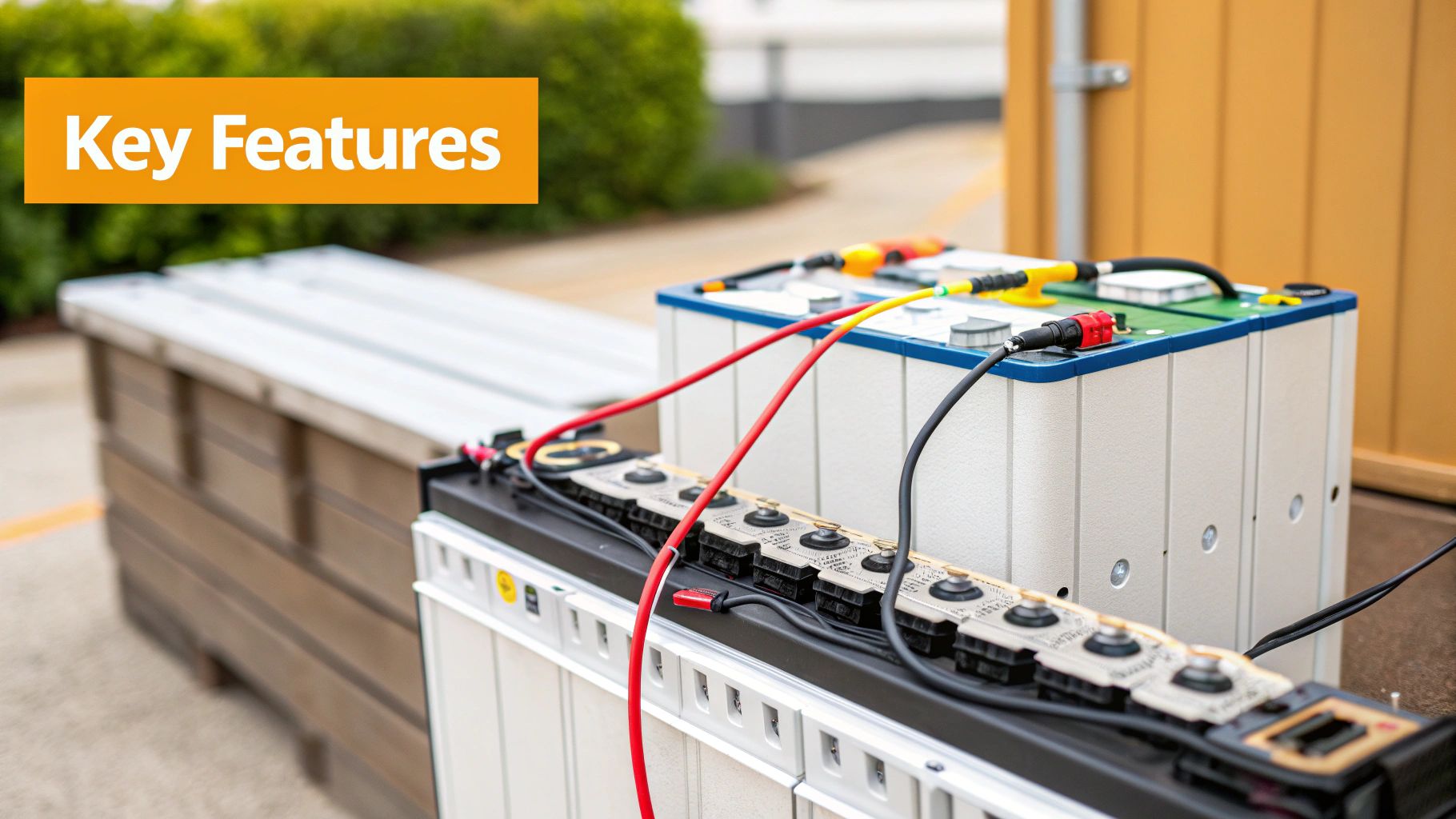
When you begin researching home battery systems, the technical specifications can feel overwhelming. However, the core concepts are straightforward. To find the right fit for your New York property, it's essential to understand a few key terms that define a battery's performance.
Key Metrics: Capacity, Power, and Efficiency
First is battery capacity, measured in kilowatt-hours (kWh). This indicates the total amount of energy a battery can store. A higher kWh number means more stored power, allowing you to run your home or business for longer during an outage. For example, a 13.5 kWh battery is often sufficient to power essential appliances through the night, but a larger system could sustain you for several days with careful energy management.
Next is power output, measured in kilowatts (kW). This metric shows how many appliances or systems the battery can run simultaneously. If you need to power high-demand equipment like a central air conditioner, a well pump in a rural Westchester home, or commercial machinery, you will require a battery with a high kW rating to handle the initial surge.
Finally, consider round-trip efficiency. This percentage indicates how much of the energy stored in the battery is usable after accounting for minor losses during charging and discharging. Most modern lithium-ion batteries feature efficiencies well over 90%, ensuring minimal energy is wasted.
Types of Battery Technology
The majority of today’s home and commercial batteries are lithium-ion, but they come in two primary chemistries:
- Lithium Iron Phosphate (LFP): Known for their exceptional safety profile and long operational lifespan, LFP batteries are the workhorses of the industry. They are an excellent choice for property owners who prioritize durability and peace of mind.
- Nickel Manganese Cobalt (NMC): NMC batteries offer higher energy density, meaning they can store more power in a smaller, lighter package. This makes them ideal for installations with space constraints, such as a compact Brooklyn brownstone where wall space is at a premium.
The demand for these systems is growing rapidly. The global home energy storage market was valued at USD 2.82 billion in 2024 and is projected to reach nearly USD 6.89 billion by 2034, driven by homeowners seeking reliable backup power and a smarter way to use their solar energy.
AC-Coupled vs. DC-Coupled Systems
The way a battery integrates with your solar panel system is also a key consideration. If you already have solar panels, an AC-coupled system is an excellent choice. The battery connects directly to your home's main AC circuit, making it a straightforward and cost-effective retrofit.
If you are installing solar panels and a battery simultaneously, a DC-coupled system is often more efficient. In this configuration, the solar panels and battery are connected on the DC side before the power is converted to AC for use in your home. This process minimizes energy conversion losses, maximizing the output of your solar array.
Understanding these fundamentals empowers you to ask the right questions and identify the best solution for your needs. The ideal battery system depends on your property's layout, energy consumption, and specific goals—whether it's simple blackout protection or complete energy independence.
For more in-depth discussions on energy solutions, our blog offers more articles on energy solutions to help guide your decision.
Comparing the Top Home Battery Systems
Choosing the right battery backup system is a significant decision. While the market offers many excellent options, the best solution for a sprawling home in Westchester County may not be the ideal fit for a historic brownstone in Brooklyn. Let's compare how the top contenders—Tesla Powerwall, Enphase IQ Battery, and Generac PWRcell—perform in real-world New York scenarios.
This comparison chart provides a high-level overview of the key differences in capacity, typical costs, and warranty coverage for these industry-leading models.
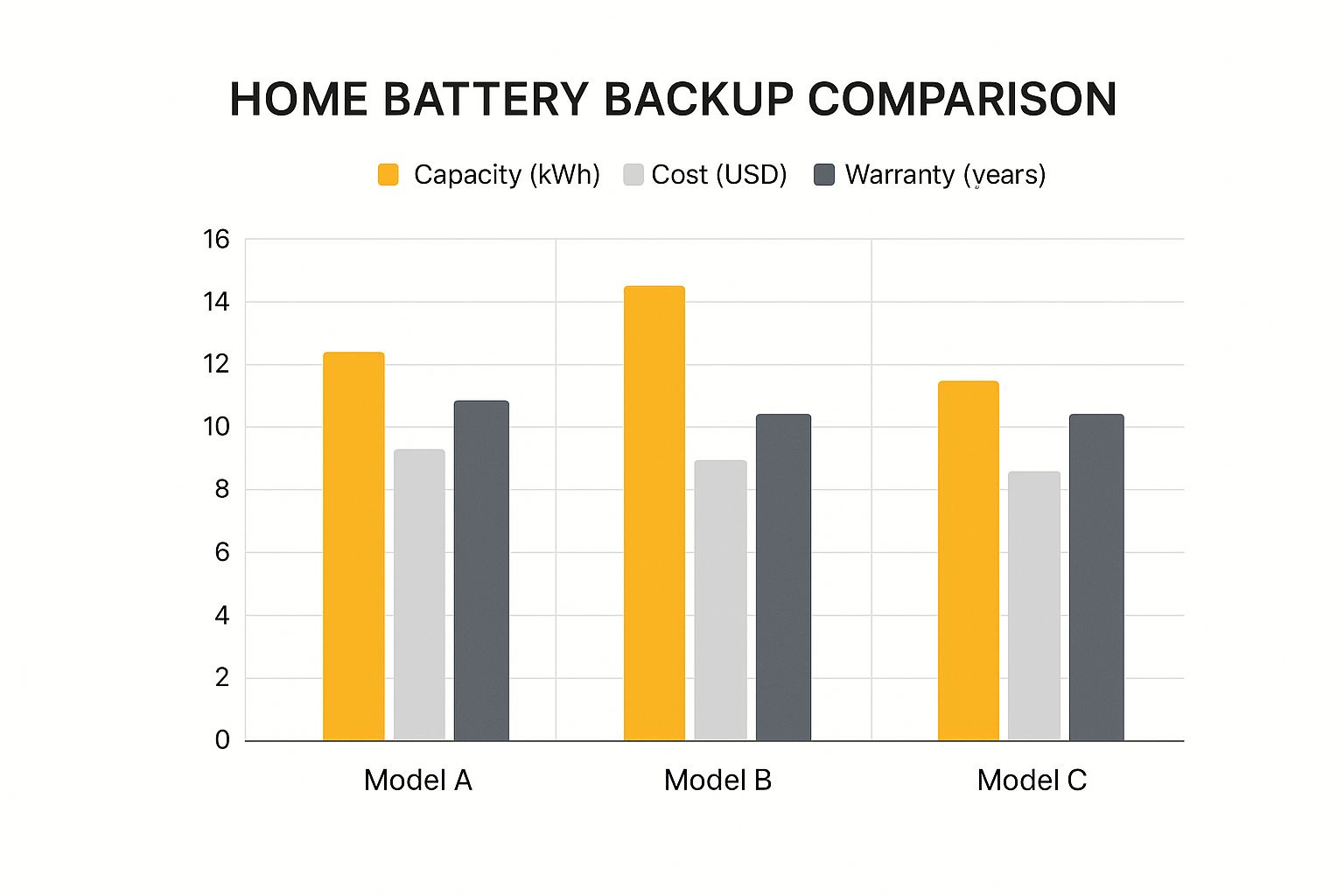
As you can see, each system offers a unique balance of performance, flexibility, and long-term value. The optimal choice depends entirely on your property's energy goals.
Top Home Battery Backup System Comparison
Here is a more detailed, feature-by-feature breakdown of these three powerhouse systems, focusing on the specifications that matter most to New York property owners.
| Feature | Tesla Powerwall | Enphase IQ Battery | Generac PWRcell |
|---|---|---|---|
| Usable Capacity | 13.5 kWh per unit | 3.36 to 10.08 kWh per unit (modular) | 9 to 18 kWh per cabinet (expandable to 36 kWh) |
| Power Output | 5.8 kW continuous, 10.6 kW peak | 1.28 kW continuous per 3.36 kWh unit | 4.5 to 9 kW continuous (depending on configuration) |
| Best For | All-in-one performance, high-power needs | Customization, future expansion, reliability | Maximum power, whole-home backup, long outages |
| Key Advantage | High power output for starting large appliances | "Pay-as-you-grow" modularity and system resilience | Massive capacity for ultimate energy independence |
| Chemistry | Lithium Nickel Manganese Cobalt (NMC) | Lithium Iron Phosphate (LFP) | Lithium Nickel Manganese Cobalt (NMC) |
| Warranty | 10 years, 70% capacity retention | 15 years, 70% capacity retention | 10 years, 70% capacity retention |
This table highlights the clear trade-offs: Tesla provides a powerful, integrated package; Enphase offers unmatched flexibility and reliability; and Generac delivers raw, expandable power for the most demanding applications.
Tesla Powerwall: A Household Name for a Reason
The Tesla Powerwall is renowned for its sleek design and robust performance. With 13.5 kWh of capacity, it serves as a powerful all-in-one solution. For many homeowners, a single Powerwall is more than sufficient to cover essential loads—lights, refrigerator, Wi-Fi—through a typical power outage on Long Island.
The Powerwall excels with its high power output, a critical feature for homes with demanding appliances. If you need to run central air conditioning or a well pump, its ability to handle high-wattage startups is a significant advantage. It also integrates seamlessly with the Tesla app, offering one of the most intuitive platforms for monitoring your energy flow.
However, it operates within a closed ecosystem. While it functions perfectly with Tesla solar or as a standalone unit, it is designed for optimal performance within a Tesla-only environment, which may limit flexibility for those who prefer mixing components.
Enphase IQ Battery: Modular and Scalable
Enphase approaches energy storage with a focus on modularity. Instead of a single large unit, the IQ Battery system consists of smaller, stackable units, allowing you to customize the system size to your exact needs. This is a game-changer for property owners with unique energy consumption patterns or limited installation space.
For example, a homeowner in Queens with a smaller roof might begin with a 3.36 kWh unit and easily add more capacity later if they purchase an electric vehicle. This scalability makes it an incredibly flexible and future-proof choice. Furthermore, because Enphase systems are built on microinverters, they are exceptionally reliable; if one component experiences an issue, the rest of the system continues to operate without interruption.
Key Differentiator: The Enphase IQ Battery's modular design allows you to start small and expand your storage capacity over time. This "pay-as-you-grow" approach offers unparalleled flexibility as your energy needs evolve.
The trade-off is that achieving a capacity comparable to a Powerwall requires installing multiple units, which can sometimes increase installation complexity and cost. However, for those who prioritize customization and system resilience, the Enphase IQ Battery is hard to beat.
Generac PWRcell: Power and Integration
Generac has built its reputation on backup power, and it brings that same focus on resilience to the PWRcell battery. This system is engineered for property owners who demand maximum power and the ability to endure extended outages. Its capacity starts at a substantial 9 kWh and can be expanded up to 36 kWh by adding battery modules within a single cabinet.
This makes the PWRcell an ideal solution for large homes, commercial properties, or facilities in areas where prolonged blackouts are a genuine concern. As a DC-coupled system, it is also highly efficient when paired with a new solar array, as it minimizes energy conversion losses. This system is designed to provide uncompromising, whole-home power.
The demand for this level of energy security is growing. The residential battery storage market was valued at USD 5.13 billion in 2024 and is projected to climb to nearly USD 27.66 billion by 2032, largely due to rising electricity costs and more frequent severe weather. You can discover more insights about this market growth on Fortune Business Insights.
Making the Right Choice for Your New York Property
How do you decide which system is right for you? It ultimately depends on your property and your priorities.
- For the Tech-Savvy Homeowner in an Urban Setting: The Tesla Powerwall is a fantastic choice. It's a powerful, user-friendly, and sleek all-in-one package that’s perfect for a modern home in Brooklyn or Nassau County looking for seamless backup.
- For the Flexible Homeowner Planning for the Future: The Enphase IQ Battery is ideal if you want to start smaller and expand later. Its modular design and reliability are perfect for anyone whose energy needs might change over time.
- For the Homeowner Demanding Maximum Resilience: The Generac PWRcell is the heavy-hitter. It's built for large properties or anyone needing to power heavy equipment through long outages, making it a go-to for homeowners in more rural parts of New York who can't afford to be without power.
The only way to know for sure is to have your property's specific energy profile assessed by a professional. At NYS Essential Power, we specialize in designing systems built for the unique demands of New York properties.
Ready to find the perfect battery for your home or business? Request a free quote from NYS Essential Power, and let our experts design a custom solution for you.
Breaking Down the Costs and New York Incentives
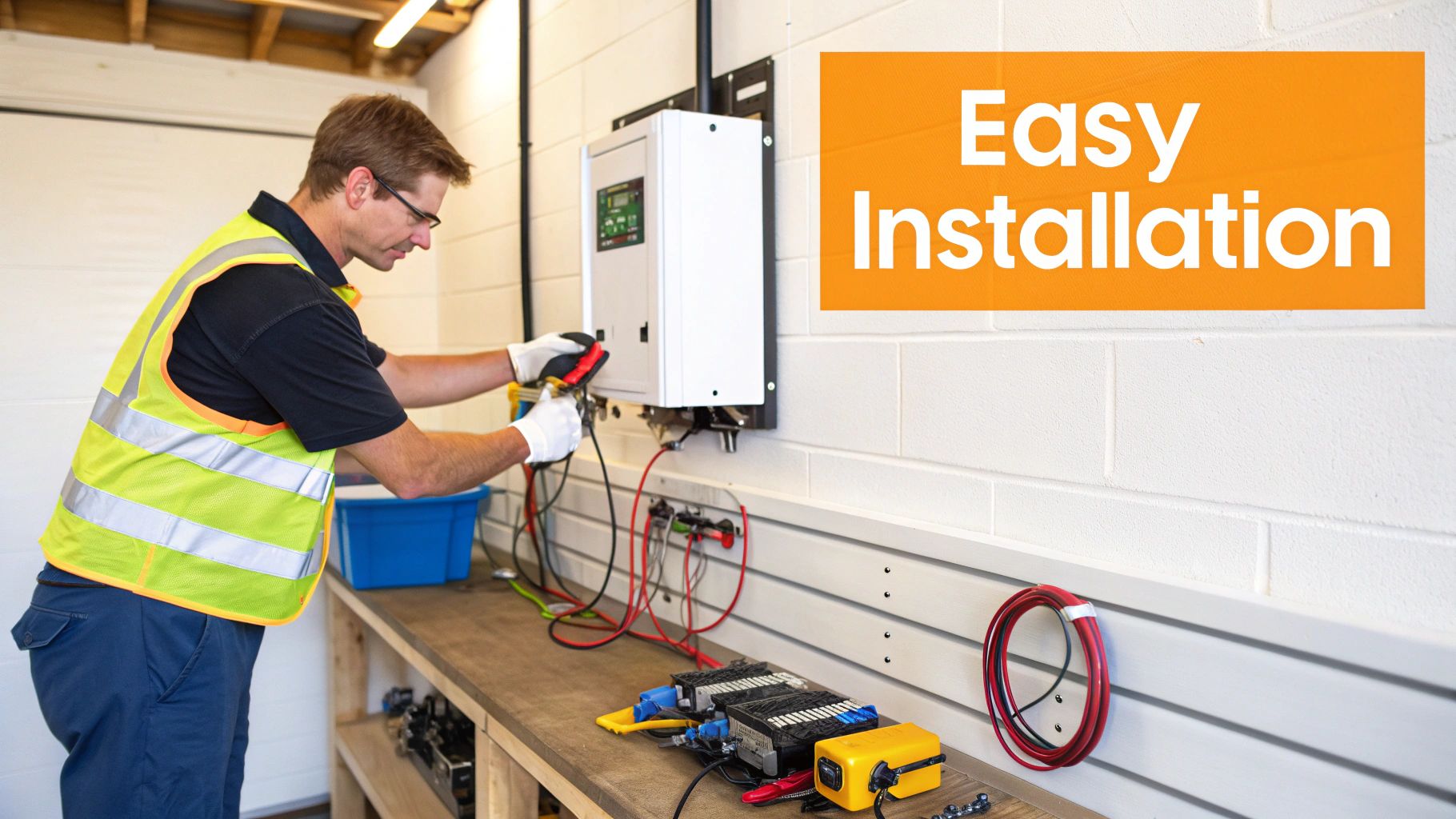
Understanding the financial investment is a critical step. The total cost of a home battery backup system includes more than just the battery unit; it encompasses the inverter, professional installation, wiring, mounting, and all necessary permits.
In New York, a high-quality, whole-home system typically ranges from $12,000 to $25,000, depending on the size and complexity of the installation. While this is a significant investment, it's essential to view it through the lens of long-term value, energy independence, and the powerful financial incentives available exclusively to New York residents and businesses.
This technology is rapidly becoming mainstream. The global battery backup market reached USD 10.5 billion in 2023 and is projected to more than double by 2032, reflecting a major shift toward energy resilience. You can learn more about these battery backup market trends to see how quickly this technology is becoming a household essential.
How New York State Helps You Save
New York offers some of the most attractive incentives in the nation to make energy storage more affordable and accelerate your return on investment.
The primary program is the NY-Sun program, administered by the New York State Energy Research and Development Authority (NYSERDA). This program provides a direct, upfront rebate for installing a battery system. The rebate amount is calculated based on the kilowatt-hour (kWh) capacity of your battery, meaning a larger system qualifies for a larger rebate.
For many property owners, the NY-Sun rebate can reduce the initial equipment cost by thousands of dollars, making New York one of the best states for investing in home energy storage.
Stacking Up the Federal ITC and Utility Rebates
In addition to the state incentive, all property owners can claim the Federal Investment Tax Credit (ITC). This powerful incentive provides a tax credit for 30% of the total cost of your battery system, including installation, when charged by solar panels.
This is a dollar-for-dollar credit that directly reduces your federal tax liability. For a $20,000 system, that equates to a $6,000 credit, fundamentally changing the financial equation.
Furthermore, it's wise to check for additional rebates from your local utility. Companies like Con Edison and PSEG Long Island often offer their own programs to encourage energy storage adoption. In most cases, these can be stacked with state and federal incentives for maximum savings.
A Real-World Look at Your Return on Investment
Your return on investment (ROI) is generated from multiple sources. Here is a sample calculation for a typical Long Island homeowner:
- Initial System Cost: $22,000
- NY-Sun Rebate: (Example) -$3,000
- Federal ITC (30%): -$5,700 (calculated on the $19,000 cost after the state rebate)
- Your Net Cost: $13,300
From that point, the system generates returns by:
- Slashing Utility Bills: Store low-cost off-peak power or free solar energy and use it during expensive peak hours.
- Boosting Property Value: A home with a resilient, independent power source is a significant asset in the real estate market.
- Avoiding Outage Costs: Eliminate the costs of spoiled food, lost productivity for remote work, or a hotel stay during a multi-day blackout.
When you add it all up, a home battery becomes a true asset that makes your property more secure and financially sound. Our team can guide you through all available incentives to find the best home battery backup systems for your budget.
Ready to see what the numbers look like for your home? Request a free, no-obligation quote from NYS Essential Power today, and we’ll create a detailed cost and savings analysis just for you.
Your Home Battery Installation Process
Once you've decided a battery backup system is the right solution, the next step is the installation. At NYS Essential Power, we have refined this process into a seamless, professional experience designed to minimize disruption and deliver exceptional results. Our primary goal is to manage every detail so you can focus on the outcome: reliable, uninterrupted power.
The process begins with a simple, no-pressure consultation to understand your goals. Are you seeking whole-home backup for your residence in Suffolk County, or do you need to protect critical operations at your business in Queens?
Initial Site Assessment and Custom Design
Following our initial conversation, one of our energy experts will conduct a thorough on-site assessment. We evaluate your property's electrical infrastructure, identify optimal locations for equipment, and analyze your energy consumption patterns. This data-driven approach ensures we design a system that is perfectly tailored to your needs.
Our engineering team then uses this information to create a custom system design. We map out every detail—from battery placement and wiring routes to integration with your solar panels or main electrical panel. You will receive a clear, comprehensive proposal outlining the recommended equipment, a complete project plan, and a transparent cost breakdown.
Navigating Permits and Regulations
Securing the necessary permits can be a complex and time-consuming process in New York. We have extensive experience working with municipal authorities across the state, from local town building departments on Long Island to the NYC Department of Buildings. Our dedicated team manages all permit applications and coordinates every required inspection, ensuring your installation fully complies with local codes and safety standards.
We handle the red tape so you don't have to. Our deep understanding of New York's specific regulations ensures your project moves forward smoothly and without unexpected delays.
This expertise is a cornerstone of our service, enabling us to deliver a professional and stress-free experience for every client.
Professional Installation and System Commissioning
Once all permits are approved, our certified technicians begin the installation. We are committed to the highest standards of quality workmanship, and our team installs every component with precision and care. They work efficiently and treat your property with respect, keeping any disruption to an absolute minimum.
After the physical installation is complete, we proceed to the most critical step: commissioning the system. We power up the battery, verify every connection, and optimize the software for peak performance. We then provide a thorough walkthrough of the monitoring app, so you can see exactly how much energy you are producing, storing, and saving. Our commitment to you continues long after the installation is finished; we are your dedicated energy partner for the long haul.
Ready to take the first step toward a more resilient property? Contact NYS Essential Power today to schedule your free consultation and learn how simple the installation process can be.
Frequently Asked Questions
When exploring the best home battery backup systems, many questions arise. This is a significant investment, and it's important to feel confident in your decision. Here are answers to the questions we hear most frequently from property owners across New York.
How Long Will My Battery Last During an Outage?
The runtime of a battery during an outage depends on two factors: its capacity (kWh) and your energy consumption. A standard 13.5 kWh battery, for example, can typically power essential loads—such as a refrigerator, lights, and Wi-Fi—through an overnight outage.
By managing your energy usage and prioritizing critical appliances, you can significantly extend that runtime. For property owners in areas like Suffolk County who may face multi-day outages, pairing a larger battery system with solar panels provides the ultimate solution. As long as there is some sunlight, your battery can recharge, allowing you to remain powered almost indefinitely.
Can I Add a Battery to My Existing Solar Panels?
Yes, absolutely. Retrofitting a battery to an existing solar panel system is one of the most common projects we undertake. This is typically done using a method called AC coupling.
In an AC-coupled system, the battery is connected directly to your property's main electrical panel, where it works in tandem with your existing solar inverter. This makes it a seamless and cost-effective upgrade that does not require a major overhaul of your current solar array.
Adding a battery to an existing solar array is a seamless way to maximize your initial investment. You gain immediate blackout protection and finally get to use your own clean energy around the clock.
What Maintenance Do Home Batteries Require?
One of the greatest advantages of modern battery systems is that they are virtually maintenance-free. Unlike traditional generators that require regular oil changes, fuel refills, and engine servicing, a battery is a solid-state device with no moving parts. Once installed, it operates silently and reliably in the background.
There are no fluids to check or filters to replace. The battery's integrated software automatically manages its performance and health. While these systems use advanced lithium-ion technology, and it's always wise to be informed about safety—you can get a deeper dive by understanding lithium-ion battery safety and risks—their "set it and forget it" nature provides a significant advantage over older backup power technologies.
Ready to secure your home's power supply and gain true energy independence? The expert team at NY Essential Power is here to design and install the perfect battery backup system for your New York property. We handle every detail, from navigating local permits to maximizing your savings with state and federal incentives.