
Choosing the best commercial solar panels for your New York business or home comes down to balancing three key factors: high efficiency, a rock-solid warranty, and a proven track record of performance in our demanding four-season climate. The top-tier brands are leaders for a reason—they consistently deliver, whether you're looking to maximize power from a Syracuse warehouse roof or a residential home on Long Island.
Ultimately, the ideal panel isn't just about a brand name; it's the one that perfectly fits your property's energy needs and your long-term financial goals, helping you achieve energy independence.
Making the Right Solar Investment for Your NY Business or Home
Deciding to go solar is a significant investment in your property's future. It’s a major decision that can deliver substantial cost savings, give you control over your energy supply, and make a powerful statement about your commitment to sustainability. For property owners here in New York, from homeowners in Islip to business owners in the Hudson Valley, selecting the right equipment is the cornerstone of a successful project.
A solar installation is much more than just panels on a roof—it's a long-term asset. The right system can slash or even eliminate your electricity bills from utilities like Con Edison or PSEG Long Island. This is about building energy independence and shielding your budget from unpredictable rate hikes, giving you stable, predictable energy costs for the next 25 years or more.
Key Factors for New York Property Owners
When you're weighing your options, keep these core benefits front and center:
- Significant Cost Savings: Lock in your energy costs and watch your monthly expenses drop. A solar investment offers one of the most reliable returns available, boosting your net operating income or freeing up your household budget.
- Energy Independence: Why rely on an aging grid? Generating your own clean power on-site makes your property more resilient and less vulnerable to outages and rate hikes.
- Environmental Benefits: Show your commitment to clean energy. This resonates with today's customers, employees, and community members, showcasing your role as a responsible neighbor and business leader.
The global solar market is experiencing incredible growth, driven by falling costs and strong government support. Projections point to a compound annual growth rate of 7.84% from 2025 to 2033. This growth is great news for property owners like you because it means better technology and more attractive incentives are constantly becoming available.
To maximize your solar investment, you should also look at broader strategies for commercial building energy efficiency. Pairing solar with smart energy upgrades creates a powerful combination that significantly reduces your overall energy consumption.
Making a smart choice now ensures your solar array is a high-performing asset for its entire 25+ year lifespan. As you explore the differences between solar panels vs traditional energy sources on Long Island, remember you're not just buying equipment—you're investing in your financial health and future.
Ready to see how the best commercial solar panels can transform your operating costs? The experts at NY Essential Power can provide a customized assessment for your New York property. Contact us today for a free, no-obligation quote and take the first step toward energy independence.
Comparing Core Panel Technologies For NY Climates
Not all solar panels are created equal, especially when you factor in New York's demanding four-season weather. A panel that works wonders for a sprawling manufacturing plant in Buffalo might be a poor choice for a business with limited roof space in Westchester or a home in a historic district. Choosing the best commercial solar panels isn't about chasing brand names; it's about understanding the specifications that deliver real, long-term value and cost savings.
Let's break down the main technologies you'll encounter in simple terms: monocrystalline, polycrystalline, and thin-film. We'll look at them through the lens of what matters most to your bottom line—efficiency, performance in our climate, and overall durability.
Monocrystalline Panels: The Efficiency Champions
For most New York properties, particularly those in dense areas like NYC or on Long Island where every square foot of roof space counts, monocrystalline panels are the premier solution. Made from a single, highly pure silicon crystal, you can spot them by their uniform, sleek black appearance.
Their biggest selling point? Unmatched efficiency. With ratings typically between 19% and 22% (or even higher), they squeeze more power out of a smaller area than any other type. If your roof is crowded with HVAC units or you simply don't have a massive space to work with, this high power density is a game-changer for maximizing your energy production and savings.
Polycrystalline Panels: The Cost-Effective Workhorse
You'll recognize polycrystalline panels by their distinctive blue, speckled look. They're manufactured by melting multiple silicon fragments together, a process that’s less intensive and creates less waste. The result is a more budget-friendly panel right out of the gate.
Their efficiency is slightly lower than monocrystalline panels, usually in the 16% to 18% range. But for a property with a wide-open warehouse roof or plenty of land for a ground-mounted array, polycrystalline panels can offer an incredible return on investment. That lower upfront cost can help shorten your project's payback period, making them a smart financial choice when space is not a constraint.
Key Takeaway: The decision often boils down to a simple trade-off. Monocrystalline panels are your best bet for maximizing power in tight spaces. Polycrystalline panels can deliver a faster ROI if you have plenty of room to build.
Thin-Film Panels: The Flexible Innovator
Thin-film is a different technology altogether. Instead of rigid silicon wafers, these panels are made by applying super-thin layers of photovoltaic material onto a backing. This makes them incredibly lightweight, flexible, and better at handling high heat.
The trade-off, however, is efficiency. Thin-film panels typically have efficiency ratings between 10% and 13%, meaning you need a much larger surface area to generate the same amount of power. They are best suited for niche applications, like on curved architectural roofs or on surfaces that can't handle the weight of conventional panels.
To help you see the bigger picture, this chart gives a side-by-side look at how these technologies stack up for a New York property.
Commercial Solar Panel Technology Comparison
| Panel Type | Efficiency Range | Best For | Cost Factor | Lifespan |
|---|---|---|---|---|
| Monocrystalline | 19% – 22%+ | Properties with limited roof space; maximizing power generation and long-term savings. | Higher | 25-40 years |
| Polycrystalline | 16% – 18% | Large, unobstructed roofs or ground mounts; budget-conscious projects with ample space. | Medium | 25-35 years |
| Thin-Film | 10% – 13% | Non-traditional surfaces (curved roofs), lightweight requirements, specialized applications. | Lower | 15-25 years |
Ultimately, the best panel is the one that fits your specific site, financial goals, and energy needs.
The infographic below highlights the core reasons property owners are making the switch to solar—it’s a powerful mix of financial wins, energy independence, and environmental stewardship.
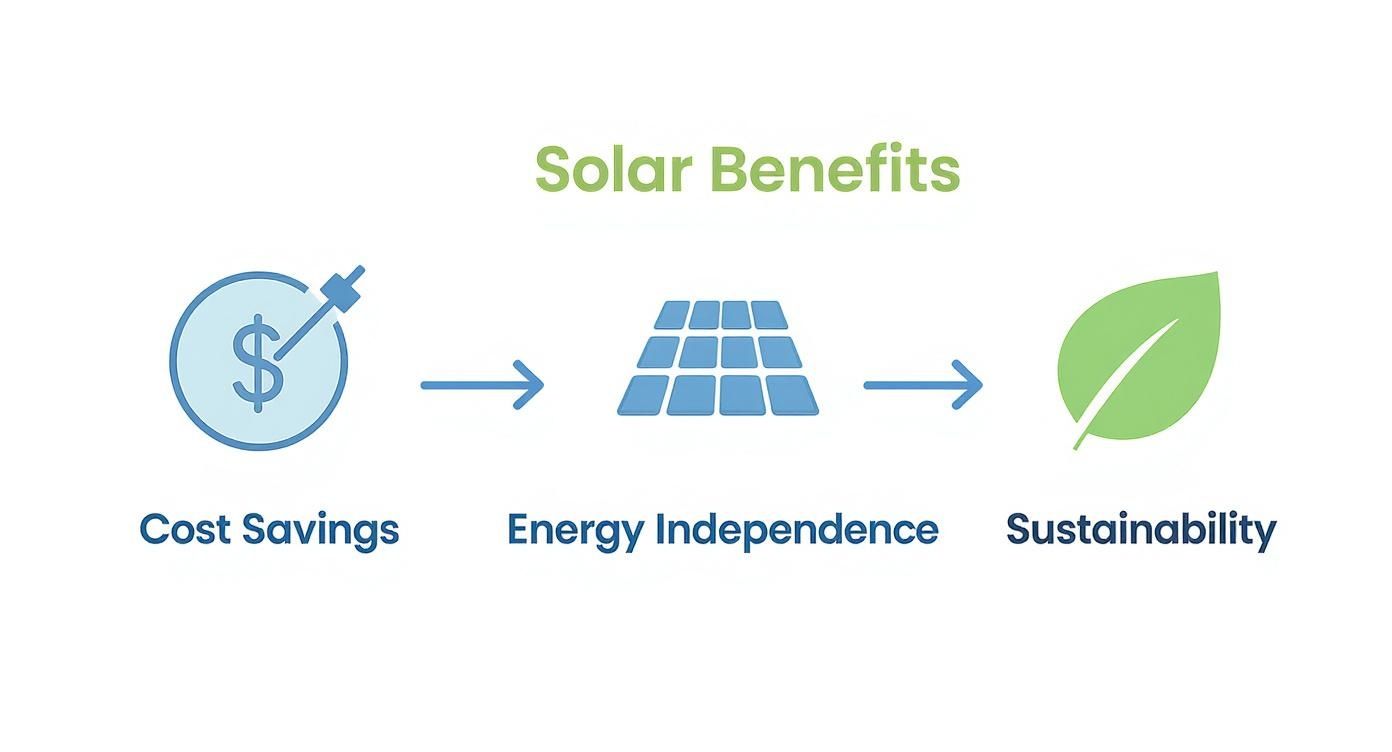
As you can see, a solar investment isn't just an expense. It's a strategic move that delivers financial, operational, and environmental advantages that make your property more valuable and your future more secure.
Technical Specs That Matter In NY
Beyond the basic type, a couple of performance metrics are critical for success in our climate.
- Temperature Coefficient: This number tells you how much a panel's output drops as it gets hotter. In solar, a lower number is always better. Think about a hot July afternoon on a Long Island roof—a panel with a superior temperature coefficient will be churning out significantly more power and savings.
- Degradation Rate: Every panel loses a tiny bit of efficiency each year. The performance warranty guarantees its output after 25 years. A lower degradation rate means your system produces more electricity—and more savings—over its entire life.
Getting these details right ensures your investment pays dividends for decades. A top-tier installation is key to unlocking the full potential of these technologies, which is why it's so important to find the right partner. You can learn more about this in our guide on what to look for when choosing a solar company in Islip.
The right panel technology comes down to your property, budget, and energy goals. Ready to figure out the perfect fit for your New York business or home? Contact NY Essential Power for a personalized consultation and a free, no-obligation quote.
Understanding Warranties and Manufacturer Stability
A solar panel system is a serious, long-term commitment—think 25 years, minimum. While it's easy to get caught up in technical specs like efficiency, the warranties and the financial health of the manufacturer are just as important for protecting your investment.
A top-of-the-line panel from a company that goes out of business in five years leaves you with a worthless warranty. That's a risk no property owner can afford to take. Your solar array is your personal power plant, and you need to know the manufacturer will be around to back up its promises for the entire life of that system.
The Two Key Solar Warranties You Need to Know
When you start digging into the best commercial solar panels, you'll come across two different types of warranties. It's crucial to understand what each one covers.
-
Product Warranty: This is your safety net against physical defects. It covers everything from faulty frames and junction box failures to problems with the backsheet. A solid product warranty from a reputable company will run anywhere from 12 to 25 years.
-
Performance Warranty: This one guarantees the panel's actual energy output over its lifetime. Solar panels naturally lose a tiny bit of efficiency each year, and this warranty promises that the panel won't degrade below a specific level—typically guaranteeing at least 80-85% of its original output after 25 years.
These two warranties are designed to work in tandem, protecting your investment from both manufacturing defects and the natural decline in performance over time.
Reading Between the Lines: What the Fine Print Really Means
Not all warranties are created equal. The devil is always in the details, and what's hidden in the fine print can make a huge difference if you ever need to file a claim.
A critical detail to look for is whether the warranty covers the labor costs for a replacement. Many standard warranties only cover the cost of the new panel, leaving you on the hook for the labor to remove the old one and install its replacement. That can easily add up to hundreds of dollars per panel. A truly top-tier warranty includes labor coverage, giving you complete peace of mind.
Another thing to check is whether the warranty is transferable. If you ever plan to sell your property, a transferable warranty is a major selling point for the new owner and helps protect your property's resale value.
Why Manufacturer Stability (or "Bankability") Matters Most
This brings us to what might be the most overlooked—and most important—factor: manufacturer stability. In the industry, we call this "bankability."
A bankable manufacturer is one that’s financially solid, has a proven track record, and a strong balance sheet. These are the companies that financial institutions trust to be around for the long haul to honor their warranty claims.
So, how can you tell? One of the most trusted benchmarks is the BloombergNEF (BNEF) Tier 1 list. This isn't a direct measure of panel quality, but rather a reflection of a company's financial health and industry acceptance. To make the list, a manufacturer must have provided their own branded products to numerous projects financed by multiple banks.
Choosing a Tier 1 manufacturer provides a powerful layer of confidence that your 25-year warranty will actually mean something, regardless of future market shifts. It’s a crucial step in securing your investment and ensuring your path to long-term energy savings is protected. As you weigh your options, our blog offers more guidance on what to look for in a solar partner.
Maximizing ROI with New York Solar Incentives
Choosing the right commercial solar panels is just one piece of the puzzle. The real financial magic happens when you stack New York's incredible solar incentives on top of that high-quality technology. These programs are specifically designed to slash your upfront costs, shrink your payback period, and make going solar one of the smartest financial moves you can make. For any property owner from the Hudson Valley down to Long Island, understanding how these incentives work together is the key to unlocking the best possible return on investment.
The financial case for solar has never been stronger. Across the United States, the industry has exploded, with total installed capacity now soaring past 163 gigawatts. Major federal programs like the Inflation Reduction Act have thrown fuel on the fire, pushing solar adoption into more communities and businesses than ever before. You can learn what’s driving the solar surge and see the stats behind this massive growth for yourself.
The Federal Investment Tax Credit (ITC)
The absolute cornerstone of solar incentives is the federal Investment Tax Credit (ITC), often just called the Solar Tax Credit. This isn't a simple deduction; it’s a dollar-for-dollar reduction of the federal income tax you owe.
Right now, the ITC lets you claim a credit for 30% of the total cost of your solar project. There’s no cap. For a $200,000 commercial installation, that’s a direct $60,000 reduction in your tax liability. That alone dramatically changes the financial picture of the project from day one.
New York’s Own Powerhouse Program: The NY-Sun Initiative
Layered right on top of that federal credit is New York State's brilliant flagship program, the NY-Sun Megawatt Block incentive. This isn't a tax credit—it's an upfront rebate that directly knocks down the price of your installation.
The program is broken into regional "blocks," such as for Con Edison or PSEG Long Island territories. Each block has a set dollar-per-watt rebate that gets smaller as more solar gets installed in that region.
Expert Tip: The NY-Sun incentive is a classic case of "the early bird gets the worm." The sooner you get your project into the queue for your region, the bigger your rebate will be. Waiting even a few months can mean losing out on thousands of dollars as those incentive blocks fill up and the rates step down.
This program is what makes New York one of the best states for solar. It directly tackles the biggest hurdle for most property owners: the initial capital investment.
Unlocking Tax Benefits with MACRS Depreciation
If you’re a for-profit business, there's another powerful tool at your disposal: the Modified Accelerated Cost Recovery System (MACRS). This federal tax rule lets you recover the cost of your solar equipment through depreciation deductions.
Under the current rules, you can depreciate 85% of your system's value over a five-year schedule. This creates a substantial tax shield that lowers your taxable income and boosts your cash flow during those crucial first few years of operation. When you combine MACRS with the 30% ITC, the financial case for going solar becomes almost impossible to argue against.
Net Metering: Your Key to Ongoing Savings
Finally, net metering is the policy that ensures you get full credit for every single kilowatt-hour your panels produce. On a sunny afternoon when your system is generating more power than your property needs, that excess electricity is automatically sent back to the grid.
Utilities like Con Edison, PSEG Long Island, and National Grid are required to credit your account for that surplus energy at the full retail rate. You can then use those credits to pay for any electricity you have to pull from the grid at night or on overcast days. In effect, the grid acts like a giant, free battery for your property, making sure none of your solar production ever goes to waste.
By stacking these powerful financial tools—the federal ITC, the NY-Sun rebate, MACRS depreciation, and net metering—New York property owners can often see a full payback on their investment in just 5 to 9 years. After that, you’re generating virtually free electricity for decades to come. To get a better feel for the process, check out our guide on finding the right solar company in Islip.
Why Your Choice of Installer Is So Critical
You can spend weeks poring over spec sheets to pick the absolute best commercial solar panels, but that’s only half the job. World-class technology doesn't mean much if it's installed poorly. A professional, high-quality installation is what actually unlocks the decades of performance and savings you’re investing in.
Think of it this way—you wouldn't put a high-performance engine in a car with a shoddy frame. Your solar project is no different.
For any property in New York, from a sprawling warehouse in the Bronx to a quiet office park in Westchester, the installer you choose is a non-negotiable part of your project's success. This partner is responsible for turning your big investment into a high-functioning asset that performs reliably for 25 years or more.
Hallmarks of a Top-Tier NY Installer
When you start talking to potential installers, you need to look past the sales pitch and dig into their actual credentials and track record. A truly premier installer will always have these qualifications—no exceptions.
- Proper Licensing and Insurance: This is the absolute baseline. Your installer must be fully licensed to work in New York and carry substantial liability and workers' compensation insurance. It's all about protecting your property and your investment from any unforeseen issues.
- NABCEP Certification: The North American Board of Certified Energy Practitioners (NABCEP) is the gold standard for certification in our industry. An installer with NABCEP-certified professionals on staff demonstrates a deep commitment to technical skill, safety, and industry best practices.
- Proven Local Experience: New York has its own set of rules—unique building codes, permitting processes, and utility interconnection requirements. An installer with deep experience working with local municipalities and utilities like PSEG Long Island or Con Edison will navigate this landscape smoothly, preventing frustrating and costly delays.
Evaluating Their Project Portfolio
An installer's past work is the single best predictor of your future success. Don't just take their word for it. Ask to see their project portfolio and look for specific examples that mirror your own situation.
For instance, do they have a history of installing systems on your specific roof type, whether it’s a flat EPDM roof common on Long Island warehouses or a pitched asphalt shingle roof on a home? Have they worked with other properties in your town or industry? Seeing successful, similar projects provides a huge amount of peace of mind. Finding the right solar company in Islip, for example, means partnering with a team that truly understands the specific zoning and building codes of that town.
A great installer won't just build what you ask for—they act as a consultant. They should be able to explain why they’re recommending a certain design or piece of equipment, making sure every decision is aimed at maximizing your return on investment and achieving your energy goals.
The Power of Modern System Design
The best installers today use sophisticated tools to design a system that’s perfectly optimized for your property. This goes far beyond just placing panels on a roof. A top-tier design process involves a detailed analysis of your building's orientation, potential shading from nearby trees or structures, and your specific energy usage patterns.
This meticulous, data-driven approach ensures your system is engineered for maximum energy production, which directly translates to the fastest possible payback period and the greatest long-term savings. A sloppy design can easily leave thousands of dollars in potential savings on the table over the life of the system. Choosing the right partner from the start ensures your project is set up for success right from the very first blueprint.
Common Questions About Commercial Solar in New York
Diving into a commercial solar project naturally brings up a lot of questions. Business and homeowners want to know the real story, from payback periods to how a system will stand up to a tough New York winter. Here are the questions we hear most often from property owners across Long Island, NYC, and upstate who are considering the switch to clean, self-generated power.
What Is the Typical Payback Period for a Commercial Solar Installation in New York?
For most businesses and homes in New York, the payback period for a commercial solar system lands somewhere between 5 and 9 years.
This timeline can shift based on the final size of your system, your property's energy consumption, and—most importantly—the specific state and federal incentives you qualify for.
Once you hit that payback mark, the electricity your system generates is virtually free. You're essentially turning a recurring utility expense into a high-performing asset that delivers serious long-term operational savings for decades. A detailed financial analysis from an experienced installer is the only way to get a precise projection for your property.
How Much Maintenance Do Commercial Solar Panels Require?
Honestly, not much. One of the best things about modern solar technology is its durability and low-maintenance design. Commercial solar panels are built tough with no moving parts, making them incredibly resilient to New York's full range of weather, from summer heatwaves to heavy winter snow.
The most common "maintenance" is just occasional cleaning to clear away any significant buildup of dirt, pollen, or snow that might block the sun. Many property owners simply schedule an annual inspection with their installer to check all the connections and make sure the system is performing at its best. Plus, your monitoring software keeps a constant eye on things and will alert you to any unexpected dips in energy production.
Can My Business Go Solar If We Have a Flat Roof?
Absolutely. In fact, flat roofs are often perfect for commercial solar installations. For these types of properties, installers typically use ballasted mounting systems, which are a fantastic solution.
A ballasted system is non-penetrating, meaning it just rests on top of your roof's surface. It uses precisely engineered concrete blocks as weights to hold the panels firmly in place. This is an excellent way to preserve your roof's integrity and keep its existing warranty intact.
The panels are then tilted at the perfect angle to capture the most sunlight throughout the day. Before any installation, a professional will conduct a thorough structural assessment to confirm your roof can safely support the system's weight and design a layout that meets all local fire and building codes.
How Does Solar Work During NY Winters or on Cloudy Days?
This is a great question, and the answer surprises a lot of people. Solar panels are more productive in the cold than you might think. They generate electricity from light, not heat, so a cold, sunny winter day can actually be a great day for production.
While a heavy blanket of snow can temporarily block sunlight, light snow usually melts or slides right off the panels' slick surface. On overcast days, production definitely drops, but it doesn't stop. Your system will keep generating power even in low-light conditions.
This is where smart system design and net metering become so important. Your solar project is engineered based on annual sunlight averages, not daily ones. It’s designed to overproduce electricity during the long, sunny days of summer. That excess energy gets sent to the utility grid, and you earn credits on your bill. You then draw on those banked credits to cover the cost of power you pull from the grid during the less productive winter months, ensuring you see savings all year long.
We cover more topics like this and offer deeper insights into the solar industry on our company blog. You can find more expert solar articles here to continue your research.
Ready to get clear answers for your specific property? The team at NY Essential Power can provide a detailed, no-obligation assessment of your solar potential and walk you through every step of the process. Our goal is to empower you with the information you need to make the best decision for your home or business. Contact us today for your free quote!