
Thinking about going solar in New York? Before you start picturing new panels on your roof, the most critical first step is determining the right system size. That's where a solar system sizing calculator comes in. It's an essential tool that removes the guesswork, ensuring you install the perfect number of panels to maximize cost savings, achieve energy independence, and benefit the environment.
Your First Step Toward Energy Independence in New York
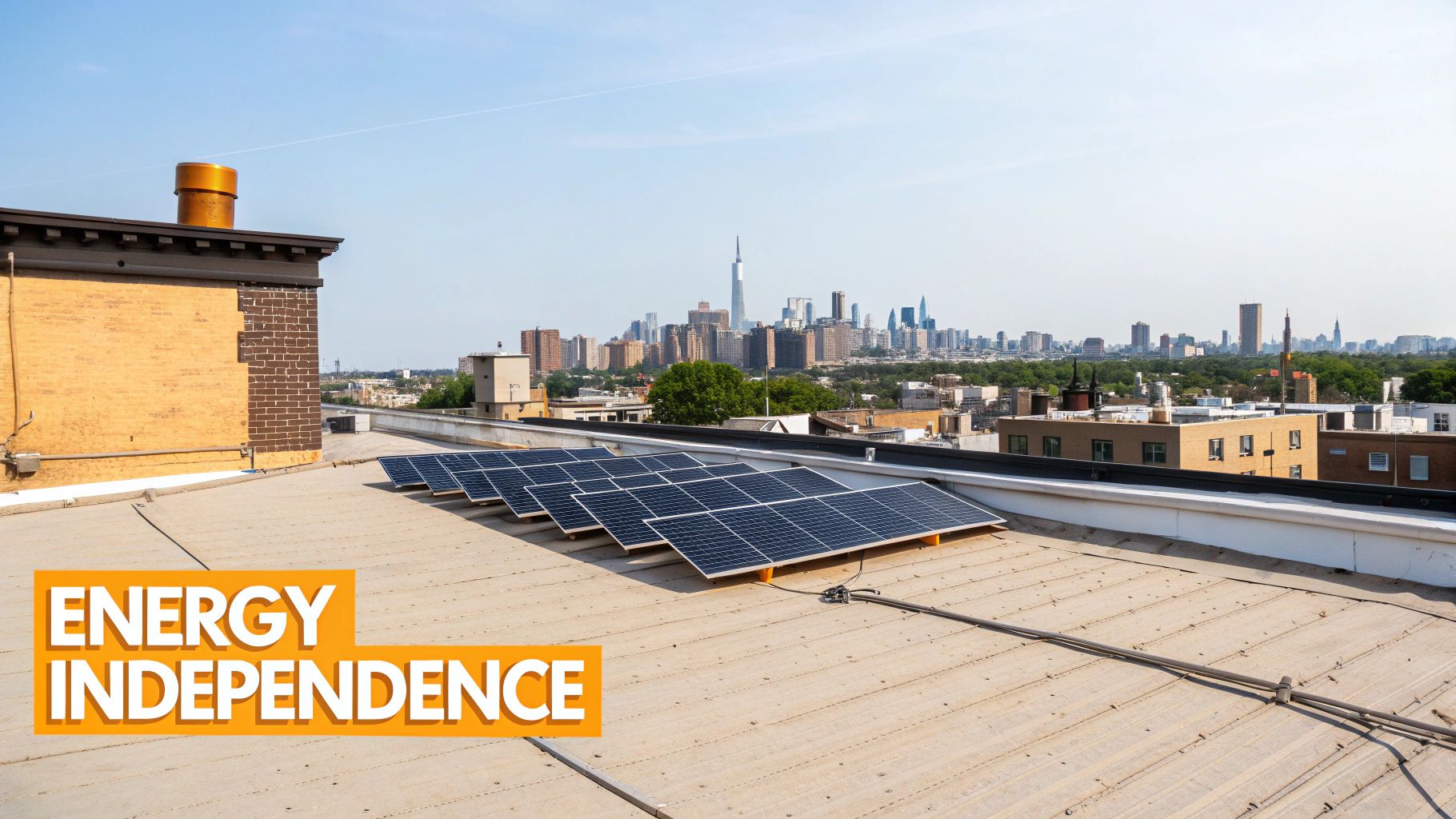
Whether you're a homeowner in Westchester or a commercial decision-maker on Long Island, the journey to lower energy bills and greater sustainability begins with one question: "How big should my solar system be?"
Install a system that's too large, and you're paying for capacity you won't use. Go too small, and you'll remain tethered to high utility bills, wondering why you didn't aim higher.
This guide is your roadmap to finding that "just right" solution. We'll walk you through using a modern sizing calculator to design a system that fits your energy needs perfectly, helps you leverage powerful incentives like the NY-Sun program, and delivers true energy freedom for your property.
Why Precise Sizing Matters for New Yorkers
Getting the size right is everything. A properly sized solar array is the foundation of a smart investment, ensuring you generate enough power to dramatically slash or even eliminate your electricity costs. For businesses, this translates to lower operating expenses and a stronger bottom line. For homeowners, it means predictable energy bills and long-term savings.
Precise sizing also positions you to maximize the benefits of net metering. This system allows you to earn credits from utilities like PSEG Long Island or Con Edison for any surplus energy your panels produce and send back to the grid, further reducing your costs.
This initial calculation is about more than just numbers. It's about building a sustainable, cost-effective energy future for your property, whether it's a family home in Suffolk County or a commercial facility in Brooklyn.
Understanding the Core Calculation
At its heart, sizing a solar system comes down to a formula that balances your property's energy consumption against its solar generation potential. It considers your annual electricity usage, local peak sun hours in your specific New York region, panel wattage, and overall system efficiency. The basic math looks something like this: Number of Panels = (Annual kWh ÷ Peak Sun Hours ÷ 365) ÷ (Panel Wattage × System Efficiency).
The good news? You don’t need to be a mathematician. A quality solar system sizing calculator does all the heavy lifting for you, transforming these complex variables into a clear, actionable recommendation.
We’ve seen firsthand how a precise estimate empowers property owners to make confident decisions when comparing solar panels vs. traditional energy sources on Long Island.
Ready to discover your solar potential? The first step is gathering your information. A clear picture of your current energy usage is the key to unlocking an accurate and beneficial solar estimate.
Gathering Your Data for an Accurate Calculation
Any solar calculator is only as good as the information you provide. Before you begin, taking a few minutes to gather specific details about your New York property is the difference between a vague guess and a genuinely useful estimate. Think of it as the essential prep work that ensures a meaningful result.
The most critical piece of the puzzle is your annual electricity usage, measured in kilowatt-hours (kWh). This isn't a number to estimate; it reflects the true story of your energy consumption over 12 months, accounting for peak air conditioning use on hot Long Island summer days and heating demands during cold upstate winters.
Find your yearly summary statement from your utility provider—whether it's Con Edison, PSEG Long Island, or National Grid. You're looking for a line item that says "Total kWh Used" or similar. Having this exact figure is non-negotiable for an accurate calculation.
Assessing Your Property's Solar Potential
Next, evaluate the physical characteristics of your property that will impact solar production.
In New York, the ideal scenario is a large, south-facing roof, as it receives the most direct sunlight throughout the day. However, don't be discouraged if your property isn't perfect. East- and west-facing roofs are also excellent candidates and can generate substantial power, especially for businesses with high daytime energy needs.
Now, identify any potential obstructions. Is there a large tree that casts a shadow across the roof in the afternoon? Does a neighboring building block the morning sun?
Shading is a significant factor. It can substantially reduce a panel's output, so it's crucial to be realistic about any potential shade issues. Even what appears to be minor shading can have a surprisingly large impact on your system’s performance and financial return over time.
This on-the-ground information helps a calculator—and, ultimately, a professional installer—determine the optimal placement for panels to maximize every ray of sunshine.
Planning for Your Future Energy Needs
Finally, a smart solar plan isn't just about your current needs—it's about anticipating the future. Your electricity usage today might look very different in five years. Are you considering any of these major additions?
- Adding an Electric Vehicle (EV): Charging an EV at home is a significant power draw that will increase your electricity consumption.
- Installing a Heat Pump: Switching from fossil fuels to an efficient electric heat pump is another major factor that will raise your electricity usage.
- Business Expansion or Home Additions: More square footage, new equipment, or more employees almost always means higher energy consumption.
Factoring these potential energy demands into the equation now allows you to design a system with enough capacity to support your goals for the long haul. It’s the kind of forward-thinking that prevents your system from becoming undersized just a few years down the road.
Once you have this data compiled—your kWh usage, roof details, and future plans—you’re ready to get a meaningful result from a solar system sizing calculator. For a deeper dive, our comprehensive solar blog is packed with more pro tips for New York property owners.
How to Use a Modern Solar Calculator
Forget clunky spreadsheets and guesswork. Today's solar system sizing calculators provide a remarkably clear initial assessment of your property's true solar potential. They take complex variables—sunlight hours in your specific town, roof angle, energy use—and distill them into a straightforward, actionable estimate.
Let's walk through how they work.
It all starts with your address. The best calculators use satellite and LiDAR data to map your roof's exact pitch, orientation (south-facing is ideal!), and even potential shading from that large maple tree or a neighboring building in your Queens neighborhood.
This infographic breaks down the key pieces of information you'll need to pull together for the most accurate results.
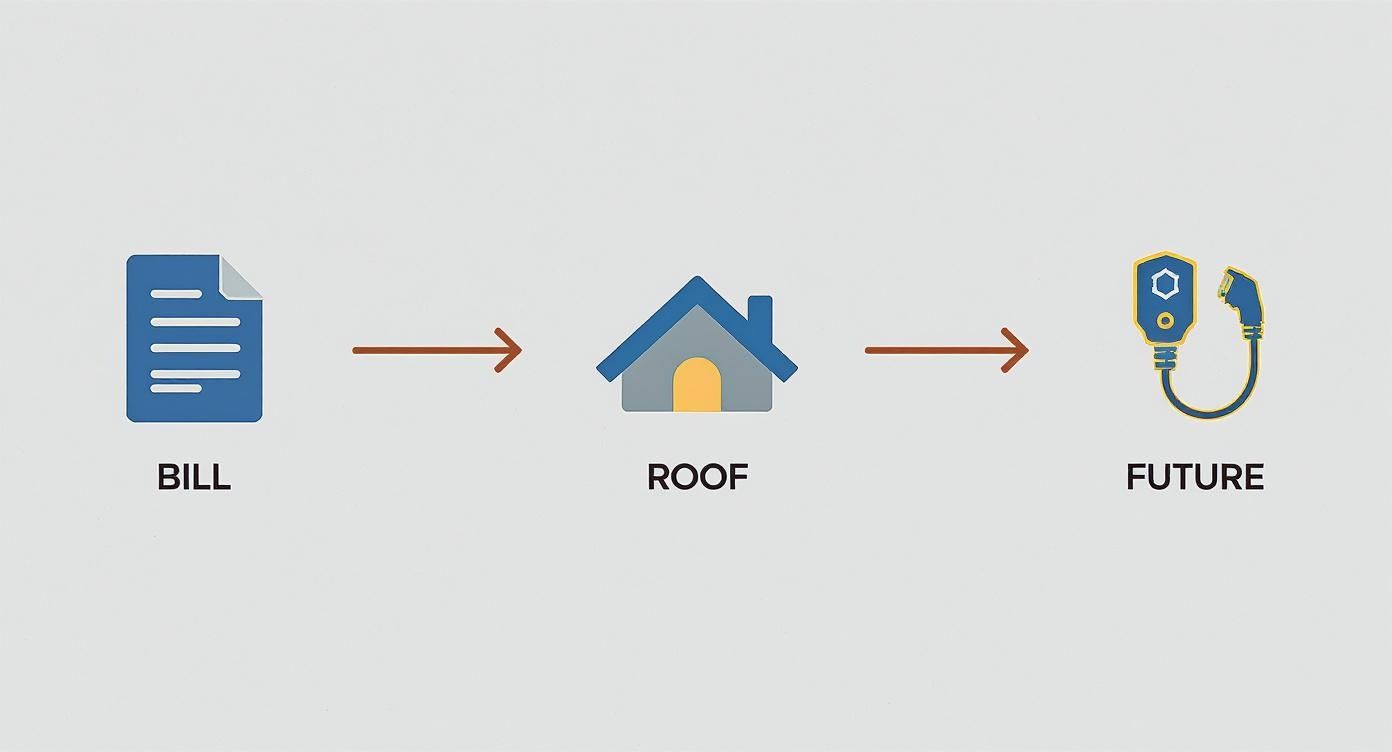
As you can see, a reliable estimate is a blend of your past energy consumption, your current property setup, and your future plans.
Getting Your Key Data Ready
To give the calculator the right information, you’ll need a few key details. Below is a quick breakdown of what to look for and why each piece matters for getting a realistic estimate here in New York.
Solar Calculator Inputs and Their Impact
| Input Data | Why It's Important for NY Properties | Where to Find It |
|---|---|---|
| Average Monthly Electric Bill | This is the simplest way to gauge your energy needs. It helps the calculator quickly estimate your annual kilowatt-hour (kWh) consumption. | Your latest Con Edison or PSEG Long Island utility bill (paper or online portal). |
| Annual kWh Usage | For maximum accuracy, your total annual usage is the gold standard. It accounts for seasonal spikes in AC use or holiday lighting. | Look for the "annual summary" section on your utility bill or log into your online account. |
| Property Address | This allows the tool to use satellite imagery and local weather data to assess your roof's solar potential and average "peak sun hours." | You know this one! |
| Future Energy Needs | Planning to buy an EV, install a heat pump, or add a hot tub? This helps size a system for your future self, not just your past usage. | Your own residential or commercial expansion plans. Estimate the kWh usage of new appliances or an EV charger. |
Having these numbers ready will make the process smoother and the results far more useful.
Understanding the Initial Output
Once you've entered the information, the solar system sizing calculator will generate a recommendation for a system size, typically in kilowatts (kW), along with an estimate of its annual energy production in kWh. This isn't just a random guess; it's advanced modeling that provides a solid, data-backed figure to begin a conversation with a solar professional.
Think of the calculator's result as a well-informed estimate, not a final quote. It’s the perfect launchpad for a detailed, on-site assessment that confirms the real-world conditions of your property.
This first step is incredibly powerful, giving you the clarity needed to move forward with confidence. For more tips and in-depth guides on making the switch to solar, our NY Essential Power blog is a fantastic resource for New York property owners. The numbers from the calculator will help you understand what's possible, paving the way for a more detailed and personalized project plan.
So, What Do All These Numbers Mean?
Once you hit "calculate," the tool will present you with a page of numbers. It can seem a bit technical at first, but each figure tells a crucial part of your solar story. Let's break down what these results mean for your New York property.
The first number to focus on is the recommended system size. Measured in kilowatts (kW), this is the heart of your solar investment. Think of it as the system's "engine"—it tells you how much power your array can generate at any given moment under ideal, sunny conditions.
To put that into perspective, the average residential solar installation in the U.S. is now around 7.13 kilowatts, a figure that continues to rise as our homes and businesses become more electrified. With over 4.7 million properties now running on solar, understanding your recommended kW size is your first step to joining this energy revolution. You can explore more solar industry statistics and trends to see how your project compares.
Decoding the Key Metrics
Your results will likely highlight a few key data points. Here’s what to look for and what it means for your property, whether it's a home in the Hudson Valley or a commercial building in Brooklyn.
-
Estimated Annual Production (kWh): This is the most important metric. It’s the total electricity your system is projected to generate over a full year, measured in kilowatt-hours. If your goal is to completely offset your utility bill, you’ll want this number to closely match the annual usage from your Con Edison or PSEG statements.
-
Estimated Number of Panels: This is where the project becomes tangible. The calculator will provide a ballpark figure for the number of panels required. This is incredibly helpful because it immediately lets you start visualizing whether you have enough usable roof space.
-
Projected Savings and Costs: This is where the value becomes clear. A good calculator will estimate your long-term savings, factoring in major incentives like the 30% Federal Solar Tax Credit and New York's fantastic NY-Sun program, which can significantly reduce your initial investment.
It's vital to remember that these results are not a final, binding quote. Think of them as an incredibly valuable starting point—a data-driven estimate that gives you a solid foundation for a detailed conversation with a solar expert.
With these numbers, you are no longer guessing. You have a real understanding of your property's solar potential and a baseline for discussing specific equipment, installation details, and financing. You're ready to move from a digital estimate to a concrete plan.
Ready to discuss your results? Contact NY Essential Power today for a free, personalized quote, and let's start building your solar future together.
Moving From an Estimate to a Real Project Plan

A calculator provides an excellent starting point, but a truly successful solar installation is built on expert, hands-on planning. With your estimated system size in hand, the next step is to bring in a professional. This is where the numbers on your screen meet the physical reality of your property.
An expert from NY Essential Power will conduct a comprehensive on-site assessment. This isn't just a quick glance—it’s a deep dive into your roof's condition, its underlying structural integrity, and your property's electrical capacity.
This process also uncovers potential infrastructure needs. For instance, the average cost of an electrical panel upgrade is a common consideration, as many older properties require more capacity to handle a modern solar array.
From Digital Guesswork to On-Site Certainty
Even the best solar system sizing calculator makes assumptions. An on-site visit replaces those assumptions with hard data that no online tool can capture.
- Pinpoint Shade Analysis: We use specialized equipment to map the sun's exact path over your property for every season, identifying any potential shading from trees or adjacent structures that could impact performance.
- Structural Verification: We get on the roof to confirm it can safely support the weight of the panels and racking, guaranteeing a secure, long-lasting installation that protects your property.
- Navigating Local Codes: We handle the complex local permitting process, which varies by town and county. Whether you're in Suffolk County or Upstate New York, we ensure every detail complies with local regulations.
This hands-on evaluation eliminates guesswork and allows us to build a plan based on the unique characteristics of your property. This detailed process is a cornerstone of our work, including for clients considering residential solar in Lake Ronkonkoma and surrounding communities.
Customizing Your Solar Solution
The on-site consultation is also our opportunity to align the system design with your personal and financial goals. We'll walk you through equipment options that fit your budget and performance expectations, ensuring complete transparency.
Your calculator estimate is the "what"—it tells you the system size. The professional consultation defines the "how"—detailing the exact equipment, panel placement, and strategy to achieve your energy and savings objectives.
This is where we discuss specifics. Perhaps you need high-efficiency panels to maximize output on a limited roof space, or maybe you're interested in battery storage like a Tesla Powerwall. Energy storage is a growing priority for New Yorkers who want reliable backup power during grid outages and greater control over their energy usage.
This professional guidance is what transforms a number from a calculator into a fully engineered project plan, ensuring your system is built for decades of peak performance and delivers the financial returns you expect.
Common Questions About Sizing a Solar System in New York
Even with a calculator estimate, it’s normal to have more questions. This is a significant investment in your property's future, and getting it right is crucial. Here are some of the most common questions we hear from New Yorkers as they move from an estimate to a real-world project.
Should I Oversize My System?
This is a frequent question. In the past, oversizing a system to bank net metering credits was a common strategy. However, as utility policies evolve, the financial benefits of significant oversizing are diminishing.
Today, the most effective approach is to aim for a system that covers 100-110% of your current and anticipated future energy needs. This ensures you generate enough power for your own use without overinvesting in capacity that provides a lower return.
What if My Roof Isn't Ideal for Solar?
Many property owners, particularly in dense areas like Long Island or Queens, worry that their roof isn't a perfect, south-facing solar canvas. While that orientation is the textbook ideal, it is by no means a dealbreaker.
East- and west-facing roofs are highly viable for solar. An east-facing array excels at generating power in the morning, while a west-facing system peaks in the afternoon, which can be ideal for offsetting peak demand charges. An expert installer can even design a "split array" using multiple roof planes to create a more consistent production curve throughout the day. Modern technologies like microinverters and power optimizers also dramatically reduce the impact of partial shading.
There's only one way to know your roof's true potential: a professional on-site assessment. We often identify effective solutions, like using higher-efficiency panels or even ground-mounted systems, to meet energy goals despite a challenging roof.
These principles of matching generation to your needs apply even on a smaller scale. For instance, selecting the right wattage is just as important when choosing portable solar charging solutions.
How Can I Future-Proof My Solar Investment?
"What happens if I buy an electric car in a few years?" This is a smart question. Long-term planning is key to maximizing the value of your solar investment. A well-designed system should not only meet your needs today but also be ready for tomorrow.
Here are a few ways we help you plan ahead:
- Design for Expansion: If you anticipate adding an EV, a heat pump, or a new addition, let your installer know. We can design the initial system with growth in mind by selecting an inverter with extra capacity or strategically leaving roof space for future panel additions.
- Choose High-Performance Equipment: Selecting high-efficiency panels from the start allows you to generate more power from a smaller footprint, preserving valuable real estate for future expansion.
- Consider Battery Storage: Adding a battery, like a Tesla Powerwall, provides more than just backup power. It gives you control over your energy. As utility rates and policies continue to change, the ability to store your solar power and use it when it's most valuable will become an even greater asset.
Ultimately, using a solar system sizing calculator is the perfect first step. It empowers you with the knowledge to ask informed questions and have a productive conversation with a solar professional who can translate those numbers into a powerful, real-world system.
Ready to turn your calculator estimate into a concrete plan for energy independence and long-term savings? The team at NY Essential Power is here to provide a detailed, on-site assessment and a free, no-obligation quote. Let's design the perfect solar solution for your New York home or business. Contact us today