
Deciding to go solar is a powerful step toward energy independence and lower electricity bills. But how do you determine the right size for your solar system? It all begins with a single, crucial number: your annual electricity usage in kilowatt-hours (kWh). For homeowners and businesses across New York, getting this number right is the bedrock of a successful solar project, ensuring your system generates enough power to deliver real savings and the energy freedom you’re looking for.
Start With Your Electricity Bill to Find Your True Energy Use

Before we talk about panels, inverters, or batteries, we need a clear picture of your property's energy appetite. The most reliable way to do that is to look at your past consumption. Your utility bills are a goldmine of information, telling the complete story of your energy usage month by month.
For anyone in New York, this means gathering the last 12 months of statements from your provider, whether it's PSEG Long Island, Con Edison, National Grid, or NYSEG. A full year is non-negotiable—it's the only way to accurately capture the seasonal swings in energy demand that are so distinct in our state, from sweltering Long Island summers to frigid Buffalo winters.
Uncovering Your Seasonal Energy Patterns
Your energy use is never a flat line. A commercial property in the Hudson Valley might see a huge spike in summer when the air conditioners are running full blast. A family home in Albany, on the other hand, will likely hit its peak in the dead of winter, powering the heating system and extra lights during those short, dark days.
By looking at a year's worth of bills, you'll see these patterns emerge:
- Peak Summer Usage: Driven by air conditioning, pool pumps, and refrigerators working overtime in the heat.
- Peak Winter Usage: Reflects energy for heating, more indoor lighting, and holiday power consumption.
- Shoulder Months: Spring and fall usually show more moderate, lower energy use.
The goal is simple: find your total annual consumption in kilowatt-hours (kWh). Just add up the kWh usage from each of the last 12 monthly bills. This final number is the target your new solar system needs to hit to maximize your savings.
How to Find Your kWh Usage on Your Bill
Finding your kWh usage on the bill is usually straightforward. Look for a section labeled "Usage Details," "Meter Reading," or something similar. It will show your consumption for that billing period in kWh. Be careful not to mix this up with the total dollar amount you owe—we're looking for the energy figure itself.
For instance, a homeowner on Long Island might use 1,200 kWh in a hot August but only 600 kWh in a mild May. Adding all 12 of those monthly numbers together gives you the complete picture of your annual energy needs.
Understanding your household or facility's average energy consumption is the first step in calculating your solar energy needs. While global averages can range from 3,000 to 12,000 kWh annually, your specific number is what matters. Once you have your yearly total, we can start breaking it down into daily or monthly needs. If you're curious, you can explore more global solar installation trends and data to see how your usage compares.
Here’s a quick look at what a typical annual usage profile might look like for different property types in New York.
Sample Annual Electricity Usage Profile for a New York Property
This table provides a sample breakdown of monthly kWh usage to illustrate seasonal energy consumption patterns typical in New York State.
| Month | Average kWh Usage (Homeowner) | Average kWh Usage (Small Business) |
|---|---|---|
| January | 950 | 3,500 |
| February | 900 | 3,300 |
| March | 750 | 3,100 |
| April | 650 | 3,000 |
| May | 600 | 3,200 |
| June | 800 | 3,800 |
| July | 1,100 | 4,500 |
| August | 1,200 | 4,800 |
| September | 900 | 4,000 |
| October | 700 | 3,400 |
| November | 850 | 3,500 |
| December | 1,000 | 3,700 |
| Total | 10,400 kWh | 43,800 kWh |
As you can see, simply taking one month's usage and multiplying it by 12 would give you a wildly inaccurate result. That's why a full year of data is essential for proper system sizing and achieving your financial goals.
Planning for the Future Is Just as Important
Your past usage is an excellent starting point, but what about the future? A well-designed solar system should last you 25 years or more, so we must account for any changes that might increase your electricity demand down the road.
Think about any big plans you have for the next few years:
- Electric Vehicle (EV) Charging: This is one of the biggest factors that can increase a home's energy use. A typical EV driver will add another 2,000 to 4,000 kWh to their annual consumption.
- Switching to Electric Heat Pumps: If you're planning to move away from oil or gas, that heating and cooling load will shift directly to your electric bill, a popular move for New Yorkers seeking to reduce their carbon footprint.
- Business Expansion: For our commercial clients, things like new machinery, longer operating hours, or an expanding team will all raise your energy baseline and impact your bottom line.
- Home Additions or Appliances: Planning a major renovation, adding a pool or hot tub, or finishing the basement? These will all increase your electricity use.
By estimating this future usage and adding it to your historical average, we can make sure your solar investment is future-proof. This forward-thinking approach helps build a system that won’t just meet your needs today but will keep delivering savings and energy independence for decades.
Figure Out Your Property's Peak Sun Hours
You’ve got your annual energy usage nailed down. The next piece of the puzzle is to figure out how much of your most important resource—sunlight—you can actually capture.
However, not all daylight is created equal. To size a solar system correctly, we must zero in on a specific metric called peak sun hours.
This isn’t just about how long the sun is up. Peak sun hours measure the intensity of the sunlight hitting your property. It's a measurement of the time when the sun is at its most powerful, delivering the potent energy your panels need to generate electricity.
Why We Talk About "Peak" Hours Instead of "Daylight"
One peak sun hour is equal to 1,000 watts of solar energy striking a square meter of your roof for one hour. The sun's rays are strongest around midday and much weaker in the early morning and late afternoon.
So, while a long summer day in New York might give you 15 hours of daylight, you might only get 5 or 6 peak sun hours. That’s the number we actually use for accurate calculations.
This figure is the key that unlocks the whole calculation—it bridges the gap between your energy consumption (kWh) and the system size you’ll need (kW). Getting this right is absolutely critical for designing a system that meets your production goals without overpaying for equipment you don't need.
A common myth is that more daylight automatically equals more solar power. The truth is, the intensity of that light is what really drives production. A crisp, sunny winter day can often generate more power than a hazy, hot summer afternoon.
New York’s Solar Landscape: A Look Around the State
Sunlight isn't uniform across New York State. While we might not have the year-round sunshine of Arizona, our solar potential is excellent and more than enough to produce serious savings on your electric bill.
As a general rule, locations like Long Island and the Hudson Valley tend to get more annual peak sun hours than Western New York or the Adirondacks.
This regional difference is a major reason why how to calculate solar energy needs isn't a one-size-fits-all formula. A house in Southampton might need a slightly smaller system to generate the same amount of power as an identical house in Rochester, simply because of the difference in available sunlight.
To give you a better idea, let's look at how the average daily peak sun hours can vary across the state.
Average Daily Peak Sun Hours by New York Region
This table gives a snapshot of the average daily peak sun hours in different New York regions, helping you get a ballpark idea of your local solar potential.
| Region | Winter Average (Dec-Feb) | Summer Average (Jun-Aug) | Annual Average |
|---|---|---|---|
| Long Island & NYC | 2.5 – 3.5 hours | 5.5 – 6.5 hours | 4.5 – 5.0 hours |
| Hudson Valley | 2.0 – 3.0 hours | 5.0 – 6.0 hours | 4.2 – 4.7 hours |
| Capital Region | 2.0 – 2.8 hours | 4.8 – 5.8 hours | 4.0 – 4.5 hours |
| Western New York | 1.5 – 2.5 hours | 4.5 – 5.5 hours | 3.8 – 4.3 hours |
As you can see, your location matters. An experienced installer will use precise, local data—not just these averages—to ensure your system is sized perfectly.
Getting a Pinpoint-Accurate Reading for Your Property
While regional averages are a great starting point, a professional solar assessment gets far more granular. We use specialized software to analyze your exact address, creating a "solar map" of your unique property.
This detailed analysis looks past general weather patterns to focus on the factors that truly impact your production:
- Roof Orientation: In New York, a south-facing roof is the gold standard because it gets the most direct sun all day. However, east- and west-facing roofs are also great candidates for solar.
- Roof Pitch (Angle): The specific tilt of your roof changes how directly sunlight hits your panels. We calculate the optimal setup to maximize your energy harvest throughout the year.
- Shading Analysis: This is a critical step. A tall tree, a neighbor's house, or even a chimney can cast shadows that move across your roof during the day. Our tools model this shading down to the hour to calculate its precise effect on your system's output.
For properties where shading or limited roof space is an issue, we can explore other solutions. Ground-mounted systems or even solar canopies on Long Island are excellent alternatives for capturing more sunlight and maximizing your return on investment.
By combining this hyper-local peak sun hour data with your energy usage, we can accurately determine the system size needed to hit your goals, whether that's eliminating 100% of your bill or just taking a big bite out of it.
Picking Your Panels and Facing Real-World Conditions
You’ve done the homework: you know your power usage and your property's sun exposure. Now for the exciting part: moving from spreadsheets to actual hardware. This is where we choose the right solar panels and, just as importantly, understand how they really perform on your roof.
When you start looking at panels, you'll see two numbers pop up again and again: wattage and efficiency. Higher-wattage panels are the workhorses; they generate more power, meaning you need fewer panels to get the job done. This is a game-changer for smaller roofs, common in places like Brooklyn or Queens, where every square foot counts.
Efficiency is all about how well a panel converts sunlight into electricity. A more efficient panel can squeeze more power out of the same physical space. For any New York property, maximizing production from your available roof area is the name of the game.
What to Expect: The Derate Factor
Now for a dose of reality that every trustworthy solar installer will discuss: the derate factor. It’s a simple concept. A 400-watt panel won't produce exactly 400 watts all the time, even in good sun. Small, unavoidable energy losses occur along the way, and that's perfectly normal.
The derate factor is a number—usually around 80-90%—that we use to adjust for these real-world losses. It isn’t a flaw; it's the signature of a professional, realistic design that ensures you get the power and savings you were promised.
So, where does this energy go? A few things are at play:
- Inverter Efficiency: The inverter converts the DC power from your panels into the AC power your home or business uses. It does a great job, but a tiny bit of energy is lost as heat during the conversion.
- A Little Grime: Life happens. Dust, pollen, bird droppings, and snow can build up on your panels, blocking a small amount of sunlight. This is why routine solar PV panel cleaning for peak performance is so valuable for keeping your system at its best.
- Summer Heat: It might seem counterintuitive, but solar panels work best when they're cool. On a blazing hot Long Island summer day, the high temperature can slightly reduce the panel's output.
How This Affects Your Final System Size
Using a realistic derate factor, typically 85% (or a multiplier of 0.85), is what turns a back-of-the-napkin guess into a professional-grade calculation. It’s our way of ensuring we don’t undersize your system. We want it to hit your energy goals even when conditions aren't absolutely perfect.
Think of it this way: If your math says you need a 10 kW system under lab conditions, applying an 85% derate factor tells us we really need to build a system closer to 11.8 kW. That extra capacity is the buffer that guarantees you’ll hit your 10 kW production target in the real world.
This is how you build a system that truly pays off. It’s not just about getting panels on the roof; it’s about designing a reliable power plant that covers your bills and gives you the financial freedom you’re looking for. The long-term cost savings are precisely what makes this switch so attractive, a point we detail in our guide on solar panels vs. traditional energy on Long Island.
By planning for these real-world factors from the start, we design a solar array that doesn't just work on paper—it excels on your roof, delivering environmental benefits and financial returns year after year.
Calculate Your Final Solar System Size
You’ve done the homework. You’ve dug into your energy bills, determined your property's peak sun hours, and you understand that real-world conditions aren't the same as a lab. Now it's time to put all those pieces together and nail down the exact size of the solar panel system you need.
This final calculation gives you a target system size in kilowatts (kW). It’s the key number that empowers you to have a confident, informed conversation with any solar installer.
The Go-To Formula for Sizing Your System
At its heart, the calculation is straightforward. It’s all about connecting your energy needs with the amount of usable sunlight your property gets.
The Calculation: (Annual kWh Usage ÷ 365 Days) ÷ Average Peak Sun Hours ÷ Derate Factor = Required System Size in kW
Think of it this way: first, we find your average daily energy appetite. Then, we see how much power you need to generate each hour during those prime sun hours. Finally, we adjust for real-world inefficiencies to land on a system size that will actually deliver the energy you need.
A Real-World Example: A Westchester Home
Let's make this tangible. Imagine a family in Westchester County. They’ve reviewed a year's worth of Con Edison bills and know they’re adding an EV charger soon, bringing their total annual electricity need to 12,000 kWh.
Their home has a great, south-facing roof that gets an average of 4.5 peak sun hours per day.
Here’s how we break it down:
- Daily Energy Need: First, we find their daily average. 12,000 kWh / 365 days = 32.88 kWh per day.
- Ideal System Size: Next, we see what they'd need in a perfect world. 32.88 kWh / 4.5 hours = 7.31 kW.
- Real-World System Size: Now, we apply that 0.85 derate factor to account for efficiency losses. 7.31 kW / 0.85 = 8.6 kW.
To cover 100% of their energy needs, this Westchester family needs an 8.6 kW solar panel system. This size is specifically calculated to give them the power they need and break free from rising utility rates.
This infographic breaks down how we get from a panel's rated power to the actual energy you can use at home.
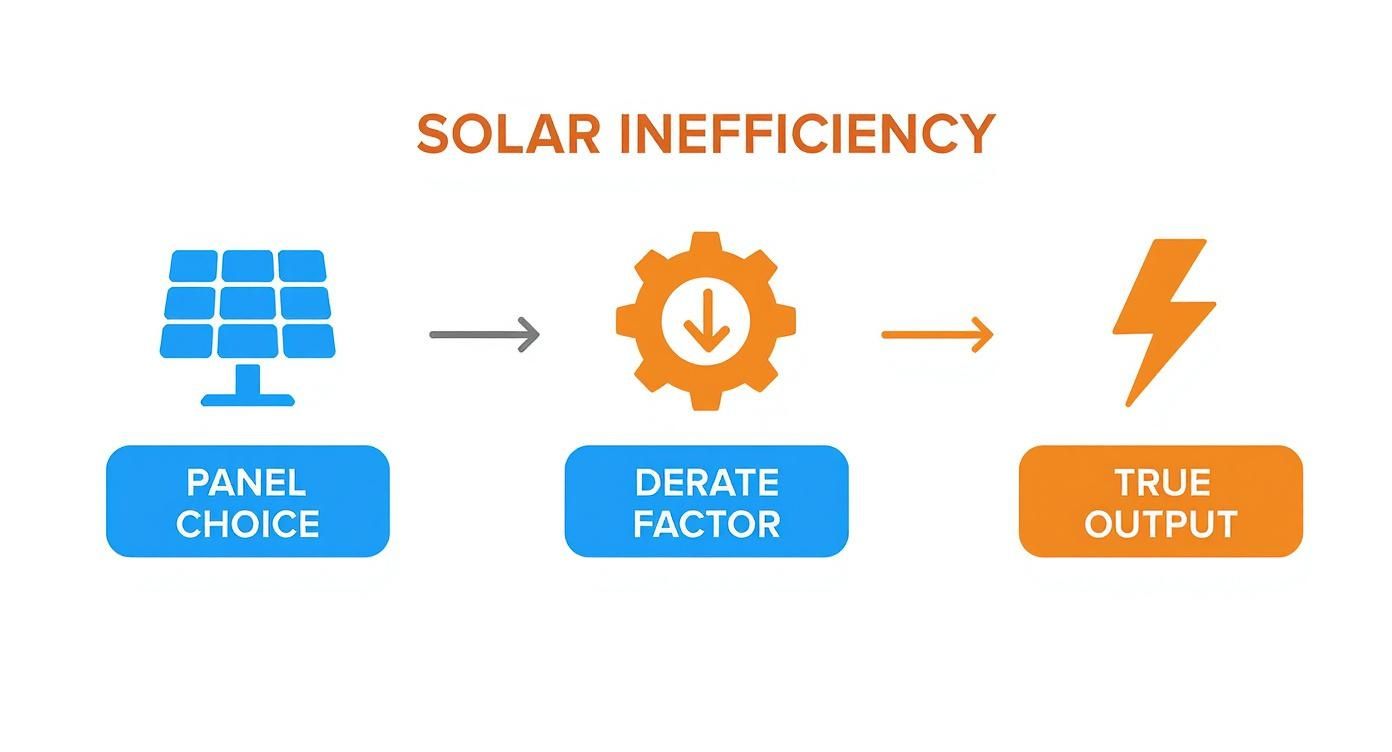
As you can see, the final, usable energy is always less than the sticker rating on the panel—and that's exactly what our derate factor accounts for. This method of dividing daily energy need by solar irradiance and then adjusting for system losses is the industry standard for accurate sizing. You can learn more about global solar calculation methods to see how this approach is applied worldwide.
Sizing for a Syracuse Small Business
Now, let's shift gears to a commercial project. A small manufacturing business in Syracuse is getting hammered by high operating costs from their National Grid bills. They use a whopping 60,000 kWh per year to run machinery and keep the lights on.
Syracuse sees a little less sun than downstate, averaging about 4.0 peak sun hours daily.
Let's run the numbers for the business:
- Daily Energy Need: 60,000 kWh / 365 days = 164.38 kWh per day.
- Ideal System Size: 164.38 kWh / 4.0 hours = 41.1 kW.
- Real-World System Size: 41.1 kW / 0.85 = 48.35 kW.
To effectively eliminate its electric bill and gain a competitive edge, this business needs a 48.35 kW commercial solar array. An investment like this doesn't just cut costs—it provides predictable energy expenses for decades, shielding the company from volatile energy markets. For a closer look at these kinds of projects, you can explore our detailed commercial solar solutions.
By following this process, you can get a solid, reliable estimate of the system your property truly requires. This number is your starting point for achieving energy independence, saving money, and making a positive environmental impact.
Ready to get a precise calculation for your New York property? Contact the experts at NY Essential Power for a free, no-obligation quote today.
Factor in New York Incentives to Maximize Your Investment
Getting the technical side of your solar system sized correctly is a huge step, but it’s only half the story. To truly understand what a solar setup looks like for your New York property, you have to connect the kilowatts to the dollars and cents. The financial incentives available are just as crucial as how much sun your roof gets.
This is where a smart energy decision becomes a fantastic long-term investment. By weaving these financial perks into your plan from the start, you can dramatically cut your upfront cost, boost your return, and potentially afford a larger system that wipes out your utility bill for good.
Unlocking Value with the NY-Sun Program
The heart of New York's solar incentives is the NY-Sun Megawatt (MW) Block program. This isn't a tax credit you wait for—it's an upfront rebate that immediately lowers the price tag of your installation. The state is divided into different regions or "blocks," and the incentive amount steps down as more people in that area go solar.
What does that mean for you? It means timing matters. The sooner you act, the larger your rebate could be. The incentive is paid directly to your installer (like us here at NY Essential Power), and we pass that savings directly to you, slashing your total project cost from day one.
For instance, a homeowner in a Con Edison service area could see a rebate that knocks thousands of dollars off their installation. That kind of savings can completely change the financial picture of your project, making solar an accessible and highly profitable investment.
Considering these incentives might even change how you size your system. You could find that you can easily afford a slightly larger array to cover 100% of your power needs or plan for that future electric vehicle, all without increasing your net cost.
Stacking Federal and State Tax Credits
On top of the NY-Sun rebate, you can stack two powerful tax credits that make going solar in New York even more affordable.
- Federal Solar Investment Tax Credit (ITC): This is the most significant federal incentive. It allows you to claim a credit for 30% of your system's total cost on your federal taxes. There’s no cap, which makes it a game-changer for everyone, from small residential installs to massive commercial projects.
- New York State Solar Energy System Equipment Credit: New York adds its own powerful incentive—a state tax credit for 25% of your system's cost, up to a maximum of $5,000. This puts another major chunk of savings right back in your pocket at tax time.
When you add it all up—the NY-Sun rebate plus both tax credits—the net cost of going solar in New York can be cut by more than half. This significantly shortens your payback period and sends your return on investment soaring. We dive into more strategies for making the most of your solar investment over on our blog.
The Big Picture and Future Growth
These local incentives are part of a massive global shift toward cleaner, more sustainable energy. As the world transitions, the support and infrastructure for solar are expanding rapidly. By the end of 2025, global solar photovoltaic (PV) capacity is expected to blow past 3,000 gigawatts (GW). This isn't just a trend; it's a fundamental change in how we power our world. Projections show that electricity demand will grow by about 120% by 2060, with renewables like solar set to power most of that growth. You can read more about the global energy transition outlook to see just how big this movement is.
For property owners in New York, this global momentum creates incredible local opportunities. By taking advantage of our state's fantastic incentive programs, you're not just making a wise financial move for yourself—you're getting in on the ground floor of a powerful energy revolution that promises a future of independence, savings, and sustainability.
Have More Questions About Sizing Your Solar System?
Even after running through the numbers, it's normal to have more questions. Getting a handle on these finer points is what will make you feel confident that you're making the right call for your home or business.
We hear many of the same questions from homeowners and commercial decision-makers across New York, so let's tackle the big ones head-on.
What Happens If My System Is Too Small?
This is a common worry, but the reality isn't as scary as it sounds. If your system is a little undersized, you won’t be sitting in the dark. You'll simply pull whatever extra power you need from the utility grid, just like you do now.
Here in New York, our net metering program ensures you still bank major savings from every bit of energy your system produces. That said, the goal is always to get it right the first time to maximize your savings and achieve energy independence. It's almost always more cost-effective to install the right-sized system from day one than to add more panels later.
A professional solar consultation is the best way to dial in the numbers. We can run a few different scenarios to find that perfect balance and make sure you're not leaving savings on the table.
Should I Really Size My System for 100% of My Needs?
Aiming for a 100% energy offset sounds great, but it’s not always the smartest financial move. For one, New York utility companies often have rules that cap system size based on your historical electricity use.
In our experience, designing a system to cover 80-90% of your usage often hits the sweet spot for the best return on investment. This strategy dramatically reduces your upfront cost while still eliminating the vast majority of your electric bill. We can easily show you a financial breakdown comparing different system sizes, helping you see where that ideal balance between cost and savings lies for your specific situation.
How Does Adding a Battery Change the Sizing Calculation?
This is a great question, especially with growing interest in energy storage. Adding a battery doesn't actually change the math for how many solar panels you need. Your solar array is still sized based on your annual kWh consumption and your property's peak sun hours.
What a battery does change is your overall energy strategy, giving you a new level of resilience and control.
Figuring out the right battery size (measured in kWh) comes down to a different set of priorities:
- Backup Power: What absolutely has to stay on during a blackout? Think refrigerators, essential lights, medical devices, or key business equipment. And for how many hours or days do you need them to run?
- Maximizing Savings: If your utility has Time-of-Use rates, a battery can be a game-changer. It stores free solar power generated during the day and lets you use it during the expensive peak evening hours, further reducing your reliance on the grid.
Think of it this way: the solar panels are your power plant, and the battery is your personal energy vault, ready to provide power, savings, and peace of mind whenever you need it.
Ready to get a precise, no-obligation solar calculation for your New York property? The team at NY Essential Power is here to design a system that meets your financial goals and energy needs, helping you achieve cost savings, energy independence, and a smaller environmental footprint. Contact us today to request your free quote!