When New Yorkers ask, "how much does solar energy really cost per kWh?" the answer is more encouraging than you might think. While utility rates keep climbing, the true, long-term cost of solar power in New York—what we in the industry call the Levelized Cost of Energy (LCOE)—typically lands somewhere between $0.06 and $0.12 per kWh after factoring in all available incentives.
Think of it this way: the LCOE is the total cost of your solar system divided by all the electricity it will produce over its 25+ year lifespan. For a homeowner in Suffolk County or a business owner in Albany, this single number provides a powerful, apples-to-apples comparison against the unpredictable rates from PSEG Long Island or Con Edison. It's the key to understanding the profound cost savings, energy independence, and environmental benefits of generating your own power.
Unlocking Your True Solar Cost Per kWh
For homeowners and business decision-makers across New York, from Long Island to Buffalo, understanding the LCOE is the first step toward achieving energy independence. It’s like calculating the true cost per mile of owning a car—you wouldn't just look at the sticker price. You'd include fuel, insurance, and maintenance. Solar is the same. The LCOE captures the full investment, revealing the genuine long-term value and shielding your budget from volatile utility hikes.
This guide will walk you through exactly how that cost is calculated. We'll break down the key factors that shape your final price, helping you see past the initial investment to focus on the decades of savings and stability ahead.
Why Solar Is More Affordable Than Ever
The dramatic drop in solar pricing isn't just a local trend; it's a massive global shift. Thanks to incredible leaps in technology and manufacturing efficiency, the cost of generating power from the sun has plummeted.
It’s truly remarkable. A recent report showed that the average cost of utility-scale solar PV electricity fell to just $0.043 per kWh globally by 2024, making it significantly cheaper than even the lowest-cost fossil fuel options. The same report found that an astonishing 91% of new renewable power projects brought online in 2024 were less expensive than any new fossil fuel alternatives. The economic argument for solar has never been stronger. Learn more about these global solar cost reductions.
This worldwide trend directly benefits New Yorkers. When you move forward with a professional solar panel installation, you're investing in a mature, highly cost-effective technology. Combine that financial reality with New York's fantastic local incentives, and the path to energy savings and independence becomes crystal clear.
By locking in a low, fixed energy cost with solar, you shield your home or business from the unpredictable rate hikes common with utility providers like PSEG Long Island and Con Edison.
Your final cost per kWh is ultimately a mix of several key variables. Each one plays a role in your system's performance and, more importantly, its financial return. We've summarized the main drivers in the table below to give you a quick overview.
Key Factors Influencing Your Solar Cost Per kWh
| Factor | Impact on Cost Per kWh | Brief Explanation for NY Property Owners |
|---|---|---|
| Total System Cost | High | This is the upfront price for panels, inverters, and labor. A lower initial cost directly reduces your LCOE. |
| Available Incentives | High | Federal tax credits and powerful New York solar incentives dramatically cut your net investment, significantly lowering your cost per kWh. |
| System Production | High | The more electricity your system generates, the lower your LCOE. This is affected by equipment quality, local weather, and roof orientation. |
By understanding these components, you can confidently calculate your own solar LCOE and see just how much you stand to save. The best way to get a precise number is to contact us at NY Essential Power. We can provide a personalized quote and show you your exact cost per kWh.
Breaking Down the Total Cost of a Solar System
To truly understand how much solar energy costs per kWh, you have to start with the total upfront price tag. A complete solar quote is made up of two main categories: the physical equipment, known as hard costs, and all the essential services that bring the project to life, known as soft costs.
Splitting the cost this way removes the mystery from the process. It allows a homeowner in Westchester or a commercial property manager in Albany to see exactly where their investment is going, providing the confidence to compare proposals and recognize the value of a high-quality installation from NY Essential Power.
The Tangible Equipment: Hard Costs
Hard costs are the components you can physically see and touch—they’re the backbone of your energy generation system and typically make up a significant portion of the total price.
- High-Efficiency Solar Panels: These are the engines of your system. The specific brand, technology, and efficiency level you choose directly impacts your long-term energy production and, consequently, your final cost per kWh.
- Inverters: This critical hardware converts the direct current (DC) electricity your panels generate into the alternating current (AC) your home or business uses. Your choice between central inverters, string inverters, or microinverters influences system performance, monitoring capabilities, and overall cost.
- Racking and Mounting Hardware: This is the robust framework that secures the panels to your roof or property. A professionally engineered racking system is non-negotiable for safety and durability, especially when facing New York's diverse weather conditions.
For commercial properties, hard costs can also include specialized structures. For example, many businesses on Long Island are leveraging their parking areas by installing solar carports. Our guide to solar canopies for Long Island businesses shows how these innovative solutions work.
The Essential Services: Soft Costs
Soft costs are the less visible but equally vital expenses required to ensure your project is properly designed, approved, and installed. These costs are essential for a successful, safe, and compliant solar energy system.
Soft costs, which cover everything from permits to skilled labor, can account for a significant portion of a solar project's total price. Understanding them is key to seeing the complete investment picture.
These crucial behind-the-scenes expenses include:
- System Design and Engineering: Every property is unique. Our experts draft a custom blueprint for your system to maximize energy production based on your roof’s orientation, available space, and sun exposure.
- Permitting and Inspection Fees: Navigating local regulations can be complex. Permitting fees vary widely across New York—from New York City to smaller towns upstate—and involve significant paperwork and coordination with municipal authorities.
- Skilled Labor and Installation: The expertise of the installation team is paramount. This cost covers the trained, certified professionals who handle everything from electrical wiring to panel mounting, ensuring your system operates safely and efficiently for decades.
This is where the broader economic picture for solar gets exciting. Over the last 15 years, the cost of solar electricity has plummeted. Large-scale utility projects now achieve a Levelized Cost of Electricity (LCOE) as low as $0.038 per kWh before subsidies, a direct result of falling hardware prices. You can explore the plummeting cost of renewable energy to see how these trends make solar an even smarter investment today.
Calculating Your True Solar Cost Per kWh
Figuring out how much solar energy costs per kWh is simpler than it sounds. It’s about looking at the big picture, not just the upfront price. The key is to calculate your Levelized Cost of Energy (LCOE)—a single number that reveals your true, long-term electricity price and allows you to compare your solar investment directly against the ever-rising rates from your utility.
The formula is straightforward but incredibly powerful for demonstrating long-term value.
(Total System Cost – All Incentives) / Total Lifetime Energy Production (kWh) = Your Solar Cost Per kWh
This simple equation unlocks the remarkable value of going solar. Let's walk through it with real-world New York examples—one for a typical home and another for a commercial property.
This chart breaks down the two main components of your total system cost before you factor in any incentives.
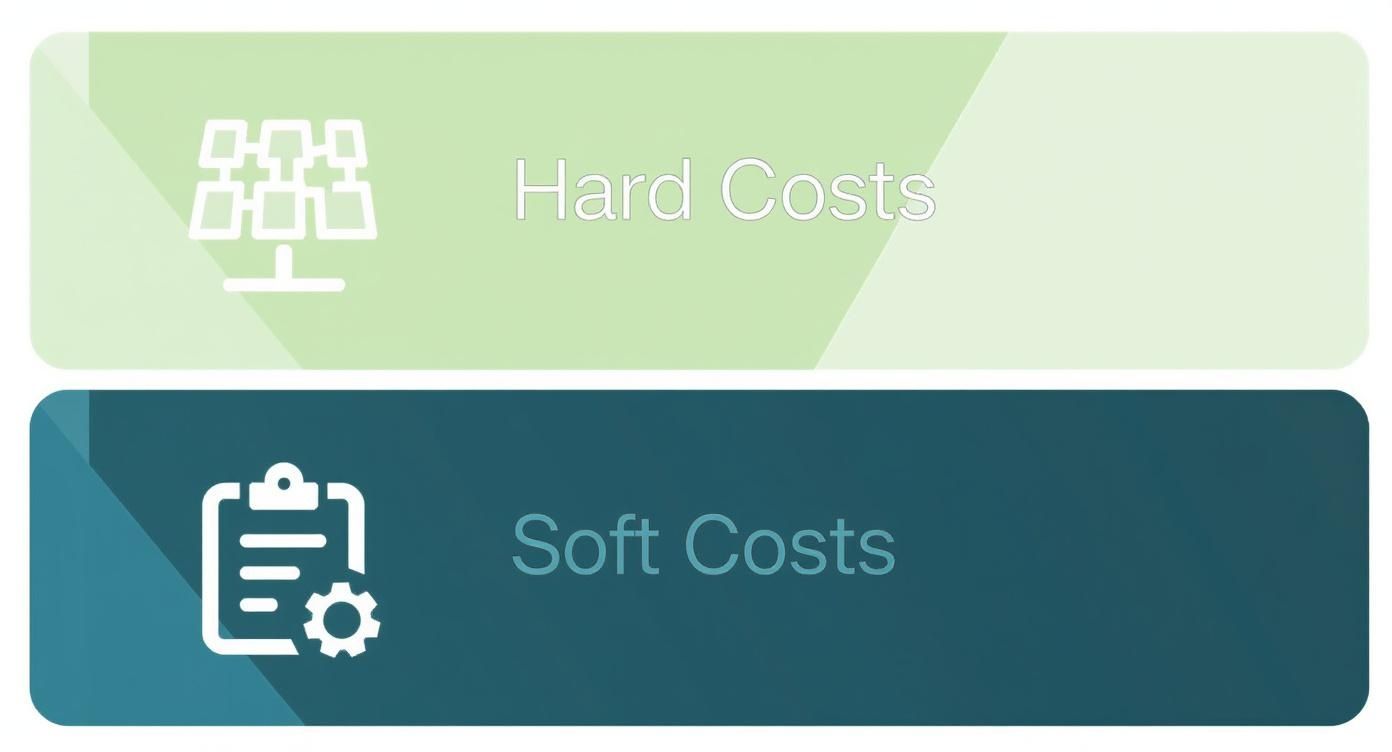
As you can see, the "soft costs"—like system design, local permitting, and labor—often make up a large portion of the total. This highlights the importance of working with an experienced and efficient installer to maximize value.
Putting the Numbers to Work: Home vs. Business
To see how this works in practice, let's compare two scenarios: a family home on Long Island and a commercial warehouse in Syracuse. This side-by-side look shows just how effective solar can be for different types of properties.
Sample LCOE Calculation Homeowner vs. Business
| Calculation Step | Residential Example (Long Island Home) | Commercial Example (Syracuse Warehouse) |
|---|---|---|
| System Size | 8 kW (to offset typical family usage) | 50 kW (for higher commercial demand) |
| Gross System Cost | $28,000 | $125,000 |
| Federal Tax Credit (30%) | -$8,400 | -$37,500 |
| NY State Incentives | -$5,000 (NY State Tax Credit) | -$25,000 (NY-Sun Grant + MACRS Depreciation) |
| Net System Cost | $14,600 | $62,500 |
| Lifetime Production (25 Yrs) | 220,000 kWh | 1,375,000 kWh |
| Final Solar Cost Per kWh | $0.066 (6.6 cents) | $0.045 (4.5 cents) |
Whether for a home or a business, the financial logic is clear. After accounting for all available incentives, the long-term cost of generating your own power is a fraction of what the utility charges. Now, let's dig into the details.
A Residential Example in Suffolk County
Let's start with that family home in Suffolk County. After a professional assessment, they determine an 8-kilowatt (kW) system is the perfect size to eliminate their electric bill.
- Total System Cost: The all-in price for a quality installation is $28,000.
- Subtract Incentives: Now the savings begin. The family qualifies for the 30% Federal Tax Credit ($8,400) and the New York State Tax Credit ($5,000). Their net cost plummets to just $14,600.
- Estimate Lifetime Production: In a sunny location like Long Island, an 8 kW system will generate approximately 220,000 kWh of clean energy over its 25-year warrantied life, accounting for slight panel degradation over time.
- Calculate the LCOE: ($14,600) / (220,000 kWh) = $0.066 per kWh.
This family has now locked in their electricity cost at a predictable 6.6 cents per kWh for the next quarter-century—a massive saving compared to the ever-climbing rates from PSEG Long Island. For anyone in the area, exploring options for residential solar in Lake Ronkonkoma is the first step toward achieving similar results.
A Commercial Example in the Capital Region
Now let's head upstate to a warehouse near Albany installing a 50 kW system to control its significant operating expenses.
- Total System Cost: The initial investment for a commercial system of this size is $125,000.
- Subtract Incentives: The business also claims the 30% Federal Tax Credit ($37,500) and can leverage accelerated depreciation (MACRS) for another significant tax benefit, dramatically reducing its effective net cost.
- Estimate Lifetime Production: Over 25 years, this larger system is projected to produce around 1,375,000 kWh.
- Calculate the LCOE: Once all financial incentives are applied, their final cost per kWh can easily drop below $0.05 per kWh.
For a business, locking in an energy cost of five cents per kWh is not just a saving—it's a powerful competitive advantage. It provides insulation from volatile utility demand charges and builds financial stability for decades. These examples make one thing clear: whether you're a homeowner on the coast or a business owner upstate, the math works.
How New York Incentives Slash Your Energy Costs
So, what’s the secret to achieving such a low cost per kWh for solar in New York? It’s not just that panels are more affordable. The real game-changer is the state’s impressive stack of financial incentives. These programs are specifically designed to reduce your upfront cost, completely rewriting the financial equation of going solar and transforming it into a state-backed investment in your energy future.
When you leverage these incentives, you’re not just saving a few dollars—you’re directly shrinking the total cost that goes into your Levelized Cost of Energy (LCOE) calculation. A smaller initial investment means a lower cost for every single kilowatt-hour your system produces for the next 25+ years.
The Federal Solar Tax Credit
The cornerstone of solar savings nationwide is the Residential Clean Energy Credit, commonly known as the federal solar tax credit. This is a powerful, dollar-for-dollar credit against the federal taxes you owe, allowing you to claim 30% of your total system cost back.
For a typical home solar installation in New York, this 30% credit often translates into thousands of dollars in savings. With no cap, it applies to projects of all sizes, making it the first and most impactful tool for cutting your net cost.
New York State's Powerful Solar Programs
On top of the federal credit, New York offers its own best-in-class incentives that solidify its status as a national leader in solar energy.
- NYS Solar Energy System Equipment Credit: This is another direct tax benefit exclusive to homeowners. You can claim a credit for 25% of your system's cost, up to a generous $5,000, and stack it directly on top of the 30% federal credit.
- The NY-Sun Megawatt (MW) Block Incentive: This is a straightforward, state-run rebate paid based on your system’s size. The amount varies depending on your region—Long Island, Con Ed territory, or Upstate—and is designed to step down as solar adoption grows. It provides an upfront rebate that immediately makes your initial investment smaller and more manageable.
When you combine the federal and state tax credits, a New York homeowner can potentially slash their initial solar investment by more than half. This is how you unlock a cost per kWh that beats the utility company, hands down.
This strong policy support is critical. Globally, solar costs are trending down, but regional policies can make or break the deal. For instance, research shows that in the United Kingdom, solar panel prices in 2024 were actually higher on average than in 2013. You can read more about how solar costs can vary by region to see just how important New York's consistent incentives are.
Special Incentives for New York Businesses
For commercial properties, the financial case is even more compelling. In addition to the federal tax credit and NY-Sun rebates, businesses can utilize a powerful financial tool.
The Modified Accelerated Cost Recovery System (MACRS) allows a business to depreciate the value of its solar panels on an accelerated schedule. This creates a significant tax deduction in the early years, improving cash flow and driving the project's net cost down even further. For a New York business, MACRS is the final piece of the puzzle that turns a utility bill into a power-producing asset.
Navigating these programs can seem daunting, but that’s where an expert partner like NY Essential Power comes in. We handle all the paperwork to ensure you receive every dollar you’re entitled to. To see which New York solar incentives your property qualifies for, contact us for a personalized breakdown.
Comparing Solar Costs to New York Utility Rates
Your solar cost per kWh is a powerful number on its own, but it truly comes to life when compared to your current utility bill. This is the moment the financial argument for solar clicks for most New York homeowners and business owners. It's when solar transforms from an expense into a strategic tool for gaining control over your budget and energy future.
Imagine your low, fixed solar cost is $0.08 per kWh. Now, compare that to a volatile utility rate that can easily exceed $0.22 per kWh. The difference is stark. This isn’t just about saving money; it’s about breaking free from a system of unpredictable price hikes that erode your finances year after year.
The Unpredictability of Utility Power
If you live on Long Island or in New York City, you're familiar with PSEG Long Island and Con Edison—and the high, often climbing, electricity bills they deliver. Utility rates are a moving target, influenced by everything from fuel costs and grid maintenance to new regulations, leaving your budget in a constant state of uncertainty.
Think of it this way: with a utility, you're renting power at a price you can't control. With solar, you're owning your power production at a price you can lock in for decades.
That volatility adds up. Even small rate increases can mean thousands of extra dollars spent over the years. Solar offers a direct way to end that cycle by providing a stable, predictable energy cost that puts you back in control.
Turning the Difference into Real Dollars
Let's apply some real numbers. If the gap between your solar LCOE and your utility's rate is $0.14 per kWh, and your home uses 10,000 kWh of electricity annually, that difference translates to $1,400 in savings in the first year alone.
Now, extend that over the 25-year lifespan of your solar panel system. The total savings can easily soar into the tens of thousands of dollars. It’s a powerful demonstration of how solar is an investment that truly pays for itself, many times over.
For a business in Westchester County, the stakes are even higher. Companies often face not just high rates but also punishing "demand charges" based on their peak energy use. Solar reduces reliance on the grid, helping to flatten those peaks and deliver even greater savings.
The Long Island Case Study
Long Island residents served by PSEG consistently face some of the highest electricity rates in the country. This makes the region a prime example of where solar offers the most dramatic financial relief.
- Fixed vs. Variable: A solar loan payment is predictable, like a mortgage. A PSEG bill is always changing and has historically only gone up.
- Asset vs. Liability: A solar system is an asset that enhances your property value. A utility bill is a recurring liability with zero return.
- Energy Independence: Generating your own electricity reduces your dependence on an aging grid, offering invaluable peace of mind.
The logic is undeniable, especially when you compare solar panels vs. traditional energy on Long Island. By going solar, you are essentially prepaying for decades of electricity at a deeply discounted, fixed rate. The conversation about solar cost per kWh is incomplete without this crucial comparison—it’s about choosing a smarter, more stable energy future.
Take Control of Your Energy Future
You now understand that calculating your solar energy cost per kWh is the key to unlocking a smarter, more stable energy future. We've walked through the calculations, analyzed the factors that drive the final price, and seen how New York’s powerful incentives make solar a brilliant financial decision for both homeowners and businesses.
Ultimately, the choice is simple. You can continue paying a volatile, ever-climbing utility bill, or you can switch to a low, fixed-cost energy source that you own. This is about more than just the environmental benefits; it’s about achieving true energy independence and securing your financial stability for the long term.
Your Path to Energy Ownership
The journey to lower energy bills and greater independence begins with getting clear on the numbers. By switching to solar, you are moving from renting power to owning your own power plant.
This strategic move gives you:
- Financial Predictability: Imagine knowing exactly what your electricity will cost for the next 25+ years.
- Long-Term Savings: Keep tens of thousands of dollars in your pocket instead of sending them to ConEd or PSEG.
- Increased Property Value: A solar energy system is a valuable asset that makes your home or commercial property more attractive.
Switching to solar is a decision to stop being a passive ratepayer and become an active energy producer. You're not just buying panels; you're investing in an asset that pays you back every single sunny day.
The next step is to move beyond estimates and see what this looks like for your property. The only way to know your true savings potential is with a custom assessment that analyzes your specific roof, energy usage, and all qualifying incentives.
It's time to get your exact numbers. Reach out to NY Essential Power today for a no-obligation quote and find out precisely how low your solar energy cost per kWh can be. Our team of experts will design a detailed solar panel installation plan just for you. Take the next step—let us help you unlock decades of savings and true energy independence.
Answering Your Key Questions About Solar Energy Costs
Even with a strong grasp of the numbers, you likely have a few more questions. That's perfectly normal. Deciding to go solar is a significant step, and understanding how much solar energy costs per kWh is just the beginning.
Let's address some of the most common questions we hear from homeowners and business leaders across New York.
Does the Cost of Solar per kWh Change Over Time?
This is one of the best parts about going solar: predictability. Unlike your utility bill, which is a moving target, your solar cost is remarkably stable.
Once we calculate your Levelized Cost of Energy (LCOE), that per-kWh cost is essentially locked in for the 25+ year lifespan of your system. This makes budgeting for energy expenses incredibly straightforward. Even better, once any financing is paid off, the power your system generates is effectively free. This slashes your electricity cost for the remaining life of the system, turning into pure savings and a fantastic return on your investment.
How Does My Roof Affect My Potential kWh Cost?
Your roof is the foundation of your solar system, and its characteristics have a major impact on energy production—a key variable in your cost-per-kWh calculation.
A few factors are critical:
- Orientation: In New York, a south-facing roof receives the most direct sunlight, maximizing energy production.
- Shading: Tall trees or adjacent buildings that cast shadows on your roof can reduce your system's output, which can increase your effective cost per kWh.
- Condition: The age and structural integrity of your roof are crucial. It must be sturdy enough to support a solar installation for decades to come.
Every property is different, which is why a professional site assessment is non-negotiable. It’s the only way to get an accurate picture of your production potential and ensure your cost calculation is based on real-world conditions, not generic estimates.
The physical characteristics of your property are a key ingredient in the solar cost formula. An ideal roof means more energy production, which directly translates to a lower cost per kilowatt-hour.
What Is the Difference Between Owning and Leasing a System?
This is a critical question, as the answer directly impacts your financial outcome. Owning and leasing are two very different paths to solar energy.
When you own the system—either by paying cash or using a solar loan—you retain all the financial benefits. This includes the 30% federal tax credit, New York State incentives, and any other available rebates. Ownership consistently delivers the lowest possible cost per kWh and the greatest long-term savings because you are investing in your own power plant.
With a lease or a Power Purchase Agreement (PPA), a third party owns the system on your roof, and you pay them a fixed rate for the electricity it produces. While this can offer some savings with little to no money down, you forfeit all the valuable tax credits and incentives. For most New Yorkers, ownership provides true energy independence and the best financial return, making it the clear winner for maximizing a solar investment.
Ready to get precise numbers for your property and see how low your energy costs can go? The team at NY Essential Power is here to provide a free, no-obligation solar quote tailored to your specific needs. Discover your true solar cost per kWh and start your journey to energy independence today by visiting https://vqssw04szvz.c.updraftclone.com.