
Imagine pulling into your Long Island driveway after a long day, plugging in your Tesla, and walking inside. The next morning, it’s fully charged and ready for the commute. No detours to a public station, no waiting—just effortless power. This is the reality of charging your Tesla at home, and for homeowners and property managers across New York, it’s the key to unlocking the true convenience and cost savings of owning an EV.
Why Home Charging Is a Game Changer for NY Tesla Owners
For Tesla owners all over New York, from a garage in Suffolk County to a dedicated spot in a Brooklyn apartment building, daily charging is part of the routine. Public Superchargers are essential for road trips, but relying on them for your daily commute means planning your life around charger availability and paying a premium for the convenience.
Installing a dedicated charger at your home or commercial property completely flips that script.
This isn't just about convenience; it's a fundamental shift in the EV ownership experience. In fact, owner satisfaction studies consistently show that a professionally installed, permanent Level 2 charger at home makes people significantly happier with their EV than relying on portable cords. If you're curious, you can read more about these EV charging study findings and see what other owners think.
The Real Benefits of Charging at Home
The advantages go way beyond just plugging in and forgetting about it. For New Yorkers, installing a home charger delivers a powerful mix of financial and environmental benefits.
-
Serious Cost Savings: Plugging in overnight on off-peak rates from PSEG Long Island or Con Edison is drastically cheaper than paying for gasoline. It’s also much more affordable than using public fast-charging stations for your daily needs, protecting your bottom line.
-
Unbeatable Convenience: Your garage or dedicated parking spot becomes your private energy station. Start every day with a full "tank" and eliminate time-consuming trips to the Supercharger.
-
True Energy Independence: The ultimate setup is pairing your EV charger with a home solar panel system. You can literally drive on sunshine, powering your car with clean energy you generate yourself. This is how you break free from volatile utility prices and achieve greater grid resilience. Check out our guide on solar panels versus traditional energy on Long Island to learn more.
Whether you're a homeowner or managing a commercial property, a dedicated EV charging station isn't a luxury anymore. It's a smart investment that future-proofs your property, cuts down on operational costs, and champions environmental sustainability.
Ready to make charging an afterthought and take full control of your Tesla experience? The team at NY Essential Power can design and install the perfect charging solution for your home or business.
Selecting the Right Tesla Charger for Your Property
When it comes to charging your Tesla at home, you have two excellent options: the hardwired Tesla Wall Connector or a versatile NEMA 14-50 outlet paired with Tesla's Mobile Connector. There's no single "best" answer—the right choice depends on your driving habits, your property's electrical setup, and your long-term energy goals.
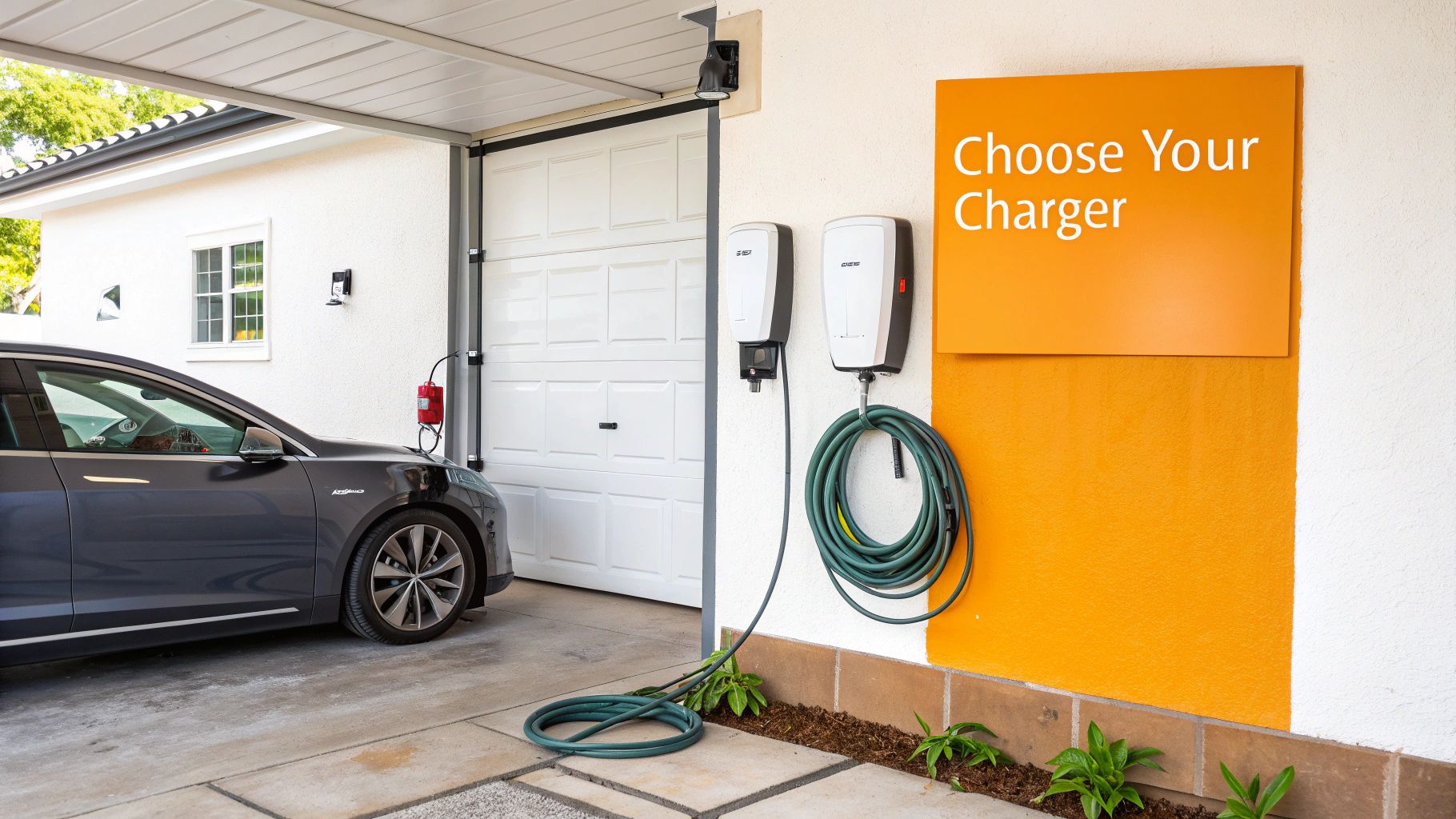
Think of the NEMA 14-50 outlet as the practical, workhorse solution. It's a heavy-duty 240-volt outlet, similar to one used for an electric dryer. This approach is often more cost-effective upfront and allows you to take your Mobile Connector on road trips. For many new Tesla owners, it’s a perfect entry point.
Then you have the Tesla Wall Connector. This is the premium, dedicated setup. It's permanently installed, which means it delivers faster charging speeds and offers a much cleaner, more integrated look in your garage or parking area. For those fully committed to the EV ecosystem, this is the superior long-term investment.
Matching the Charger to Your New York Lifestyle
So, how do you decide? Let’s walk through a couple of real-world scenarios you'd find right here in New York. The decision really hinges on your daily driving and what your home's electrical panel can handle.
-
For the Multi-EV Household or Commercial Property: Picture a family in Westchester with two Teslas, or a commercial property in Queens wanting to offer charging as an amenity. Sharing a single NEMA outlet would be inefficient. This is where the Wall Connector excels. Its Power Sharing feature is a game-changer, letting up to six chargers intelligently split power from one circuit. It’s ideal for multi-EV homes or commercial buildings looking to add a high-value, scalable amenity.
-
For the Budget-Conscious Homeowner: Now, consider someone in a classic Long Island home with 100-amp electrical service. The NEMA 14-50 outlet is often a perfect fit. It provides more than enough speed for a full overnight charge without necessitating a potentially complex and costly panel upgrade.
The crucial first step is to get a clear picture of your home's electrical capacity. Many older New York homes have 100-amp service, while most newer builds come with 200 amps. A professional assessment from a certified electrician will tell you exactly what your system can safely support.
Future-Proofing Your Charging Setup
While your current needs are top of mind, it’s smart to think about what’s next. Is a second EV on the horizon? Are you considering a home battery like the Tesla Powerwall for energy independence?
The Wall Connector is built for the future, integrating seamlessly into a complete energy ecosystem for smarter power management. If you’re curious about building a complete home energy system, you can find a ton of great information on the NY Essential Power blog.
At the end of the day, take stock of your daily commute, how many EVs you plan to own, and your property's electrical panel. That will point you directly to the right charger and the incredible convenience of waking up to a full battery every single morning.
What a Home Charger Installation Really Costs in New York
Let's get straight to the point: what's this going to cost? When you're thinking about installing a Tesla charger at your home or business in New York, the final price isn't a simple, flat fee. It’s a custom job, and the cost depends entirely on your property's layout, its current electrical system, and your location.
The biggest variable we see is the distance from your main electrical panel to your desired charger location. If your panel is in the basement and your garage is on the other side of the house, that's a long electrical run. More wire, more conduit, and more labor all add to the cost.
The Big Three: Panel, Placement, and People
Another huge factor is the state of your electrical panel. We work on a lot of homes on Long Island and in the outer boroughs with older 100-amp service. Often, these panels are already at capacity. Adding a powerful Level 2 charger might mean you need to upgrade the whole panel to 200 amps, which is a significant part of the project's cost.
Finally, where you live matters. Labor rates in Brooklyn are different from what you'll find out in Suffolk County. It’s the nature of the business. This is exactly why a one-size-fits-all estimate just doesn't work.
For most EV owners, that initial installation cost is the big question mark. Based on our experience, a typical Level 2 charger installation usually lands somewhere between $1,000 and $2,000. This can change based on the factors we just talked about. For a broader look, you can check out some national data on EV charging trends and costs.
How New York Incentives Can Slash Your Bill
Now for the good part. As a New Yorker, you don't have to foot the entire bill yourself. The state and local utilities have some fantastic incentives that can bring your costs down significantly. Knowing how to navigate these is the key to maximizing your investment.
- Federal Tax Credit: Homeowners can benefit from a federal tax credit for charger installation, covering 30% of the cost up to $1,000. For businesses, the incentive is even more substantial.
- Utility Programs: This is where the real magic happens. Companies like Con Edison and PSEG Long Island offer rebates or special time-of-use rates for EV owners. These programs can take a huge bite out of both your upfront cost and your monthly electric bill.
This is where we come in. At NY Essential Power, we do more than just the installation. We're experts at identifying every single rebate and credit you qualify for. We'll handle the paperwork and make sure you get the savings you're entitled to. Our goal is to make your switch to home charging not just easy, but a smart financial move from day one.
What to Expect During Your Charger Installation
Getting a home charger installed can seem like a big project, but a professional process makes it seamless and stress-free. It's more than just hooking up a few wires; it's a carefully planned installation to ensure your setup is safe, reliable, and compliant with New York’s strict electrical codes. We handle all the technical details so you don't have to.
The process begins with a consultation and site visit. One of our certified electricians will come to your property, whether it's a house in Nassau County or a commercial building in Queens, for a thorough assessment. We'll evaluate your electrical panel, identify the best location for the charger, and provide a clear, upfront quote.
The Permit and Installation Process
Once we have a plan, we manage the paperwork. Permitting rules can be complex and vary from one town to the next across New York. Our team knows the local requirements inside and out, so we handle all filings with your municipality to ensure everything is fully compliant.
On installation day, our licensed electricians work efficiently and cleanly. From running the conduit to making the final connections, every step adheres to the National Electrical Code (NEC) and local New York building codes. This isn't just about quality workmanship—it's about ensuring the safety of your property and family. If you're looking for the right professionals, understanding how to choose a general contractor is a fantastic place to start.
The infographic below breaks down the main factors that influence the complexity and cost of an installation.
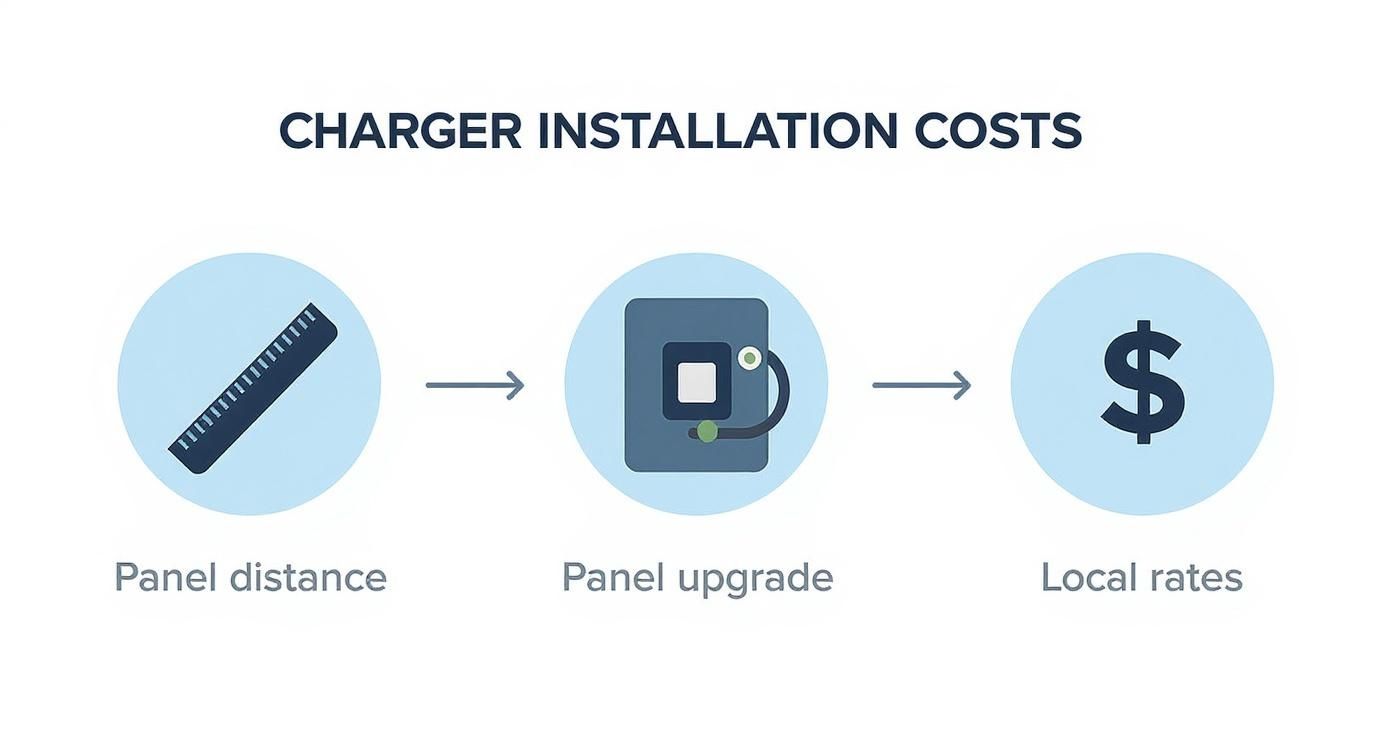
As you can see, factors like the distance from your electrical panel to your garage can significantly change the scope of the project. Your home's current electrical capacity also plays a major role.
Final Inspection and Personalized Walkthrough
After the charger is physically installed, we’re not quite finished. We schedule the final inspection with your local building department to get their official stamp of approval. This is your absolute guarantee that the work meets the highest safety standards.
The final and most important part of the process is the personalized walkthrough. We'll show you exactly how to use your new charger, configure settings in your Tesla app for smart charging, and answer any lingering questions.
Our goal is simple: you should feel completely confident and comfortable using your new charger from day one. It's the final step in making home charging an effortless part of your daily routine.
Turn Your Charger Into a Money-Saving Machine
Once your Tesla home charger is up and running, the real financial benefits begin. With a few smart strategies, you can transform your charging setup from a simple convenience into a powerful tool for shrinking your monthly electricity bill and enhancing your energy independence.
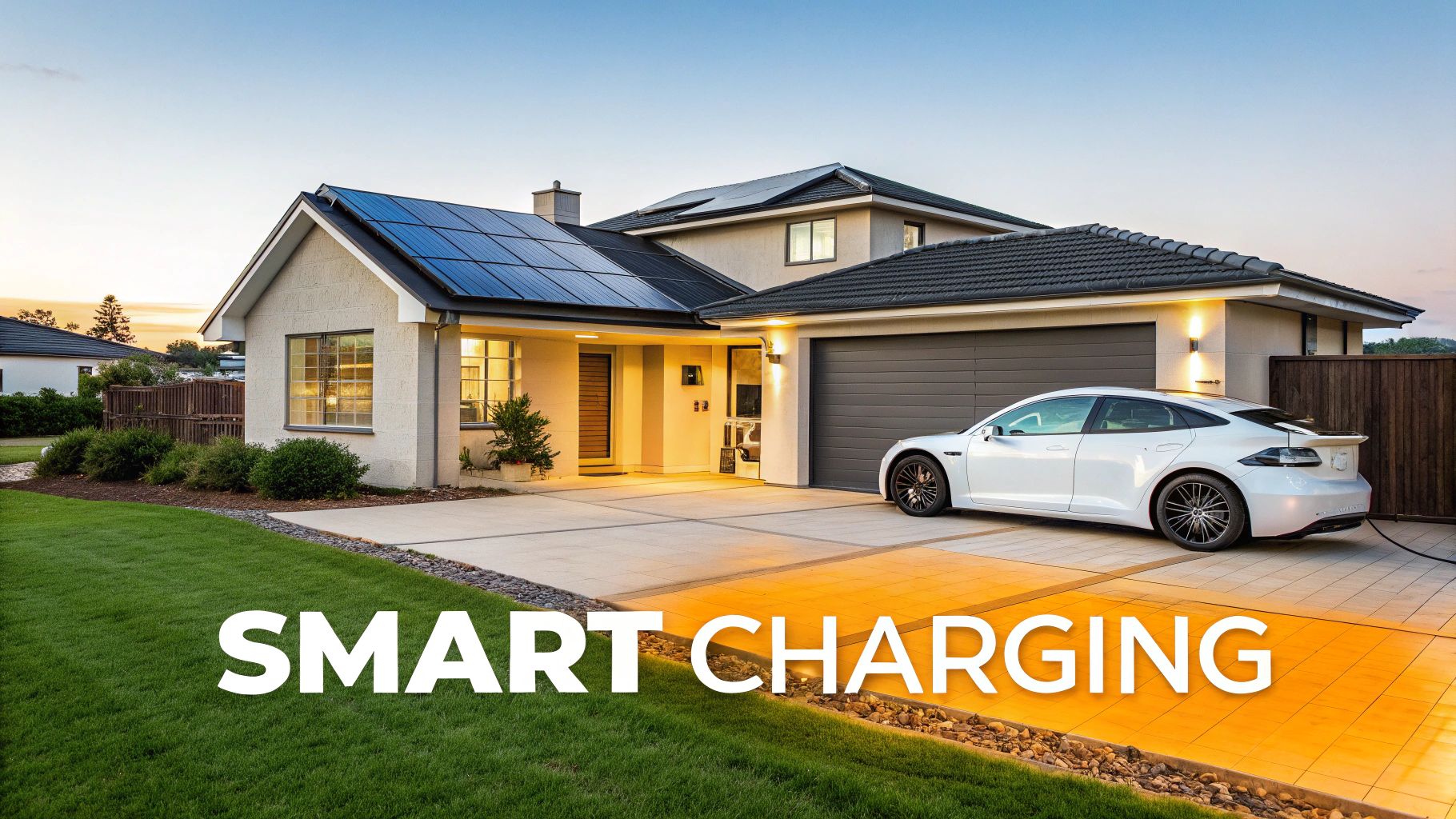
The easiest win is to schedule your charging sessions for off-peak hours. Many New York utilities, including Con Edison and PSEG Long Island, have time-of-use (TOU) plans. This means electricity is significantly cheaper late at night when overall grid demand is low.
You can set this up in seconds right from the Tesla app. Just tell your car when to start charging, and it does the rest. This single adjustment ensures you're fueling your daily drive for the lowest possible cost.
The Ultimate Goal: Energy Independence with Solar
For maximum savings and environmental impact, nothing beats pairing your EV charger with solar panels and a home battery. A system built around a Tesla Powerwall, for instance, lets you capture free, clean energy from your solar panels during the day and store it for later use.
Instead of pulling expensive electricity from the grid at night, your car simply charges using the solar power you’ve stored. This creates a powerful, self-sufficient energy loop right at home. You’re not just saving money; you’re insulating yourself from unpredictable utility rates and contributing to a more stable grid.
We've helped countless homeowners design these integrated systems. You can see how we approach residential solar in Lake Ronkonkoma and throughout Long Island.
By generating and storing your own power, you effectively lock in your transportation energy costs for decades. It transforms charging your Tesla at home from a simple convenience into a cornerstone of a sustainable, cost-effective lifestyle.
This synergy between convenient home charging and a reliable public network like the Superchargers is what makes EV ownership so practical. You get the best of both worlds: cheap, easy charging for your daily routine and fast charging for long road trips.
Ready to take control of your energy future? An integrated solar, battery, and EV charging solution is the most effective way to slash your bills and power your life with clean energy.
Answering Your Top Tesla Home Charging Questions
It's natural to have questions when you're considering a home charger for your Tesla. We hear these all the time from homeowners and property managers across New York, so let's address some of the most common ones.
Do I Need a Permit to Install a Tesla Charger in New York?
Yes, absolutely. Any time you're adding a new dedicated 240-volt circuit—which Level 2 chargers require—an electrical permit is necessary. This applies everywhere from NYC to the East End of Long Island.
Think of it less as red tape and more as a critical safety measure. A permit ensures the installation is inspected and certified to meet all local and national electrical codes. When you partner with a licensed electrician like NY Essential Power, we handle the entire permitting process for you, coordinating with local inspectors to guarantee your system is safe and fully compliant.
Can I Install a Charger in My NYC Apartment or Condo?
This is a common question for city dwellers, and the answer is increasingly yes. New York's "Right to Charge" laws prevent most HOAs, co-op boards, or landlords from unreasonably denying a request to install an EV charger.
The key is to have a professional plan. Success often depends on your building's electrical capacity and the location of your parking space. We have extensive experience with installations in multi-family buildings in Brooklyn, Queens, and across the city. We work directly with building management to design safe, compliant solutions that benefit everyone.
Our Experience Shows: Don't assume it can't be done. Getting a charger in an apartment or condo parking space is very achievable when you have a professional who understands local codes and how to collaborate with building management.
How Much Will This Add to My Electric Bill?
This is the number one question, and the good news is the answer is almost always: far less than you're currently paying for gas. The exact amount depends on how much you drive and your utility's rates.
Let's use a real-world example. If you drive about 1,000 miles a month, your Tesla will need roughly 285 kWh of electricity to cover that distance.
- With the average New York electricity rate around $0.22/kWh, you're looking at about $63 per month to charge.
- That cost can drop even lower if you enroll in a time-of-use plan from a provider like PSEG Long Island and charge overnight during off-peak hours.
Compare that to the $200+ you'd easily spend on gas to drive the same 1,000 miles. The cost savings are immediate and significant.
Wall Connector vs. NEMA 14-50 Outlet: What’s the Real Difference?
This choice boils down to what you value more: versatility and upfront cost, or speed and advanced features.
A NEMA 14-50 is a heavy-duty 240-volt outlet. You simply plug your Tesla's Mobile Connector into it. It’s an excellent, often more budget-friendly option that reliably charges your car overnight.
The Tesla Wall Connector, on the other hand, is a dedicated, hardwired charging station. It offers a cleaner aesthetic, charges slightly faster, and includes smart features like power-sharing, which is ideal for properties with multiple EVs. For most New York Tesla owners planning for the long term, the Wall Connector is the premier choice for convenience and performance.
Ready to experience how simple and affordable charging your Tesla at home can be? The team at NY Essential Power is here to provide a seamless, professional experience from start to finish. We'll help you navigate your options, maximize incentives, and install a safe, reliable charging solution that saves you time and money.