A solar panels array is your property's personal power plant. While a single solar panel can capture sunlight, an array is where the real power lies. It's a complete system that links multiple panels together, generating enough electricity to significantly reduce—or even eliminate—your monthly utility bills. For homeowners and business leaders across New York, from Long Island to the Hudson Valley, this means achieving energy independence and predictable costs.
This isn't just about the panels themselves. It’s the entire setup: the panels, inverters, and mounting hardware all working together seamlessly to convert sunlight into savings.
Your Personal Power Plant
A solar array is so much more than the panels you see on a roof; it's a complete ecosystem built to turn raw sunlight into electricity you can use in your New York home or business. For a homeowner in Brooklyn, that might look like a sleek, compact system designed to fit perfectly on a brownstone. For a commercial warehouse in Suffolk County, it could be a massive ground-mounted installation powering the entire operation.
The end goal is always the same: gaining energy independence, locking in lower energy costs, and embracing environmental responsibility. That’s why every array we design is tailored to your property’s unique layout and specific energy needs.
Key Components of Your Solar Array System
So, what makes a solar array tick? It comes down to a few essential parts working in perfect harmony. While the panels get all the attention, they couldn't do the job alone. You need a system that not only captures sunlight but also converts it into the right kind of power and keeps everything securely in place.
Here’s a quick look at the core components that form the backbone of every solar energy system.
| Component | Function |
|---|---|
| Solar Panels | These are the workhorses. Packed with photovoltaic (PV) cells, they absorb sunlight and generate direct current (DC) electricity. |
| Inverters | This is the brain of the operation. The inverter takes the DC electricity from the panels and converts it into alternating current (AC) electricity—the kind your home appliances and the grid use. |
| Mounting System (Racking) | This is the rugged foundation. The racking securely fastens the panels to your roof or the ground, holding them at the perfect angle to soak up as much New York sun as possible. |
Understanding how these pieces fit together is the key to seeing how a few panels can become a reliable power source, delivering real, tangible savings and a powerful environmental benefit.
A properly designed solar panels array isn’t just an energy-saving tool; it’s a long-term asset. It generates clean power, boosts your property value, and represents a smart investment in a more sustainable, affordable future.
When you see how these parts function as a single unit, the benefits become crystal clear, especially when you compare the long-term costs of solar panels vs. traditional energy sources on Long Island.
Ready to start your journey toward lower bills and energy freedom? Contact NY Essential Power for a free quote today.
Choosing the Right Solar Array Configuration
When designing a solar panel system, one size definitely does not fit all. Picking the right setup is crucial for maximizing energy production and achieving the greatest savings. Your decision will depend on the specifics of your New York property—your roof's shape, potential shade from trees or nearby buildings, and your budget. Let's break down the three main ways these systems are configured.
This infographic gives a great visual of how different solar panel arrangements can look on a sun-drenched city rooftop, a familiar sight for many New Yorkers.
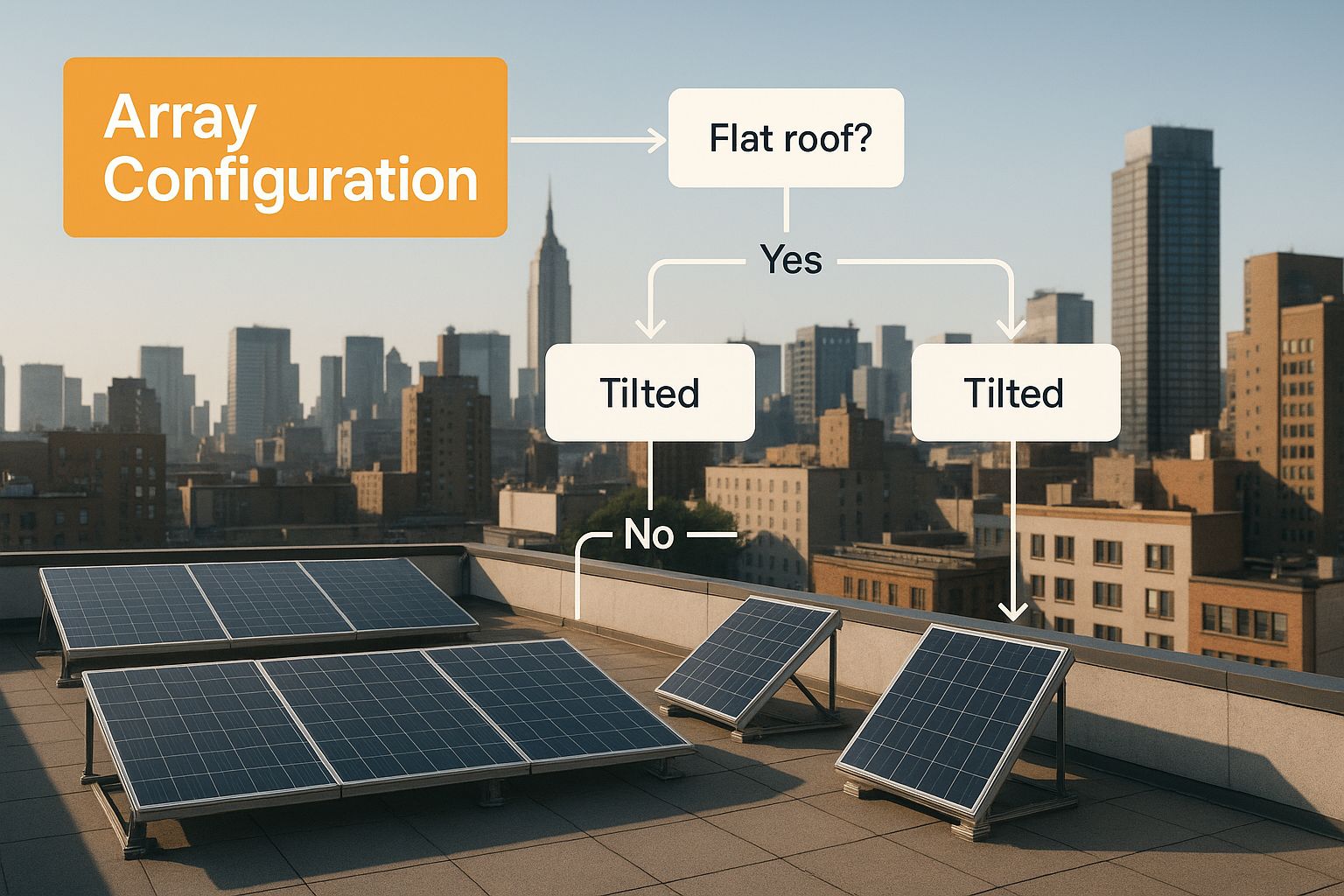
As you can see, the best layout must work with the building's unique architecture and the surrounding environment. There's no single "right" answer.
String Inverter Systems
The easiest way to think about a string inverter system is to picture a string of holiday lights. Multiple solar panels are wired together in a series, or a "string," and all feed their power into one central inverter. This is often the most affordable option to get started.
However, it has a performance weakness. If just one panel in that string gets shaded—say, by a large oak tree in your Westchester yard or a neighboring high-rise in Queens—the power output of the entire string drops significantly.
Microinverter Systems
Microinverters represent a more advanced approach. Instead of one large central inverter, each individual solar panel gets its own tiny inverter. This setup lets every panel operate independently at its maximum potential.
If shade hits one panel, the rest continue generating power at full capacity. This makes microinverters a fantastic choice for complex rooftops with different angles, dormers, or the intermittent shading common in dense areas like Long Island. This panel-level optimization ensures you squeeze every possible watt out of your solar panels array.
By allowing each panel to function at its peak, microinverters maximize your energy harvest. This translates directly into greater long-term savings and a faster return on your investment, a key benefit for both homeowners and businesses.
Power Optimizer Systems
Power optimizers offer a smart middle ground, combining the best features of string inverters and microinverters. Similar to microinverters, a small device—the optimizer—is attached to each panel to monitor and manage its individual output.
These optimizers then condition the DC power and send it to a single central string inverter. You get the benefit of panel-level optimization to combat shading issues, but the overall system is often more budget-friendly than a full microinverter setup. For businesses considering larger projects like solar canopies on Long Island, this hybrid model can strike the perfect balance between performance and cost.
This constant push for better efficiency is a big reason the solar industry is booming. Experts predict the global solar market will install a staggering 655 GW of new capacity in 2025 alone. To learn more, you can explore the complete Global Market Outlook for Solar Power.
How to Size Your Perfect Solar Array
Figuring out the right size for your solar panels array isn't about guesswork or covering every inch of your roof. It's a strategic calculation to find the sweet spot where your energy needs meet the best possible return on investment. The process starts with your utility bills, not a ladder. Getting this step right is the key to a system that generates the power you need, saves you money, and gives you true energy independence.
First, you need to know exactly how much electricity you use. Before designing your system, you must have a firm grip on your current energy habits. If you're unsure, you can learn more about how to accurately calculate your electrical energy consumption with this helpful guide.
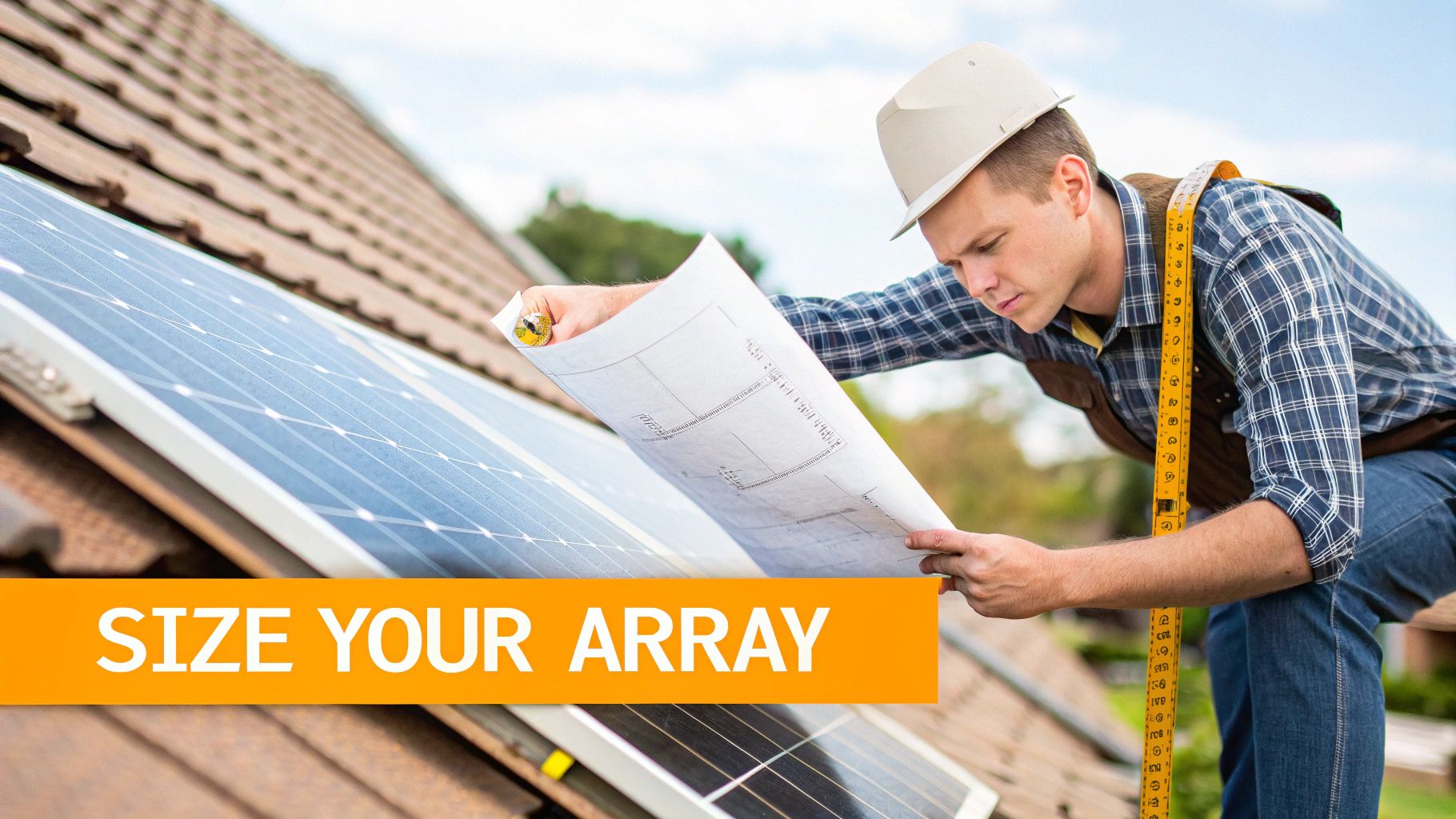
For anyone in New York, this means gathering your last 12 months of utility bills—whether from Con Edison, PSEG Long Island, or National Grid. A full year of data is essential. It reveals the complete picture, from brutal August heatwaves when the AC runs nonstop to dark winter months with holiday lights and increased heating.
From Kilowatt-Hours to Panel Count
Once you have your annual electricity usage in kilowatt-hours (kWh), we can begin designing your system. However, it's not as simple as matching one number to another. Several factors unique to your property will dramatically influence how many panels you'll need to meet your energy goals.
We zero in on these key variables to determine the perfect size:
- Your Roof's Orientation: Here in New York, a south-facing roof is the ideal canvas for a solar array, offering prime sun exposure. However, east and west-facing roofs are often perfectly viable options as well.
- Local Sun Exposure: The amount of direct sunlight your property gets—what we call "peak sun hours"—varies. A home in an open Albany suburb will soak up more rays than a Brooklyn brownstone tucked between taller buildings.
- Panel Efficiency: Not all solar panels are created equal. High-efficiency panels are workhorses, generating more power from a smaller footprint, making them an excellent solution for city homes with limited roof space.
By analyzing these details, we can calculate the exact number of panels needed to slash your energy bills.
A professional assessment is the only way to accurately account for all the variables that impact system performance. A custom-sized solar panels array ensures you don't overspend on an oversized system or get stuck with one that underperforms, guaranteeing the best possible financial outcome.
A Tale of Two Systems
Let’s look at two different scenarios. A family in Queens might use about 10,000 kWh a year. After we account for their specific sun exposure and choose a standard-efficiency panel, they'd likely need a 7-kilowatt (kW) system, which is about 20 panels.
Now, picture a commercial warehouse up in Albany. With heavy machinery and constant operations, their usage could be 100,000 kWh annually. That massive energy demand would call for something more like a 70 kW system, easily 200 panels or more. It’s a perfect illustration of why "one-size-fits-all" just doesn't apply to solar.
Ready to find out the perfect size for your solar array? Request a free, no-obligation quote from NY Essential Power today!
New York Solar Installation Factors to Consider
Installing a solar panel array in New York isn't a one-size-fits-all job. It’s about understanding the unique character of our state. Whether you're in a dense city neighborhood or on a sprawling upstate farm, a successful solar project hinges on smart planning and deep local knowledge. This ensures your system runs at peak efficiency and sails through local compliance, setting you up for decades of clean power and cost savings.
The first big decision is figuring out what kind of system fits your property and goals. Is a sleek roof-mounted system the right call for your suburban home, or does a powerful ground-mounted array make more sense for your commercial property? Each path has its own set of trade-offs.
Navigating Local Rules and Regulations
Before a single panel is touched, we must navigate the maze of local permits and zoning laws. Every town and county, from Suffolk to Westchester, has its own rulebook. Getting this paperwork right from the start is key to a smooth, hassle-free installation.
That's why we always start with a thorough property assessment. It’s a crucial step that covers all the bases:
- Roof Condition: We'll check the age, material, and structural health of your roof to ensure it can support a solar array for its entire 25+ year lifespan.
- Electrical System: Our team will inspect your current electrical panel to confirm it can handle the added power from the solar panels, planning any upgrades if needed.
- Zoning Compliance: We design every system to meet local setback and height restrictions, keeping everything compliant with town officials.
Tackling these details upfront prevents headaches and costly surprises. We work across the state, and you can see a complete list of the New York service areas we cover right here.
The Bigger Picture in New York Solar
While getting local details right is crucial, it’s also exciting to see the incredible momentum behind solar power globally. This massive wave of adoption helps push technology forward and bring down costs for everyone.
Just look at the numbers. In the first half of 2025 alone, global solar PV installations surged, adding an incredible 380 gigawatts (GW) of new capacity—a staggering 64% jump from the previous year. This trend makes one thing clear: the world is making a decisive shift toward renewable energy. If you're curious, you can discover more insights about the global solar boom.
By understanding both the hyper-local requirements of your New York town and the broader trends shaping the industry, you can make a truly informed decision. A successful solar project is one that’s perfectly tailored to your property and built to meet all local standards.
This blend of local expertise and a big-picture perspective is how we make going solar feel simple and straightforward.
Ready to see what a solar array could do for your New York property? Contact NY Essential Power for a personalized quote today!
Getting the Most Bang for Your Buck with NY Solar Incentives
Installing a solar panel array on your property is a major upgrade, but here in New York, you don't have to foot the entire bill yourself. Thanks to a powerful combination of federal, state, and local incentives, going solar is one of the sharpest financial moves a property owner can make. These programs are specifically designed to slash your upfront costs, shorten your payback period, and boost your long-term savings.
For everyone from homeowners to business owners, this financial support turns a solar project from a distant dream into a smart, affordable reality. It's a huge part of why New York is consistently ranked as one of the top states for solar energy.
Stacking Your Solar Savings
The real magic happens when you start combining these incentives. Think of it like stacking coupons—each one takes another bite out of the total cost of your solar panel array, making the final price much more manageable.
Here are the main programs available to New Yorkers:
- Federal Solar Tax Credit: This is the big one. The federal government allows you to claim 30% of your total system cost as a credit against your federal income taxes. It’s a dollar-for-dollar reduction of what you owe.
- NYS Solar Energy System Equipment Credit: New York State offers its own generous credit. You can claim an additional 25% of your system costs (up to a $5,000 cap) on your state taxes, further dropping your out-of-pocket cost.
- NY-Sun Megawatt Block Incentive: Run by NYSERDA, this program provides an upfront rebate based on your system's size. The exact amount varies by region—from Long Island to Upstate—and the incentive level drops as more solar is installed in your area, creating a real advantage for acting sooner.
Earning Credits with Net Metering
On top of the initial savings, your solar array continues to pay dividends through a program called net metering. When your panels generate more electricity than your property is using, the excess power flows back to the grid. Your utility company—whether PSEG Long Island or Con Edison—is required to give you credit for every kilowatt-hour you contribute.
Those credits are automatically applied to future bills, often zeroing out your electricity charges during the cloudier winter months. Net metering essentially turns the utility company into your personal energy bank, ensuring you get full value for every bit of power you produce.
This powerful trio of tax credits, rebates, and ongoing bill credits makes installing a solar panel array in New York an incredibly sound investment.
Ready to see how much you can save with New York’s solar incentives? Contact NY Essential Power today for a free, personalized quote and start your journey to lower energy bills.
Long-Term Performance and Maintenance
When you invest in a solar panel array, you’re buying a workhorse designed to churn out reliable energy for decades. These systems are tough, built to withstand everything New York throws at them, from heavy Long Island snow to gusty Hudson Valley winds. That built-in durability ensures your array keeps producing clean power and savings year after year.
Most top-tier panels and inverters come with a 25-year warranty. That's a quarter-century of guaranteed performance. This isn't just a feature; it's the bedrock of your investment, giving you peace of mind that your system will be a dependable asset for a generation.
Keeping Your System at Peak Performance
One of the best things about modern solar arrays is how little maintenance they require. The myth about constant upkeep is simply not true. For the most part, these systems are "set it and forget it." A good rainstorm is usually all it takes to wash away dust and keep your panels working efficiently.
That said, to get the absolute most out of your array, a little care goes a long way. Occasional professional solar panel cleaning services can make a real difference, especially after a long dry spell or if your property is surrounded by trees dropping pollen and leaves.
A well-maintained solar array isn’t just an energy producer; it's a financial asset. Simple, periodic care protects your investment, ensuring it delivers the highest possible returns and the greatest energy savings over its entire lifespan.
Smart Monitoring at Your Fingertips
Gone are the days of climbing on the roof to check if everything is working. Today’s solar arrays come with user-friendly monitoring software that puts all the data right in the palm of your hand.
With a simple app on your phone or computer, you can:
- Track exactly how much energy each panel is producing in real-time.
- Review historical data to see your savings stack up over weeks, months, and years.
- Get automatic alerts if the system detects any potential performance issues, often before you would notice.
This kind of technology is a direct result of the explosive global growth in solar power. It's amazing to think that by the end of 2024, the world’s total solar PV capacity shot past 2.2 terawatts (TW). To learn more, you can discover more insights about this global solar expansion.
This advanced monitoring gives you total transparency, so you always know your system is performing at its best. It’s one more way we put you in control of your energy future.
Ready to invest in a reliable, low-maintenance energy solution? Contact NY Essential Power for a free quote today!
Answering Your Questions About NY Solar Arrays
It's natural to have questions when considering an investment like a solar panel array. As a New York property owner, you want to be certain you’re making a smart move that will deliver benefits for years to come. We’ve gathered the most common questions from homeowners and businesses across the state to give you the clear, straightforward answers you need.
Let's tackle those final questions so you can feel confident about your decision.
What About All That Snow?
This is the number one question we get, from Buffalo to Long Island. The answer is simple: solar panels are built tough, and we install them at a slight angle for a reason. That tilt helps snow slide right off as soon as the sun comes out.
The dark surface of the panels also absorbs sunlight and warms up, speeding up the melting process. While a massive blizzard might temporarily lower your energy production, the effect on your total yearly output is minimal. Modern system designs already account for New York's weather in their performance forecasts.
Don't let a few snowy days cloud the big picture. The minimal energy loss is a drop in the bucket compared to the huge year-round savings and energy freedom you gain. New York gets more than enough sun to make solar a fantastic investment.
How Long Will a Solar Array Actually Last?
A solar panel system is a long-term property upgrade, built to perform for a generation or more. The panels themselves almost always come with a 25-year performance warranty, guaranteeing they'll still be producing a high percentage of their original power after a quarter-century on your roof.
Other critical components, like the inverter, also have strong warranties, typically ranging from 10 to 25 years. With minimal upkeep, you can count on your system to generate clean, free power for decades, allowing you to lock in your energy costs for the long haul.
What Happens if the Power Goes Out?
This is an important distinction. A standard grid-tied solar array is required by law to shut down during a power outage. This is a crucial safety measure to protect utility workers repairing the lines.
However, if you want to keep the lights on, a battery is the solution. By pairing your solar panels array with a home battery like a Tesla Powerwall, you create your own personal microgrid. When the grid goes down, your panels continue to charge your battery, which then powers your home, giving you a seamless and independent energy supply.
Ready to get answers specific to your home or business? The team at NY Essential Power is here to walk you through your options and design a solar solution that's a perfect fit for your goals and property.