When New York business owners start thinking about solar, the first question is always the same: what’s this actually going to cost me? The straight answer is there's no one-size-fits-all price tag. Think of it as a custom investment tailored to your business, not an off-the-shelf product. Generally, you can expect the upfront commercial solar installation costs to land somewhere between $1.83 to $3.50 per watt—and that’s before factoring in New York's fantastic local incentives.
Going solar is one of the smartest financial decisions a New York business can make. It's about taking control of your energy future, achieving independence from unpredictable utility rates, and making a powerful statement about your company's commitment to sustainability. This guide will provide clear, straightforward information to help you understand the costs, the incredible savings, and the long-term benefits for your business.
Your Guide to Commercial Solar Costs in New York
As a busy decision-maker, you need to know the real value of going solar. While that initial cost is a big piece of the puzzle, it's really just the starting point. A smart solar investment pays you back for years to come through massive energy savings, powerful tax credits, and some fantastic New York-specific incentives that can slash the net price.
This guide will walk you through how businesses from Long Island to Buffalo are taking control of their energy bills and boosting their bottom line. We want to give you the clear, non-technical information you need to make a confident financial decision.
To give you a clearer picture, here’s a quick look at what typical commercial solar projects in New York might look like before any incentives are applied.
Estimated Commercial Solar Costs & Savings in NY (Pre-Incentives)
| System Size (kW) | Business Type Example | Estimated Cost Range | Potential Annual Savings |
|---|---|---|---|
| 50 kW | Small retail store, local auto shop | $91,500 – $175,000 | $7,000 – $10,000 |
| 100 kW | Medium-sized office building, brewery | $183,000 – $350,000 | $14,000 – $20,000 |
| 250 kW | Small manufacturing facility, grocery store | $457,500 – $875,000 | $35,000 – $50,000 |
| 500 kW | Large warehouse, cold storage facility | $915,000 – $1,750,000 | $70,000 – $100,000 |
Keep in mind these numbers are just a starting point. Your final costs and savings will depend entirely on your specific site, energy usage, and the incentives you qualify for.
A Look at the Investment Landscape
The best news for any business considering solar right now? Commercial solar installation costs have dropped significantly over the last decade. This makes the financial argument for making the switch more compelling than ever.
The game-changer is the 30% federal investment tax credit (ITC). Once you apply it, the effective net cost for a commercial system often falls to a much more manageable $1.20–$1.75 per watt. That credit alone provides a massive discount on your initial investment.
This dramatic price drop, combined with powerful state programs, transforms a solar array from a simple piece of equipment into a predictable and profitable asset. You're essentially locking in your energy costs for the next 25-30 years, giving you stability and control over what is likely one of your biggest operating expenses. No more guessing what the utility company will charge you next quarter.
If you want to dive deeper into all the components that make up these costs—from hardware and labor to permits and financing—this resource is a great place to start: A Developer's Guide to Commercial Solar Installation Costs.
Ultimately, the key is to see solar for what it is: a capital improvement that generates both immediate and long-term financial returns. It all starts with understanding the numbers, and we're here to help you navigate this profitable transition every step of the way.
Breaking Down What You're Paying For
When you get a quote for a commercial solar project, it can feel a little overwhelming. But a good, transparent quote breaks everything down so you know exactly where your money is going.
This way, you can have a real conversation about your investment. Every single line item has a purpose, from the physical panels on your roof to the skilled professionals who make it all come together.
To get a clearer picture, let's look at the main cost categories for a typical commercial solar installation.
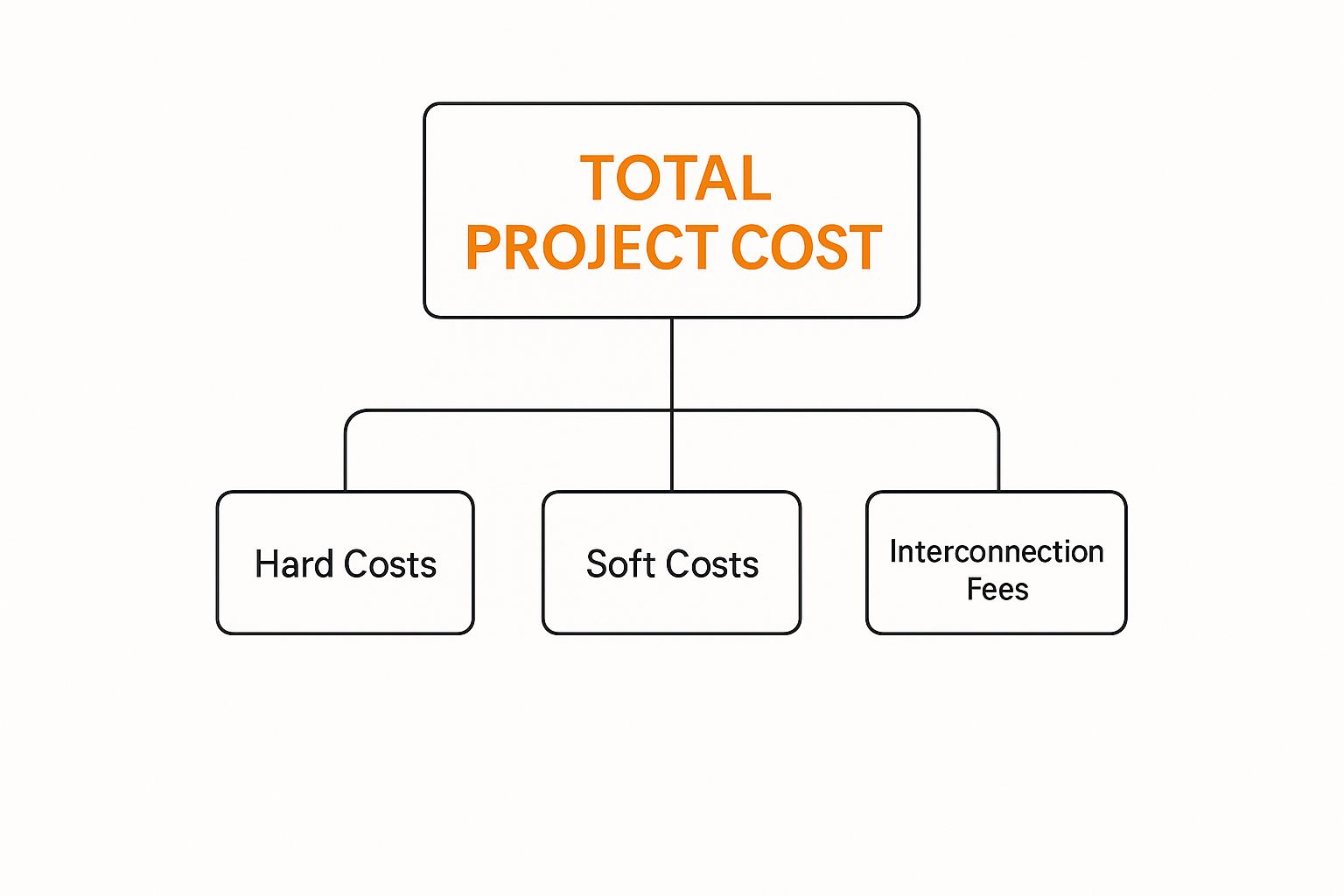
As you can see, the total cost is split into a few key areas. Each one covers a different, but equally important, part of the process. Let’s dive into what each of these really means.
The Hard Costs: Tangible Equipment
The most straightforward part of any solar quote is what we call the hard costs. This is all the physical equipment you can actually see and touch—the hardware that will be generating clean energy for your business for the next 25-plus years.
These are the workhorses of your solar energy system:
- Solar Panels (Modules): The most visible part of the system. We select high-efficiency panels designed specifically for commercial applications to make sure we’re squeezing every possible watt out of your available roof space.
- Inverters: This is the brain of the whole operation. Inverters are responsible for converting the direct current (DC) electricity the panels produce into the alternating current (AC) your building's electrical system actually uses.
- Racking and Mounting: This is the specialized skeleton that securely attaches the panels to your roof or the ground. For flat commercial roofs, especially here on Long Island, we use meticulously engineered racking that tilts the panels for optimal sun exposure without ever compromising your roof's integrity.
The Soft Costs: Expertise and Labor
While the equipment is critical, it’s the soft costs that actually turn a pallet of panels into a high-performing financial asset for your company. These costs cover all the expert services, skilled labor, and administrative legwork needed for a successful installation.
These aren't optional add-ons; they are essential for ensuring your system is safe, efficient, and fully compliant with all local regulations. Soft costs include everything from the initial design to the final handshake after the utility gives you the green light.
A common mistake is getting fixated only on panel prices. In reality, the soft costs—like engineering, navigating the permitting maze, and paying for skilled labor—are just as critical to your project's long-term success and ROI.
These costs can vary quite a bit depending on how complex the project is and where it’s located. For example, navigating the permitting process in New York City is a completely different ballgame with different rules and fees than a project in a smaller town like Rochester.
Here’s a closer look at what falls under the soft cost umbrella:
- System Design and Engineering: Our engineers create a custom blueprint for your system to maximize energy output based on your property’s unique layout, shading, and structural capacity.
- Permitting and Inspection Fees: This covers the administrative costs of filing paperwork with the local municipality and coordinating all the necessary inspections to prove everything is built to code.
- Skilled Labor: You’re paying for certified electricians and seasoned installers who know the ins and outs of working safely and efficiently on commercial properties. This isn't a DIY project.
- Interconnection Fees: This is the fee charged by the utility to connect your solar system to their grid. We handle this process with companies like Con Edison or PSEG Long Island to ensure a smooth, seamless integration.
Nationally, the price of a commercial solar system reflects this blend of hard and soft expenses. You can get more details on the current surge in commercial solar projects and the factors driving it.
How Your Property Shapes the Final Cost
The equipment and labor you see on a quote are just one piece of the puzzle. The property itself—your building, your roof, your land—plays a massive role in what your commercial solar installation will actually cost. Every commercial property in New York has its own quirks, and these unique details directly impact the project's design, complexity, and, ultimately, its price tag.
Your property is the blueprint. The whole process starts with a deep dive into your facility's electricity bills to see how and when you use energy. We take that data, look at the physical space you have, and figure out the right system size for your needs. Seeing your building through the eyes of a solar designer is the only way to understand why a generic online estimate just won't cut it.
Roof Condition and Type
Most commercial solar panels go on the roof, but not all roofs are created equal. The material it's made of and its current condition are huge cost factors. A flat membrane roof on a warehouse in Queens is a completely different ballgame than a pitched metal roof on a manufacturing plant up in Syracuse.
Here’s what we have to look at:
- Roof Age and Condition: If your roof is getting on in years, it might need repairs or even a full replacement before we can install a solar array that’s meant to last 25-30 years. It’s a crucial upfront investment that prevents major headaches down the road.
- Structural Integrity: This is non-negotiable. A structural engineer has to sign off that your building can handle the added weight of the panels and racking, especially when you factor in Long Island's heavy snow loads.
- Roofing Material: Different materials mean different mounting hardware and techniques. A ballasted system, where we use weights to hold everything down on a flat roof, is worlds away from a system that requires drilling into a sloped asphalt shingle roof.
Available Space and Shading
How much open, sunny space do you actually have? This is another major driver of both cost and how much power you'll generate. In crowded places like Brooklyn or the Bronx, shading from nearby buildings or even your own rooftop HVAC units can kill a system's output.
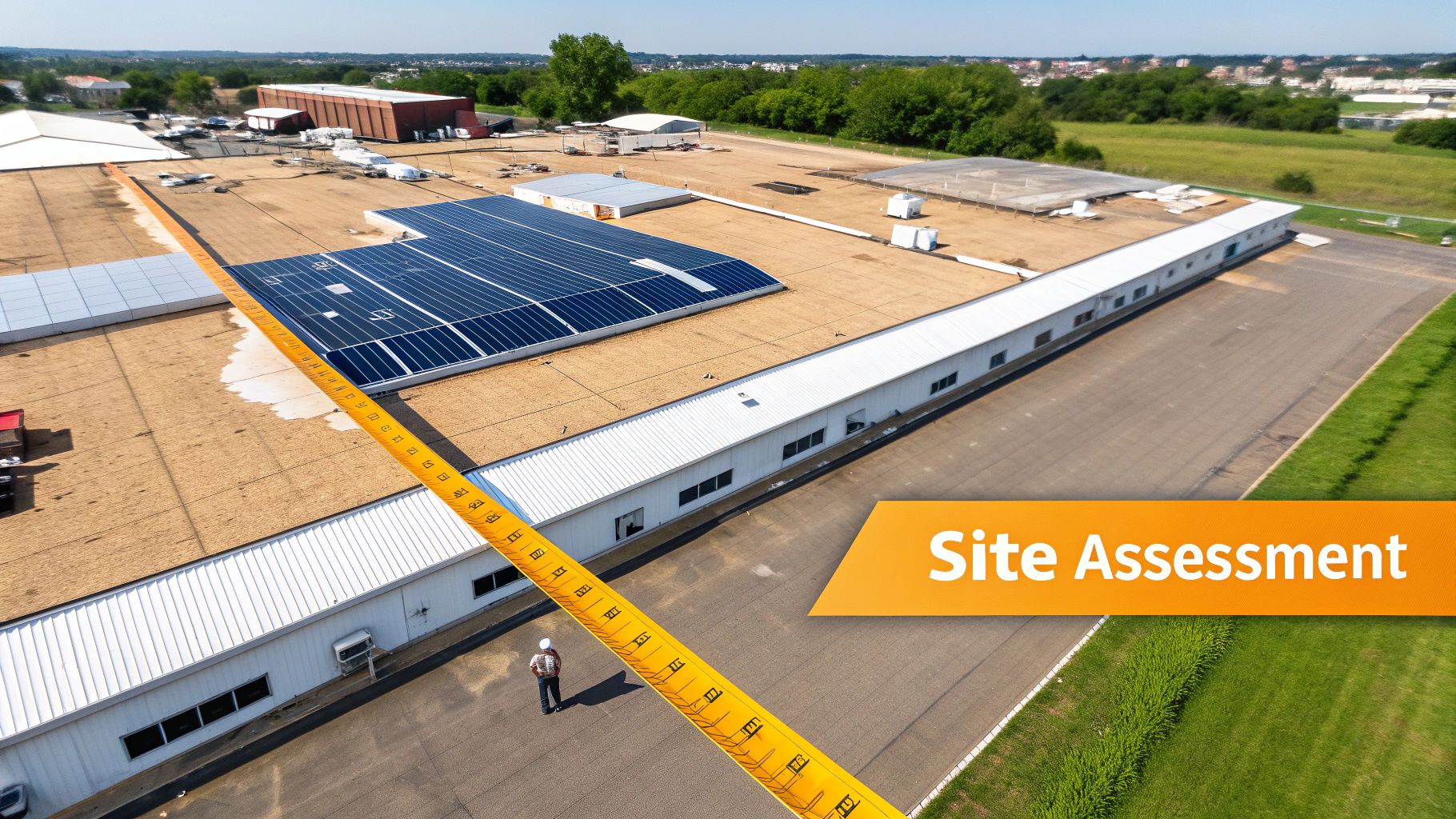
A professional site assessment isn’t just a quick look-around. We use specialized tools to map the sun’s path across your property for the entire year, identifying anything that could cast a shadow. This analysis is key to designing a system that squeezes every last drop of sunlight, maximizing your return.
Getting creative with unused space is often the answer. For businesses with big parking lots, a solar canopy is a fantastic solution. You're not just generating clean power; you're also giving employees and customers covered parking. You can see how solar canopies on Long Island are turning asphalt lots into power-producing assets.
Ground-Mounted Systems as an Alternative
What if your roof isn't a good fit, but you've got plenty of land? A ground-mounted solar array is a powerful alternative. You often see these at farms upstate or sprawling industrial facilities.
They can have a higher initial cost because of the foundation work and trenching required, but they come with some serious advantages:
- Optimal Orientation: We can angle them perfectly toward the sun, without any of the constraints of a roof. This almost always means higher energy production.
- Easier Maintenance: Cleaning and servicing panels is much simpler and safer when our technicians can just walk right up to them.
- Scalability: It's often much easier to add more panels to a ground-mounted system down the line if your energy needs grow.
At the end of the day, a custom site assessment is the only way to get a real price. It lets us account for all these property-specific details and design a system that truly works for your business.
Unlocking New York's Solar Incentives and ROI
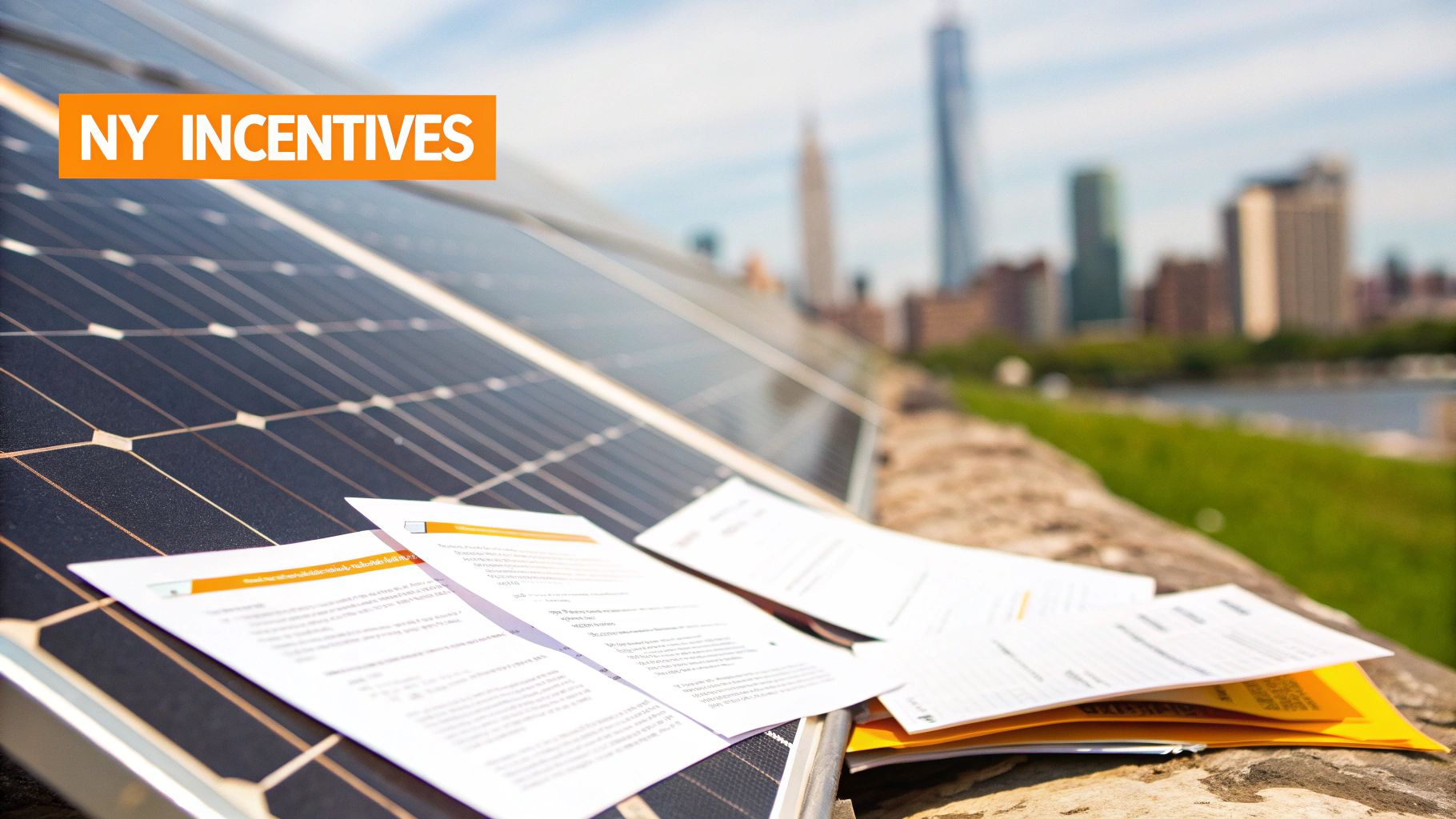
The sticker price on a commercial solar proposal is almost never what your New York business will actually pay. Thanks to a powerful lineup of financial incentives at both the federal and state levels, your net commercial solar installation costs can be dramatically lower, making it one of the smartest investments for your company's future.
Think of it like this: the government and utility companies are essentially offering to co-invest in your energy independence. By tapping into these programs, you can slash your payback period and start generating pure profit much faster.
Federal Incentives: The Foundation of Your Savings
Your savings journey starts at the federal level with two cornerstone programs that every New York business needs to know about. These incentives are designed to give you a massive discount right off the bat.
First up, and easily the most impactful, is the federal Investment Tax Credit (ITC). This is a dollar-for-dollar credit you can claim against your federal tax liability, and it's equal to a whopping 30% of your total system cost. If your solar installation costs $200,000, that’s a direct $60,000 reduction in what you owe the IRS. Just like that, your net cost drops to $140,000.
On top of the ITC, businesses can also take advantage of the Modified Accelerated Cost-Recovery System (MACRS). Solar equipment qualifies for an accelerated depreciation schedule, which means you can deduct a huge chunk of the asset's value in the first few years. This creates another significant tax shield and gives your project's financial return an extra boost.
Stacking the ITC and MACRS depreciation is a powerful one-two punch for your bottom line. It’s not just about saving money on electricity; it’s about turning your roof into a tax-advantaged asset that actively improves your company’s financial health.
New York State Programs: Accelerating Your ROI
Now, here's where New York really shines. The state offers some of the most generous local incentives in the country, making solar a no-brainer for businesses from Rochester to Ronkonkoma.
A major driver is the NY-Sun Megawatt Block Incentive. This is an upfront rebate that pays you a set amount for every watt of solar you install. The exact amount changes depending on your region and utility—a business in Con Edison territory in NYC might get a different per-watt incentive than a business served by National Grid upstate. The program is built on a "first-come, first-served" model, so the incentive values step down as more solar is deployed. That means acting sooner gets you a better deal.
Another game-changer is New York's Value of Distributed Energy Resources (VDER) tariff. It’s a bit more complex, but it’s incredibly beneficial. VDER calculates the total value your solar energy provides to the grid—including its environmental benefits and its ability to reduce grid strain during peak demand. This means the utility pays you based on the true value of the power you produce.
Below is a quick overview of the key programs that can help your business go solar.
Key Solar Financial Incentives for New York Businesses
| Incentive Name | Governing Body | Benefit Type | Key Details for NY Businesses |
|---|---|---|---|
| Investment Tax Credit (ITC) | Federal (IRS) | Tax Credit | A 30% credit against your federal tax liability for the total cost of the solar system. |
| MACRS Depreciation | Federal (IRS) | Tax Deduction | Allows businesses to accelerate the depreciation of their solar asset, creating a significant tax shield. |
| NY-Sun Megawatt Block | State (NYSERDA) | Upfront Rebate | A one-time, per-watt incentive that lowers the initial installation cost. Varies by region. |
| VDER Tariff | State (Utilities) | Energy Credit | Compensates solar owners based on the total value their energy provides to the grid, not just volume. |
An experienced installer can help you navigate the nuances of these programs and create a detailed financial forecast. You can discover more about how we help businesses with this on our page about commercial solar on Long Island.
When combined, these incentives make the financial case for solar undeniable. They transform a capital expenditure into a high-return investment that delivers immediate tax advantages, long-term energy savings, and predictable operational costs for years to come.
Smart Ways to Finance Your Solar Investment
Let's be honest: the upfront cost of a commercial solar installation can look intimidating. But it absolutely shouldn't be the barrier that stops you from gaining long-term savings and energy independence. For businesses here in New York, there are several solid financing options that can turn a major capital expense into a manageable operational one.
The right path really comes down to your company's financial goals. Are you focused on maximizing your long-term return and owning the asset? Or is preserving capital and locking in a predictable monthly payment your top priority?
Direct Cash Purchase
If your business has the capital on hand, paying cash is the most direct route to the highest and fastest return on investment. It's simple: you own the system from day one.
This means you get 100% of the energy savings and are entitled to claim every single federal and state tax incentive available, including the 30% ITC and MACRS depreciation. For pure financial return, nothing beats a direct purchase.
Solar Loans
A solar loan is a great middle-ground, letting you finance the system's cost while still retaining full ownership. This is the perfect option if you want to keep your working capital free for other business needs.
You still get to claim all the tax credits and incentives yourself. Many businesses use that influx of cash from the tax credits to immediately pay down a huge chunk of the loan. When thinking about funding, checking out guides on equipment financing for small businesses can offer some really practical advice.
The goal with a good solar loan is to structure the monthly payments so they're lower than your old electric bill. That way, your business becomes cash-flow positive right away, using the savings to pay for the very asset that’s creating them.
Solar Leases
A solar lease is a straightforward, low-risk way to go solar. A third party installs, owns, and maintains the entire system on your roof.
You simply pay a fixed monthly "rent" for the system, which is calculated to be less than your current utility bill. This gives you immediate, predictable savings with little to no money down. The trade-off is that the third-party owner gets the tax incentives, not your business.
Power Purchase Agreements (PPAs)
A Power Purchase Agreement (PPA) is another zero-down option, very similar to a lease. A developer installs, owns, and operates the solar system on your property, and you don't pay a dime for the equipment.
Instead of a fixed rent, you agree to buy the solar energy the system produces at a set rate per kilowatt-hour (kWh). This rate is almost always lower than what the utility charges, locking in savings for the long haul—typically 15-25 years. This makes PPAs a popular choice for non-profits and municipalities across New York that can't take advantage of tax credits.
The financial structure you choose is just as crucial as the physical hardware you install. Understanding these options is the first step to ensuring you pick a strategy that perfectly aligns with your business goals, whether that's long-term ownership or immediate budget certainty.
Get Your Custom Solar Quote from a NY Expert
You've seen all the moving parts that go into the cost of a commercial solar project—from the hardware itself to the specific quirks of your property and the powerful incentives available here in New York. The next logical step? Seeing what those numbers look like for your business.
A generic online calculator can only get you so far. It can’t see your roof, understand your unique energy consumption patterns, or navigate the specific permitting process in your town. That's where real, local expertise comes in.
An accurate, actionable proposal requires a deep understanding of your building's structure and the local landscape. It's about designing a system that’s engineered to squeeze every last drop of value from New York's state and federal incentives, setting you up for the best possible financial return right from the start.
Take Control of Your Energy Future
Think of commercial solar as more than just an eco-friendly upgrade. It's a strategic business asset that creates predictable, long-term financial returns. By generating your own power, you're taking direct control over one of your biggest operating expenses and insulating your business from the shock of unpredictable utility rate hikes.
This is especially true for businesses exploring commercial solar on Long Island, where energy costs are notoriously high. For them, a move toward energy independence isn't just a nice-to-have; it's a proven strategy for a healthier bottom line.
Your business isn't a carbon copy of any other, and your solar solution shouldn't be either. A custom quote from an experienced NY installer is the only way to get a real-world picture of your costs, savings, and long-term ROI.
Here at NY Essential Power, we believe in transparent, detailed quotes that lay out every cost and every benefit in plain English. We want you to feel completely confident that you’re making a smart, informed decision that fits your financial goals perfectly.
It’s time to stop guessing and start planning. Contact NY Essential Power today for a free, no-obligation solar assessment. Our team will build a custom quote specifically for your property and show you exactly how much you stand to save.
Got Questions About Commercial Solar Costs? We've Got Answers.
When you start digging into the idea of a commercial solar project, the big questions always bubble to the surface. New York business owners are smart—they want straight talk and real numbers before they commit. We get it. Here are the answers to the questions we hear most often.
What’s the Real Payback Period for a Solar Investment in New York?
This is usually the first question on everyone's mind: "How long until this thing pays for itself?" The good news is, it's faster than most people think. Once you factor in the powerful federal tax credits and New York's own incentives like the NY-Sun rebate, most businesses in the state break even in just 4 to 8 years.
Your exact payback timeline will hinge on what you pay for electricity now, the final size of your solar array, and your net cost after all the incentives are tallied up. After that break-even point, every kilowatt-hour your system generates is pure savings for your bottom line.
Are Maintenance Costs Going to Eat Into My ROI?
It's a fair question, but here's the reality: modern solar panel systems are workhorses. They are built tough and are surprisingly low-maintenance. Think of them as a silent partner on your roof that just works, day in and day out.
For the most part, the only thing you might need is an occasional cleaning to wash off any grime or debris that could slightly shade the panels. That’s it.
We bake these minimal, predictable maintenance costs right into our financial projections from the very beginning. That way, your ROI calculation is honest and accurate, with no surprises down the line. The savings we forecast are the savings you can expect to see.
This upfront approach ensures your path to energy independence is not only profitable but also completely transparent.
Can I Go Solar if I Lease My Commercial Space?
Yes, absolutely. This is a situation we handle all the time, particularly in places like New York City and across Long Island where leasing is the norm. You don’t need to own your building to own your power.
It all comes down to working out an agreement with your landlord. We have years of experience structuring these deals so they're a win-win for both the tenant and the property owner. You get to slash your energy bills and meet sustainability goals, and they get a valuable upgrade to their property.
Ready for clear answers tailored to your business? The team at NY Essential Power can walk you through a detailed assessment and give you a transparent quote for your property. Take the next step toward controlling your energy costs and securing a brighter future for your business.